• About
  • Directory
  • Free stuff
  • Lovecraft for beginners
  • My Books
  • Open Lovecraft
  • Reviews
  • Travel Posters
  • SALTES

Tentaclii

~ News & scholarship on H.P. Lovecraft

Tentaclii

Category Archives: New discoveries

‘Picture postals’ from Lovecraft: Jean Libbera

19 Friday Feb 2021

Posted by asdjfdlkf in New discoveries, Picture postals

≈ Leave a comment

From a 1934 letter by Lovecraft…

… in a freak show (Hubert’s Museum in W. 42nd St.) in New York [he saw in 1925] “Jean Libera” [sp. Libbera …]. So far as I know, he is still living and on exhibition. [In 1930] “I chanced to mention the matter [of the story “Cassius”] to my old friend Arthur Leeds of New York, who has had the extensive dealings with freaks and other amusement enterprises. Fancy my surprise when he told me that he knows Libera well — that the man’s real name is Giovanni Libera, that he is an Italian of great intelligence, that he is interested in everything weird, and that (believe this or not — it’s actual truth!!) he is especially fond of my work in Weird Tales!!!!

Jean Libbera and his large ‘twin’, quite gruesome when unclothed.

I’ve found an ad that shows that Libbera played Coney Island for the summer season of 1925, therefore Lovecraft’s visit to Hubert’s (aka Hubert’s Dime Museum) must have been either January-March or October-December of 1925.

In the Wandrei letters Lovecraft remarks that his friend Arthur Leeds had become associated with a human freak show. Possibly this one, though there was also likely another on Coney Island and I’ve found he also ran one in Chicago. More on that tomorrow.

There’s a book on the Museum as it was in the 1950s and 60s, Hubert’s Freaks. One can pick it up on eBay fairly cheaply. The site appears to have been on Times Square, then notorious for sleaze and set to grow ever more so into the 1970s and 80s… before the big Zero Tolerance clean-up of the early 90s.

“Calling W5DAV, calling W5DAV…”

08 Monday Feb 2021

Posted by asdjfdlkf in Historical context, New discoveries

≈ Leave a comment

Here’s a snippet possibly of interest to some on a dull Monday morning, re: the mystery of ‘whatever happened to Winifred V. Jackson?’ after she collaborated with H.P. Lovecraft.

First, some background. The last known contact between Lovecraft and Jackson was July 1921, and Lovecraft’s wife Sonia apparently stated that she stole Lovecraft away from Jackson, re: marriage. A small-ad I found earlier suggests that Jackson was likely working for a New York advertising agency in 1920 and was then seeking an assistant. This seems to place her in New York City by that time. She was said to be living in Boston circa 1926 (see the booklet Ancestors and Descendants of Joshua Williams, 1927). Based on these slim filaments of evidence my feeling is that she was into New York City perhaps four years before Lovecraft, finding a living there in advertising. But that she probably did not ‘stick’ and returned to Boston. If she tried again in 1924, as Lovecraft did, is unknown. Even if she got back in, then she was likely out of the big city at about the same time as Lovecraft departed it.

But now a new discovery of data. In Spring 1935 and Spring 1936, two directory listings for a ham radio operator and their call-sign…

W5DAV — Portable, Winifred V. Jackson, 527 29th Av., Meridian, Miss.

Meridian was then a medium-sized city in Mississippi, 100 miles north of New Orleans. The American term is “city”, but it was not as big and grand as that makes it sound. The British would call it a large town. Number 527 has been swept away by a long ugly road flyover, and the fields opposite have vanished under now-shabby late-1950s industrial units. But 615 29th Av. remains near to the foot of the flyover on the same side of the Avenue, and the trim house (right) gives a flavour of what was lost. The setting might have reminded Winifred of her childhood place, which had been the sleepy and rural Great Pond, Maine.

Now the obvious objection is that Lovecraft’s Winifred was a Boston lady who died in “Mass.” in 1959. My research question is then: could the radio listing be a typo for “Meridian, Mass”? There is no such place in Mass., other than “Meridian St., East Boston”, and this Boston address has no possible “527 29th Av.” connected with it. The listing stands then, and appears unchanged for two years in the Mississippi section of the magazine. If this “Miss.” was Lovecraft’s Winifred, she presumably had an amateur radio station for access to more stimulating conversations than the edge of a Mississippi town could provide after sundown.

It certainly looks like this could be the same Winifred V. Jackson, still involved in amateur affairs but now of the amateur radio sort. It might be that — with her obvious talents — she was connected in some way with the town’s Meridian Star (1914-) newspaper. But that’s just a guess and we will likely never know, because The Library of Congress is missing the 1929-1936 run of that title.

But what was she doing in Mississippi, if she is indeed Lovecraft’s Winifred? Well, consider that in 1935 she was aged about 59 or 60. In the depths of the Great Depression the Social Security Act of 1935 had just set the U.S. retirement age to 65 years for citizens in private employment. She thus had a gap of some five years to fill, and perhaps even more if she had been in the habit of fudging her age downward (as was common in those days, e.g. Lovecraft’s friend Mrs Miniter). She might therefore have been a paid companion/secretary to some elderly amateur journalist, for a few years, and done some occasional work for the town’s newspaper. But my best guess is that 527 29th Av. was only an over-wintering address, a place for her and her elderly mother to avoid the brutal Boston winters. Meanwhile the Boston home could have been let out for cash, which would have been very welcome in the depths of the Great Depression.

There is oblique confirmation of this theory, from the 1930 U.S. Census. There is no Winifred + Jackson in Mississippi at that date, on two 1930 census search-engines (admittedly limited ones, as the full Census access appears to be paywalled). Thus I do not appear to have lighted on a young namesake who had grown up in Mississippi and happened to develop an interest in radio.

Some printing and typographic skills were involved in such hobbies, which again gives slight supporting evidence. For instance, here is a typical 1935 example of the sort that amateur radio hams would exchange by mail after long-distance conversations over the airwaves. Such cards would be hand-stamped on heavy blank postcards with rubber-stamps and coloured ink-pads, and with the call-sign prominent.

The case is tantalizing but unproven. Yet if I am correct then it would be amusing to imagine that Lovecraft’s own dial-twiddling on the short-wave radio at that date might, accidently via a blip in the cosmic ionosphere, have once again brought Jackson’s voice to his ears.

Lovecraft’s Virgil?

15 Friday Jan 2021

Posted by asdjfdlkf in Historical context, New discoveries, Odd scratchings

≈ Leave a comment

Newly up for sale at Abe, what’s said to be The Works of Virgil from Lovecraft’s personal library, in an 1855 English translation with some comments and corrections seemingly from the man himself. It appears to show that he thought the translation of Eclogue VIII “very fine”, had noted an “Egyptus” name in the Aeneid, and had revised the translation for sense in at least one place. It also provides a specimen of the free handwriting of the young Lovecraft, then still at 598 Angell Street. The only thing that gives me pause is wondering if, at that point in time, he would not rather have used his full name than a simple “H.P.”? The dots on the H.P. are also rather ebulliently high, and the huge comma doubles-up as an exclamation mark. Are there comparable early inscriptions in books?

Lovecraft in Esquire, 1947

02 Friday Oct 2020

Posted by asdjfdlkf in Historical context, New discoveries, Picture postals

≈ 3 Comments

The post-war chill of January 1946 was made a little colder for readers of Esquire magazine by an article on the 1938 New England floods, illustrated with with a very gloomy picture specially commissioned for the article.

Not quite a “Friday ‘picture postal'”, but a flooded Providence is as as-good-as. This image unwittingly visually trailed a short profile and supposed memoir of one H.P. Lovecraft, then a figure of quite some mystery. This item was to be found later on in the issue, and was penned by John Wilstach.

S.T. Joshi bluntly calls this memoir “fictitious” in his monumental Lovecraft Bibliography. It’s easy to agree, and for this reason I won’t muddy the waters by republishing it here. The editor of Esquire magazine even appears to implicitly warn his readers of being too credulous, in his trailer-blurb for the article…

In the article itself Wilstach claims to recall that he was drinking with the poet Hart Crane one day in New York in the twenties, and Hart happened to have the crumpled manuscript of Lovecraft’s “He” in his pocket. Crane thought highly of the tale and asked Wilstach to accompany him then and there on a visit to Lovecraft’s decrepit room in Red Hook, as he allegedly felt tender and protective toward the ‘old gent’. Given what we now know of Crane’s antipathy toward Lovecraft, and his apparent ignorance of the tale (only published September 1926, after Lovecraft had left New York), this seems highly unlikely.

But possibly the Esquire article needed jazzing up for acceptance. As such it’s not impossible that Wilstach substituted the famous Crane for a lesser writer he had actually known and who had known Lovecraft. His biographical blurb puts him in about the right place for that…

John Hudnall Wilstach (b. 1891) was a short-story writer and novelist specializing in circus and carnival life, crime, and science fiction.

Given his apparent circus specialism, one wonders if a possible candidate for the ‘real’ Crane might then have been Arthur Leeds. Leeds had a circus background, and might once have asked Wilstach to look over Lovecraft’s new ‘New York’ tales with a view to finding a market in ‘the slicks’ in which Wilstach sometimes published. That would be one hypothesis which could fit, but more would have to be known about Wilstach in 1920s New York to say more.

It can however be more firmly suggested that Wilstach had most of his personal material for the Esquire article from Paul Cook. Comments on the Esquire article, on the front page of the NAPA amateur journal the Literary Newsette for 2nd February 1946, seem to confirm this…

Wilstach obviously “… obtained most of the facts from W. Paul Cook, for whom he seems to have a strong admiration.

Wilstach’s article also claims he once made a post-New York winter visit to Lovecraft’s home in Providence, though he gives no address or date and not a single telling detail. There are however a couple of interesting points in his article, arising from his likely Cook connection. In the second half of the article there is an un-credited quote, which the editor has surprisingly let slip through un-credited. Presumably this quote is from Cook, given Cook’s known concern over people making the Poe comparison…

A friend once suggested that he stimulate dreams by means of drugs. Lovecraft exclaimed that if drugs would give him any worse dreams than he experienced without them, he would go mad. His dreams were his own. It is unfair to call him equal to Poe, greater than Poe, or lacking in certain Poe qualities. Better, consider him as standing alone.

That sounds like Cook, although if the quote was hooked from print I can’t discover. Evidently Wilstach had talked with Cook, since he relates the ‘Lovecraft wouldn’t disturb a sleeping cat in his lap’ anecdote, and states it was “told me by Cook”. A later June 1946 Esquire letter by Wilstach, defending his claims of a mid-1940s “Lovecraft cult” against a questioning March 1946 letter by Weird Tales founder Henneberger, shows that Wilstach had access to Cook’s mid-1940s little magazine Ghost. In this same letter he also talks of “my friend Cook”.

Given this reasonably firm Cook connection, one point in Wilstach’s article does ring true…

The [Lovecraft] family had been prominent in Providence. It was Lovecraft’s ambition to buy back the old home and restore the family’s position. He was almost in tears when he found a number of his grandfather’s books in a bookshop. He bought all he could.

Given that we know Lovecraft went on long book-hunting trips in Providence with Cook, both at the store of ‘Uncle Eddy’ and at other book-sellers, this last seems quite likely to be a fragment of memoir had via Cook. One then wonders if finding “his grandfather’s books in a bookshop” can be confirmed by a mention somewhere in Lovecraft’s letters? It does seem the sort of thing he would have told at least one correspondent about, though I don’t recall encountering it.

The Esquire article succeeded in bringing Weird Tales founder Henneberger to print, on the letters page of the June 1946 issue. This item is not in the Lovecraft Bibliography. He makes a pithy rebuttal without specifics, but more interestingly flashes a light on the very moment of Lovecraft’s initial reception in the Weird Tales office.

This itself is somewhat questionable in light of what we now know. Henneberger recalls that it was he who discovered Lovecraft, via Home Brew and the story “Randolph Carter”. But we know it was Cook’s The Vagrant that had published “Randolph Carter” in May 1920, not Home Brew. While Henneberger was doubtless keeping a close and wary eye on Home Brew (a possible competitor), it’s less certain he had also been tracking The Vagrant since summer 1920. However, its quite likely that in late 1922 he had made enquiries among the amateur journalists about suitable writers for his new Weird Tales, and been sent a bundle of The Vagrant.

He has it that he “contacted Lovecraft through this magazine” via editor Houtain, and personally invited a submission from Lovecraft. He was sent “The Rats in the Walls” and after reading it he showed it to his editor who was incredulous. We know it was published in Weird Tales, but not until March 1924, and we also know that this was not the “first” story to see print. That was “Dagon”, in the Halloween 1923 issue.

We also know that “Rats” could not have been among the initial handwritten manuscripts Lovecraft sent to Weird Tales in May 1923, since the tale was only written in late summer 1923. “Rats” was eventually submitted to Weird Tales, but it only arrived in the office circa 10th November 1923 (Selected Letters I, page 259). “Rats” had been typed by Eddy for Lovecraft, presumably with a couple of carbons, and submitted in good form to Argosy, which was one of the well-paying ‘slicks’. Evidently a carbon had also been mailed to Arthur Leeds, since Lovecraft states Leeds had written back to say he felt the tale was just too horrible for Argosy to accept… and so it proved. The rejected “Rats” was then quickly sent on to Weird Tales, to join the pile of other Lovecraft tales awaiting consideration.

One way of explaining Henneberger’s memories is then to say that he had indeed been tracking Home Brew and that, via Houtain its editor, he had indeed acquired Lovecraft’s address and passed it on to his editor at Weird Tales. This is not incompatible with the known fact that Lovecraft’s friends were drawing the new Weird Tales to his attention and urging him to submit some stories. We know that Lovecraft had eventually after much persuasion sent in stories in passable hand-written manuscript form in May 1923 (“Dagon”, “Carter”, “Ulthar”, “Arthur Jermyn”, The Hound”). But Henneberger’s 1947 letter implies that Lovecraft only really came to his attention when the Weird Tales editor queried how startlingly good the Eddy-typed “The Rats in The Walls” was, when it was read in mid November 1923. Clearly this Lovecraft was a cut above his Home Brew “Herbert West” and “Lurking Fear” serial-shockers, and his sent-in tales “Carter” and “The Hound” obviously gave only a hint of what he could really do. This seminal moment in time would then be what Henneberger was recalling in his 1947 letter. He did indeed ‘discover’ Lovecraft via Home Brew, at least in terms of getting an address out of Houtain. But he perhaps wasn’t quite aware of what a great writer he had got hold of, until his startled editor landed “Rats” on his desk for a second opinion. What he then pulled off his shelves to comfort his editor would not have been the serial-shockers of Home Brew, but was more likely something like some back-issues of Cook’s amateur publication. Containing as it did items such as the 1920 printing of “Randolph Carter”, and more importantly Cook’s 1919 essay “Howard P. Lovecraft’s Fiction” which had introduced “Dagon” to the world. In this respect it’s perhaps notable that “Dagon” was the first Lovecraft story printed in Weird Tales (October 1923). Evidently there was a copy of this in good form, somewhere in the Weird Tales offices. The presence of this last item in print would be ‘a given’, had Lovecraft in May 1923 sent his “Dagon” to Weird Tales not in the handwriting which obscured the other tales in his bundle, but rather in Cook’s 1919 printed form.

Such was the past, as Henneberger recalled it after some 25 years. What of the future? He has certainly been proven correct in his prescient forecast that Lovecraft…

will be read as enthusiastically in 2023 as he was in 1923

A useful reminder that Halloween 2023 will be the 100th anniversary of Lovecraft’s fiction first appearing in Weird Tales.

A few more facts on Arthur Leeds

25 Tuesday Aug 2020

Posted by asdjfdlkf in Historical context, New discoveries

≈ Leave a comment

After I had found new details of Arthur Leeds and the Canadian Army in the Bloch letters, another new biographical item has been found in the volume of Moe letters. In September 1930 Lovecraft remarked…

I’d like to see the old boy [Leeds] myself, & certainly hope he’ll look me up if his itinerant outfit traverses this part of the world. Hope his prosperity is permanent — he deserves some peace and freedom from anxiety after the long gruelling years of the past [post-war poverty in New York City]. But what a beastly shame his Old Cap Colliers were not waiting for him. (Letters to Maurice W. Moe, page 515)

From this it appears that Leeds likely departed New York City soon after the Great Depression hit, and went home to Canada. There he found that his precious childhood things had either been thrown out or given away. “Old Cap Colliers” indicates that Leeds had once collected this 1880s-90s dime novel series (a series, incidentally, whose plots and situations were later extensively mined to fuel the 1930s pulp character Nick Carter, Detective).

After that Leeds had evidently once again ‘run away with the circus’ in the form of setting off with some travelling theatre, but this time at a better salary and perhaps as the manager. That’s how I read Lovecraft’s comments, and the new data is bolstered by Lovecraft’s 1931 comment that… “Leeds has come on slightly better times, through his side-line of the drama”. It seems likely this travelling theatre working the eastern Canada / Chicago area, perhaps travelling alongside and shadowing a large circus and thus quite lucrative. That Lovecraft thinks of it as a “side-line” may indicate it was seasonal work.

But the Great Depression deepened and the job probably didn’t last more than a couple of seasons. S.T. Joshi notes that Leeds was back in Brooklyn, New York City, in June 1932. There he appears to have turned to dealing in used correspondence courses. At some point he began to live on the fringes of Coney Island, as I’ve detailed in another recent post. It would be logical to assume that he was able to pick up seasonal work at the famous Coney Island attractions, while having time to write in the winter.

All this augments my Leeds biography and photo, which is to be found in my book Lovecraft in Historical Context #4.

Photo of the Twin Islands

24 Monday Aug 2020

Posted by asdjfdlkf in Historical context, New discoveries

≈ Leave a comment

Back in May 2019 I posted here on the Twin Islands. They don’t appear on all maps, but they are on this one of Providence…

At that time I was unable to find an actual photo of them. The photo is now found, and it also looks like it has a date that more or less fits…

The cameraman was up on Fort Hill and the picture looks up the Seekonk which then curves around to the left and goes out of sight. As a strong lad Lovecraft was a keen rower in a boat on the Seekonk, and he went down past the bridge and landed on these islands…

I used to row considerably on the Seekonk … Often I would land on one or both of the Twin Islands — for islands (associated with remote secrets, pirate treasure, and all that) always fascinated me.” — Lovecraft letter to Rimel, April 1934.

Being rather tidal, presumably they had a quite Dagon-ish texture underfoot…

When at last I awaked, it was to discover myself half sucked into a slimy expanse of hellish black mire which extended about me in monotonous undulations as far as I could see, and in which my boat lay grounded some distance away. — “Dagon

Protected: The juvenile gangs of Red Hook during Lovecraft’s time there

13 Thursday Aug 2020

Posted by asdjfdlkf in Historical context, New discoveries, Scholarly works

≈ Enter your password to view comments.

This content is password-protected. To view it, please enter the password below.

‘Picture postals’ from Lovecraft: the Hope Street Reservoir

03 Friday Jul 2020

Posted by asdjfdlkf in Historical context, New discoveries, Picture postals

≈ 1 Comment

H.P. Lovecraft lived at 10 Barnes St., Providence, from 1926 to May 1933. Since the mid 1890s, Barnes Street had a large 75 million gallon reservoir looming up at the back of it. Even if Lovecraft had become habituated to the sight and vicinity of this reservoir, he cannot have been unaware of it when writing “The Colour out of Space” in March 1927. You’ll recall the story involves a planned reservoir, and potential contamination of the urban water-supply. The story was written about a year after he had moved to 10 Barnes St.

Hope St. reservoir and pumping station.

Was the reservoir still full at that time? Probably partly full, but possibly no longer being pumped with fresh water — and thus emitting a certain invisible miasma over the neighbouring streets by early spring 1927. Because according to a Providence magazine of early 1928 the reservoir was then being decommissioned and its slow drainage was well underway… it “is not yet dry, but it will soon be; the city may make use of the site of the big pool for school purposes”. It may have been used as a school sports area, but other reports indicate it remained undeveloped at Lovecraft’s death. The pumping station/house was decommissioned in July 1928.

Lovecraft lived a little off the left of this picture-map, which shows the reservoir and Barnes Street. Looking at another map, it appears that Lovecraft’s high school directly faced the reservoir. He must surely have been familiar with its existence, even if he never walked up there and peered down into its fishy depths.

It would take work at the local archives to discover more, and the exact dates at which the slow drainage started. I assume it takes a year or so to slowly drain something like that, as rapid drainage could cause landslips and catastrophic spillage etc. But from the dates we do have it appears we can be fairly sure that Lovecraft would have taken note of the city’s plans to drain the reservoir, and possibly the start of the drainage, at about the time of the writing of “The Colour out of Space”. If the two were connected or not is now lost in the mists of time.


Update:

Thanks to Tom Douglass, local historian, who writes…

“I believe you are right about the connection you draw between the two, and perhaps more directly than you stated. … When Scituate’s water treatment facility came online in 1926, the Hope pumping station was decommissioned.”

So it’s interesting that the two events – draining Hope and filling Scituate – should be so closely connected. Lovecraft later recalled in a letter that the filling of Scituate was the key inspiration.

Fowler Wright as an inspiration for “Shadow Out of Time”

13 Monday Apr 2020

Posted by asdjfdlkf in Historical context, New discoveries

≈ Leave a comment

WARNING: CONTAINS SPOILERS

Well, I’ve finished the classic S. Fowler Wright book The Amphibians / The World Below in its Galaxy Novel form.

I first wondered if Tolkien had read it, as there are a couple of similarities with The Lord of the Rings…

1) The vivid opening action recalls what happens the instant Galdalf steps onto the threshold of Moria. It has some resemblance to The Amphibians, when a slight step off the path triggers a ferocious tentacle attack…

her left foot pressed for a second on the purple soil beyond. As it did so, with the speed of light itself, the nearest of the bright-green globes shot open in a score of writhing tentacles, of which one caught the slipping foot

The similar scene from The Lord of the Rings…

He strode forward and set his foot on the lowest step. But at that moment several things happened. Frodo felt something seize him by the ankle, and he fell with a cry. … the waters of the lake seething, as if a host of snakes were swimming up from the southern end. Out from the water a long sinuous tentacle had crawled; it was pale-green and luminous and wet. Its fingered end had hold of Frodo’s foot and was dragging him into the water. Sam on his knees was now slashing at it with a knife. The arm let go of Frodo, and Sam pulled him away, crying out for help. Twenty others arms came rippling out. The dark water boiled, and there was a hideous stench.

2) There are some passages that remind me of the entrance and walk into Lorien in The Lord of the Rings. A peaceful wood of yellow but-vitally living leaves, the troop of elf-warriors heading out to deal with the orcs, the freeing of the Fellowship from worry or grief…

I could not say if the others slept, for I knew nothing more till I woke bewildered in a dim golden light, with my comrade of the night touching my hand to rouse me. The rest of the troop had begun to move forward already.

I was sunk deeply in the soft moss, which was of a very close texture, and of so dark a green as to look black in the shadow. The branches overhead spread low and wide, as do those of a beech. The leaves also were beech-like, but of a golden yellow. Not the yellow of Autumn, but one of an abundant vitality. I noticed the fragrance which had soothed my exhaustion when we entered. It gave me now a sense of contentment and physical well-being such as I had never experienced.

Indeed, there seemed to me a general kinship between Wright’s Amphibians and Tolkien’s elves, in terms of i) their tall superhuman movement, sight and agility; ii) their method of ‘waking sleeping’; iii) various aspects of their ‘strangeness’; and iv) the ability of some of their kind to perceive the minds of others. The Amphibians are also sea-dwellers and thus, in their venture onto land, have a “sea-longing” akin to Tolkien’s elves. If in circa 1930 Tolkien had been looking for a way to get his elves out of diminutive Edwardian fairyland, he would have found here several possibilities.


I also spotted a rather firmer and more likely inspiration, but this time for H.P. Lovecraft, re: his “The Shadow Out of Time” (written Nov 1934 – Feb 1935). In the first book Wright offers…

In the interior where they live, the Dwellers have captive specimens of the inhabitants of many bygone ages. These they keep under such conditions as approximate to those from which they come, so that they may study their habits and acquire their knowledge, if they should have any which may be worth recording.

The similarity with the modus operandi of The Great Race in “The Shadow Out of Time” is quite obvious.

The dating also fits. A letter shows that Lovecraft had The World Below as a Christmastime gift in December 1932 or January 1933 (I allow for the vagaries of the mail at such a busy time), and presumably he then found time to read it sometime in 1933 or even into 1934. Which would mean he read the book before he wrote “The Shadow Out of Time”.

Wright’s initial idea about ‘captive minds from many bygone ages’ is only very loosely developed in the second book, The World Below. Firstly there is some cursory introduction of ‘display windows’ showing cinema-like fragments of time (a dinosaur-era pool, a calm ice-age scene, a giant-bird hunting scene possibly from an intermediate future). These are seen as the hero passes through The World Below, being displayed on tunnel walls by some undetermined method of the Dwellers. But they reveal little and are concluded to be akin to decorative wall-hangings for solemn contemplation by the morose Dwellers. The first book’s idea of there being many captive minds from many ages is only alluded to at the end of the second book, when the hero learns of a method of sanctuary from the Dwellers, in one of the library-temples…

if you can then make your way to the Place of the Seekers of Wisdom, you will be in a sanctuary from which none will seek to remove you. They will question you of the life you left, and so long as you can tell them of new things they will be very sure to keep you in safety.

The hero goes there, but the ending of the second and final book is very cursory and must have been frustrating for Lovecraft…

I was with the Seekers of Wisdom many months, till the year was completed. During that time I was examined incessantly on every detail of the civilisation from which I came. … But to write of these in detail would be to begin a book when it is time for the ending.

We learn nothing of the Seekers, their temple-like Place, and there is no mention of the other minds from other times that (if the retentive reader remembers a brief aside given in the first book) must also be held there.

There are a few other similarities, beyond the obvious time travel (here going forward, rather than back). Such as the weirdly verdant setting, the vast library, and the wider scenario re: a millennia-past global conflict and its apparently fragile and fearful resolution — which is breached while the time-travelling hero is there, when the feared monsters attack again…

they [the Dwellers, the dominant race] passed through a period of warfare with the inhuman population of other portions of the earth’s surface, in the course of which many of them were destroyed, and which remained as a continuing menace when the actual conflict ceased.

Their enemy takes the form of huge…

… monstrous insects flying low over the water. As it neared the conflict, its head drew back into a neck-like collar, which shone with a metallic lustre, similar to that of the wing-sheathes. The front pair of sheathes lifted and adjusted their positions, till they formed a vertical shield to the advancing monster.

These are battled with what are in effect giant blue laser-beams, which once fired, form into living “wil o’ the wisps” that act like a wolf-pack. Again, one thinks of “The Shadow Out of Time”, in which the Great Race greatly fears the resumption of a war by…

a final successful irruption of the Elder Beings. Mental projections down the ages had clearly foretold such a horror, and the Great Race had resolved that none who could escape should face it. … the Great Race maintained its cautious vigilance, with potent weapons ceaselessly ready despite the horrified banishing of the subject from common speech and visible records.” Their weapons being… “camera-like weapons which produced tremendous electrical effects”

And then there are Lovecraft’s own beetles…

After man there would be the mighty beetle civilisation, the bodies of whose members the cream of the Great Race would seize when the monstrous doom overtook the elder world.

Asenath in Uniform

23 Monday Mar 2020

Posted by asdjfdlkf in New discoveries, Odd scratchings

≈ Leave a comment

I’m now part of the way through reading O Fortunate Floridian, Lovecraft’s letters to Barlow. Only a few surprises so far, but I’m only up to late summer 1933 and they’re just getting warmed up.

One of the surprises was Lovecraft’s seemingly rather extensive cinema-going circa summer 1933, probably triggered by his spending Christmas 1932/33 in New York and seeing a number of the new movies there.

For instance, who knew that aspects of “The Thing on the Doorstep” were inspired by Lovecraft’s viewing at the cinema of the notorious Madchen in Uniform — just a month before the story was written?

Photo of Winfield Townley Scott

28 Saturday Sep 2019

Posted by asdjfdlkf in Historical context, New discoveries

≈ Leave a comment

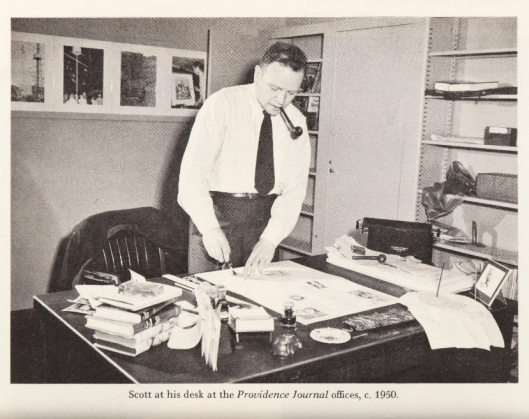
I’ve found a photo of the first Lovecraft biographer, Winfield Townley Scott (1910-1968) in his prime. Likely to have been made in 1947 or 1948, at the time he was nearing the completion of around five years of writing about Lovecraft for the local newspaper and Books at Brown. The current online photos of him show an older and rather beaten-down-by-booze man.

Scott worked at the Providence Journal after his graduation from Brown, writing the “Bookman’s Galley” column in the 1930s. He later became the Literary Editor of the Providence Sunday Journal from 1944-51, before ceding the post to George F. Troy Jr.

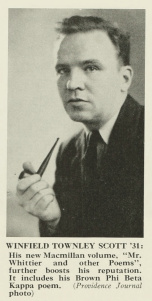
The “’31” here indicates that he graduated from Brown University in 1931.

What follows is partly a summary review of the facts given in Scott’s biography, with my additional research and commentary.


Scott Donaldson, Poet in America: Winfield Townley Scott (University of Texas, 1972).

Winfield Townley Scott graduated well from Brown University, but the year was 1931. He stepped out of the gilded gates into the teeth of the Great Depression. As such he was glad of $15 a week offer to run and edit the book section of the Providence Journal. By the mid 1930s he was supplementing his book reviewing with income from movie reviews. He also worked as a broadcaster on the radio station then owned by the Journal. His radio work introduced him to the city as a known personality and voice.

Only in 1944 was his Journal salary raised substantially and at that point he formally took the title of Literary Editor, with his weekly column being re-titled “Bookends and Odds” to reflect the change. This major career event provides some professional context for his 1943-49 work on discovering Lovecraft. Both his radio work and his new standing as Literary Editor may partly help explain his ability to get ‘memoir letters’ (and from those relatively high up in Providence society), access to childhood friends, as well as access to medical records and the confidence of a doctor.

Scott also rather bravely used his newspaper to berate New England’s literary censors, as the local Watch & Ward committees escalated their scares into further legislative force via an alliance with activist district attorneys. Again, this provides yet more context for his interest in Lovecraft’s fiction. At that time literary censorship by the police and courts was alive and well, and would only start to fade away circa the late 1960s (though the Canadian customs officers maintained heavy seize-and-destroy censorship of print, such as underground comix, well into the 1990s).

Scott first knew of Lovecraft as a horror writer in 1943, though a Scott letter to The Acolyte (Fall 1944) shows that the newspaper had dealings with him as a poet while alive. I had read somewhere that Scott once had some “correspondence” with Lovecraft, but perhaps this was only an occasional factual exchange relating to some niggling point in a book review? Anyway, 1943 is a key date in his public interest, evidenced by a remark in his 1949 Books at Brown issue and his review of the second Arkham volume of Lovecraft’s fiction for the Providence Sunday Journal…

Curiously, this review does not appear in A Weird Writer in Our Midst: Early Criticism of H. P. Lovecraft. Perhaps S.T. Joshi didn’t want to stymie a possible book collection on Scott at some future date? (See below for my outline on the possible contents of such a book).

It’s well known in Lovecraftian circles that Scott wrote and published the important early Lovecraft articles “His Own Most Fantastic Creation: Howard Phillips Lovecraft” (1944) and “Lovecraft as a Poet” (1945), both published with revisions in his own Exiles and Fabrications and also to be found in the book-length collection Lovecraft Remembered and now the new collection of memoirs.

Less well known is that Scott also edited and heavily abridged a memoir of Lovecraft by his wife Sonia, published in the Providence Sunday Journal for 22nd August 1948. This later appeared, with a Scott introduction and still abridged, in the February 1949 ‘Lovecraft special’ double-issue of Books at Brown. In this Scott noted that its newspaper publication “brought forth letters of rebuttal as well as of corroboration”. Where are these letters now, from those who knew Lovecraft? Were they published? Has Brown University’s Scott Collection, with his huge archive of letters to “900 correspondents”, been checked for the original letters?

In 1951 a snippet in the Brown Alumni Monthly revealed him to be retiring from his post as Literary Editor to complete… “a book-length narrative poem on the Viking discoverers of America”. Posterity might have preferred to have a newspaperman-poet’s full-length biography of Lovecraft, made especially insightful by Scott’s own antiquarian bent, city pavement-pounding and regionalist sentiment. But as it is we have neither item, and it appears the Viking saga was either never written or was lost. By the early 1950s the general reading public anyway seemed to have less and less taste for fantasy and science-fiction, and I’d suspect that the poetic old ‘Vikings in New England’ notion of the 1920s and 30s — which had given birth to such fakes as the supposed ‘Vinland Map’ — had a fading allure for publishers in such an atmosphere.

Yet we should be grateful that Scott spent a number of years accessing rather difficult areas of Lovecraft’s life. Such as the medical records of Lovecraft’s mother, speaking to her doctor, and also getting letters from friends of the family along with newspaper-publication permission ➻. Then leaving us the first substantial and well-researched biographical text on Lovecraft. Without his boots-on-the-ground local work, several important aspects of Lovecraft’s life would be unknown today.

Some have idly insinuated that Scott might not have been a trustworthy observer of Lovecraft’s life. Well, his biography offers a partial answer. He was at that time a mature man of standing and deeply embedded in the city’s print news culture. Also in networks of literary scholarship and facticity. Here was a man who for the last 12 years had been called upon to scrutinise the detailed claims of others, as a weekly book reviewer, evaluating both scholarly and locally-known facts alongside their emotional tone and shadings. He was also a news man for the newspaper’s radio station. As such, we are entitled to assume that he took a local 1940s newspaperman’s pride in ‘reporting the facts’ and not embellishing them. It’s my feeling that if he had he been ‘making up’ claims, such as having seen the medical records of Lovecraft’s mother, then the informal ‘old boy’ and ‘old girl’ networks of the city would quickly have ‘called him out’ on the matter. As an active bisexual, newly engaged for marriage to a young heiress, he had a certain amount of standing to lose and little to gain from his curious interest in the then strange and mysterious Lovecraft. His anti-censorship stand and his published Diaries and memoirs also suggest a man scrupulously and personally dedicated to telling the truth, warts and all.

Yet he was foremost a poet and in the 1950s he was able to achieve his time-for-poetry due to his marriage to the lively young heiress Eleanor Metcalf, ten years his junior. He lived with her in Connecticut for a few years, until they went west in 1954 to join a colony of mostly visual artists in sunny Santa Fe. Part of the impetus seems to have been to give their young children an unsullied intellectual and physical landscape. They look the sullying of the landscape so seriously that they would sometimes go out at night and cut down the advertising billboards, then starting to mar the wide-open views. The Scotts also tried to en-noble their new home in more practical ways, lobbying for a college to move there and supporting the Santa Fe Opera — for which they started the youth programme. Again, we see a certain kinship here with Lovecraft — who had worked with the Irish youth to form an amateur journalism circle in Providence, who was mentor to so many young talents by correspondence, and who at the end of his life took the Jewish schoolboy Kenneth Sterling under his wing in Providence.

By now Scott was increasingly fighting the booze, but he kept his hand in with book reviews and wrote for The Santa Fe New Mexican. That title may be worth a quick check for overlooked 1954-64 reviews of Arkham books, perhaps, if someone has access to the relevant run of digitized issues. Those interested in his landscape sensibilities may be interested to know that Scott wrote a long essay on New Mexico, “A Calendar of Santa Fe”, detailing all its varieties and delights season-by-season. Looking at snippets of it, it sounds like the sort of item a local illustrator or graphic-novelist might usefully work into a new book today while interspersing it with a half-dozen local poems by Scott.


There is some potential for a Lovecraft-oriented Scott book, though I lack the finances to put it together. Here is my suggested outline:

* Memories of Newport in the 1920s, as an August 1951 memoir in the “Rhode Islander” section of the Providence Sunday Journal in which he penned “a love letter to Newport”. This was reprinted in his collection Exiles and Fabrications. Newport was where he had grown up as a child, before moving back to Haverhill for his teenage years (incidentally he mentioned elsewhere that Newburyport was considered ‘the seaside’ for Haverhill, presumably Plum Island). The dates here would approximately fit his Newport memories with the town’s ‘Lovecraft years’, circa 1920 — if Scott was recalling his town as seen through 10-year-old eyes.

* The Newport memoir was later followed by the full childhood memoir The Owl in the Hall. This was penned 1956 but only published in 1971 when its frank truthfulness meant it had small deletions made to accommodate family sensibilities. Some sources say it’s a full memoir, others a long poem, and I’ve been unable to see it.

* Any topographical poetry of Newport and Providence, relevant to Lovecraft.

* Relevant extracts from his biography (University of Texas, 1972) and his essay collection (Exiles and Fabrications).

* Memories of Haverhill and Newburyport in the 1920s (also Lovecraft places at the same time period).

* Any extracts from his well-regarded Diaries (published as a book in the 1950s), if he there describes the Providence that Lovecraft knew.

* “New England’s Newspaper World” (1943 essay).

* His 1943 Arkham Lovecraft book review.

* “His Own Most Fantastic Creation”, his essay on Lovecraft. With notes on what was revised for later re-publication.

* “Lovecraft as a Poet”. With notes on what was revised for later re-publication.

* Facsimiles of the above Lovecraft newspaper material, along with the twelve or so newspaper columns on Lovecraft, which Joshi’s Bibliography records as published 1944-49. It would be good to be able to read these in sequence.

* The Books at Brown journal had Lovecraft issues in 1944 and 1949. The 1944 issue is not scanned and online. The issues are:

   March 1944, Books At Brown, Volume 1, No. 3. “The Haunter of the Dark: Some Notes On Howard Phillips Lovecraft”.

   February 1949, Books at Brown, Scott’s foreword to his heavily abridged version of Sonia’s memories of Lovecraft. A 16 page double-issue.

* Any supernatural or R.E. Howard-like ‘Viking’ poetry (see above) he wrote.

* “The Tower at Newport” (essay, possible poetic musings on Vikings and New England?).

* Any other newly-discovered Lovecraft reviews (e.g. in The Santa Fe New Mexican, and he also wrote for the New York Herald Tribute in the 1940s).

* Suitable extracts from his letters (Brown University’s Scott Collection apparently has his archive of letters to “900 correspondents” and his 1944 handwritten journal), re: Providence and Lovecraft. “900 correspondent” suggests he had a further kinship with Lovecraft as an avid letter writer. Yet perhaps the bulk of the letters relate to his extensive book reviewing work?

* Scott also had a short letter to the ‘zine The Acolyte (Fall 1944), which shows he was in contact with the Lovecraft scene as it existed at that point.

* As an appendix, any of his reviews of 1930s horror movies that survive.


➻ Clara L. Hess, letter to The Providence Journal newspaper, 19th September 1948, later reprinted by Derleth (with some additions gleaned from an interview with her, probably conducted in late 1948) in the book Something about Cats and other Pieces, Arkham House, 1949, appearing there under the title “Addenda to H.P.L.”

Friday ‘Picture Postals’ from Lovecraft: In the Stacks

27 Friday Sep 2019

Posted by asdjfdlkf in Historical context, New discoveries, Picture postals

≈ 1 Comment

H.P. Lovecraft once had a ticket allowing him to freely access the lower “stacks” or “stack house” of the Providence Public Library, to browse among shelves inaccessible to the general public. If the public ever overheard librarians talking of “the stacks”, they probably vaguely imagined tottering towers of books stacked up in some mouldering basement. But by the time of Lovecraft’s youth the nation’s libraries employed more modern methods of bulk storage for their little-consulted items. The picture above shows what the Providence “stacks” looked like when first installed, before being filled with books and journals. They appear to have been of the usual tall sliding-case type, where the shelves are on sliders and can be compressed together to save space. The usual situation for access is that one then turns a knobbed and wheeled device at the end of certain cases, which then cracks open a walkway sufficiently large to allow entry for book or journal retrieval. One doesn’t linger, as one feels there could be another browser cranking a wheel elsewhere that could close the cases. Many such “stacks” must still exist behind the scenes, though I suspect that not many students encounter them today on the open library floors.

The young Lovecraft may well have had “behind the scenes access” to the public library, and a “stacks” card. He certainly became very fond of a Cataloguing Room Messenger & Stacks boy of about his own age, Arthur J. Fredlund. Arthur was a young and slight Swedish boy, the newly arrived Swedes then forming the largest immigrant group in Providence. Such a flood of blond beauty into the city, at such a formative time for Lovecraft, no doubt permanently influenced his conception of ‘the nordic’ in physical form. According to the Library Report Fredlund was a Messenger Boy in 1905, but Lovecraft talks of him working in the ‘stacks’ in 1906…

I came across a superficially bright Swedish boy in the Public Library. He worked in the ‘stack’ where the books were kept and I invited him to the house to broaden his mentality (I was fifteen and he was about the same, though he was smaller and seemed younger.) I thought I had uncovered a mute inglorious Milton (he professed a great interest in my work), and despite maternal protest entertained him frequently in my library. … But ere long he uncovered qualities which did not appeal to me … I never saw him more…” (21st August 1918, letter to Alfred Galpin)

Other data points for Lovecraft’s life show that their friendship lasted only from Spring to Autumn 1906, and had followed Lovecraft’s… “nervous breakdown (winter ’05-’06)” (Lord of a Visible World, page 32).


By the mid 1920s we know that Lovecraft definitely carried not only a regular Public Library borrowing card, but also a further card that would allow him to access the ‘stacks’. This was probably due to the goodwill of the head librarian, “good old William E. Foster”.

The stacks, and perhaps others like them in New York, probably contributed to Lovecraft’s idea of the library in “The Shadow Out of Time”…

These cases were stored in tiers of rectangular vault — like closed, locked shelves — wrought of the same rustless metal and fastened by knobs with intricate turnings.

I thought of the locked metal shelves, and of the curious knob-twistings needed to open each one. My own came vividly into my consciousness. How often had I gone through that intricate routine of varied turns and pressures in the terrestrial vertebrate section on the lowest level! Every detail was fresh and familiar. If there were such a vault as I had dreamed of, I could open it in a moment.

My feelings toward these shelves cannot be described — so utter and insistent was the sense of old acquaintance. … My [human] fingers, half-numb from climbing, were very clumsy at first; but I soon saw that they were anatomically adequate. And the memory-rhythm was strong in them. Out of unknown gulfs of time the intricate secret motions had somehow reached my brain correctly in every detail — for after less than five minutes of trying there came a click whose familiarity was all the more startling because I had not consciously anticipated it. In another instant the metal door was slowly swinging open with only the faintest grating sound. Dazedly I looked over the row of greyish case-ends thus exposed, and felt a tremendous surge of some wholly inexplicable emotion. Just within reach of my right hand was a case whose curving hieroglyphs made me shake with a pang infinitely more complex than one of mere fright. Still shaking, I managed to dislodge it amidst a shower of gritty flakes, and ease it over toward myself…

The insistent need for silence in opening the cases in “Shadow” may reflect something of the need to prevent creaking and rumbling when using the stack cases of the Providence Public Library. Incorrect or fumbling openings and slamming closings might have caused annoying sounds to be heard by the patrons of the silent Library above. In those days public libraries were real libraries, not children’s centres with a computer circle and a few books in one corner. A hushed silence was strictly enforced.

Another point of comparison suggests itself. Look again at the picture above an notice these items…

The lower cone-like section appears to me to bear comparison with the cone body-shape of the alien Great Race of Yith, the librarians in “Shadow”. Literary critics seeking sources always make the mistake of assuming that inspiration can only come from other literature, and the more prestigious the better. Writers know that inspiration can come from anywhere, and the more obscure it is the better they like it.

← Older posts
Newer posts →


Please become my patron at www.patreon.com/davehaden to help this blog survive and thrive.

Or donate via PayPal — any amount is welcome! Donations total at Easter 2025, since 2015: $390.

Archives

  • February 2026
  • January 2026
  • December 2025
  • November 2025
  • October 2025
  • September 2025
  • August 2025
  • July 2025
  • June 2025
  • May 2025
  • April 2025
  • March 2025
  • February 2025
  • January 2025
  • December 2024
  • November 2024
  • October 2024
  • September 2024
  • August 2024
  • July 2024
  • June 2024
  • May 2024
  • April 2024
  • March 2024
  • February 2024
  • January 2024
  • December 2023
  • November 2023
  • October 2023
  • September 2023
  • August 2023
  • July 2023
  • June 2023
  • May 2023
  • April 2023
  • March 2023
  • February 2023
  • January 2023
  • December 2022
  • November 2022
  • October 2022
  • September 2022
  • August 2022
  • July 2022
  • June 2022
  • May 2022
  • April 2022
  • March 2022
  • February 2022
  • January 2022
  • December 2021
  • November 2021
  • October 2021
  • September 2021
  • August 2021
  • July 2021
  • June 2021
  • May 2021
  • April 2021
  • March 2021
  • February 2021
  • January 2021
  • December 2020
  • November 2020
  • October 2020
  • September 2020
  • August 2020
  • July 2020
  • June 2020
  • May 2020
  • April 2020
  • March 2020
  • February 2020
  • January 2020
  • December 2019
  • November 2019
  • October 2019
  • September 2019
  • August 2019
  • July 2019
  • June 2019
  • May 2019
  • April 2019
  • March 2019
  • February 2019
  • January 2019
  • December 2018
  • November 2018
  • October 2018
  • September 2018
  • August 2018
  • August 2015
  • July 2015
  • April 2015
  • March 2015
  • February 2015
  • January 2015
  • December 2014
  • November 2014
  • October 2014
  • September 2014
  • August 2014
  • July 2014
  • June 2014
  • May 2014
  • March 2014
  • February 2014
  • January 2014
  • December 2013
  • November 2013
  • October 2013
  • September 2013
  • August 2013
  • July 2013
  • June 2013
  • May 2013
  • April 2013
  • March 2013
  • February 2013
  • January 2013
  • December 2012
  • November 2012
  • October 2012
  • September 2012
  • August 2012
  • July 2012
  • June 2012
  • May 2012
  • April 2012
  • March 2012
  • February 2012
  • January 2012
  • December 2011
  • November 2011
  • October 2011
  • September 2011
  • August 2011
  • July 2011
  • June 2011
  • May 2011
  • April 2011
  • March 2011
  • February 2011
  • January 2011
  • December 2010
  • November 2010
  • October 2010
  • September 2010
  • August 2010
  • July 2010

Categories

  • 3D (14)
  • AI (70)
  • Astronomy (70)
  • Censorship (14)
  • de Camp (7)
  • Doyle (7)
  • Films & trailers (101)
  • Fonts (9)
  • Guest posts (2)
  • Historical context (1,095)
  • Housekeeping (91)
  • HPLinks (73)
  • Kipling (11)
  • Kittee Tuesday (92)
  • Lovecraft as character (58)
  • Lovecraftian arts (1,625)
  • Lovecraftian places (19)
  • Maps (70)
  • NecronomiCon 2013 (40)
  • NecronomiCon 2015 (22)
  • New books (966)
  • New discoveries (165)
  • Night in Providence (17)
  • Odd scratchings (984)
  • Picture postals (276)
  • Podcasts etc. (430)
  • REH (184)
  • Scholarly works (1,468)
  • Summer School (31)
  • Unnamable (87)

Get this blog in your newsreader:
 
RSS Feed — Posts
RSS Feed — Comments

H.P. Lovecraft's Poster Collection - 17 retro travel posters for $18. Print ready, and available to buy — the proceeds help to support the work of Tentaclii.

Proudly powered by WordPress Theme: Chateau by Ignacio Ricci.