• About
  • Directory
  • Free stuff
  • Lovecraft for beginners
  • My Books
  • Open Lovecraft
  • Reviews
  • Travel Posters
  • SALTES

Tentaclii

~ News & scholarship on H.P. Lovecraft

Tentaclii

Category Archives: New discoveries

Notes on Letters to Family, Vol. II – part one

29 Tuesday Jun 2021

Posted by asdjfdlkf in Historical context, New discoveries

≈ Leave a comment

I’ve begun reading the second volume of the new Letters to Family. Here are my notes on Lovecraft’s letters home, until the point when he returns home to Providence and Barnes St.


There is an evocative passage on “vast unknown islands” in the Arctic (page 560) in which Lovecraft seems to anticipate some future unwritten tale. Not impossible, at least historically, when you look at the topography and know that sea-level used to be much lower in the last Ice Age…

He laments that intellectually stunted people then made up “almost a majority” of the population of the USA, and he presumably was basing this on some test-based research of the period. A little later he also implies that knows whereof he speaks, when he says he has given up his former “loafing about slum cafeterias” on the edge of Red Hook.

He appears to have read the memoirs of the illustrator and leading printmaker Joseph Pennell, presumably The Adventures of an Illustrator (1925). This would have given him an insight into the artistic/publishing life of London from the 1880s to the early 1900s, and then the illustration side of magazine publishing in the New York ‘slicks’. By 1921 Pennell was living in Brooklyn, and its not impossible that in 1925 their circles overlapped at the edges.

He had begun reading some of the ghost stories of M.R. James and was impressed, referring to James a new “idol of idols”.

Evidently there was a large and capacious family scrap book, “Grandma’s red scrap book”, which had been kept into the mid 1920s and was still being added to. One wonders what became of it.

Vaudeville at Fay’s Theatre in Lovecraft’s youth could include lectures. He saw there a lecture by Dr. Cook, the polar explorer. Presumably this included a show of ‘magic lantern’ slides.

He saw the movie The Tower of Lies (1925) with Lon Chaney. Now a lost movie.

He gives the dates of his severe boyhood illness of 1903, “late April and early May”.

Loveman’s poetry was both “polished” and (later) proofread by Lovecraft (pages 551-2).

The location of Peter’s restaurant was “on Joralemon St near the corner of Clinton” in NYC.

Lovecraft’s Providence barber was named Fernando King at 72 Westminster Street. His partner in trade was Eduoard Fontaine. I see that the Nightingale Papers archive holds a local press “clipping and program for party held in King’s honor, 1926”. In New York Lovecraft’s final haircut is at “the barbers at State and Court”.

Lovecraft read the Henry James story “The Turn of the Screw” for the first time in February 1926, while working on his survey Supernatural Literature.

He makes a brief reference to the influenza of 1918, as a “scourge” (page 558). He later says that its symptomatic “effects are so far reaching” (page 576) suggesting he was still well aware of the unusual and devastating symptoms.

The plans for the giant Hope Reservoir were known to Lovecraft by February 1926. He talks about the plans, and what might replace it. We know from the Providence magazine that it was still not quite drained by early 1928, having begun draining in 1926. On return to Providence, he would live very near to it.

He saw the movie The Torrent, featuring Greta Garbo. This climaxes when “a huge storm hits the town, causing houses to flood, ceilings to cave in, and the dam to break bringing a torrent of rushing water”. A while later he saw an “impressive” costume-drama movie of the Jamestown Flood of 1889. Given that the giant, creaking and possibly dangerous (while the water level was being slowly lowered) Hope St. reservoir was almost directly behind his new home in Barnes St., these viewings seem well-timed.

He remarks that, at February 1926, he had never seen a decent display of the aurora (‘northern lights’).

He shops at the Clinton Delicatessen, presumably in Clinton St. Above it is the Taormina restaurant he and Sonia patronised in the 1925, but which had raised prices dramatically by 1926.

He recalls the Empire Book Shop in Providence, which he used to patronise, in Empire St. Another source gives the prop. as “H. D. Dana”, known later as a leading book dealer in Providence. By 1923 “new” at Weybosset St…

In the move to New York he lost the beautiful star-atlas booklet that accompanied the book Geography of the Heavens. The Library of Congress has it online now.

He talks of Eliphas Levi as “the best source of magical lore”, as translated by Waite (page 570). In March 1926 he is reading Constant’s History of Magick (page 585) but this again indicates Eliphas Levi — since Levi was Constant’s pseudonym. This must therefore have been the book The History Of Magic but Lovecraft’s epistolary whimsy has given the title an 18th century touch by using the spelling “Magick”.

He talks of enjoying “the subsidiary features” of movie-going, suggesting that he also sat through the cartoons, short travelogues, news-reels etc.

He states in the past he had read some “Hindoo” (Hindu) fables from India.

He disparages Freud and especially on dreams…”… his theory of dreams is perhaps the weakest link in his whole chain. Many of his hypotheses can be punctured quite readily…” (page 578)

Lovecraft reassures his aunt that, in his fragile mental state, he is not raving at immigrants in the streets… “don’t fancy that my nervous reaction against alien N.Y. types takes the form of conversation likely to offend any individual” and “don’t think I fail to appreciate the genius and good qualities of the entire assemblage” (by which he seems to mean ‘other groups, when considered in the round’). He also comments on the lack of leakage from the Kalems and his circle… “our group is not noted for faux pas‘s or inconsiderate repetition of opinion.”

He sees a re-run of the John Ford blockbuster movie “The Iron Horse” (1924) about the transcontinental railroad. Another movie that seems to foreshadow his return (by rail) to Providence.

Long patronises The Womrath Library, a library cum bookstore in New York, and sub-lends Lovecraft at least one book from it.

The family storage stables in Providence, at least at that point in time, are owned by a “Mrs Glazer”.

A favourite Italian joint in Providence was the Belvedere, “at the S.E. corner of Washington and Aborn”, and Lovecraft states he intends to make it a regular haunt when he returns.

He chanced to see the melodrama movie Stella Maris with Sonia, and recalled seeing the first half of the earlier Mary Pickford version in Providence in 1918. In 1918 he had to leave the cinema early due to health problems. This suggests the reason why he only saw half the Providence Houdini show.

He saw a foreign movie of Cyrando de Bergerac, possibly a French print of the Italian movie version of the time.

He saw the movie Don Juan, and enjoyed it all the more because the then-new Vitaphone technology sync’d the music perfectly.

He was impressed with the John Metcalfe (1891–1965) story “The Bad Lands”, in The Smoking Leg, and other stories (1925). This has not been collected in an anthology of ‘Lovecraft faves’ by Lovecraftians, presumably due to copyright. But note that the 1926 U.S. first edition should put it in the public domain in the USA in 2022. The story is now online, extracted from the British magazine publication of 1920. On reading, one immediately finds it a likely partial source of inspiration for “The Colour out of Space”, minus the colour and reservoir and meteor.

In the ravine of memory…

21 Monday Jun 2021

Posted by asdjfdlkf in Historical context, New discoveries

≈ Leave a comment

At £18 each can’t afford either of these antique stereo cards, but this is highly likely to be Lovecraft’s childhood ravine, adjacent to the road before the road grading. The photographer is from Providence.

Road and Seekonk.

And presumably the ravine adjacent to the same road.

A comparison with a winter picture from a lower elevation, known to show the results of the extensive and earth-moving and road-grading work that swept away much of Lovecraft’s favourite haunt of middle-childhood. As I wrote of this in my essay on the Seekonk site in Lovecraft in Historical Context #4…

The [Blackstone Park, Seekonk] shorefront road now runs as a barrier between the pond and the river, to join up the River Rd with Irving Avenue. Above is an undated photo of this corner, looking south-east, after the grading of the Irving Avenue extension and the connection of the two roads (possibly circa 1900). One can still see road surveying stakes in the foreground. My feeling is that the height of the bluffs on the north side of York Pond were lowered by earth-moving at this time.

I have the eBay pictures ready be posted as colourised up-res versions in due course. But some may want to own the original stereo card pictures.

Theosophist sex orgies at Home

02 Sunday May 2021

Posted by asdjfdlkf in Historical context, New discoveries

≈ 2 Comments

Following yesterday’s post, here is a little more about Lovecraft’s friend James F. Morton. Recently on Archive.org, The American Mercury for August 1943. This issue ran the innocuous-sounding article “Brook, Farm, Wild West Style”. This was actually a brisk and vivid history of the ‘Home’ anarchist colony, written little more than 20 years after the colony failed. Morton had been a leading light, teacher and editor of the Home colony newspaper. Lovecraftians will note the classes in Theosophy and the wild accusations of “horrible sex orgies” which occurred during Morton’s time…

As well as espousing various forms of ‘free love’, many anarchists of the time were militant atheists. But the Home colony was very different. The historian Laurence R.R. Veysey noted this in The Communal Experience: Anarchist and Mystical Communities in Twentieth Century America (University of Chicago Press, 1978) stating that… “At Home, Theosophy and spiritualism gained widespread, persistent attention” and he remarked that Morton “lectured in [nearby] Tahoma on the unity of purposes between Theosophy and anarchism”. Veysey, having access to runs of the relevant paper and journals, also noted that “one encounters surprisingly frequent references” to Theosophy in the wider anarchist publications of the period. The “sex orgies” accusations were evidently hysteria, of the false sort that have since become wearyingly familiar. But the Theosophy was clearly fact and was being personally pushed by Morton. Since he was also the colony’s teacher, we might plausibly assume he was the one leading the classes in Theosophy.

Is there confirmation to be found in the Morton-Lovecraft Letters? Not unless you were digging for it and, even then, hardly anything. I have the book as a Kindle ebook and a search there for theosophist brings nothing and theosophy brings just one result. At the back of the book Morton looks back on his intellectual career and he remarks, very much in passing and without any precision about years, that… “For a much longer period I clung to Theosophy, and for a number of years engaged in the different aspects of what is called Occultism”. “Occultism” seems to indicate Blavatskian Theosophy, then.

There is another interesting though more tenuous parallel with Lovecraft’s work, re: “The Shunned House” (1924). A deranged gunman, claiming to be an anarchist though with no discoverable connections to them, assassinated U.S. President McKinley in 1901. This caused a great deal of trouble for the Home colony and Morton. At the assassin’s funeral… “The remains of the murderer were buried and destroyed by means of a carboy of commercial sulphuric acid poured upon the body in the lowered coffin.”

Home failed in 1921, and it was in 1922 that Morton and Lovecraft began to know each other. [Update: I mean, know each other beyond their initial acquaintanceship]. If Morton verbally conveyed much about Blavatskian Theosophy must remain doubtful, though. Since in February 1933 Lovecraft did not recognise what his fellow weird writer Smith was then using to develop some new tales…

What you say of your new tale, and of the [new] myth-cycle which you have dug up, interests me to fever heat; and I am tempted to overwhelm you with questions as to the source, provenance, general bearings, and bibliography of all this unknown legendry? Where did you find it? How can one get hold of it? What nation or region developed it? Why isn’t it mentioned in ordinary works on comparative folklore? What — if any — special cult (like the Theosophists, who have concocted a picturesque tradition of Atlanteo-Lemurian elder world stuff, well summarised in a book by W. Scott-Elliott) cherishes it? [Later…] I’m quite on edge about that Dzyan-Shamballah stuff, the cosmic scope of it — Lords of Venus, and all that — sounds so especially and emphatically in my line!

Evidently Lovecraft had read little more than W. Scott-Elliott, and probably not much of that. He had either skipped large sections of the book(s) or had simply forgotten by 1933 that Scott-Elliott had much to say about the Lords of Venus and the Book of Dzyan and related notions.

Certainly Lovecraft could not have had his memory jogged about such things in summary from a key book on his shelves, since Spence’s An Encyclopaedia of Occultism (1920) discusses Theosophy at a fairly high ‘spiritual’ level and does not offer any of the cranky details. Nor, obviously, had Lovecraft been hearing “all that” from Morton in the early and mid 1920s. Which is not to say that Morton was not able to draw on those old ‘cosmic’ ideas at that time, perhaps presenting them as story possibilities in his discussions and without any obvious Theosophist hallmarks. That is speculation but it does offer one interesting possibility for a tangential influence of occult ‘knowledge’ on Lovecraft, if one needs to find such things.

A modern readable history of Home can be easily found the short book, Trying Home: The Rise and Fall of an Anarchist Utopia on Puget Sound, Oregon State University Press, 2014. Original title: Trying Home: The Rise and Fall of an Anarchist Colony on Puget Sound. Presumably the title was changed when the word “Colony” caused shrieking and wailing among anarchist reviewers.

Morton’s glow-in-the-dark collection

01 Saturday May 2021

Posted by asdjfdlkf in Historical context, New discoveries

≈ Leave a comment

New on Archive.org, a note from Rocks and Minerals (July 1946) concerning Lovecraft’s friend Morton and his appearance in Lovecraft’s “The Call of Cthulhu”…

This led me to the mentioned “Passing of a noted mineralogist” obituary for Morton, in the October 1941 issue of the same monthly journal…

Lovecraftians will note here that Morton was keen on collecting the fluorescent (i.e. glow-in-the-dark) minerals, which is something about him that I had not heard before. Indeed, he made a “finest in the world” collection of such. The American Mineralogist obituary makes no mention of these, but the writer does not appear to have personally seen the Paterson collection.

And is this a possible photo of Morton in his prime? It seemed to me unlikely that the writer (the editor and publisher, Peter Zodac) would be so crass as to have his own picture on an obituary of a colleague. Although the large signature hinted otherwise. Could it be Morton with his waved hair shaved down, no moustache and wearing glasses? I then quickly rescued the picture from the microfilm, as far as is possible, to get a better look. Though I did not colourise it as I was not convinced they had the right file-photo. It could also be a picture of Zodac, the editor.

I then found a comparative picture of Zodac. Though he was turned, picking through a rock-pile in the late 1950s…

Yes, on looking at that and another picture I’m now certain that the editor really did slap his own picture on Morton’s obituary. Oh well, so… it’s not a new picture of Morton all spruced up with a haircut and shave and ready for his museum job. Maybe Zodac was rushing for a printer’s deadline, and had left space but at the last minute found he still had no picture of Morton? Such are the tough decisions of an editor with a deadline to meet.

But at least he reveals to the world Morton’s “glow in the dark” minerals collection. One wonders where this world-class part of the collection is now, and if it still glows?

Lunch in New York: Spaghetti in Breuckelen

14 Wednesday Apr 2021

Posted by asdjfdlkf in Historical context, New discoveries

≈ 1 Comment

H.P. Lovecraft’s epic 1925 pursuit of a new winter suit, purchased with a well-timed Weird Tales payment and finally bagged at The Borough Clothiers on Fulton St., is detailed in I Am Providence.

But in Letters to Family Lovecraft tells of how he found another and earlier bargain suit, a suit so vitally needed after his clothes were stolen from his seedy Clinton Street room on the edge of Red Hook. The first of the two New York suits was found purely by chance. He was eating Italian at his regular “John’s” and, being with Sonia, he was given a window table looking onto the street. Casually surveying the scene across the street, “up one flight” he spied a bargain suit advert from the “Monroe Clothes” outfitters. (Vol. 1, page 305). Monroe was a big national chain, and in large cities had special “Upstairs Monroe Clothes Shops” where bargains could regularly be had. “A short flight to economy” was their slogan for these stores.

This reference usefully seems to gives a fix on where “John’s” actually was. Other mentions in the letters vaguely talk of the corner of Fulton and Willoughby Street, and the western end of Willoughby St and even “in Willoughby St.” (the latter said much later, though, recalling the 1920s New York days). There is indeed one to be seen about there, but on a closer view it is the “Marconi” and as it faces a park there is no way it could have looked across at a Monroe Stores…

Letters to Family definitely tells us that “John’s” was directly opposite a Monroe ‘upstairs’ store. The addresses for the New York stores are available, from about five years before…

* “587 Fulton, Flatbush” doesn’t fit the bill. On 1940s.nyc one can see there was a cafe somewhat opposite the location, under a “Chop Sticks” Chinese upstairs “bar”. But the cafe below is not named “John’s” and may be Chinese rather than Italian. It does not fit other aspects of the description.

* The other Monroe store address was located way to the west of Borough Hall and far from Willoughby.

* The “Fulton and Hoyt” Brooklyn address could therefore be Lovecraft’s “Monroe” store. This had been on the site since 1916: “Our Tenth Monroe Clothes Shop opens to-morrow at Brooklyn’s busiest corner, Fulton and Hoyt” (New York Evening World, 15th December 1916). And another newspaper ad usefully adds… “UPSTAIRS Above Mirror Candy Shop.”

On the 1940s.nyc map this takes one back a step from the very corner tip where Fulton and Willoughby converge, and where one would otherwise start looking along Willoughby. But no John’s can be seen along or very near to Willoughby on 1940s.nyc. The corner of “Fulton and Hoyt”, on 1940s.nyc (photos 1939-40), then looks more like the place to find a Monroe store. In the StreetView-like 1939-40 photos we see a place filled with shoe and clothes shops, some daytime cafes, an ice-cream bar and a (perhaps later) Automat. Still no photo of a place labelled either John’s or Monroe, for clear identification. Nor should Monroe be expected, since the company failed in December 1925 – June 1926 after being “dragged into bankruptcy” by a vexatious creditor. But there is a cheap looking “Lunch” place directly opposite where the Monroe upstairs store should be (corner of “Fulton and Hoyt”). The distinctive curved arches, seen on the building a little further down the street, can also be seen on the modern Google StreetView — thus confirming the site and direction of the 1939/40 picture.

Here it is glimpsed on the far right of the picture. It’s a baking hot day in summer. Two stand-ins for Lovecraft and Long appear to have just exited or are passing the “Lunch”. We can see the cafe is next to a “Chock Full of Nuts” ice-cream bar filled with young girls. There is a large hair stylist salon above.

And here it is as the combination of two close pictures, as best I can enlarge and colour it…

This is, incidentally, the oldest spot in “Breuckelen” (Brooklyn) which was a settlement first “established in 1646 in the vicinity of the present intersection of Fulton and Hoyt Streets”. Something Lovecraft would have known. The psychogeographers among my readers may perhaps take this as another bit of supporting evidence. Today the Lunch is the H&M menswear store at 497-501 Fulton Street, a wholly new metal-girder shell.

There is however a further bit of evidence to consider. Lovecraft offers another way to vector onto the location of “John’s”, in Selected Letters II…

… at twilight, I wended my homeward way, pausing at John’s Spaghetti place for my usual [30-cent] Sunday dinner of meat balls and spaghetti, vanilla ice cream, and coffee. Incidentally — not many doors away, on the other side of Willoughby St., I found a restaurant which specialises in home-baked beans. (May 1925)

This appears to be it, directly on Willoughby St. The window lettering “Home-made baked beans” can just about be read and that seems a clincher…

This must complicate matters, as “not many doors away, on the other side of Willoughby St.” is clear enough. And yet, so is the fact that “John’s” was directly opposite a Monroe Clothes store. The two facts appear irreconcilable. Also the rather seedy Willoughby St. does not look like a place to open a Monroe Clothes store, had an additional one been opened circa 1921-25. Anyway, for those who want to puzzle on the location further, here is the 1939 map with marking…

There is a final piece of the puzzle. When the official receiver was appointed for the Monroe Clothes bankruptcy in June 15th 1926, it was listed as located at “409-21 Fulton Street”. Was this a temporary consolidation address for the Brooklyn stock, after the failure of the chain? Or had it been there in June 1925 when Lovecraft fatefully glanced out of the window of John’s and saved his wardrobe from disaster? It is more or less “on the corner of Fulton and Willoughby”, but I can find no evidence of a move or a new branch, and in pictures the location appears to have been that of the Citizen newspaper offices. It may be that the address is actually the HQ at the Manhattan end of Fulton Street, across the river.


Of course, Lovecraft’s habits shifted a little as the summer waned. In the fine Autumn weather (Kirk’s diary says it was a lovely New York ‘Indian summer’ for a few weeks) Loveman and Leeds tipped him off to two places where one could get a good 25-cent spaghetti dinner, and his occasional patronage of these new places and others was perhaps aided by John’s upping the price of a dinner from 30 to 35-cents. There was a long nationwide coal strike starting, and it sounds from his Letters like everyone was putting up prices in anticipation of an expensive 1925-26 winter. His landlady also jacked up the price of the room. January 1925, you’ll recall, had seen New York’s worst snow-storm in living memory, and many including Lovecraft were likely expecting another freezing winter. In the Autumn/Fall he tried to restrict his spaghetti meals to Sundays-only, if he hadn’t already done so, as he anticipates the cost of his room’s oil heater during the winter. At this time his letters talk of snacking and staving off hunger, as he worked, by the occasional consumption of stale left-over Kalem Club crumb-cake or rather more tasty boxed cheese ‘Tid-bits’…

For meals in his room, the cooling weather meant he could re-introduce bread-and-cheese. There was no such new-fangled thing as a fridge in a cheap Brooklyn lodging house in 1925. He states he then took his meals off home-made ‘newspaper’ plates, and he appears to have been eating straight out of cold cans. The 35-cent Sunday meal at “John’s” would have seemed a feast by comparison.

Lunch in New York: Tigers in Greenwich

13 Tuesday Apr 2021

Posted by asdjfdlkf in Historical context, Kittee Tuesday, New discoveries

≈ Leave a comment

In Letters to Family Lovecraft gives an actual address for an Italian cafe he frequented with Kirk during the Clinton St. period. The cafe offered not only delicious spaghetti and cheese and a very friendly Italian owner, but also long-time lap-service by two delightful ‘tiger’ kittens.

Greenwich Village, where at #17 (not #10!) Downing St we found the little returned tiger-kitty, who sat in Grandpa’s lap just as serenely as one of those Tilden and Thurber kitties during the entire meal of native Italian spaghetti — for which Kirk insisted on paying” (May 1925)

These kittens were an attraction mentioned on several visits, and it appears to have been a regular haunt. “Tilden and Thurber” is the Providence based Tilden-Thurber Co, Inc., at that time having “miniature kitties” as part of their range of kitsch giftware. Lovecraft’s aunt enquired if Kirk might like one.

Kirk & I take a perennial delight in two small tiger kittens in an Italian restaurant in Greenwich Village. They know us, & we each have one which we habitually hold. Kirk calls his Lucrezia Borgia [the infamous poisoner], & I call mine Giambattista Tintoretto [old name for the famous Baroque painter].

Loveman and Kleiner sometimes joined them there. Occasionally Lovecraft and Loveman dined there without Kirk, at a later point when there was a Loveman-Kirk feud. He states that “the Downing Street joint is weak” on the coffee, which was a drawback.

In September Kirk adopted one of the cafe’s kitties, to be delivered October, and we thus learn more of the place from Lovecraft…

… he is an orphaned waif, who strayed into Kirk’s favourite Downing Street restaurant just at the time when the old lady cat was nursing her own tiger brood. Madam Tabitha, in generous mood, added the forlorn mite to her household without the least hesitation … these Downing St. Italians cherish their felidae with an almost Egyptian tenderness which warms the heart! No kitten has ever been killed in that restaurant, but with each new brood a canvas of patrons is made with a view to providing homes. … the homes [have] been always forthcoming …

Kirk’s Diary shows he could not wait and Lovecraft’s letters reveal that he instead tried to adopt a purloined alley cat… “the darlingest kitten vot I’ve adopted … white mostly with a black tail” (Kirk), and he jokes about starting a cattery. This new alley-adoption quickly ran away. Kirk seems to have been ill-fated with cats. A year later, the cat he finally settled on was run over and killed by a car.

Kirk’s Diary does not, so far as I can tell from a quick re-read, take an interest in describing or naming the cheaper New York eatieries or their cuisine, and all we get is an occasional “lunched with so-and-so”.

Lovecraft calls the place an “Italian-ordinary”, presumably meaning it was a cheaper and more everyday Italian restaurant than several others he would visit with Sonia such as the Taormina. His regular everyday cafe near his room in Brooklyn he calls “The Tiffany” or “Tiffany Cafeteria” and it was evidently a place that young hoodlums and hardened gangsters would also frequent. He also frequents “John’s” near Willoughby St. for Sunday meals, on which more tomorrow. And he often calls at the nearby Scotch Bakery on the corner of Court St and Schermerhorn. With the “gang” there are sometimes art-world coffee places to hang out in, such as the ‘Double R’.

17 Downing Street clearly means the Greenwich Village street rather than the street of the same name in Brooklyn (near Fulton St.), since this is a Kirk eatery. A little later in his letters Lovecraft talks about exploring the slums section between “the 4th Avenue and Downing Street”, which would make sense for a night-time tour of Greenwich Village. At this time Kirk had a new shop at No. 97 Fourth Avenue (page 288) and “the 4th Avenue and Downing Street” area thus becomes a prime target of more explorations into Greenwich’s ancient alleyways and hoary courtyards with “the gang”.

As one can see here, Downing Street was not as salubrious as today…

No. 17 is the dark shopfront three doors along. The gigantic Locatelli ‘Italian cheese’ sign seen here would likely have existed in the mid 1920s and would have naturally attracted the attention of wanderers in the small hours. Especially Lovecraft, who adored his cheese.

[I] Like Italian cooking very much — especially spaghetti with meat and tomato sauce, utterly engulfed in a snowbank of grated Parmesan cheese.

Here we move a little closer. There appears to be a two-part junk shop adjoining No. 17, part storage garage / old clothes-rack and part a smaller and more secure junk shop with a show-window.

Here 17 is more central…

But there’s a problem… another photo from 1940s.nyc lets us read the shopfront lettering. No. 17 is labelled as “Cabinet Maker” in the front window, and of course that’s a natural adjunct to a junk shop. We can even see what appears to be new-made chairs stacked near the window.

My feeling is then the next door section is actually the cafe in the picture, which makes the cafe No. 19-21. It looks like one, though there is no sign visible.

What of his exclamation “(not #10!)”? Evidently he intends his aunt to visit without him, and is giving her the address and recommendation without actually needing to state he is doing so. She is quite familiar with Greenwich Village and capable of visiting it herself. One possible explanation might be that the cafe was indeed once small and cheap and located at #17, but some 15 years later (seen above) had found success and moved next door to larger premises.

But it is far more likely that there was a simple transcription error in the Lovecraft letter. “17” was actually written as “19”, in which case his comment “(not #10!)” suddenly makes a lot more sense. His “9” might look like “0”, and there was and is no “10” in the street. This actually seems the most likely explanation to me, at least without a palaeographic scrutiny of the original letter.

A 1925 Italian trade directory of New York has… “Prota, A. & Co., 19 Downing St., New York”, and another directory adds “importer of foodstuffs” as the trade and elsewhere distinguishes Brooklyn addresses with “Brooklyn”. Hence this is not the Brooklyn Downing St. Also in 1925, a “Fratelli Prota” is granted a patent for peeled canned tomatoes, on behalf of “Prota, Angelina & Co., doing business as Fratelli Prota”. Thus the Downing Street eatery is likely to have been “Fratelli’s” and owned by the Prota family.


Today the street is very gentrified, and as we see here No. 17 has a stylish new brick frontage (presumably unappealing to graffiti vandals and inimical to drug-dealer stickers). But No. 19 was, until recently, a discreet wine-bar… and it may still be so. It’s the red door. Nice to think that you might still eat in New York City where Lovecraft and his circle once ate.

Inside the other Weird Tales building, Chicago: 840 North Michigan Avenue

16 Tuesday Mar 2021

Posted by asdjfdlkf in Historical context, New discoveries

≈ 1 Comment

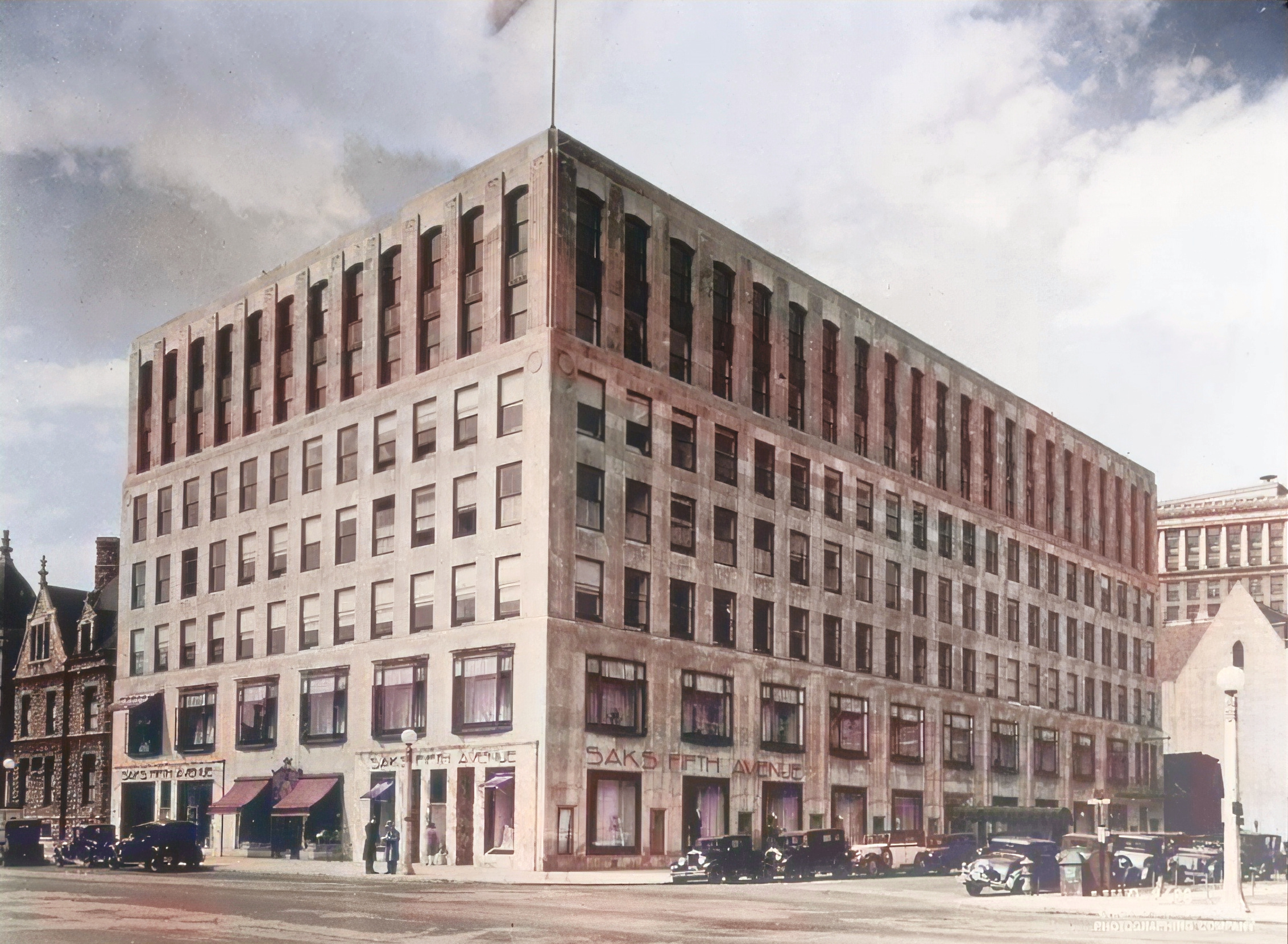
Saks at “The Michigan-Chestnut”, Chicago, circa 1929.

840 North Michigan Avenue, Chicago. One time home of Weird Tales during the Lovecraft years. Designed by the delightfully named Holabird & Root, though their forbidding exterior obviously lacks the same fairy-tail quality. According to the newly released Archive.org microfilm of Editor & Publisher magazine, the first magazine-related tenants moved in just before Christmas 1928, and the place formally opened in 1929. Additional space was opened October 1930, possibly the artists’ studios.

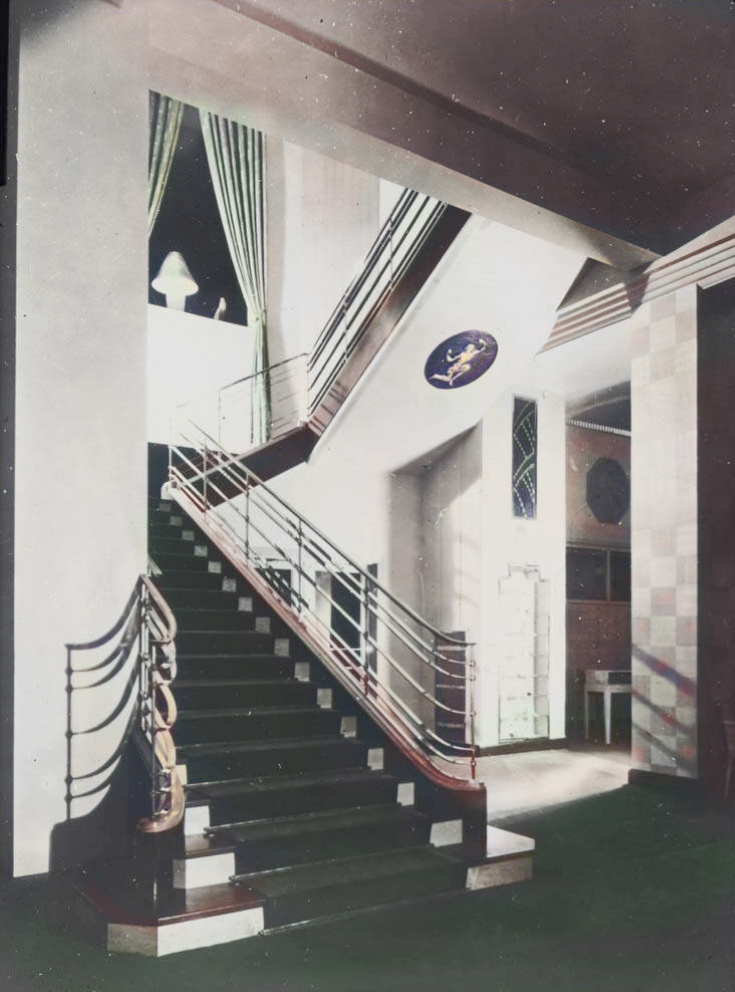
The upmarket retailer Saks Fifth Avenue occupied the walk-in street floor from early March 1929, as can be seen here, when the building was known as “the Michigan-Chestnut”. Perfume and shoes were located on the ground floor, and seemingly also a beauty salon. Womenswear, junior sportswear, hats and probably jewellery were up a flight of stairs, and Saks may even have also occupied most of the first floor. Saks was an oasis for the wealthy lady shopper and thus the building faced the threat of crime from Chicago gangsters. For instance June 1929 saw Saks robbed, in a “terrifying” daylight gunpoint attack, of $20,000 of cash and jewels.

The Saks stairs photograph does at least hint at the likely style of the rest of the interior. Regrettably the upper offices and corridors appear to have eluded the camera, though there is apparently in Marginalia (1944)…

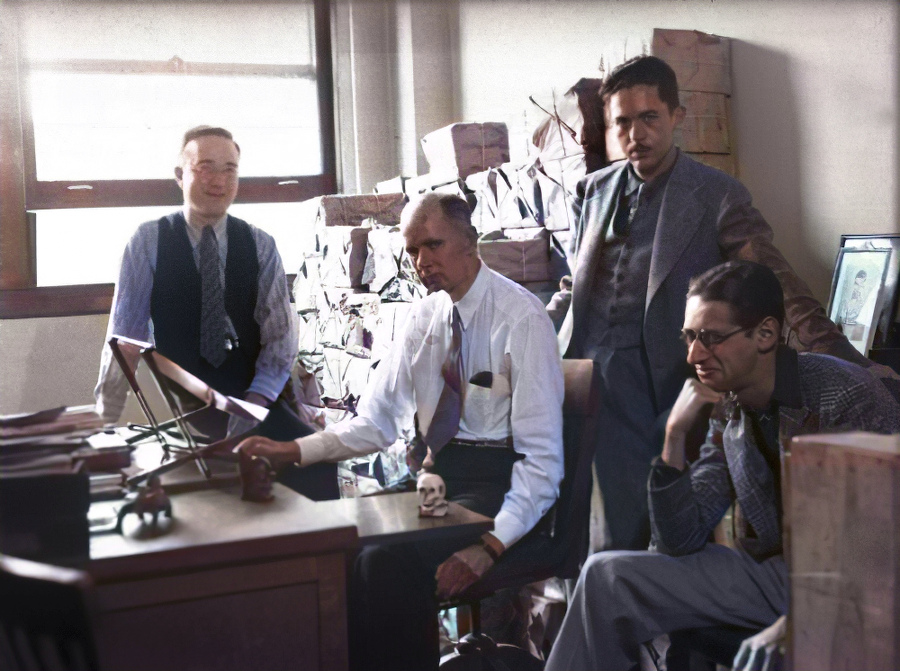
a picture from about 1937 of a part of the Weird Tales office in the “palmy Chicago days” Seated at his desk is Farnsworth Wright.

Possibly it is this one…

Weird Tales editorial office, Chicago. The business manager Bill Sprenger, then editor Farnsworth Wright seated, Henry Kuttner, and then Robert Bloch on the right.

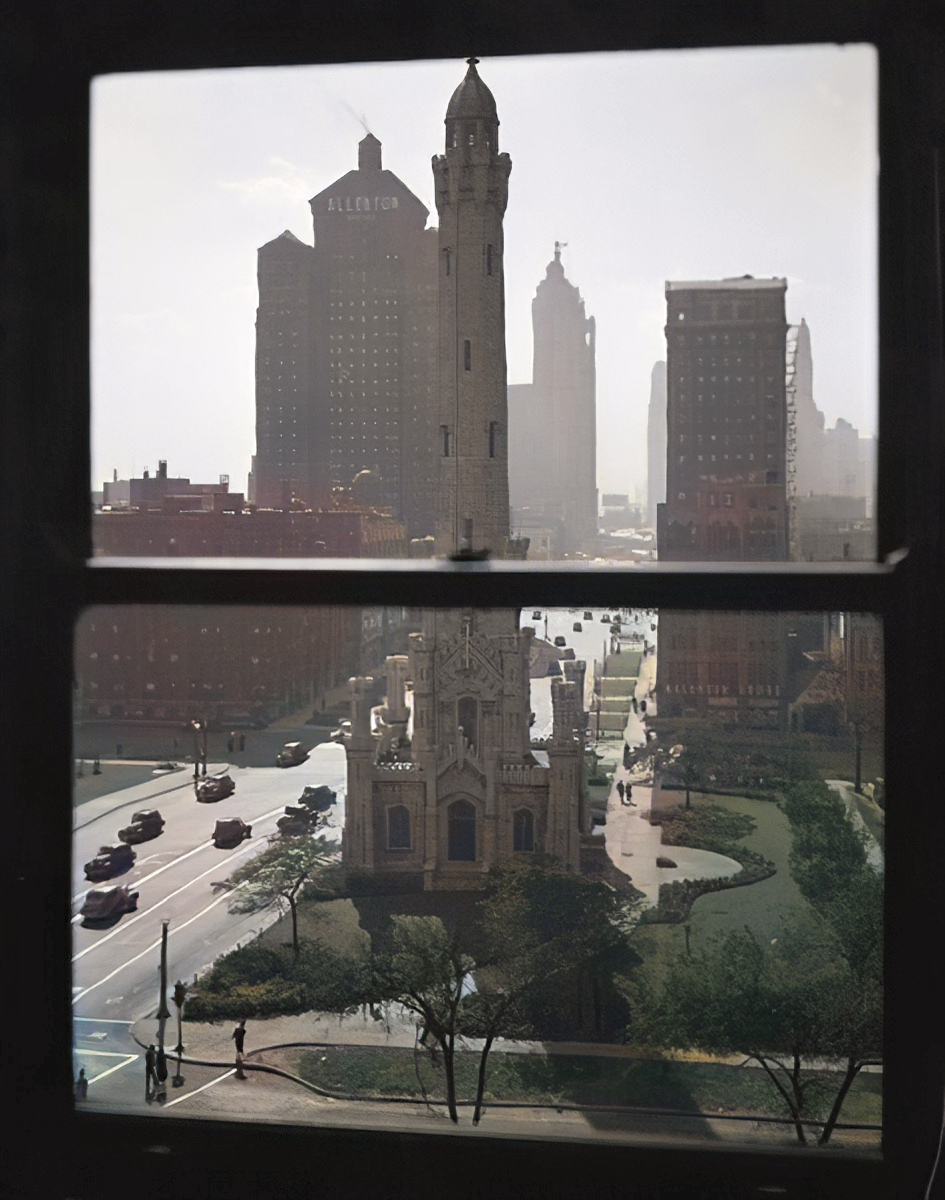
There is however one vintage architectural view available from the windows, here enlarged and newly colorised. Note that the window casing is the same as that on the group picture above, which shows the Weird Tales office had a view of some sort. Though this particular view only has a one-in four chance of approximating the view had by Farnsworth Wright from the Weird Tales office.

Still if it was indeed more or less his daily view then, as editor of Oriental Stories and with a personal interest in the arts of the East, he might have appreciated the rather incongruous pseudo-oriental minaret. The photograph’s impression of cleanliness and order in the city is perhaps deceptive. One of Lovecraft’s correspondents felt… “unimpressed [by Chicago]… the city is filthy” after visiting the Weird Tales office. The Michigan-Chestnut building and Saks does however seem to have been at the centre of a set of upmarket ladies’ stores, according to the retail histories, so perhaps the area formed an oasis in the gangster-ridden city? Bloch had lived there as a youth and later recalled the smells…

I learned the geography of the city through the windows of streetcars, elevated trains, or double-decker buses. Sometimes my parents would even let me ride on the open-air upper level of a bus, if the wind on Michigan Avenue wasn’t too strong. Everything blew into the Windy City in the twenties — stench from its famous stockyards, smoke and steam from the daily discharge of a thousand trains. The odor of alcohol fermenting in tenement stills mingled with perfume rising from the crowded lobby of the new opera house…” (Introduction to Murder and mystery in Chicago)

Sadly his short memoir reveals nothing about the particulars of the Weird Tales office, other than that he visited it when he returned to the city. The presence of Bloch and the architectural detail of the window confirms that the above group-photo was made in the Michigan Avenue building.

Saks moved out of the building in 1935, most likely due to the stringencies of the Great Depression, and opened a new Chicago store in January 1936. Possibly the presence of Saks had meant that visitors to the Weird Tales and Oriental Stories offices would have been glad to walk in out of the stink of Chicago and through the plush and beautifully scented bazaar to reach the office elevators or back-stairs. But after Christmas 1935 this perfumed pleasure evaporated. Weird Tales followed a few years later, moving out in 1938.

Doubtless there are more small details to be gleaned from various accounts of personal visits to the Weird Tales Chicago office c. 1929-1938, buried deep in the memoirs of writers and fans such as Hoffman Price, but I lack the print resources for such a post.

Inside the Weird Tales building, Chicago

15 Monday Mar 2021

Posted by asdjfdlkf in Historical context, New discoveries

≈ 1 Comment

A peek at the environment in which the Weird Tales offices existed, when at the Dunham Building, Chicago, during the prime ‘Lovecraft years’. Entrance in 1926, from Archive.org. Other pictures via Chicago History Museum Images, from which large b&w prints can be had.

It was probably not as brown as this rescued-from-microfilm and colorised picture. The entrance when new was described as having a quirky “colorful stone exterior” (1930 Architectural Annual, Chicago). Another journal suggests the building facade and entrance were elegantly lit at night. In daylight the exterior above the entrance was an ungainly hodge-podge of layers and decoration, but I guess it might have worked better when seen at night and from the ground.

Elevator entrances and corridor, and boards listing current office occupants for each floor.

One of the private offices.

The architects were Burnham Brothers and the building was that of a successful heating and refrigeration company. One thus assumes the heating and cooling was always perfect. The pictures suggest the interior would have felt like modernity de-luxe, efficient and clean but hand-crafted and with a nice touch of eccentricity hiding the advanced technologies. Lovecraft would likely have felt somewhat at ease there, had he accepted the editorship of Weird Tales and moved to Chicago. More so, too, due to the super-efficient heating during the tough Chicago winters. However, they were only there for about three years and then moved to a modernist building he might have found less congenial.

The building’s ownership may relate to editor Farnsworth Wright’s curious rejection of “Cool Air”. Wright may have been worried that the building’s owners might have thought the story was meant to be poking fun at them.

In the 1950s it appears to have been home to another popular magazine, Science and Mechanics. The building was later renamed “450 E. Ohio Street”, and demolished in 2007.

New addition, Tentacles over Brooklyn

12 Friday Mar 2021

Posted by asdjfdlkf in Historical context, New discoveries

≈ Leave a comment

A new addition to today’s ‘Picture Postals’. I’ve managed to catch a glimpse of the elusive giant squid, and also a picture of the first Invertebrate Hall as it existed until c. 1927. By 1928 it had been moved into another Hall.

The first Invertebrate Hall at the Brooklyn Museum, later moved wholesale to another hall c. 1927 and opened again by 1928.

This is as Lovecraft would have known it until c. 1927. Both the Giant Octopus and Giant Squid are seen, though it’s still not a good view of the squid.

‘Picture Postals’ from Lovecraft: Tentacles over Brooklyn

12 Friday Mar 2021

Posted by asdjfdlkf in Historical context, Lovecraftian arts, New discoveries, Picture postals

≈ 2 Comments

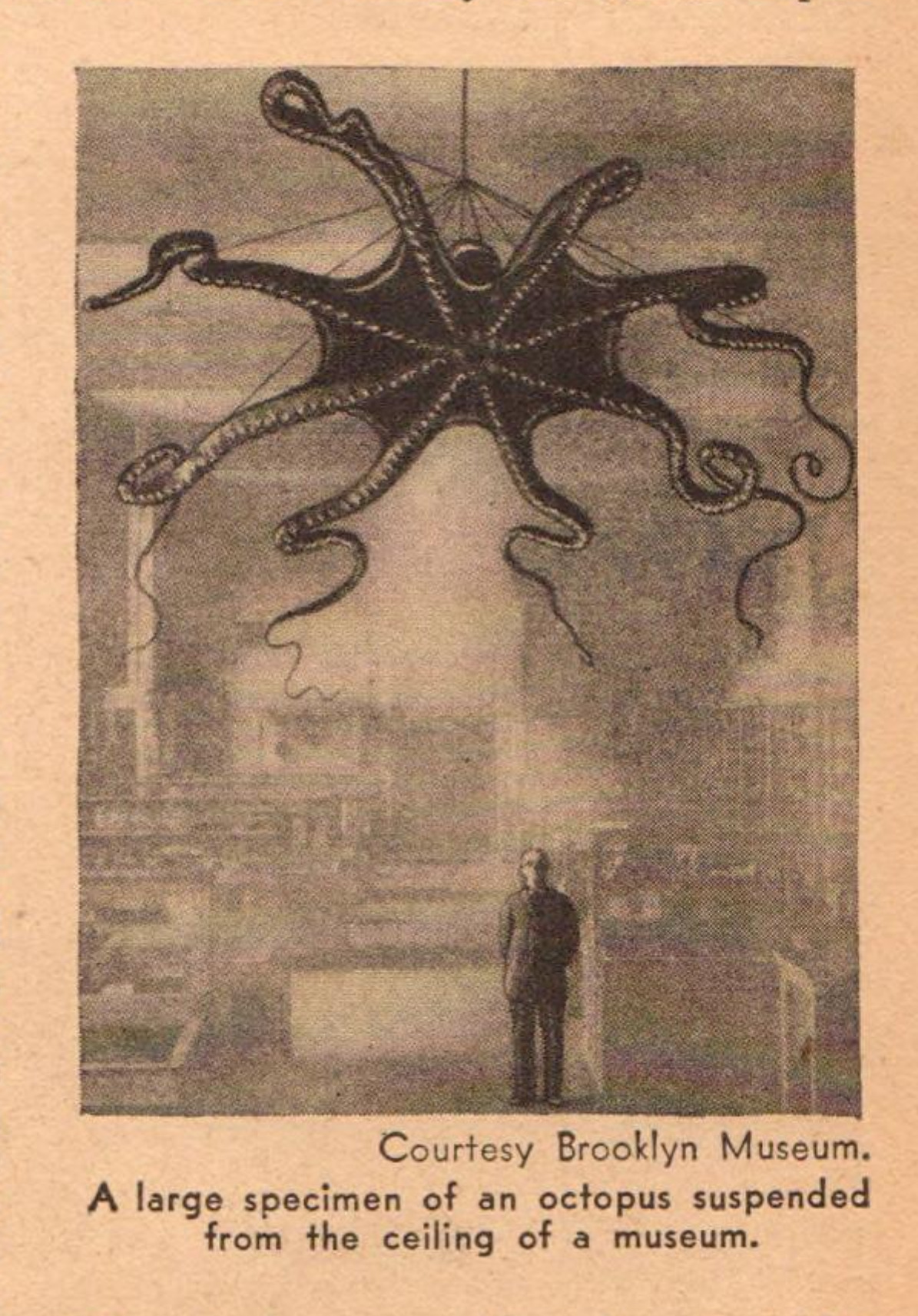
Tentacles in the Brooklyn Museum, 1931. Found while flipping through Science and Invention magazine for March 1931, newly on Archive.org. An initial search suggested there was also a giant squid, as the modern book Brooklyn Museum of Art: Building for the Future talks of their having once been natural history galleries and a specific section for… “Invertebrates housing not only display cases of specimens but also large models of a squid and an octopus suspended overhead”.

The first hall, moved wholesale to another hall and re-opened by 1928. This is as Lovecraft would have known it until c. 1927.

The first question was, did H.P. Lovecraft know the Museum from 1922 onward? Yes, of course he did. He saw it as a tourist first, and then ‘did it’ systematically and thoroughly later in 1922. Its galleries and the adjacent Japanese Gardens became a regular haunt when he was in New York. Another question was, was it always the “Brooklyn Museum” or did it have another or formal name? Indeed it did, being also known as the Brooklyn Institute. Pictures? Yes, here is a rare eye-level card showing it about a decade earlier. Most of the other cards are later, gaudily coloured and vigorously airbrushed.

Were there other attractions there? Well, a big attraction was the cost. Entry was free on most days, and the place was also open in the evening on Thursdays. By circa 1930 he probably knew the place well, but he was also well aware of the new items being accessioned. He did the Museum solo in May 1930, seeing the new ‘Colonial furniture and interiors’ wing which newly offered complete rooms arranged for Lovecraft’s lingering delight. In 1933 he “…did the Brooklyn Museum with Sonny” — Lovecraft letter to Morton, 12th January 1933, when they focussed on the “Dutch” section. I would suspect that this may also have been new.

But what of the tentacles, and the “Cthulhu” period? Regrettably there appears to be a lack of vintage postcards from the Museum, showing the interior, still less the Invertebrates section. Still there is one negative of a record-picture of the Hall of Invertebrates in 1928. Below I have newly enlarged and colorised it. The picture makes the room appear smaller than it was. The cabinets are man-high, not at child-level as they might be today.

1928, after removal from the second floor, east wing, to the first floor, west wing.

The hanging giant octopus was there before “Call of Cthulhu” was written, as confirmed by the book Guide to the Nature Treasures of New York City (1917). Also the giant squid…

Models of the octopus and squid occupy the last wall case at this end of the hall and should be compared with the giant octopus and squid suspended from the center ceiling and the marine painting above.

Thus it would be plausible to suggest that this (and the squid) could have played into Lovecraft’s conception of Cthulhu… “The cephalopod head was bent forward, so that the ends of the facial feelers brushed the backs…”.

1920 saw the addition of a ‘Pacific case’, a fine diorama with glass models. Possibly these were in the closed wooden cases seen at the back of the 1928 photo above. As such the picture below exemplifies the sort of detailed and accurate ‘undersea’ scene available in this Hall.

Here is the full description of what Lovecraft would have seen there circa 1922. This also notes the microscope views and many glass re-creations…

“… invertebrates and plants in the eastern galleries [on the “second floor” until 1927, the on the “first floor, west wing” after that]… the Hall of Invertebrates of the Brooklyn Museum (Room 7 on plan) is next entered, where the sponges and corals, worms, mollusks, crustaceans and other types of animals lacking a backbone (invertebrates) are exhibited.

Among this invertebrates are the sponges and corals, from all parts of the world, are systematically arranged in wall cases on the west, north and south sides of the hall, and in various floor cases special groupings have been made of sponges and corals of particular beauty or interest or of unusual size.

Other invertebrates are specimens of the Protozoa, or one-celled animals, the simplest forms of animal life, are shown in the first floor case on the left (north) side of the hall, by the aid of micro-scopes, and also by enlarged glass models. The sponges are the simplest forms of animals whose bodies consist of more than one cell, for the cells, although arranged in two layers, act each independently. Varieties of lime sponges, glass or silicious sponges and horny sponges are shown, as well as fresh-water, deep-sea and boring sponges, and sponge spicules under the microscope.

Models of coral, showing the anatomy of the polyps and their relation to one another, are seen in the second floor case on the left, which contains also models of the freshwater polyp hydra and other related forms. In the adjacent wall cases, specimens of mushroom, staghorn and brain coral and other forms are shown. A very large specimen of brain coral from the Bahamas and a specimen of staghorn coral, one of the largest pieces of branching coral ever collected, are exhibited in floor cases in the center of the hall.

Among the mural paintings in this hall of the Brooklyn Museum, representing some of the more striking invertebrates as they appear in life, is one depicting a coral reef in a tropical sea, and on the south wall in the center of the hall a large window group shows a coral reef close at hand and the animals that frequent it. Other mural paintings show an octopus at home, the formation of a mangrove swamp and other typical shore scenes of the Atlantic coast. Proceeding down the left side of the hall, the starfish and sea urchin families occupy the next case, and the development and anatomy of starfishes and sea urchins are illustrated by drawings, dissections, models and specimens of various ages. Abnormal specimens and specimens showing regeneration of rays in a starfish also are shown. The various types of sea urchins occupy the eastern side of the case. The worms in the next cases include the serpulid worm of the sea, the horsehair worm and a model enlarged and dissected; the branchiopods, related to both worms and mollusks, are shown here.

Crustaceans, in the next case of invertebrates, are represented by some one hundred species, including the crayfish with an enlarged model of dissection to show the anatomy, and a section of mud from a river bank showing a crayfish group at home, together with crabs, lobsters, shrimps, barnacles, horseshoe crabs and others. In the wall case at this point, the giant spider crab and the locust lobster of Japan, the largest species of living crustaceans, are shown.

The systematic series of shells, which includes characteristic examples of the principal divisions of mollusks and gives a general impression and synopsis of this group of animals at the Brooklyn Museum, is arranged in two floor cases on the right (southern) side of the hall at this (western) end. The largest specimens are in the upper part of the case, and the extensive study collections are arranged systematically in drawers below. Fine specimens of the nautilus and argonaut, representing the higher mollusks, may be seen, also the paper nautilus of Japan; a particularly interesting specimen is the naked mollusk from Naples, which appears to have no shell because the shell is internal.

An exhibit of land snails and of shells from Lake Tanganyika occupies a position in the systematic series of shells and shows specimens of the eggs of marine mollusks. The ship-boring bivalve teredo and its work in destroying ship bottoms are exhibited in the case next on the east; sections of wood show the damage done and method of work, and photographs show the anatomy of the animal. Other boring mollusks are exhibited here also, and in the upper part of the case are habitat groups of the edible snails of southern Europe. An exhibit of pearl shells from the pearl fisheries …

The marine animals of the coast of Long Island and New England, from high tide to a depth of 7,200 feet, form an interesting exhibit in the last floor case on this side. Among the specimens may be mentioned the oyster drill, showing the drilled shells, egg cocoons and stages of growth of the animal, and mounted specimens of the pipefish, sand flea and other shore creatures. Models of the octopus and squid occupy the last wall case at this end of the hall and should be compared with the giant octopus and squid suspended from the center ceiling and the marine painting above.

Passing into the Insect Hall (Room 8 on plan) …”

Ah, the Insect Hall. What monstrous wonders might he have seen through microscopes in there…?

Lovecraft’s tailor

01 Monday Mar 2021

Posted by asdjfdlkf in Historical context, New discoveries

≈ 1 Comment

The new Letters to Family reveals the 1920s Providence tailor… “Bernstein, late of the Golden Ball Inn”. It appears he was the go-to for substantial clothing repairs and alterations required by H.P. Lovecraft and his aunts. “Late” likely indicates the business had moved from Benefit Street.

A 1975 obituary for his son (above) reveals that Mr. Bernstein the tailor was also a Providence correspondent for the Jewish Daily Forward. This was a large-circulation Yiddish newspaper of record and culture, published nationally from New York City. The archives of the newspaper are online, but no article by a “Morris Bernstein” is to be found. Most likely the name does occur there, but in Yiddish. Or else his name was not given on his Providence reports. Unfortunately this prevents me determining the dates when he was the newspaper’s Providence correspondent.

The Jewish Daily Telegraph had a short report in English at Christmas 1926, from a “Chicago Correspondent, Morris Bernstein”. This is the only time his by-line appears there, and they have the whole run online and with an exemplary search-tool and results presentation. Could this actually be the Providence Bernstien, picking up news of an important ‘cosmic’ experiment near Chicago, from a chance conversation with Lovecraft, and stringing it along to the news service?

Prof. Michelson’s invention … measures the speed of a beam of light flashed from one mountain peak to another. He will use the interferometer when he once more conducts the world famous experiment which involves the measuring of the speed of the earth, and with it, the whole solar system through space.

His son (1910-1976) went on to become a leading man in Providence, a patron of the arts and a pioneer of persuasive advertising methods. Lovecraft was unlikely to have encountered the son, who started his ad agency in 1941 several years after Lovecraft’s death.

Still, this adds to the picture. Lovecraft’s jobbing tailor was likely also a working journalist, and his son had a very remarkable flair for words and a strong interest in the arts. These facts may hint at why Lovecraft favoured Mr. Bernstein above other Providence tailors who he might have patronised, beyond simply his presence in the historic Golden Ball Inn.

My thanks to Ken Faig for his new Moshassuck Monograph No. 33 on the “Golden Ball Inn”, which prompted me to see what I could find online about Lovecraft’s tailor.

The Golden Ball in the early 1910s. Possible side-entrance to tailoring workshops in the upper-back? (Picture not from the Moshassuck Monograph)

A visit to 211

25 Thursday Feb 2021

Posted by asdjfdlkf in Historical context, New discoveries

≈ 2 Comments

Lovecraft’s friend and correspondent James Morton lived for many years at No. 211, West 138th Street, in a top floor apartment of a very dusty and unkempt building located a little north of the centre of Harlem, New York City. Lovecraft described it as a “single house”, Long in his memoirs as a “brownstone”. Both were partly right. Lovecraft was likely using the architecturally-correct Georgian term for a long single-block of row-houses, built in a pseudo-Georgian style in the 1890s, rather than meaning ‘a detached single house with a garden and yard’.

I’ve now found modern rental photos showing the inside of No. 215, the pictures being here suitable treated for a more retro look. The interior is not quite 211 but must surely evoke something very close to what a visit to Morton’s place might have been like. You have to imagine it prior to the strong gentrification, of course, and incredibly dusty as Lovecraft describes it in the new Letters to Family books…

No. 211 — the Morton mansion — is an old brick single house owned by an elderly eccentric named Edwin C. Walker; a spacious & unkempt edifice, thick with dust, & with half the rooms unused. Morton’s room is on the top floor, reached by dark & winding stairs, & is remarkably neat though atrociously dusty.

Anarchists, as a rule, tend to be disinclined to housework. The dust also suits their paranoia, usefully revealing the intrusion of the clandestine police investigators they imagine are around every corner. Lovecraft thought the street pleasant enough, though, with decent houses and trees and no policemen idling on the corner.

Entrance to 215, seen at an angle.

Entrance to 215

Lower exterior window of 215

The building’s owner was the fellow orator and publisher Edwin C. Walker (1849–1931) who then still ran the freethought / free-love / inter-racialist ‘Sunrise Club’ from there. This was a long-running bi-weekly dining meeting which had in its time seen a wide variety of invited after-dinner speakers, ranging from the distinguished racial universalist Du Bois (1919) to anarchist Emma Goldman on birth-control and censorship (1915), along with a wide range of fringe speakers on the burning topics of the era. Evidently ‘Red’ Emma was a regular guest, as she was impressed when she met and heard Du Bois there in 1919. These speakers are also known to have included spiritualist mediums. Glimpses of Walker’s Fair Play magazine of 1908, with a different mailing address, suggests the mix: pro-sex and birth-control stances; interest in the disciples of Walt Whitman; individualistic Stirnerite anarchism; anti-censorship; racial equality; and spiritualist ‘mediumship’. Lovecraft himself attended a meeting on pro and anti-censorship in 1922, finding the speakers and arguments facile except for the contribution on Morton.

It seems likely that the lower street windows of the building were those of Walker’s rooms, and thus in the latter years may have presented to the world a certain faded bohemian glamour in decor. Possibly there was sometimes a window-card to indicate the ‘Sunrise Club’, though in 1922 it was held in a nearby cafe for the meeting that Lovecraft attended. The “empty rooms” Lovecraft knew of were likely available as discreet meeting rooms on the first floor, above the prying eyes of police or journalists or Houdini-like debunkers. Walker is listed at that address in Hartmann’s Who’s Who in Occult, Psychic and Spiritual Realms, 1925. For more on Walker see The Sex Radicals: Free Love in High Victorian America (1977).

Lovecraft evidently met Walker briefly, when he first visited and probably also thereafter. Though Walker was in his early-mid 70s in the 1920s. Lovecraft had a lot of time for ‘good old fellows’ but he was unlikely to have seen eye-to-eye with Walker, had they chanced to settle into conversation. Though they might have been alright if they had stuck to the pros and cons of censorship and anti-liquor matters, things on which they both broadly agreed. I imagine he might have been a slight influence on the character of Robert Suydam in “The Horror at Red Hook”.

A photograph shows that Walker had been quite a looker, seen here his prime about the year 1889 when his ‘Sunrise Club’ was founded…

← Older posts
Newer posts →


Please become my patron at www.patreon.com/davehaden to help this blog survive and thrive.

Or donate via PayPal — any amount is welcome! Donations total at Easter 2025, since 2015: $390.

Archives

  • August 2026
  • July 2026
  • June 2026
  • May 2026
  • April 2026
  • March 2026
  • February 2026
  • January 2026
  • December 2025
  • November 2025
  • October 2025
  • September 2025
  • August 2025
  • July 2025
  • June 2025
  • May 2025
  • April 2025
  • March 2025
  • February 2025
  • January 2025
  • December 2024
  • November 2024
  • October 2024
  • September 2024
  • August 2024
  • July 2024
  • June 2024
  • May 2024
  • April 2024
  • March 2024
  • February 2024
  • January 2024
  • December 2023
  • November 2023
  • October 2023
  • September 2023
  • August 2023
  • July 2023
  • June 2023
  • May 2023
  • April 2023
  • March 2023
  • February 2023
  • January 2023
  • December 2022
  • November 2022
  • October 2022
  • September 2022
  • August 2022
  • July 2022
  • June 2022
  • May 2022
  • April 2022
  • March 2022
  • February 2022
  • January 2022
  • December 2021
  • November 2021
  • October 2021
  • September 2021
  • August 2021
  • July 2021
  • June 2021
  • May 2021
  • April 2021
  • March 2021
  • February 2021
  • January 2021
  • December 2020
  • November 2020
  • October 2020
  • September 2020
  • August 2020
  • July 2020
  • June 2020
  • May 2020
  • April 2020
  • March 2020
  • February 2020
  • January 2020
  • December 2019
  • November 2019
  • October 2019
  • September 2019
  • August 2019
  • July 2019
  • June 2019
  • May 2019
  • April 2019
  • March 2019
  • February 2019
  • January 2019
  • December 2018
  • November 2018
  • October 2018
  • September 2018
  • August 2018
  • August 2015
  • July 2015
  • March 2015
  • February 2015
  • January 2015
  • December 2014
  • November 2014
  • October 2014
  • September 2014
  • August 2014
  • July 2014
  • June 2014
  • May 2014
  • March 2014
  • February 2014
  • January 2014
  • December 2013
  • November 2013
  • October 2013
  • September 2013
  • August 2013
  • July 2013
  • June 2013
  • May 2013
  • April 2013
  • March 2013
  • February 2013
  • January 2013
  • December 2012
  • November 2012
  • October 2012
  • September 2012
  • August 2012
  • July 2012
  • June 2012
  • May 2012
  • April 2012
  • March 2012
  • February 2012
  • January 2012
  • December 2011
  • November 2011
  • October 2011
  • September 2011
  • August 2011
  • July 2011
  • June 2011
  • May 2011
  • April 2011
  • March 2011
  • February 2011
  • January 2011
  • December 2010
  • November 2010
  • October 2010
  • September 2010
  • August 2010
  • July 2010

Categories

  • 3D (14)
  • AI (74)
  • Astronomy (70)
  • Censorship (14)
  • de Camp (7)
  • Doyle (7)
  • Films & trailers (101)
  • Fonts (9)
  • Guest posts (3)
  • Historical context (1,096)
  • Housekeeping (91)
  • HPLinks (98)
  • Kipling (11)
  • Kittee Tuesday (92)
  • Lovecraft as character (58)
  • Lovecraftian arts (1,643)
  • Lovecraftian places (19)
  • Maps (72)
  • NecronomiCon 2013 (40)
  • NecronomiCon 2015 (21)
  • New books (976)
  • New discoveries (166)
  • Night in Providence (17)
  • Odd scratchings (984)
  • Picture postals (278)
  • Podcasts etc. (433)
  • REH (190)
  • Scholarly works (1,480)
  • Summer School (31)
  • Unnamable (87)

Get this blog in your newsreader:
 
RSS Feed — Posts
RSS Feed — Comments

H.P. Lovecraft's Poster Collection - 17 retro travel posters for $18. Print ready, and available to buy — the proceeds help to support the work of Tentaclii.

Proudly powered by WordPress Theme: Chateau by Ignacio Ricci.