• About
  • Directory
  • Free stuff
  • Lovecraft for beginners
  • My Books
  • Open Lovecraft
  • Reviews
  • Travel Posters
  • SALTES

Tentaclii

~ News & scholarship on H.P. Lovecraft

Tentaclii

Category Archives: Lovecraftian arts

HPLinks #22 – the key 1919 Vagrant, the uninhabitable universe, a Lovecraft rock opera, and more…

22 Wednesday Jan 2025

Posted by asdjfdlkf in HPLinks, Lovecraftian arts, Scholarly works

≈ Leave a comment

HPLinks #22.

* The Drayton Arms theatre in London has officially announced the London Lovecraft Festival, for 16th-17th February 2025. The Drayton also has Web pages for the stage shows, which are booking now.

* Newly for sale, Lovecraft’s seminal “Dagon” as published in The Vagrant, November 1919. Said to be in near-fine condition.

* L’antique Sentier introduces Newburyport, a real-world model for Innsmouth, to French readers.

* From the University of North Carolina, the Masters dissertation “Popular Purity: Change Over Time in the Racial Views of H.P Lovecraft, and the Spectrum of Racial Ideas as Promoted by Popular Culture: 1917-1936” (2023). Freely available for download.

* At Stanford, the B.A. final dissertation “Lovecraft and the Question of an Uninhabitable Universe”. Winner of the university’s DLCL Award (2020). Now freely available for download.

* At McQuarie University, Australia, the PhD thesis Out of time/Out of control: speculative modernism and the limits of thought (2024), on Lovecraft and William S. Burroughs. Freely available for download.

* Forthcoming, an academic book collection on the topic of movie ‘creature features’. With a submission deadline of 10th March 2025, the editor is seeking…

… close readings of films led by creatures and monsters in the 21st century. Classic [older] films will be welcome if analyzed through new, contemporary theories to show how their purpose/meaning has changed over time.

* In Spanish, the YouTube recording of a 2023 Madrid conference on Geologia en la literatura fantastica y de terror (‘Geology in fantasy and horror literature’).

* Also in Spanish, MetalTrip reviews…

A new rock opera, ‘Legado De Una Tragedia: Lovecraft’, which brings together theatre and symphonic metal music. The result is a horror rock-opera full of the best heavy metal. Each song is based on one of Lovecraft’s most iconic stories.

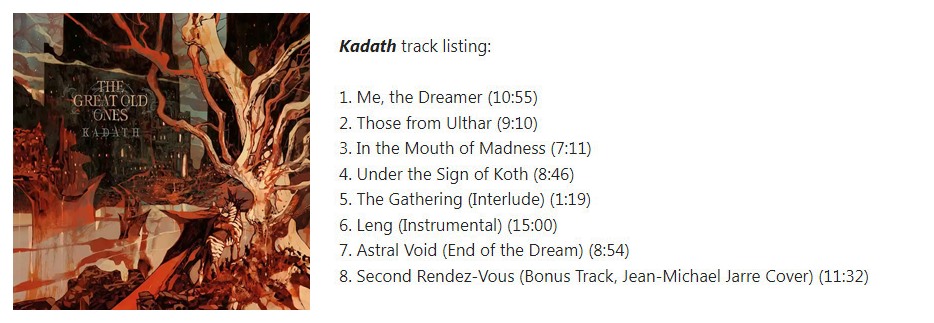
* The Void reviews Kadath, the new Lovecraft-centred metal album by the Lovecraftian band The Great One Ones. Hardforce also has a review in French.

* On the south coast of the UK, Falmouth University will stage a three-day conference on Haunted Modernities, 16th-18th July 2025. Deadline for submissions: 17th March 2025. The conference seems to be casting the net wide, but will focus around…

… haunted modernities and spectral futures of all sorts. Looking back to the past as a haunted space and forward to the ‘spectres’ of the future, we want the ‘Haunted Modernities’ conference to be indicative of wide open spaces and fruitful intersections in scholarship and practice. Whether work is hyper-local, global, or interstellar we welcome imaginative, creative, ethical, and diverse discussions from all disciplines and subject areas. As well as traditional papers, creative practice work is also invited in whatever form — written, film, audio, performance, exhibitions etc.

* New on Librivox, a public-domain reading of the English translation of Hesse’s Steppenwolf. 1929, in first English translation, which I assume is the translation used here due to the 1929 U.S. copyright expiration date. So far as I know, Lovecraft never encountered the translation.

* A forthcoming book, Space Ships! Ray Guns! Martian Octopods!, will be a transcribed collection of interviews with science-fiction and fantasy authors, drawn from Richard Wolinsky’s Probabilities radio show. His half-hour interviewees included Robert Bloch, Fritz Leiber, Ray Bradbury and many more. The book is due from Tachyon in August 2025. No Amazon listing as yet.

* New on Archive.org, a scan of the 1990s Sheffield horror-punkzine Gibbering Madness #6. This has a fannish look at punk rockers in horror movies, with the article naming about 18 such movies. Also of note is the punkzine Scrawl #3 from Belfast, though only for a 7″-single review which mentions in passing that…

Rudimentary Peni are quite rightly recognised as pioneering and influential in the realm of anarcho punk and are possibly one of the most deranged bands ever. […] The late eighties saw [their album] Cacophony, which was a musically inventive yet immensely bizarre tribute to the works of H.P. Lovecraft.

* Blinks notes a new broadcast TV travel documentary which (though otherwise tiresome) gives… “a number of interesting scenes showing both the inside and outside of Dunsany Castle”, plus some snatches of discussion with the current Lord Dunsany.

* And finally, new on eBay at a sensible price, ‘Stereo View of the Head of the Providence River’, which appears to show the ‘Old Brick Row’ which Lovecraft tried to save.


— End-quote —

“Good old Providence — there is no other town quite like it! [Until 1929 and the loss of the Old Brick Row, it still had the coherent] ancient waterfront with slant-roofed brick warehouses and lanes of gambrel-roofed shops and pillared taverns […] Then, too, from most points’ along the [College] hill crest there is a breath-taking view of the outspread roofs and spires and domes of the westward-stretching lower town — a view reaching even to the dim violet hills of the country beyond the country whence many of my ancestors came. At sunset this vista is past description — the marble dome of the State House, the Gothic tower of St. Patrick’s, and the distant spires of Federal Hill against the flaming, mysterious west — and then the cryptic twilight, with the violet of the far hills creeping eastward to engulf the whole drowsy valley, and little specks of light leaping out one by one till the expanded sea of roofs is one titanic constellation […] And even more magical now that we have tall buildings to light up and suggest enchanted cliff cities of Dunsanian mystery.” — Lovecraft to E. Hoffman Price, February 1933.


HPLinks #21 – Spectral Realms, Spanish Lovecraftians, Madness on the London stage, Azoth 1918-1921, and more…

15 Wednesday Jan 2025

Posted by asdjfdlkf in HPLinks, Lovecraftian arts, New books

≈ Leave a comment

HPLinks #21.

* New on the Hippocampus Press website, the annual weird poetry journal Spectral Realms No. 22. There are a few ‘classic reprint’ poems as well, including… “a rare poem from Weird Tales by pulpmeister E. Hoffmann Price”.

* In Spanish, a new open-access journal article in the latest Signa: Revista de la Asociacion Espanola de Semiotica. This focuses on discussion of two… “spearheads of genre fiction in our country: Emilio Bueso and Guillem Lopez, [who adapt] the Lovecraftian model to their own distinctive styles and obsessions”. Freely available online.

* In English in the latest edition of the Hungarian journal Patchwork, Escape from Innsmouth and The Shadow over Innsmouth: The Role of The Reader and Player in Postmodern Multimedial Narratives. Freely available online.

* The latest Good Friends of Jackson Elias podcast hosts, as a guest, the author of the new book Ripples From Carcosa: H.P. Lovecraft, Haunted Landscapes and True Detective (2024).

* French blog L’Antique Sentier translates part of the letter from H.P. Lovecraft to Helen V. Sully, 5th March 1935.

* Another 2025 London Lovecraft Festival theatre listing, for At The Mountains Of Madness at the Drayton Arms Theatre, 16th February 2025. Booking now. As yet, no sign of a 2025 programme at the official Festival website.

* Spraguedecampfan has a detailed review of Planets and Dimensions by Clark Ashton Smith. As I blogged last week, a scan of this 1970s book collection of CAS’s essays is now free on Archive.org.

* New from Scriblus, an 8,000-word article on “The Ballantine Adult Fantasy Series (1969-74): An Introduction”.

* Frontier Partisans trails the forthcoming “comprehensive and meticulously curated” 646-page new edition of the Western Tales Of Robert E. Howard. Due from the Robert E. Howard Foundation Press in February 2025.

* Modern Age magazine suggests “It’s Time for a Walter Scott Revival”… “He’s known for his swashbuckling tales but offers much more.”

* Free on Archive.org, Azoth: The Occult Magazine of America (1918-1921). Of possible interest to Mythos writers seeking deep background on the immediate post-war period, which were also the years in which Lovecraft started to write stories again.

* Inverse reconsiders Underwater, a submarine horror box-office flop of a movie. Has major spoilers.

“Five years ago, Underwater did what many Lovecraft adaptations couldn’t. […] The film isn’t adapting any particular [Lovecraft] story, but a dedicated watch reveals details that are intentionally [Lovecraft] lore-consistent”.

* And finally, Beth Murray was a photographer who made a fine set of 1940s views of Providence, which I collected in a blog post a while ago now. Later I found one more from the set, which was later issued as postcards. I’ve now found another card not seen before, showing the Seekonk River near Red Bridge. Small size, but clear enough to suggest that it was still very much a working river when Lovecraft was alive. The river was strongly tidal and salty.

Red Bridge on the Seekonk, Providence, in the 1940s.


— End-quote —

Lovecraft at the Red Bridge: “I was standing on the East Providence shore of the Seekonk River, about three quarters of a mile south of the foot of Angell Street, at some unearthly nocturnal hour. The tide was flowing out horribly — exposing parts of the river-bed never before exposed to human sight. Many persons lined the banks, looking at the receding waters & occasionally glancing at the sky. Suddenly a blinding flare — reddish in hue — appeared high in the southwestern sky; & something descended to earth in a cloud of smoke, striking the Providence shore near the Red Bridge — about an eighth of a mile south on Angell Street. The watchers on the banks screamed in horror — “It has come — It has come at last!” — & fled away into the deserted streets. But I ran toward the bridge instead of away; for I was more curious than afraid. When I reached it I saw hordes of terror-stricken people in hastily donned clothing fleeing across from the Providence side as from a city accursed by the gods. There were pedestrians, many of them falling by the way, & vehicles of all sorts. Electric cars [tram-cars] — the old small cars unused in Providence for six years — were running in close procession — eastward away from the city on both of the double tracks. Their motormen were frantic, & small collisions were numerous. By this time the river-bed was fully exposed — only the deep channel filled with water like a serpentine stream of death flowing through a pestilential plain in Tartarus. Suddenly a glare appeared in the West, & I saw the dominant landmark of the Providence horizon — the dome of the Central Congregational Church, silhouetted weirdly against a background of red. And then, silently, that dome abruptly caved in & fell out of sight in a thousand fragments. And from the fleeing populace arose such a cry as only the damn’d utter — & I waked up …” — Lovecraft to Rheinhart Kleiner, May 1920.


HPLinks #19 – hard and Long, Joshi’s Recognition reviewed, a Fanhistory Project webinar series, dreaming cats, and more…

02 Thursday Jan 2025

Posted by asdjfdlkf in HPLinks, Lovecraftian arts, Scholarly works

≈ Leave a comment

HPLinks #19.

* Newly listed for discounted pre-order, a 500-copy hardcover edition of A Sense of Proportion: The Letters of H.P. Lovecraft and Frank Belknap Long. Due to ship in early spring 2025 (“March”), and it can’t ship outside the USA.

* In English in the latest edition of the Hungarian open-access journal Patchwork, “Subjectivity and Cosmic Ambiguity in H.P. Lovecraft’s “The Nameless City””.

* The latest edition of the new open-access journal The Incredible Nineteenth Century: Science Fiction, Fantasy, and Fairy Tale has a review of Joshi’s The Recognition of H.P. Lovecraft: His Rise from Obscurity to World Renown (2021).

* In the Italian open-access journal Classica Vox, “Il richiamo degli abissi: una ripresa del Glauco ovidiano in H.P. Lovecraft” (‘The Call of the Deep: a revival of Ovidian Glaucus in H.P. Lovecraft’). Presents, in Italian, the idea that Ovid’s… “Metamorphoses, [specifically the] episode of Glaucus, was an important source of inspiration for the short story The Shadow over Innsmouth”.

* A special new Lovecraft issue of the French journal EaN… “Cthulhu waits no longer. Lovecraft is more relevant than ever: this is perhaps what explains the contemporary interest in his surprisingly modern work.” EaN appears to be open-access.

* In the latest issue of the French journal Otrante ($ paywall) “Relecture juridique de la nouvelle Le molosse d’H.P. Lovecraft” (‘A legal rereading of the short story The Hound by H.P. Lovecraft’).

* The current Weird Tales IP owners recently had a 100-page ‘Cosmic Horror’ special issue (#367), which I think I missed hearing about. But usefully, last week the Tellers of Weird Tales blog perused this issue, finding that… “the contributors to this issue are mostly movie, television, and comic book people” rather than writers. He also suspects that most of the unsigned pictures, of which there are apparently many, were generated by AI models. Which I’ve no objection to myself… provided AI images are done well, generated by someone who knows what they’re doing, and tickled a bit with Photoshop before release. Tellers of Weird Tales also has another post taking a deeper look at the Cosmic Horror issue.

* FanHistory Project Zoom Sessions. This is an online webinar series with the holders and curators of science-fiction fandom university collections. Set to run from January through April 2025.

* A few years back the Chinese communist authorities took a sudden and unexpected interest in science-fiction fans and communities. What seemed somewhat benign at the time now looks different, as a new paper reveals the “unexpected intensification” of censorship which followed, and how “government censorship caused once-thriving fanfiction communities to break apart”.

* Propnomicon posts the scenario setup for The Miskatonic University Sahara Expedition 2025. A real-world LARP in the deserts of North Africa.

* An early indication of the return of the London Lovecraft Festival in February 2025. A listing for “A Night Beneath The Elder Sign” at The Drayton Arms Theatre, London, on 16th February 2025. Lovecraft’s “Celephais, a tale from the Dreamlands, told in shadow puppet style” with “electronic soundtrack performed live”. Plus a “dramatic retelling of From Beyond”.

* Metal Temple interviews the band The Great Old Ones… “Lovecraft may be the sixth member of the band. It’s always music first, but Lovecraft is part of the band, you know?”

* And finally, the English edition of the leftist El Pais asks “How do cats dream?”.


— End-quote —

“My dream of the black cat city was very fragmentary. The place was built of stone & clung to the side of a cliff like some of the towns drawn by Sime for Dunsany’s stories. There are towns more or less like it in Spain. The place seemed to have been built by & for human beings aeons ago, but its present feline inhabitants had evidently lived there for ages. [I beheld] the cats moving about in a rational & orderly manner, evidently in the performance of definite duties.” — Lovecraft to Lumley, June 1936.


HPLinks #18 – Lovecraft and relativity, Lovecraft’s political evolution in Spanish, a Canton discovery, and more…

19 Thursday Dec 2024

Posted by asdjfdlkf in HPLinks, Lovecraftian arts, New discoveries, Scholarly works

≈ Leave a comment

HPLinks #18.

* A new Wormwoodania post, “Remembering Scott Connors”, the Clark Ashton Smith and weird fiction scholar who has recently passed away. Related is last week’s news that S.T. Joshi intends to spend 2025 writing the long-awaited Clark Ashton Smith biography, a book Connors had apparently started but was unable to bring to publication.

* The Papers of Sonia H. Davis blog surveys 2024’s accomplishments in producing valuable new data and scholarship about Lovecraft’s wife.

* New on Archive.org, a scan of Marion Zimmer Bradley’s Fantasy Magazine for Winter 1992, with the lead article being the memoir “H.P. Lovecraft Meets Fafhrd and The Gray Mouser” by Fritz Leiber.

* The Fossils website has a new “scan of the article “The Phenomenon of H.P.L., a ten-page biography of H.P. Lovecraft by Helen V. Wesson originally published in The Fossil for July 1957.”

* Now free on YouTube, S.T. Joshi’s presentation “Lovecraft and the Physicists: Coming to Terms with Relativity and Indeterminacy”, given at the recent ‘Lovecraft et les sciences’ conference in France. Two hours, but the length is partly due to the lack of an AI insta-translator. Thus there are many pauses needed for manual translation.

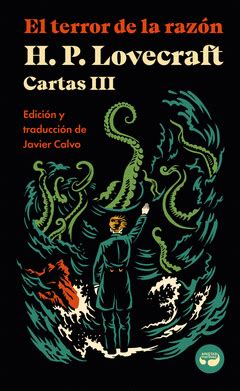
* A third Lovecraft book of translated letters for Spanish readers, El Terror de la Razon. Cartas III (2024), new from publisher Aristas Martinez. The blurb reveals that the first section flows around the idea of… “‘The Terror of Reason’, his ideas about humanity and the cosmos that he disseminated in his most famous stories [and fashioned into] visionary thought that would later inspire a new generation of posthumanist philosophers”. Then the second part of the book focuses on the evolution of the man’s political ideas and ideals, in his own words. I’d hope there are copious footnotes enabling younger readers with no personal experience of the 20th century to (for instance) distinguish national socialism from soviet socialism, and to know what a ‘blackshirt’ was, etc. e.g. when he signs off “Yrs for the blackshirt march on Washington” — Lovecraft to Galpin, July 1934.

* New from Brazil in open-access, a Spanish-language journal article with the translated title ‘Gods, Monsters, Aliens: Lovecraft and the Post-Human’.

* The free bundle of Lovecraft tales, specially set up for deep textual analysis with a computer, is now available as lovecraftr version 1.2 (December 2024).

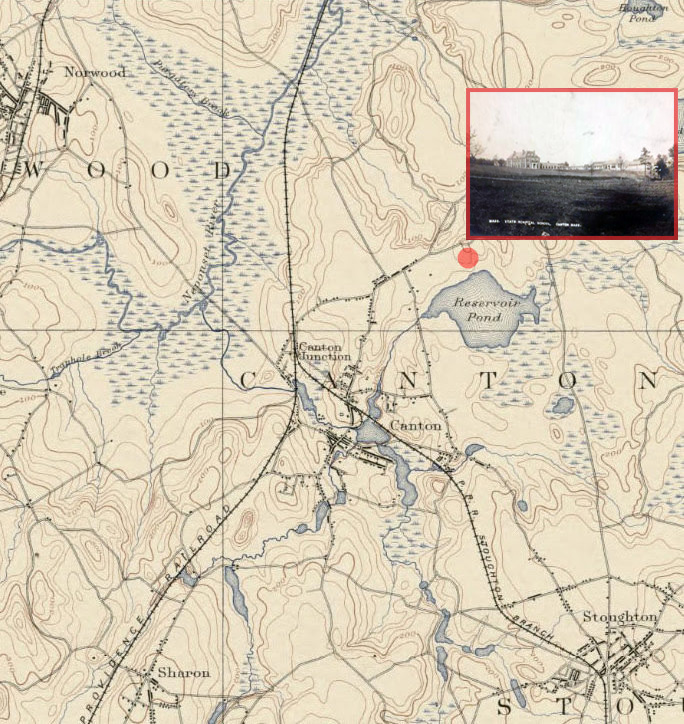
* Further to my July 2024 post on “that Canton madhouse”, Tentaclii reader Luke has written to say that he’s spotted a possible state institution at Canton (this being the Canton to be seen from a tall railway viaduct, when on the rail route from Providence to Boston). This was the ‘Industrial School for Crippled and Deformed Children’, later the ‘Massachusetts Hospital School’. Opened in 1907 and continuing to the present day, located on an 160-acre slope going down to meet the large local lake then called ‘Reservoir Pond’. Lovecraft had written “I shall plan my cousin’s escape from that Canton madhouse”. Yet this real place was not a “madhouse”, but rather an institutional residential hospital with vocational training (farm work, craft workshops etc) for ages 2 to 20. This possibility is certainly worth considering. But, so far as I can see, the location and relatively low-rise appearance (compared to the vast castle-like state madhouses of the time) suggests it may not have made much of an impression on passing rail travellers, even if it could have been seen from a train window…

Note that Luke plausibly observes that the use of “poor little cousin” indicates that the Innsmouth-tainted cousin may have been sent away when a child. He was “little” but then “I had not seen him in four years”, and then a few more years pass before the rescue plan. All of which suggests a boy of perhaps 12 or 13 at the time of the rescue. A boy who would not yet have been transferred to an adult institution. Thus, to find the key state institution for “deformed” children at the real Canton is certainly intriguing.

* A new Skull Session podcast interview with Will Murray… “Will Murray and I discuss his long and varied career writing for Marvel Comics and magazines” and the influence of Lovecraft.

* It’s official, there will be a “4k restoration” version of the Re-Animator movie, complete with bubbling vats of newly-brewed extras. Likely to appear in early April 2025, and to ship with a 150-page book. The much-loved 1985 comedy movie adapted Lovecraft’s Home Brew magazine shocker-serial “Herbert West: Reanimator”.

* In Denmark in August 2025, a three-day conference on ‘Otherworldly Entertainment’…

Today, videogames continue to be one of the biggest platforms for horror, magic, gothic, and occult entertainment, even outperforming cinema and television. Despite [this deep reach into] broad audiences, [the topic] remains severely understudied.

* A paying Lovecraft-related job for a “Dark and mysterious painterly illustrator” wanted for the early stages of a commercial project. Predictably it’s a ‘rush job’ and over Christmas and New Year too. But the offer looks quite serious and there should be just enough time. Sadly the application is by a “super detailed and borderline complicated form” (‘exit stage-left: half the creatives in the room, screaming…’, etc).

* Tartarus Press on the T. Lobsang Rampa books. I recall these being prominent on home bookshelves, as a young child. Not my own shelves, as I never read the Rampa books. But it’s fascinating to learn now that the supposed mystical Tibetan lama who peeped out at me from the book-cases as a child, was… “in fact the son of a plumber from Plympton in Devon [southern England] called Cyril Hoskin”. He became a sometime fitter of corsets, sometime photographer, in the dreary greyness of post-war London. After his first 1956/57 best-seller…

with each subsequent book, Rampa casually shared his knowledge of astral travel, civilisations on Venus, UFOs, etc. One of his books was even meant to have been dictated to him by his cat.

The newspaper expose didn’t matter. He just went into full character for the rest of his life, claimed ‘reincarnation’ and much else… and credulous readers still lapped it up. Tartarus is now seeking anyone who can help with the research for a new full biography of this strange and strangely popular Englishman.

* Islands magazine recommends a visit to an “Underrated Literary Gem Filled With Rare Finds In Rhode Island”. This being the John Hay Library in Providence. Along with the huge Lovecraft collection, evidently the visitor can find there what sounds like one of the world’s finest collections of miniature toy soldiers, and for the especially ghoulish… four books bound in human skin.

* And finally, at the Grolier in New York City, “Imaginary Books: Lost, Unfinished, and Fictive Works”. Their exhibition runs until 15th February 2024. The Necronomicon is, regrettably, represented by a rather naff plastic ‘joke’ case (supposedly holding ye dreadfull tome).


— End-quotes —

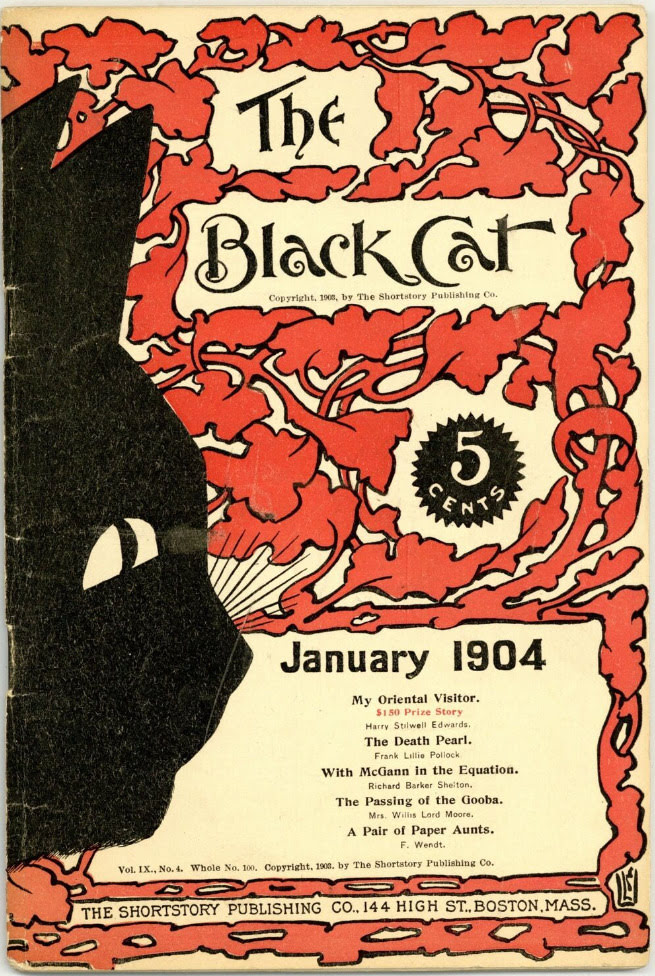
“Hope ya kin get your Black Cat file [i.e. a complete ‘reference file’ run of a past magazine]. I used to buy that reg’lar-like, and recall the swell weird stuff it had.” — Lovecraft to Morton, 23rd February 1936.

“I have been re-reading [your new story] “Marsh-Mad” — & the more I analyse it the better I like it! I shall make every effort to get this in the official organ [but, if not then it] is far too good to waste on any but a first-rate paper! Try it on the Black Cat.” — Lovecraft to Galpin, 29th August 1918.

“Once again I’ve followed a Mortonian [Morton] tip, as I did when sending “Dagon” to the Black Cat and “The Tomb” to the Black Mask and have slipped Weird Tales five of my hell-beaters” — Lovecraft to Morton, May 1923.

We know Lovecraft began to “notice” the magazine Black Cat in 1904, but I know of no scholars able to pinpoint the exact date at which he ceased to buy or read the title.


HPLinks #17 – Masonic Lovecraft, Lovecraft as trainspotter, Lovecraft and Science conference, search the Providence Journal archives, and more…

11 Wednesday Dec 2024

Posted by asdjfdlkf in HPLinks, Lovecraftian arts, Odd scratchings, Scholarly works

≈ Leave a comment

HPLinks #17.

* The journal Fraternal Review, from the Southern California Research Lodge, has a new ‘H.P. Lovecraft and Freemasonry’ special edition. Contents include…

* Harry Houdini and Masonry.
* Lovecraft’s Masonic grandfather.
* Masonic influences on Lovecraft, as well as Lovecraft’s subsequent influences on the occult world.
* Real-life location of the Masonic Lodge that inspired the one taken over in Lovecraft’s “The Shadow Over Innsmouth”.

A $5 digital edition is available. It’s interesting to think what might have happened had Lovecraft taken a different path… able to break into local journalism, then a local magazine editor (he would have been a cert for something like the Hospital Trust magazine The Netopian, with all its local history) and… thus been enticed to join a local Masonic Lodge. Possibly there’s a “what if” Mythos story in that?

* Deep Cuts looks into Her Letters To August Derleth: Muriel E. Eddy, and there are also a few firmer biographical memories found in the article “Mrs. Hinckley’s Providence”. The latter having an item of data on Lovecraft’s youth that I don’t think I’d seen before…

Dorothy Walter, a member of our Short Story Club, said Mr. Lovecraft used to call on her when she was young. About 20 years ago [circa 1946-47] a stranger came from Baltimore and asked Miss Walter and me [Mrs Hinckley] many questions. I only remember that my father knew Mr. Lovecraft and always spoke to him. When we came from Wickford to go to school, Mr. Lovecraft was usually sitting in the Providence railway station, probably because it was nice and warm there.

Presumably the father was taking the girls to the train for school each day, or meeting them off the train, and thus he said ‘hello’ to the boy Lovecraft. This seems quite plausible, though due to Lovecraft’s avid early interest in trains and railroad-men rather than for the warmth (his adult aversion to cold was later known, which probably coloured memories). Deep Cuts puts this at a time when Lovecraft was perhaps 10-12 year old. So maybe 1901-02? I also note that the article also recalls that at that time, at the back of the railway station there was a “beautiful backwater cove”. Tidal and sweet-smelling as she recalled it, but which was later filled in. This huge water feature can be seen on panorama views of the early city. It’s interesting to hear that it may have been known to Lovecraft as a boy. I seem to recall he was to be found, late in life, doing a bit of ‘urban exploring’ in the same location.

* Deep Cuts also has Three Letters to the Editor, 1909, found via the digital archive of the Providence Journal. The topic of Lovecraft’s letters was Robert E. Lee and the South in the Civil War. Also letters from the young Lovecraft on the stage play The Clansman, something which was also debated among amateur journalists some years later — and as such his opinions on it are already well known.

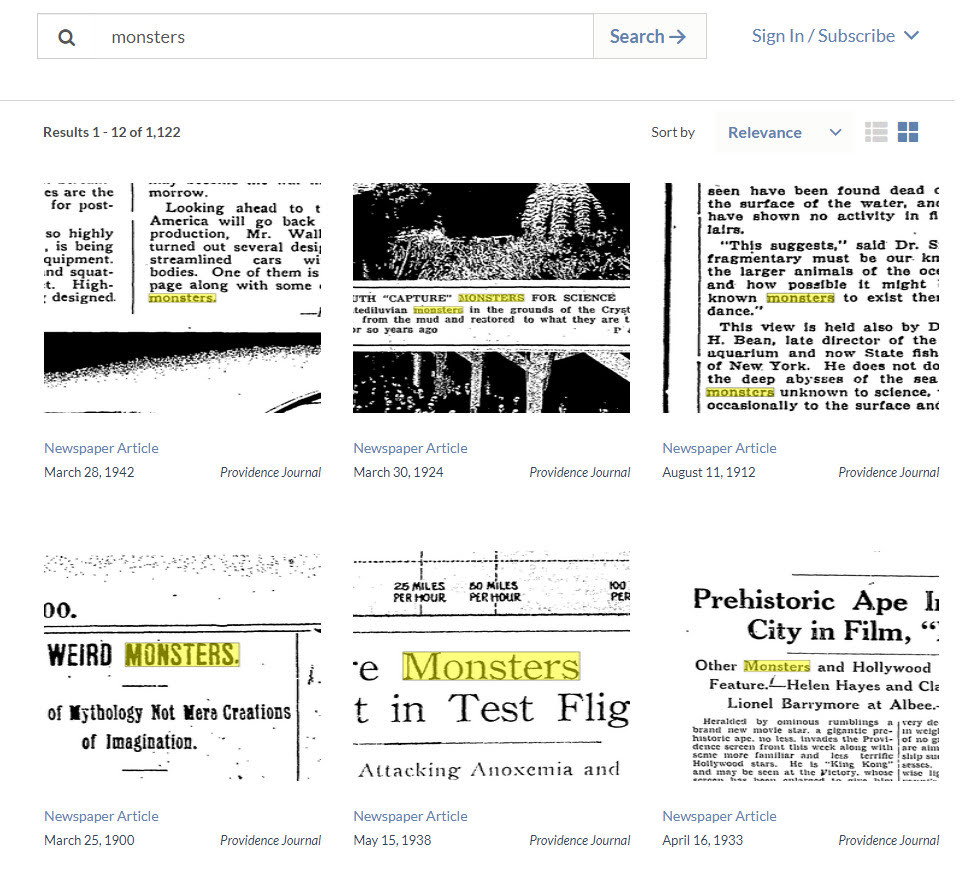
* I see the (new?) Providence Journal Archives search is free, but then any items found are paywalled via individual pricing or a monthly subscription. I’m uncertain if they can take payments from outside the U.S., since payment is via credit card only. $29.95 gets you a one-month ‘unlimited downloads’ pass. Sadly passes cannot be gifted to researchers, since only the cardholder is allowed to use them.

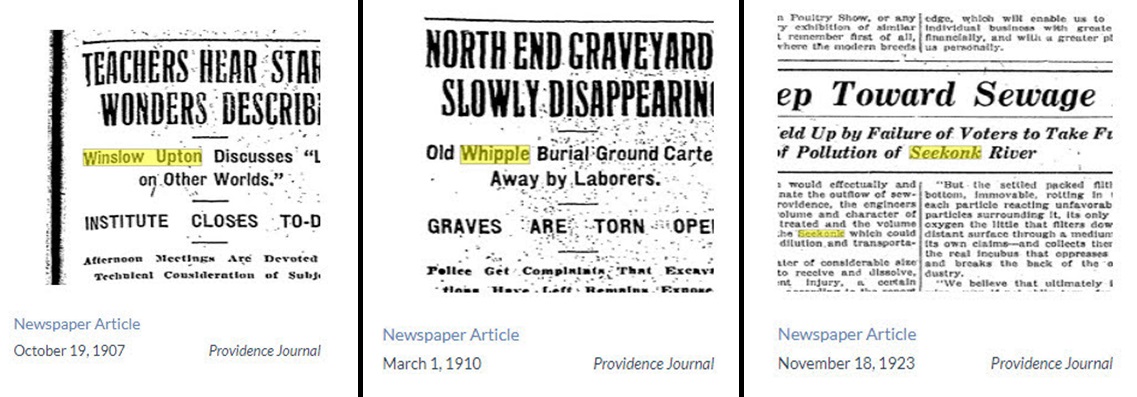
The search-box supports phrases in quote marks e.g. “Ladd Observatory”. As with many old newspapers, however, the OCR of tiny print leaves much to be desired and there are many false-positives and oversights. For instance a search for “Winslow Upton” of the Ladd, will not find some articles that have his name and can be found with “Ladd Observatory”. Still, there are fascinating free snippets available, and even these may give mythos writers a historical hook on which to hang a story…

Found in a few minutes: Winslow Upton of the Ladd Observatory discussed “life on other worlds” in public in 1907. Whipple graves were opened ‘en masse’, 1910. Lovecraft’s beloved River Seekonk was being totally poisoned by sewage outflows, 1923.

* Newly announced, the dates for the Robert E. Howard Days in June 2025.

* The German Lovecraftians have released dates for their annual get-together, 17th to 20th July 2025. In scholarly activity, note that a Literature Team Leader is now required to take forward their ongoing work… “on a volume of essays from German-speaking countries and a translation project for Lovecraft’s letters and essays”.

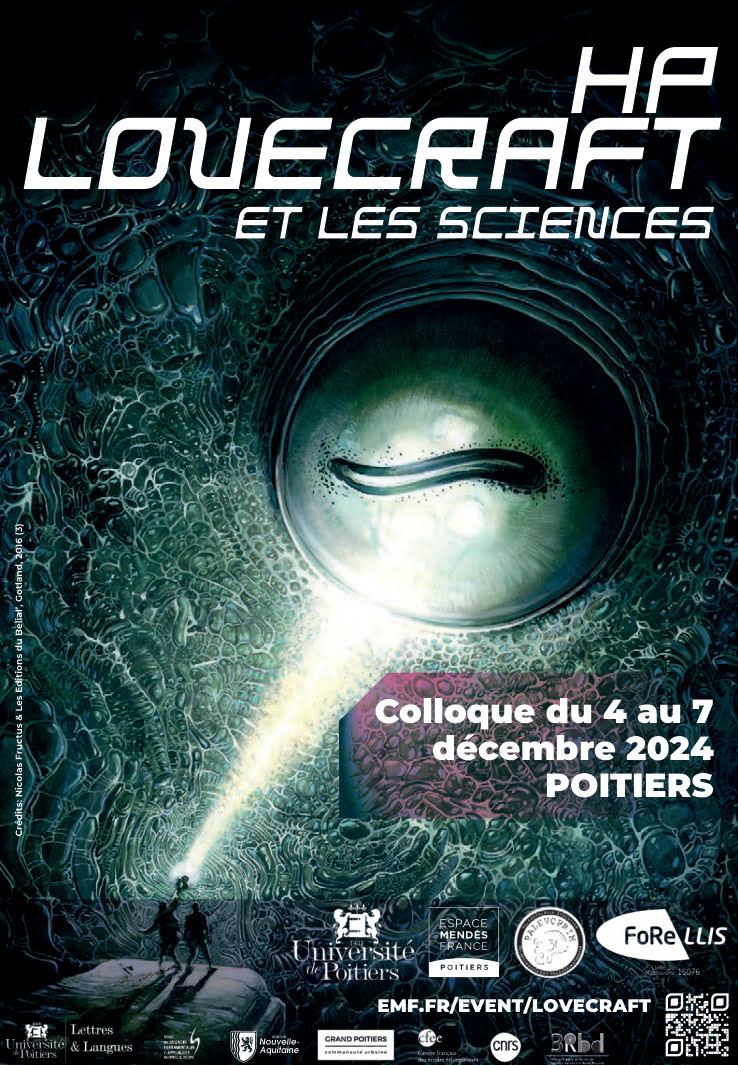
* In France, a two-day conference at the University of Poitiers on ‘Lovecraft and the Sciences’. 5th-6th December 2024, so sadly it’s been and gone. But here’s the programme in PDF, and I guess there may be recordings on YouTube and/or a book in due course.

* Skulls in the Stars reviews The Opener of the Way by Robert Bloch. Being a “quality edition” of 22 early Bloch stories, published by Valincourt. Has plot spoilers.

* New and free at FantasyBabble (spin-off from HorrorBabble), “A Stroll through the Dreamlands: 13 stories by H.P. Lovecraft”. The reading runs 2 hours 47 minutes, and it has all the Dreamlands stories in audio (except the Randolph Carter tales).

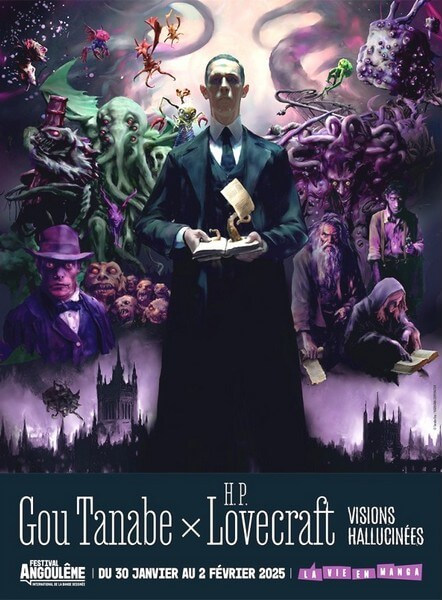
* In early 2025 France’s prestigious comics mega-fest Angouleme will feature a Masterclass with Gou Tanabe, the acclaimed manga adapter of Lovecraft. The event is one of several that will run alongside his large one-man exhibition ‘Gou Tanabe x H.P. Lovecraft’…

The great architect of a mythology which has infused all the world’s popular culture, H.P. Lovecraft has now built a bridge between 20th century New England and 21st century Japan, transcending borders and time, enabling pulp and manga to meet and join hands. This show is an opportunity to verify, once again, how great stories are universal.

* News of another Lovecraft all-night lakeside camp-out near Mexico City. Noctambulante 2025 is a Lovecraft-themed ‘camping and cinema’ event, and this time the organisers also promise that… “Cthulhu will emerge from the depths of Lake Xochimiclo”. Campers are expected to dress in a Lovecraftian manner. Starting on the evening of 29th March 2025, and booking now.

* The well-loved vintage videogame The Thing: Remastered, apparently forthcoming in a new release with… “updated character models, textures, and animations, with the implementation of advanced 3D rendering for updated lighting and atmospheric effects.”

* Also being mooted for a polish, a 40th anniversary Re-Animator edition of the celebrated 1985 comedy-adaptation movie of Lovecraft’s Home Brew shocker “Herbert West: Reanimator”.

* Visualizing Camelot was a 350-item university gallery exhibition surveying the uses of King Arthur in popular culture. The show was developed by subject-expert curators who were able to draw on specialist American and British collections of such material. It’s been and gone but a substantial website remains online.

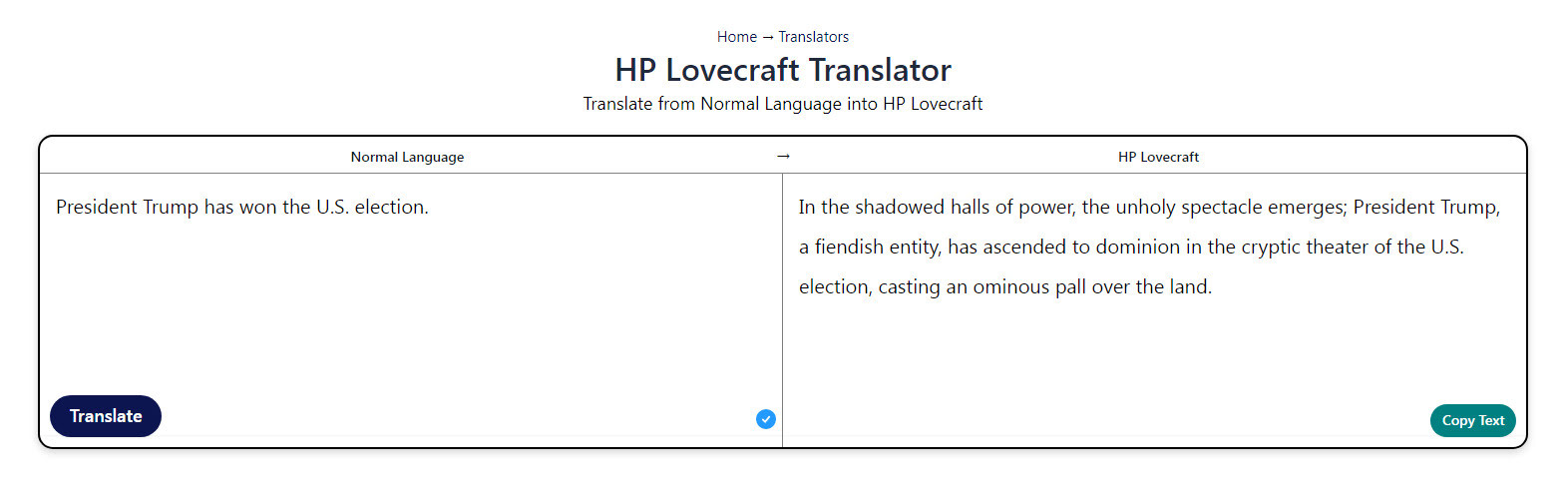
* And finally, the new online H.P. Lovecraft Translator…


— End-quote —

“I was arrested mainly by the great temple of the Scottish Rite Masons, whose striking architecture lifts it out of the commonplace and mundane into the realm of the cosmick and mystical. Gazing upon it, I could well believe all the vague legends connected with the Masonick order; for here surely dwelt arcana whose sources are not of this earth. I saw it first at night, when only the twin cryptick braziers beside the great bronze door lit up the grim guardian sphinxes and the huge windowless facade. Mystery dwelt there — and I departed full of vague thoughts hinging upon the obscurest of dream-memories.” — Lovecraft on his visit to Washington in 1928.

“The hall retains its pristine impressiveness; its lofty rooms forming the present home of Ionick Lodge, the Masonick branch founded by my grandfather, and of which he was the first Grand Master. It did me good to see his picture there, enshrin’d in proper state.” — Lovecraft visits his grandfather’s Masonic Lodge in 1926.


HPLinks #16 – Lovecraft Imagined, imagining Northumberland, manifest destiny, AI shoggoths, and more.

05 Thursday Dec 2024

Posted by asdjfdlkf in Astronomy, HPLinks, Lovecraft as character, Lovecraftian arts, Scholarly works

≈ 1 Comment

Welcome to HPLinks #16.

* S.T. Joshi’s latest blog post brings news of a new Ken Faig Jr. book, The Skull of Roger Williams: Lovecraft Imagined. In Joshi’s words, this offers…

powerful and poignant stories (and even a play or two) featuring Lovecraft as a character, along with some of his close family members; Clark Ashton Smith and R. H. Barlow appear in one of the pieces. If you’re looking for over-the-top horror tales with liberal doses of gruesomeness, you should go elsewhere; but if you’re interested in deeply moving portrayals of Lovecraft and his family as they actually lived their lives from the 1890s to the 1930s, written by one of the most learned and sensitive of Lovecraft’s biographers, this is a volume you will not want to miss.

Sounds good. Available now, as a 440-page paperback or as a budget ebook.

* In Italian in this week’s edition of the newspaper Domani, a long feature-article on “L’inferno artificiale di Lovecraft: come costrui il suo Northumberland senza esserci stato” (‘Lovecraft’s artificial hell: how he built his Northumberland without having been there’). Related, and linked to by the article, is an essay on “Lovecraft Archaeology”.

* Deep Cuts blog remembers Philomena Hart and her tangential connection with Lovecraft. She was the wife of Bertrand Hart, long a favourite newspaper columnist in Providence and one who tangled with Lovecraft in print.

* The work of Alfred North Whitehead, a British philosopher whose 1920s works influenced Lovecraft, is now in the public domain. Thus, new this week, we now have Whitehead’s acclaimed and seminal Science and the Modern World (1925) as a LibriVox audiobook.

* The latest Typebar Magazine has “An Unintended Critique of Manifest Destiny in H.P. Lovecraft’s At The Mountains of Madness”. The author states he worked on it long, and it is now… “available on Patreon for magazine subscribers now, it’ll be available in a month or so for non-subscribers to read online.”

* In a South American open-access journal “La metafora del shoggoth en la inteligencia artificial” (‘The shoggoth metaphor in artificial intelligence’). The PDF has an English abstract.

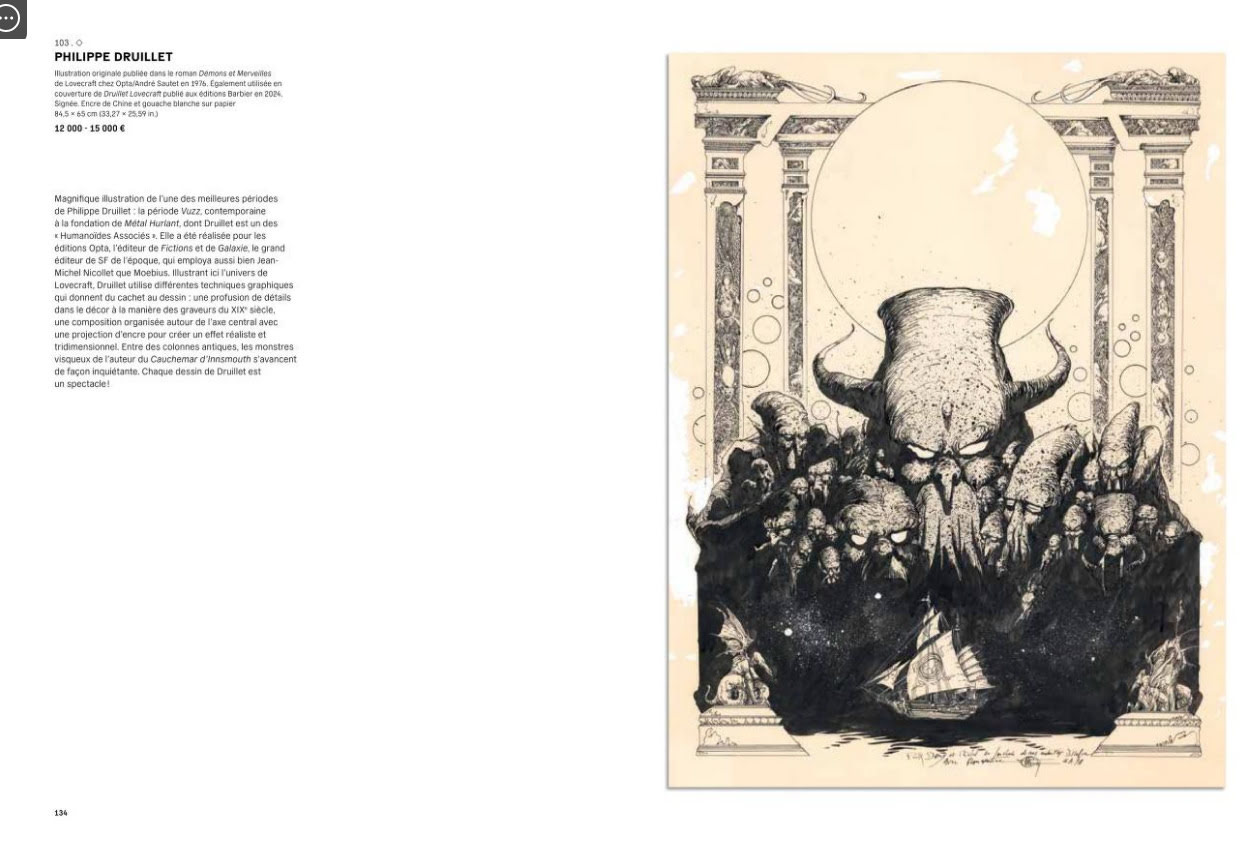
* Up for auction, in France, original Druillet Lovecraft artwork from the 1970s.

* This week, John Coulthart outlines the edition history of his Yuggoth collage.

* I see that the £122 Routledge academic book Critical Approaches to Horror Comic Books (2022) had a chapter on “Tanabe Gou’s Manga Adaptations of H.P. Lovecraft”.

* Wormwoodiana blog has a new post on Arthur Machen and the Sherlock Holmes stories.

* Who knew that Bram Stoker wrote a book of fairy tales, as well as the famous Dracula? Yup.

* A special ‘Haunted Midlands’ issue of the regional history journal Midland History. This being the English Midlands of the UK. Appears to be free to access, at present. Serious articles, not contemporary ‘ghost-hunter’ piffle and confabulation.

* The World Fantasy Convention 2025, set for the south coast of the UK, now has its two themes: ‘Lyrical Fantasy’ and ’50 Years of British Fantasy and Horror’.

* A call-for-papers for Youth and Horror: An International Conference.

* The new £130 Routledge academic book Entering the Multiverse (2024) has a chapter on “The Arkham Horror Multiverse”. With a focus on fan-interaction in the form of fan-guides for the game, which aim to boost the pleasures to be had from the… “endless world-building that comes from ludifying [i.e. ‘making game-like’] Lovecraft”.

* New on Archive.org, a run of Unbound fanzine, which offered a range of fan-written Call of Cthulhu (Chaosium) adventures in the 2010s. Including a set for solo players.

* A new Creative Commons open ebook on Hybrid Monsters in the Aegean Bronze Age. A bit niche, but it may appeal to writers or RPG makers seeking monster ideas from the deep past.

* Mythos writers may also be interested to know that the CQuill offline fiction-writing software is now available for Mac, albeit in an experimental but working version. A few days ago I was able to get a discounted copy of the Pro version for Windows, in the Black Friday sales. Having Pro means I’ll be able to make a Lovecraft ‘Style Assistant’ for it, when I find time sometime in 2025. I guess I may then share the Assistant via my Patreon. The standard version of CQuill is free, and only lightly crippled — it will load (but not create) an Assistant from an author’s works.

* And finally, a reminder that The S.T. Joshi Endowed Research Fellowship in H.P. Lovecraft application deadline is 17th January 2025. The awardee gets to swish around the Brown campus with up to $5k in their back pocket, while researching Lovecraft.


— End-quote —

“… you have no doubt read reports of the discovery of the new trans-Neptunian planet […] a thing which excites me more than any other happening of recent times. […] Asteroidal discovery does not mean much — but a major planet — a vast unknown world — is quite another matter. I have always wished I could live to see such a thing come to light — & here it is! The first real planet to be discovered since 1846, & only the third in the history of the human race! One wonders what it is like, & what dim-litten fungi may sprout coldly on its frozen surface! I think I shall suggest its being named Yuggoth!” — Lovecraft on his reaction to the discovery of the planet Pluto, in a letter to Miss Toldridge of April 1930.

A new mega-observatory in Chile is now coming online, with the largest camera ever built, and it should be able to easily find the ‘Planet X’. Recent research shows this very likely rolls in an unknown orbit far beyond Pluto, and some 80% of the likely locations have now been discounted. The current best estimate is that, when found in 2025 or 2026, the planet will be around 6.66 times the mass of the Earth. An ominous number.


HPLinks #15 – Zann, R Lovecraft, a new Lovecraft philosophy book, Lovecraft and nostalgia, a new REH letter and more…

28 Thursday Nov 2024

Posted by asdjfdlkf in HPLinks, Lovecraftian arts, REH, Scholarly works

≈ Leave a comment

HPLinks #15.

* In the latest Journal of The Fantastic in the Arts (35.1, 2024), “Beyond Worlds: Music, Literature, and the Fantastical in H.P. Lovecraft and E.T.A Hoffmann” ($ paywall). “Zann” is here compared…

with Hoffmann’s [story] “Ritter Gluck: Eine Erinnerung aus dem Jahre 1809” [ with discussion…] especially concerning the influence of German Romantic notions of music […] In Lovecraft’s tale, the unheimlich (‘uncanny’) is invoked through and by the romantic notions of music that the author utilizes to wrestle with language’s limitations in expressing the abstract, thus showcasing the importance of a musical approach to the fantastical.

* “Vascones, Pompelo and Calagurris in the three Versions of ‘The Very Old Folk’, by H.P. Lovecraft” a new book chapter, archived on Academia.org. In Portuguese. Relates to the previous 2019 article on the same topic, freely online in English, by the same author.

* A new issue of the open-access Journal of Gods and Monsters (Winter 2024).

* LovecraftR 1.2 on GitHub. Being Lovecraft’s stories pre-packaged for computational text-analysis using the R coding language. Regrettably the sources of the texts are not given. Thus, it’s uncertain if these are the gold-standard Joshi-corrected texts or not.

* Now free in open-access (was previously $ paywalled), the broad survey article “‘Awed listening’: H.P. Lovecraft in classic and contemporary audio horror” (2022).

* A new £135 academic philosophy book from Routledge, Reading Lovecraft in the Anthropocene: A New Dark Age, due in early spring 2025. If one looks past the book’s alarmist, tendentious and pseudo-scientific title (perhaps foisted on the German author by the publisher) then the book sounds interesting. The core of the blurb states…

the book traces Lovecraft’s gothic and decadent influences, examines materiality and its transcendence in weird fiction, and considers the posthuman and postsecular dimensions of his narratives. Through this, the study highlights Lovecraft’s role in navigating the challenges of a secular, disenchanted world, offering a ‘dark enchantment’ that echoes current philosophical concerns.

* Psychogeographic Review reviews the forthcoming book Ghost of an Idea: Hauntology, Folk Horror and the Spectre of Nostalgia (2025) which begins with Charles Dickens and then apparently… “closely consider[s] the works of other writers such as H.P. Lovecraft and Alan Moore” in relation to nostalgia.

* Futuramen blog brings news that there’s now a hardback for Lovecraft’s Collected Fiction: A Variorum Edition Volume 4 (Revisions and Collaborations). According to the post, the first three volumes were hardback but this fourth book had only been in paperback until now.

* Miskatonic Books still has copies of Arcana Viridia: An Occult Herbarium (2013) which sounds like a very unusual book of interest to some readers of Tentaclii. Apparently the handsomely-presented and illustrated book is the result of some 25 years of active field and desk research. A possible Christmas present?

* Deep Cuts blog looks at “Her Letters to Clark Ashton Smith: Annie E.P. Gamwell”. This being Lovecraft’s aunt.

* The Pulp Superfan surveys the Lovecraft-Eddy tales and memoir books currently in print from Fenham.

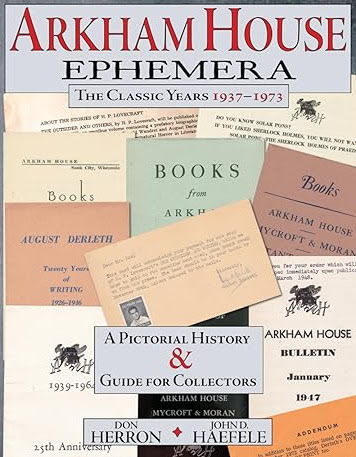
* Wormwoodania blog looks at the new Arkham House Ephemera: The Classic Years 1937-1973: A Pictorial History & Guide for Collectors.

* It seems the HPLHS will visit Australia in 2025, having been picked as International Guests of Honour for Chaosium Con Australia 2025. I assume they will receive travel tickets, a hotel room, and their own personal shoggoth… rather than it being just a virtual visit over the InterWebz.

* The latest issue #49 (November 2024) of The Paperback Fanatic has an article on the “UK Panther editions of Lovecraft” and also a “Guide to Conan Pastiches”. Available now, in paper only.

* A new Robert E. Howard Letter Dated to August 1932 has been discovered. The letter was sent to E. Hoffmann Price. Among other matters, REH discussed a sketch-portrait of Lovecraft.

* A new public-domain one-hour audio reading of “Red Shadows” by Robert E. Howard, at Librivox.

* Another text interview with the creators of the new HPL graphic-novel partial-biography of Lovecraft. In Italian.

* New to me, I find that acclaimed comics artist P. Craig Russell adapted Lovecraft, first published in badly-printed form circa 2003 and then pristine in Murder Mysteries and Other Stories: Gallery Edition (Titan, 2015). Apparently the story was “From Beyond”, though I can’t find any sample pages from the adaptation. The sumptuous 2015 oversized edition is now well out-of-print and is (from the sound of it) highly collectable.

* The new volume Dripping with Fear – Ditko Archives Volume 5 collects Ditko’s mystery-horror comic-book shorts, from 1958 onwards.

* A review of a new videogame at GameSpew. “Blood on the Thames is amateur theatre meets H.P. Lovecraft”, and the game is found by the reviewer to be a “wobbly but oddly appealing adventure”.

* And finally, Spectre Miniatures, the British maker of 1.1″ RPG miniatures, has released a new ‘machine-gun Mythos’ set along with some game rules…

The Mythos range is Spectre’s first release for ‘Supernatural Horror In Miniature’. Inspired by the works of H. P. Lovecraft, Mythos takes Spectre Operations players back to the weird world of Lovecraft’s 1930s America.


— End-quote —

“My favourite toys were very small ones, which would permit of their arrangement in widely extensive scenes. My mode of play was to devote an entire table-top to a scene, which I would proceed to develop as a broad landscape […] Toy trees — of which I had an infinite number — were used with varying effect to form parts of the landscape […] even forests (or the suggested edges of forests). Certain kinds of blocks made walls & hedges, & I also used blocks in constructing large public buildings. […] My people were mainly of the lead-soldier type [sometimes adapted and re-painted …] My mode of play was to construct some scene as fancy — incited by some story or picture — dictated, & then to act out its life for long periods — sometimes a fortnight — making up events of a highly melodramatic cast as I went. These events would sometimes cover only a brief span — a war or plague or merely a spirited pageant of travel & commerce & incident leading nowhere — but would sometimes involve long aeons, with visible changes in the landscape & buildings. Cities would fall & be forgotten, & new cities would spring up. Forests would fall or be cut down, & rivers (I had some fine bridges) would change their beds. […] Horror-plots were frequent […] There was a kind of intoxication in being lord of a visible world (albeit a miniature one) & determining the flow of its events.” — Lovecraft recalling his time circa 1900 as a boy pioneer of the ‘tabletop RPG’, in a letter of November 1933.


HPLinks #14 – Sonia as researcher, The Temple as radio drama, Tanabe in the Dreamlands, a tentacular takeover, and more…

21 Thursday Nov 2024

Posted by asdjfdlkf in HPLinks, Lovecraftian arts, Scholarly works

≈ Leave a comment

HPLinks #14.

* A long new post on Lovecraft’s wife Sonia as a historical researcher. This was her paid role with the Brooklyn Children’s Museum, undertaken in 1933, and which temporarily brought Lovecraft and Sonia together again. This scholarly post draws on as-yet unpublished archives.

I found an eBay picture of the Museum’s staff entrance seen in 1950, at the same Brower Park site that Sonia would have known.

* Librivox have released a new ghost and horror collection of public domain audio. Includes free and re-usable readings of Lovecraft’s “Cool Air” and “Polaris”, and from the Lovecraft Circle Arthur Leeds’s “The Return of the Undead” and Frank Belknap Long’s “Men Who Walk Upon the Air”. The latter appeared in Weird Tales for May 1925, alongside Lovecraft’s “Erich Zann”. Also available on on Archive.org.

* Now available for purchase and download, the Dark Adventure Radio Theatre full-cast audio adaptation of Lovecraft’s “The Temple”.

* Fumito Logica reviews the new Italian graphic novel of Lovecraft’s life and death…

HPL’s anti-humanism was a desperate faith in the absurd, in a silent and indifferent cosmos, while he lived through an era that clung to habit and the superfluous. […] Yet his desperation gave him the ability to transcend his era, while remaining sitting in a cold room in Providence. He used the power of the word to cross the threshold of eternity, entering dimensions that seek to erase every residue of humanity. [The book] is an imaginative and intimate biography, material and evanescent. Taddei insinuates himself into HPL’s flesh, while Lacavalla paints his darkest nightmares without sparing himself.

Also, Italian paper Il Manifesto has an interview with the writer and artist (spoiler alert). Freely available online.

* Heavy Metal magazine’s blog surveys the Lovecraft Art of John Holmes, the British artist who painted the covers for the early 1970s Ballantine paperbacks.

* New on YouTube, Christian Matzke Interview: Creating H.P. Lovecraft’s Necronomicon, and also with some chat about his Alien Absolution fan-film.

* Newly listed on Amazon UK, the forthcoming book Les Chats d’Ulthar (‘The Cats of Ulthar’) by Gou Tanabe, set for release on 23rd January 2025 in French. Three Lovecraft tales of the Dreamlands are adapted by the Japanese graphic-novel master, “The Other Gods”, “Celephais” and “The Cats of Ulthar”.

* Metaladdicts brings news that the band “The Great Old Ones Release New Single ‘In The Mouth Of Madness'”, this being… “a haunting precursor to their forthcoming [Dreamlands themed] album, Kadath”. The album is due at the end of January 2025.

* Now published, Chaosium’s latest edition of Cthulhu by Gaslight Investigators’ Guide: Mysteries and Frights in the Victorian Age. This is the 2024 edition, presumably expanded and aligned with the latest core RPG game. I see the first edition was published way back in 1986, and that by 2012 there had been three editions. The book is possibly also useful for Mythos writers unfamiliar with the details of the British Isles in this period.

* From the HPLHS and new to me, The Providence Pack for Lovecraft’s Providence, including a wall-map sized reprint of the College Hill plat map. Again, potentially useful for writers as well as RPG players.

* Paywalled in the new gothic studies book Graveyard Gothic (2024), the chapter “Weirding the Gothic graveyard”. This discusses… “how Lovecraft uses the graveyard in “The Tomb” (1922), “Herbert West – ​Reanimator” (1922) and others”. At the end the author sees the later “The Call of Cthulhu” (1928) as “reshaping [the graveyard] through the prism of a very modernist artistic and scientific sensibility”.

* A forthcoming 1,100+ page hardcover claiming to be The Complete Fiction, Poetry, and Essays of H.P. Lovecraft. Set for publication in early December 2024 at nearly £50. The publisher is Revive Classics, which shovels public-domain classics into slick hardback covers at high prices… and gets disappointed one or two-star reviews. I’d be willing to bet that this isn’t complete. The legit Collected Essays set from Hippocampus runs to five volumes and some 1,500 pages in small type. The legit collected poetry is around 600 pages in a wide oversized book. There’s no way you could cram all that, plus all the fiction, into just over 1,100 9″ x 6″ pages. Buyer beware.

* New on Archive.org for download, Arthur Machen’s late novel The Green Round (1933).

This was a book read by Lovecraft, early in 1934. He found it meandering but was positive…

Have just read Machen’s new book — The Green Round — his first weird production in 17 years. It is really extremely interesting — with something of that persistent sense of unreal worlds impinging on the real world which many imaginative persons possess. In the casualness & unexplainedness of the phenomena represented, it recalls some of Machen’s queer prefaces to his earlier books”. — Lovecraft to Miss Toldridge, March 1934.

* And finally, science seemed to become more weirdly Lovecraftian this week. More so than usual, these days. An Oxford University expert speculated that the octopus species will in time take over the world, should humans somehow die off or leave for the stars. Plus our fledgling quantum computers can, it seems, be reliably powered by weird imaginary cats. A scenario that springs to mind, then: a post-human quantum computer powered by an octopus named Cthulhu, who is dreaming about imaginary cats (possibly from Ulthar). This octo-cat-powered computer is keeping ‘alive’ the AI-reconstructed personality of one HPL, while located in a crypt deep under an Earth that is being burned into its final cinder by the last stages of an expanding sun. Add a few time-travelling humans who suddenly arrive in the crypt, and must extract HPL from the tentacular embrace of Cthulhu before the planet burns. This may perhaps be a Lovecraftian RPG scenario of use to some readers. Or possibly just another crap episode of Doctor Who.


— End-quote —

In March 1934 Lovecraft gave tongue-in-cheek advice to his friend Morton, on the possibilities of writing a weird mystery tale for Morton’s mineralogist colleagues…

“… you could have a great mineralogical curator from Paterson [Morton’s museum in New Jersey] murdered by some spy of the American Museum – the latter institution being jealous of having its pebble section surpass’d. Later it could be discover’d that the assassin had left his photograph imprinted on some obscurely sensitive stone (if none exists, invent one!) that yields up its secrets only under a blend of inframauve light from a special fur-lined vacuum tube. Then, when the murderer has explain’d this away by saying he left the image on some other visit, in stalks Old King Brady the Petrological Pinkerton with a radio-active kind of feldspar or sparkill or solidified argon which restores the life-vibrations of the murder’d man. Up sits the great curator on his bier, and points his finger at the dastard from 79th street. “He done it!” “He done it!” But since the victim ain’t dead no more, the murderer is let off on probation — tho’ the American Museum is forced to transfer most of its treasures to the enlarged marble palace at Summer Street and Broadway [at Paterson]. […] For gawd’s sake don’t have puppet [pseudo-comic names] like Sir Stoneham Pyrites, Capt. Magnetite de Magistris, Prof. Boulder B. Traprock, etc., etc. cluttering up your pages! [As for the follow-on serial…] You could vary your locale and incidents magnificently; having unknown minerals found in crypts under aeon-old deserted cities in the African jungle, and all that. Then there are hellish stony secrets filtering down from the forgotten elder world — think of the Eye of Tsathoggua, hinted at in the Livre d’Eibon, and of the carved primal monstrosity in lavender pyro-jadeite caught up in a Kanaka fisherman’s net off the coast of Ponape! God! Suppose the world knew why Curator Konbifhashi Taximeto of the Wiggiwaga Museum in Kyoto committed hara-kiri after examining the fluorescent emanations of this unholy blasphemy through the differential spectroheliograph!”

In an earlier post at Tentaclii I discovered good evidence that Morton’s collection at Paterson excelled in collecting and exhibiting fluorescent — i.e. glow-in-the-dark — minerals. Hence Lovecraft’s emphasis here on the technology of special light + minerals. So far as I can tell, Lovecraft invented the word “inframauve”. Nice name for a swishy fanzine.


HPLinks #12 – Arkham ephemera, Eddys expanded, Lovecraft as intellectual ‘extracosmic magma’, Chaosium in the UK, and more…

02 Saturday Nov 2024

Posted by asdjfdlkf in HPLinks, Lovecraftian arts, Scholarly works

≈ 2 Comments

Welcome to HPLinks #12.


“Little Bobby Barlow, for all his scant 16 years, can remember a world & a phase of civilisation — the feverish, thoughtless, reckless age of the 1920’s — which is today as dead as Tyre & Babylon!” — Lovecraft letter to Toldridge, March 1935.


* Now published, Arkham House Ephemera: The Classic Years 1937–1973 (October 2024)…

The story of [the early Lovecraft publisher] Arkham House told in the ephemera is no less than the personal autobiography of the press. Year by year and sometimes month by month, see plans unfold — always to publish more books to keep readers and collectors coming back. In this ‘Pictorial History and Guide for Collectors’ each individually numbered item spotlights a shot of the cover or distinguishing interior feature. In full color. With additional selected information, so that any item can be recognized easily from any other.

* This week John Coulthart blogged on “Richard Taylor’s Lovecraftiana”, Taylor being the artist Derleth tapped for the dust-jackets of various Arkham House books.

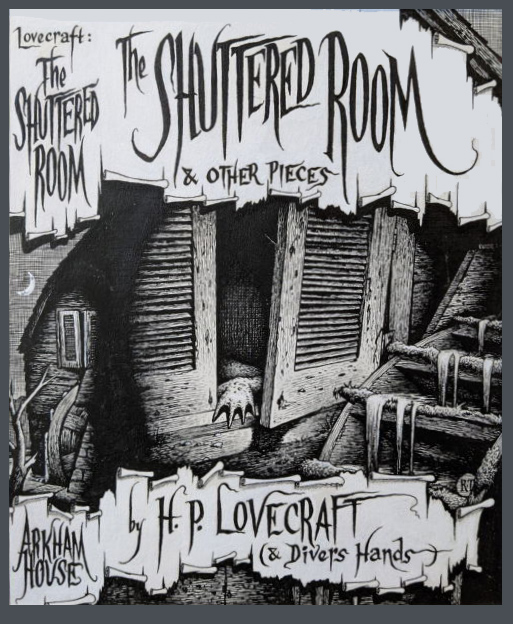
* Talking of covers, I’d never until recently seen the cover of this 1983 Polish translation of Lovecraft. The unknown artist has made a pleasingly loose sans-Cthulhu combination of the broken ground of the risen R’lyeh, the mind-bending portal-door found there, and a cosmic sky-vista.

Unlike many cover artists, it appears he had actually read and considered the story he was illustrating…

… everyone watched the queer recession of the monstrously carven portal. In this phantasy of prismatic distortion it moved anomalously in a diagonal way, so that all the rules of matter and perspective seemed upset. The aperture was black with a darkness almost material. That tenebrousness was indeed a positive quality; for it obscured such parts of the inner walls as ought to have been revealed, and actually burst forth like smoke from its aeon-long imprisonment, visibly darkening the sun as it slunk away…” (“The Call of Cthulhu”).

* New in The European Conservative, the article “Rebuilding R’lyeh: Houellebecq, Lovecraft, and the Meaning of Architecture”. Freely available online.

* A 2023 Brazilian post-graduate thesis, O horror cosmico de H.P. Lovecraft como expressao da barbarie do mundo administrado (‘H.P. Lovecraft’s cosmic horror as an expression of the barbarity of the administered world’). Freely available in PDF here, with an English abstract. The work examines…

relations between the aspects of form and content used by [Lovecraft] and the forms of control and domination of nature marked by technological rationality, barbarism, and fear, characteristic of the living conditions found in the administered [i.e. bureaucratic] society. The main themes [found were] criticism of the occult; of the regression to barbarism in the context of war; the constitution of authoritarianism through patriotism; war neuroses; the disappearance of the intellectual type; the formation of sects and fanaticism; and the notion of imminent threat of the end. [Lovecraft] explores, through fear, the path of regression of society and the submission of its members to disastrous ideas and policies, as well as an attack on narcissism through the exploration of the sublime. In this way his work allows contact with fears that, if brought to consciousness and reflected upon, may reduce their harmful effects on the individual [reader’s psychological] formation process.

* From Spain, the new 2024 multi-author academic book A Traves Del Abysmos: H.P. Lovecraft y el horror ontologico (‘Traversing the Abyss: H.P. Lovecraft and ontological horror’).

This chunky book costs a very reasonable 19 Euros from Amazon Spain. Had this been in English it might have been locked away at £120, by a big academic publisher aiming at a few hundred sales to academic libraries. It’s thus cheap enough to cut off the spine, scan to OCR and then auto-translate, if you needed to see it for your thesis etc. I have the contents pages auto-translated to English (the nice font and typesetting is lost), and here’s a translation from the blurb…

[Lovecraft resists] classification or explanation on a purely theoretical level. [He takes us] beyond the limits of what is human, making his literature a privileged threshold from which the most radical issues of philosophical reflection [can] emerge. The unknown relationships of time, space and matter; contact with extratemporal non-entities; the breakdown of existential certainty; the abyssal descents; the antediluvian languages; scientific revelations incompatible with what is human; the dream materialisations. Lovecraft [becomes] an extracosmic magma that flows though and illuminates the intricate network of the tensions running throughout modernity. Lovecraft’s manifestated ideas have permeated contemporary thought, prompting an important segment of thinkers to reflect on the unthinkable, talk about the unnameable and peer into the radical exteriority that surrounds the human world.

* The National Review magazine on “The Call of Lovecraft” ($ paywall). Possibly just another Halloween clickbait re-hash, of no interest to Lovecraftians? It’s difficult to know without seeing all of the article.

* Helios Press has announced a pre-order for a new expanded edition of The Gentleman from Angell Street. 140 pages in hardcover, compared to 70 pages in the previous paperback. I’m uncertain if it will contain the supposedly extant correspondence between HPL and the Eddys said to date “as early as 1918”, the existence of which was claimed many years ago by one of the Eddy descendants (see Joshi’s I Am Providence, page 465). But which was apparently not even shown to Joshi, and has never since been revealed. The blurb for the new edition does claim it will have new… “correspondence between and related to the Eddys and Lovecraft”. But that sounds to me like it could be letters sent ‘between the Eddys’, plus letters ‘related to Lovecraft’ — such as Clifford Eddy’s 1966 letter about Lovecraft (‘Knew Lovecraft’) which was published in The Providence Journal. That 1966 letter was not in the earlier edition. But all this is just my guess, based on the probability that, if we were to get actual new Lovecraft letters to the Eddys, then a lot more fuss would be being made about it in the blurb. I guess we wait and see. The book is due in 2025.

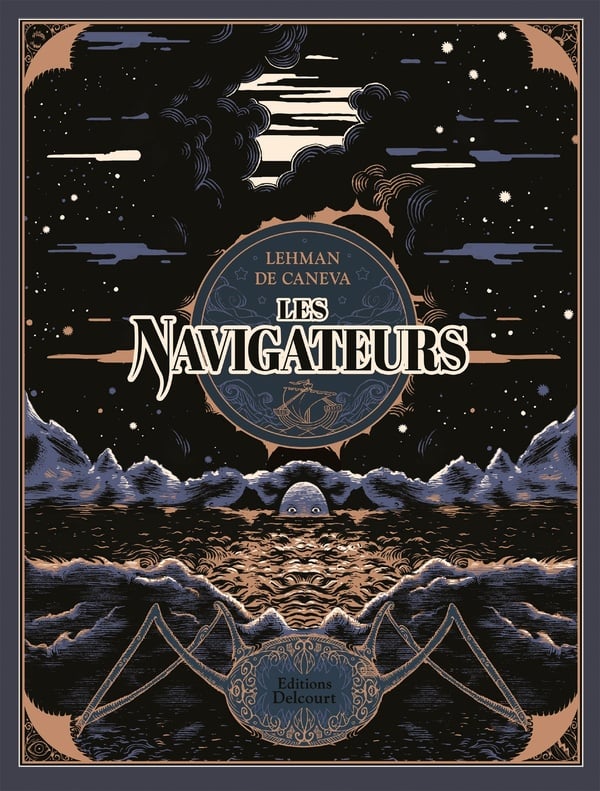
* Les Navigateurs, a new French ‘BD’ graphic novel by Caneva & Lehman. I see some good reviews, and apparently Lehman is a Lovecraftian who has made this book into a ‘Lovecraft in Paris’ tale. At least according to Marianne.net, which describes it as… “Lovecraft meets the waters of the Seine river”.

The preview pages make it look quite gritty-indie. And even less encouraging is the opening multi-page slog through some domestic teen-angst. Yet there is one page which hints the story may become more Lovecraftian later on…

* Veteran European comics publisher Humanoids plans to revive its venerable Metal Hurlant magazine title via a Kickstarter, as an English-language quarterly. The sci-fi comics magazine will aim to be… a “massive 272+page literary experience curated to theme, with all-new content from today’s best and brightest comics creators”, plus rare Moebius reprints. Given the recent big French ‘Lovecraft special’ comics-magazine, the re-launch would likely be Lovecraft-friendly. The crowdfunder is billed as “launching soon”, and currently has over 1,600 followers. Which bodes well.

* Cthulhu is wading over to the British Isles. Chaosium Con is to stage its first Call of Cthulhu RPG convention in the UK. Set for 2025.

* Cthulhu 2025, billed as a “massive” four-day camping and music festival at the start of May, and set to feature… “the best bass music artists in the country”. No nation specified, but I assume the USA and also that there may be a Lovecraft theme of some sort. But there are no further details as yet. Still, it may be of interest to some Lovecraftian creatives seeking an appreciative platform for their large-scale work.

* And finally, my new blog post on the short novel The Greatest Adventure (1929). With a bare-bones plot-summary, and some basic exploration of the unproven and probably-unprovable possibility that Lovecraft read this Antarctica novel before writing “At The Mountains of Madness”.


— End-quote —

“We are not nearly so well equipped for combating a varied environment [i.e. the natural variability of the earth as it moves through the ice-ages etc] as are the articulata; and some climatic revulsion will almost certainly wipe us out some day as the dinosaurs were wiped out — leaving the field free for the rise and dominance of some hardy and persistent insect species — which will in time, no doubt, develop a high specialisation of certain functions of instinct and perception, thus creating a kind of civilisation, albeit one of wholly different perceptions, (when other species view a given object, their ocular [i.e. seen by the eyes] image of it differs — sometimes widely — from ours) emphases, feelings, and goals.” — H.P. Lovecraft in a letter to his friend, the mineralogist and anarchist Morton, 30th October 1929.

HPLinks #11 – Germans and Germany, meteors on film, flaming politics, roaring music, and more

26 Saturday Oct 2024

Posted by asdjfdlkf in HPLinks, Lovecraftian arts, New books

≈ 2 Comments

HPLinks #11.


“… fat boars we shall tear limb from limb with our hands, and gnaw with our sharp teeth. Great Thor, but this is life! We ask no more! We know the cool of deep woods, and the spell of their gloom and the things void of name that lurk or may lurk in them. Bards sing them to us in the dark with great hoarse voices when the fire burns low and we have drunk our mead.” — Lovecraft empathising with the pre-Christian forest-life of the Germanic tribes, in a Christmas letter to Frank Belknap Long in December 1923. Selected Letters Vol. 1, page 275.


* There’s now a firm date for the forthcoming German book Kulturelle Spiegelungen zwischen H.P. Lovecraft und Deutschland (‘Cultural Reflections: H.P. Lovecraft and Germany’). Amazon UK lists it as 11th November 2024 in hardcover from WGB Academic. It appears to focus around the… “German influences [that] are extremely numerous in the writer’s stories, poems, letters and essays, [plus the] German characters appearing in the tales [and] Lovecraft as influenced by the First World War”. One wonders if it also considers the correspondents and friends who had various links to Germany in the inter-war years?

* In The Cape Cod Chronicle, “Chatham Orpheum Theater To Conjure Up ‘Strange Magick'”. Being an interview with the maker of a new film Strange Magick: A Documentary which reportedly strains to bring Lovecraft and the occultist Aleister Crowley together in history. Though billed as a ‘documentary’, from what I’ve read it seems to be best viewed as a ‘what if’ movie? For instance, the interview notes the source book used for Crowley in the USA, Secret Agent 666, which centres on Crowley in 1914 – 1919. We learn there that Crowley wrote columns for such [pro-German] weekly newspapers as The Fatherland [and in one of these] he is said to have “sowed rationalizations for destroying the Lusitania” (i.e. the notorious sinking of a British passenger ship). A paragraph or two after these apparent facts the reader is also given the name of Crowley’s propagandist… “employer, George Sylvester Viereck”. This combination of published sentiment and infamous paymaster would have made Crowley forever anathema to Lovecraft, even if they had indeed met or corresponded somehow. There is talk by the movie’s makers of “Lovecraft, Crowley’s and Little’s acquaintanceship”, but I’m uncertain as yet if it’s claimed that Crowley and Lovecraft actually met in person or perhaps corresponded.

* A documentary film directed by the German director Werner Herzog, which had escaped my notice, Fireball: Visitors from Darker Worlds (2020). The last film I saw from him was the Cave of Forgotten Dreams (2010, documentary on the mysteries of Europe’s famous prehistoric cave-paintings) and I’m glad to find there’s another like it. His new film takes the topic of flaming meteorites, ‘shooting stars’, deep-impact craters and more. A new open-access paper in the journal RuMoRes draws attention to a possible Lovecraft influence on this film. Since it observes that both men… “use similar settings, such as remote places, frozen lands or volcanic areas, and extreme natural phenomena, such as the fall of meteorites”.

* New to me, Lovecraft et la Politique (2023), in French. A translated selection of his writing on politics and political philosophy, plus the new essay ‘Lovecraft: the Marx of nightmares’. Currently available in paper.

* New in the July 2024 edition of the journal Science Fiction Studies ($ paywall) “The Non-Euclidean Gothic: Weird Expeditions into Higher Dimensions and Hyper-Matter with H.P. Lovecraft”… “The first part of the paper reviews the suite of mathematical and scientific discoveries informing Lovecraft’s treatment of higher-dimensional and Non-Euclidean geometries in his mythos.”

* S.T. Joshi’s blog has a long report on a recent trip to Mexico. During which he bravely battled with our future insect-overlords, in the form of eating a dish of fried grasshoppers (“not terribly appealing”). He also endures a long trek to reach an “immense R.H. Barlow Archive”. There he was able to obtain addresses for, and then to see on Google StreetView, two former Barlow residences in Mexico.

* Joshi also reports that his own ‘Lovecraft as character’ tale “In His Own Handwriting” is now a free and authorised HorrorBabble audiobook on YouTube (36 minutes). It turns out to be a fun combo of the ‘shaggy dog’ / ‘what if?’ tale, written for an audience of learned Lovecraftians. Though with an ending I felt might have had more punch.

* S.T. Joshi’s chunky annual journal Penumbra No. 5 (2024) is now available from Hippocampus Press. Includes, among others, “John C. Tibbetts present[ing] an interview and analysis of the weird work of Brian Aldiss”, the 1960s/70s British science-fiction writer.

* An Interview with Eric Williams, who recently collected the best translations published by the old Weird Tales magazine, in a new book now available called Night Fears: Weird Tales in Translation (2023). In the interview he states…

“Weird Tales continues to dominate pop culture to this day. [Creators] all have Weird Tales in their DNA.

True. And Lovecraft in particular, who is often found to be thoroughly intertwined, once you know what you’re looking for. For instance I recently encountered Harlan Ellison’s two-issue stint with The Incredible Hulk (Avengers #88 crossing over into Incredible Hulk #140), which to my surprise opened with a Lovecraft quote and then went on to gleefully and freely mix several Lovecraft story-ideas (from “Cthulhu” the swamp-bachanal scenes, hideous idols connected across cultures, south Pacific co-ordinates, from “Pyramids” the giant paw, and for good measure Harlan also threw in an evolved-insect ‘space god’ who serves the unseen ‘Dark Ones’. There’s even a 1930s pulp ‘Lost Race tale’ princess).
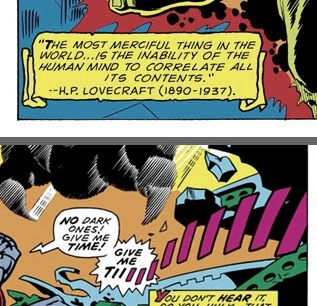
Most of the nods-to-Lovecraft would have sailed over the heads of most readers at that time, unless they knew their Lovecraft as early as 1971. And I suspect that Harlan dashed off this creaky collage of a story in an hour or two. But it’s fun on the page, and is an example of a nod to Lovecraft in the classic Marvel Comics. I must have read it as a boy, though it seemed new to me in 2024.

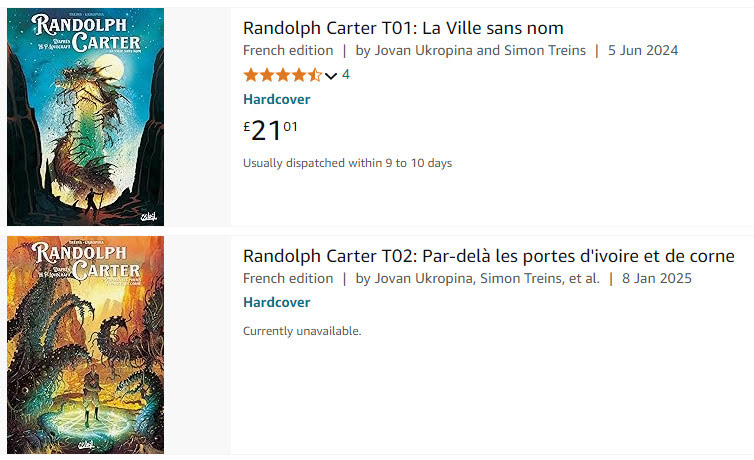
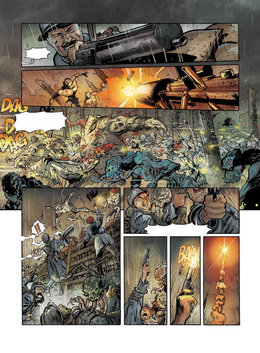
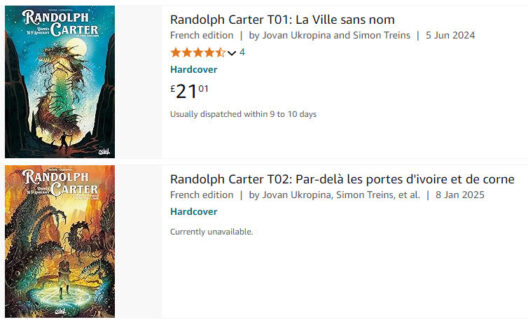
* On DeviantArt from the artist, a sample preview page for the first Randolph Carter graphic novel. This made me look again, and I now see a January 2025 publication date for a Vol. 2.
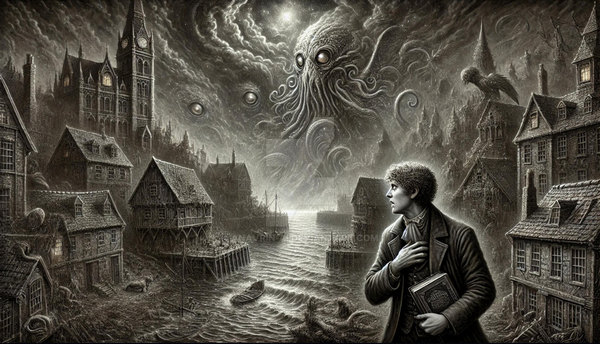
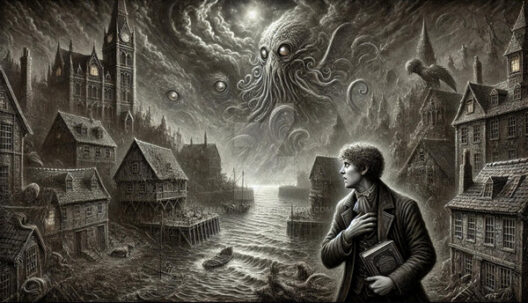
* Also on DeviantArt, an impressive new AI-generated image from Anavrin-ai…
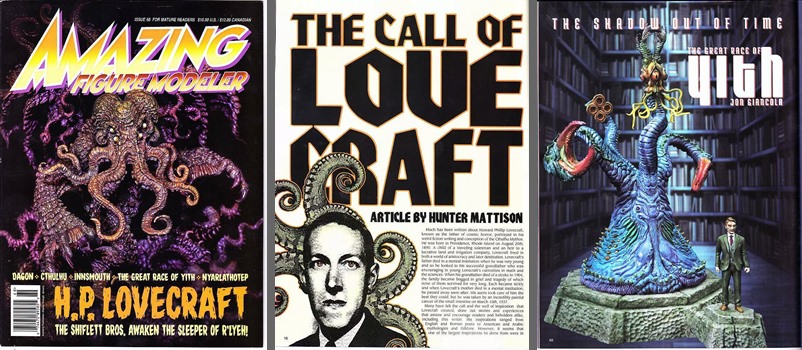
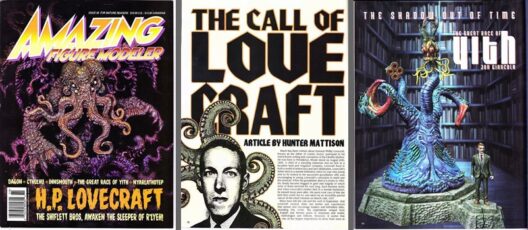
* New to me, Amazing Figure Modeler magazine #68 (2020), which was a Lovecraft special. The issue can still be picked up for a reasonable price on eBay…
* The Great Old Ones to release new studio album Kadath in January 2025. The concept album by the French metal band offers a… “descent into the Dream Cycle [of Lovecraft…] an odyssey through the realms that teeter between fantastical wonder and cosmic dread.” On YouTube there’s already a sample track, “Me, the Dreamer”.

* In the U.S., a university “Music Department hosts an eldritch performance”. This being a 60 minute opera/reading-performance of “The Dunwich Horror”, with an ensemble of classical musicians, no less. Sounds to me like they’re building up to a fully fledged screeching-and-wailing costumed opera performance, at some point in the future.

There were three scenes within the performance, each being about 20 minutes long. Each scene had their own setting and characters, with the performers rotating off of the stage in accordance with their characters in the opera. They also had costumes fitting their unique characters, and acted along with the words being sung.

* The blog Bibliotheque de H.P. Lovecraft looks at The Gamekeeper at Home: Sketches of natural history and rural life (1878), a book owned and presumably read by Lovecraft in the latter part of the 1920s. Though not listed in my old copy of Lovecraft’s Library (update: it’s in the 2024 edition), and one has to wonder if the apparent HPL name inscribed in the book may actually be another example of Loveman’s late penmanship. The book detailed the hunting and shooting life of the English countryside, through the eyes and work of a gamekeeper, in the 1870s. Unmentioned in the blog post, though some readers will recall it, is that Lovecraft had once been a crack shot with a rifle and once had a large collection of guns. Thus the book would have been doubly appealing to the Anglophile Lovecraft.

* Coming soon, a single-volume collection of Two-Gun Bob’s Adventures in Science Fantasy, checked against the original manuscripts and published by the REH Foundation.

* The new Daniel Crouch Rare Books Catalogue XXXIX: “I wisely started with a map…” – a celebration of fictional cartography (2024). £50 in paper, or you can download the sumptiously illustrated PDF for free.

* At Tentaclii this week, I note “Some changes at Amazon”. Where did all those Warehouse Deals on books go? Turns out they’re still there, but hidden and only accessible via a special kind of search. You’re welcome.

* And finally, talking of affordable books for scholars, The Internet Archive is back online. No personal logins at present, so you can’t yet change your password to a new secure one. Or upload new items. Or ‘search inside’ the text of books and magazines. In the meanwhile I’m sure they’d welcome a ‘happy to see you back’ donation.


— End-quote —

“… Cyclopean phantom pinnacles flowering in violet mist, surging vortices of alien life coursing from wonder-hidden springs in Samarcand and Carthage and Babylon and AEgyptus, breathless sunset vistas of weird architecture and unknown landscape glimpsed from bizarrely balustraded plazas and tiers of titan terraces, glittering twilights that thickened into cryptic ceilings of darkness pressing low over lanes and vaults of unearthly phosphorescence…” — H.P. Lovecraft, recalling his early experience of the sunset cityscapes and towers of New York City, in a letter of 18th January 1930.

HPLinks #10 – Teutonic subs, weird decadents, ancient astronauts, cosmic radios, painted zoogs, a new Bram Stoker tale and more

20 Sunday Oct 2024

Posted by asdjfdlkf in HPLinks, Lovecraftian arts, Scholarly works

≈ Leave a comment

HPLinks #10.


     “… it would be damned improbable if there were any real phenomena existing unknown in space and happening to correspond to these error-born myths” [which assume] “such things as gods, immortality, etc.” — Lovecraft on ‘space gods’, to Robert E. Howard on 16th August 1932.


* The Lovecraft Historical Society have another Dark Adventure Radio Theatre recording due, currently available for pre-order. It’s an adaptation of Lovecraft’s wartime submarine-supernatural “The Temple” (1920). Due to surface from the depths on 24th November 2024.

* A new long post from JonBlackWrites on “Yellow Signs: The Decadent Movement and its Influence on Weird Fiction”…

“If one considers the poetry of two of the most celebrated practitioners from each movement, Charles Baudelaire and H.P. Lovecraft, there are lines of their poetry which, ripped out of context, would be almost impossible to identify as the work of one creator or the other.”

* Jordan M. Poss has “Further notes on aliens and the gothic and makes a short but convincing case that UFO lore and the literary gothic have a lot of strands in common. One can see at a glance how much of Lovecraft’s mythos corresponds in much the same way. I don’t recall of any book or article showing a heavy overlap between the post-1950s UFOs-are-aliens crowd and Lovecraft, but perhaps it’s an area worthy of a little historical study. I guess the ‘ancient astronauts’ angle would come closest to overlap (ably dealt with in the book: The Cult of Alien Gods: H.P. Lovecraft And Extraterrestrial Pop Culture, 2005). And, ah yes… there was also that definite early influence of Lovecraft on Terence McKenna, who later became a big name among the mystical-trippy UFO crowd.

* Talking of “ancient astronauts”, Deep Cuts this week takes a deep-dive…

“into the history of one of the most contentious affairs in pulp science fiction in the 1940s, the Shaver Mystery, and its interactions with H. P. Lovecraft’s Mythos”.

* The Papers of Sonia H. Davis has been blogging extensively over the summer, and now on into the autumn with a long new post on Lovecraft’s daughter by marriage. Especially note the long research-heavy posts “Dear Mrs. Greene” Part I and Part II, on Galpin’s letters to Sonia.

* A 2023 Philology degree dissertation “Images of the Living Dead in Lovecraft’s Oeuvre in the Light of the Aesthetic of Ugliness”. Just a firm abstract, in English. One wonders if the author was able to also draw on Lovecraft’s various remarks about his own ugliness and sense of facial disfigurement. But there’s no PDF available.

* Corbeyran’s Classic Fantastic book of comics adaptations of fantasy classics, now 89% funded on French crowdfunding platform Ulule.

* The TransAtlantic Fan Fund (TAFF) now has the Work For Hire book for free download, being a book of essays by Dave Langford… “written for sf, fantasy and horror reference works published long ago from 1996 to 2007. These do not include the Encyclopedia of Fantasy and Encyclopedia of Science Fiction, both freely available online.” Authors discussed include Rudyard Kipling, Brian Stableford and Colin Wilson, among many others. The Fan Fund helps send British science fiction fans to conventions in the USA, and will welcome a donation if you enjoy the book.

* Last week John Coulthart surveyed the covers for “Lovecraft at Ballantine” in the mid 1970s. The covers are shown and there’s an eyebrow-raising amount of dragons and similar.

It then occurred to me that in 1976 dragons were ‘hot’ (remember Anne McCaffrey and all that best-selling dragon-riders stuff?). Perhaps that’s why a cynical publisher wanted to suggest that Lovecraft wrote about dragons and dragon-like sea-serpents? But if so, Ballantine also made some unfortunate choices in the cheap-looking artwork and questionable graphic-design for the framing. Compare these editions with the vastly better work on the Panther paperback covers, appearing around the same time here in the UK.

* Via Chaosium, watch the panels from this year’s Miskatonic Repository Con, online. Including one on writing Mythos scenarios, and another on how to intertwingle real-world history into your Mythos setting.

* Reviews from R’lyeh has a long new review of the 1920s Gumshoe-based game The Terror Beneath: An Investigative Roleplaying Game of Weird Folk Horror…

There are elements of folk horror here, but also eldritch horror, such that Machen’s work is seen as a precursor to and influence upon the works of H.P. Lovecraft. The latter is important in The Terror Beneath in several ways. [The setting is not rural Wales, but rather among the] communities of London’s docks and veterans of the Great War [i.e. the First World War]”.

Nice to see a British working-class 1920s setting. The game is currently pre-ordering and is due for publication on 24th October 2024.

* In the Portland Press Herald local newspaper (accessible from the UK, no ‘EU cookies’ nonsense), a new exhibition review titled “Discover a quirky Vermont college that you’ll wish had really existed”. The show offered relics from “St. Amelia’s College of Speculative Timbre”, where among other things…

“Professor Samuel Drexler built odd musical contraptions taken from literary works, such as ‘the Detestable Electrical Machine’ H.P. Lovecraft wrote about”

The “electrical machine” (un-capitalised) is found in Lovecraft’s tale “From Beyond” (1920).

* At DeviantArt, a set of eight finely painted section-illustrations for The Dream-Quest of Unknown Kadath. Also, by the same artist, Zoogs.

* Also at DeviantArt, a new Halloween photo-set, as-if from 1970s experiments in Providence which sought to enter the Dreamlands of HPL via ‘cosmic radios’.

* And finally, the National Library of Ireland reports “Hidden Bram Stoker Story Unearthed in Irish Archives”. An amateur researcher has found the lost “Gibbet Hill”…

“in an 1890 Christmas supplement of the Daily Express Dublin Edition. The story was unknown even to Stoker biographers and literary scholars for over 130 years.”

The tale’s setting, Gibbet Hill. A gibbet being where criminals were hanged and then left for display.

Which just shows that there may even still be an unknown Lovecraft item lurking somewhere, perhaps in some amateur journal or old newspaper.


— End-quote —

“Around the All-Hallows period I unearthed a highly picturesque district on the city’s very rim — Fruit Hill, from one point of which I caught a view of almost incredible loveliness which included a twilight-clad descent of walled meadows (with a wood and glimpses of a sunset-litten river at the bottom), dim violet hills against an orange-gold west, a steepled village in a northward valley, and over the rocky eastward ridge a great round Hunter’s Moon preparing to flood the scene with spectral light.” — H.P. Lovecraft, to Richard Ely Morse, 14th November 1933.

The Cosmic ‘Radio’

15 Tuesday Oct 2024

Posted by asdjfdlkf in AI, Lovecraftian arts

≈ Leave a comment

[The narrator is an intern in a Catskill Mountains insane asylum]. I placed… “upon his head and mine the two ends of my cosmic ‘radio’; hoping against hope for a first and last message from the dream-world in the brief time remaining. In the cell with us was one nurse…” — “Beyond The Wall of Sleep” (1919).

Stable Diffusion 1.5.

← Older posts
Newer posts →


Please become my patron at www.patreon.com/davehaden to help this blog survive and thrive.

Or donate via PayPal — any amount is welcome! Donations total at Easter 2025, since 2015: $390.

Archives

  • February 2026
  • January 2026
  • December 2025
  • November 2025
  • October 2025
  • September 2025
  • August 2025
  • July 2025
  • June 2025
  • May 2025
  • April 2025
  • March 2025
  • February 2025
  • January 2025
  • December 2024
  • November 2024
  • October 2024
  • September 2024
  • August 2024
  • July 2024
  • June 2024
  • May 2024
  • April 2024
  • March 2024
  • February 2024
  • January 2024
  • December 2023
  • November 2023
  • October 2023
  • September 2023
  • August 2023
  • July 2023
  • June 2023
  • May 2023
  • April 2023
  • March 2023
  • February 2023
  • January 2023
  • December 2022
  • November 2022
  • October 2022
  • September 2022
  • August 2022
  • July 2022
  • June 2022
  • May 2022
  • April 2022
  • March 2022
  • February 2022
  • January 2022
  • December 2021
  • November 2021
  • October 2021
  • September 2021
  • August 2021
  • July 2021
  • June 2021
  • May 2021
  • April 2021
  • March 2021
  • February 2021
  • January 2021
  • December 2020
  • November 2020
  • October 2020
  • September 2020
  • August 2020
  • July 2020
  • June 2020
  • May 2020
  • April 2020
  • March 2020
  • February 2020
  • January 2020
  • December 2019
  • November 2019
  • October 2019
  • September 2019
  • August 2019
  • July 2019
  • June 2019
  • May 2019
  • April 2019
  • March 2019
  • February 2019
  • January 2019
  • December 2018
  • November 2018
  • October 2018
  • September 2018
  • August 2018
  • August 2015
  • July 2015
  • April 2015
  • March 2015
  • February 2015
  • January 2015
  • December 2014
  • November 2014
  • October 2014
  • September 2014
  • August 2014
  • July 2014
  • June 2014
  • May 2014
  • March 2014
  • February 2014
  • January 2014
  • December 2013
  • November 2013
  • October 2013
  • September 2013
  • August 2013
  • July 2013
  • June 2013
  • May 2013
  • April 2013
  • March 2013
  • February 2013
  • January 2013
  • December 2012
  • November 2012
  • October 2012
  • September 2012
  • August 2012
  • July 2012
  • June 2012
  • May 2012
  • April 2012
  • March 2012
  • February 2012
  • January 2012
  • December 2011
  • November 2011
  • October 2011
  • September 2011
  • August 2011
  • July 2011
  • June 2011
  • May 2011
  • April 2011
  • March 2011
  • February 2011
  • January 2011
  • December 2010
  • November 2010
  • October 2010
  • September 2010
  • August 2010
  • July 2010

Categories

  • 3D (14)
  • AI (70)
  • Astronomy (70)
  • Censorship (14)
  • de Camp (7)
  • Doyle (7)
  • Films & trailers (101)
  • Fonts (9)
  • Guest posts (2)
  • Historical context (1,095)
  • Housekeeping (91)
  • HPLinks (74)
  • Kipling (11)
  • Kittee Tuesday (92)
  • Lovecraft as character (58)
  • Lovecraftian arts (1,626)
  • Lovecraftian places (19)
  • Maps (70)
  • NecronomiCon 2013 (40)
  • NecronomiCon 2015 (22)
  • New books (966)
  • New discoveries (165)
  • Night in Providence (17)
  • Odd scratchings (984)
  • Picture postals (276)
  • Podcasts etc. (431)
  • REH (184)
  • Scholarly works (1,469)
  • Summer School (31)
  • Unnamable (87)

Get this blog in your newsreader:
 
RSS Feed — Posts
RSS Feed — Comments

H.P. Lovecraft's Poster Collection - 17 retro travel posters for $18. Print ready, and available to buy — the proceeds help to support the work of Tentaclii.

Proudly powered by WordPress Theme: Chateau by Ignacio Ricci.