Where’s my Shoggoth?
10 Saturday Sep 2011
Posted in Lovecraftian arts, New books
10 Saturday Sep 2011
Posted in Lovecraftian arts, New books
04 Sunday Sep 2011
Posted in Lovecraftian arts
The Worry of Newport is a new Lovecraftian Crysis mod. Ok, let’s translate that into English for those who don’t play videogames. CryEngine 3 is a wonderful cutting-edge game engine, the thing that puts the visuals and audio and game mechanics on the screen. The Crysis games are some of the biggest games out there, although not to my taste. Now there’s a new free mod (i.e.: a free fan-made modification or ‘makeover’) for the game. You buy the game, you apply the mod, you get a new game. All part of the crazy remix culture, m’lud.
The naff choice of fonts for the trailer, and the title (“The Worry…”?) are both initially very discouraging. But the game is getting taken seriously by the genuine and respected reviewers, such as Rock, Paper, Shotgun which writes…
“Although it’s small and imperfectly formed, The Worry of Newport is as authentic a Lovecraft experience as I’ve ever played. That’s not to say it’s the best Lovecraft-inspired game I’ve ever had my hands on, it’s just the most true to the man himself. […] it’s slow, wordy and takes itself very seriously indeed. However, it’s also atmospheric, creepy and mysterious.”
Here’s the creator’s description of the mod/game…
“The Worry of Newport is a two part horror/mystery mod for Crysis built around immersion and story telling, rather than combat or action. Both parts span a story arc that concerns a nameless protagonist awakening in the ocean outside of the island of Newport, a fictional [island] colony in the Atlantic. Upon exploring the port nearby and uncovering a little bit of the backstory, it is on his (and your, the players) shoulders to pursue the truths behind the dark secrets on the island.”
[youtube http://www.youtube.com/watch?v=GgKDb-jYsSg&w=640&h=390]
02 Friday Sep 2011
Posted in Lovecraftian arts
The Philadelphia Cartoonist Society have a Lovecraft art exhibition coming up, Dead and Dreaming at the Paradigm gallery (warning: really nasty Flash-only site that takes three minutes to load, and then the navigation buttons don’t work). The show opens in Philadelphia, USA, 30th September 2011.
30 Tuesday Aug 2011
Posted in Lovecraftian arts
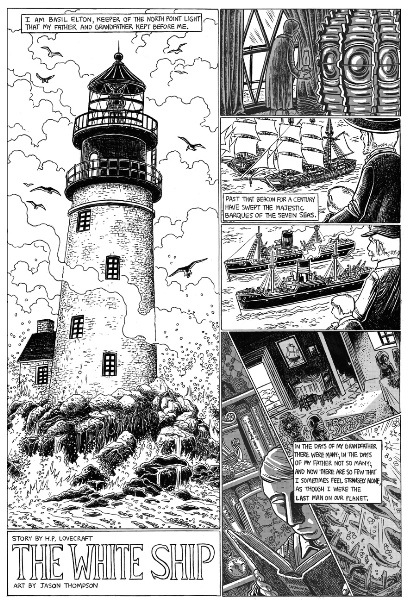
Free online scans of faithful comics adapations of Lovecraft’s “The White Ship” and “The Strange High House in the Mist“, both by the Eisner Award-nominated Jason Thompson. He’s also currently posted his “Celephais” adaptation on the same blog, although that’s not yet complete.


23 Tuesday Aug 2011
Posted in Lovecraftian arts
Myke Amend added to the ‘Lovecraft on the Web’ Directory…
20 Saturday Aug 2011
Posted in Lovecraftian arts
The UK Intelligent Life magazine’s blog has a new short article on theatre adaptations of Lovecraft.
19 Friday Aug 2011
Posted in AI, Lovecraftian arts, Odd scratchings
H.P. Lovecraft gets turned on : a short speculation.
On the 20th day of August in the year 2040 Mr. H.P. Lovecraft finally got turned on. It was the result of 15 years of effort by a team of hundreds of scientists, scholars, writers and artists. His 150th birthday present was to be brought back to life, the first and the most important personage who would ever be created by the trillion-dollar U.S. Artificial Sentience Program (ASP). He would be able to draw on, and semantically combine and recombine, words/phrases/themes from a huge bank of his own authentic writing. In doing this, aided by the latest technology, he would seem almost as real in conversation as any other human being.
There had been much controversy in choosing Lovecraft to become the world’s first fully-fledged autonomous artificial personality. Yet he was by far the best choice. Lovecraft’s life was one of the most fully self-documented of the 20th century, and he had written about himself and his opinions with great intelligence and insight. Hundreds of people who knew him had assessed his personality with intelligence and artistic insight shortly after his death. He had used a careful and consistent style, and scholars had combed his published corpus for errors for over a century — this was critically important for the semantics technologies used. He was one of the 20th century’s most distinctive and unique personalities, and in 2040 he was still an immensely popular literary figure. And, had he not written in a most potent fashion about ‘mind transfers’, and about the ways in which dead books can be made to talk to the living? Was he not a firm atheist, so no religion would be ‘offended’ by his resurrection into the new immortality? Had not a core part of his own unique philosophy been a sort of antiquarian neo-‘ancestor worship’? Even the racism was a selling point, since people would now be able to argue with him about it. You see, in his new incarnation he would be able to learn as well as to talk.
The passing of 20th Century Copyright Liberation Act of 2033 had, of course, greatly aided the cutting-edge project. Everything he had ever written was carefully transferred and sifted into a new and highly advanced neural AI system (hem hem… it is impolite to call these proto-beings ‘computers’ in 2040), together with a highly-advanced semantic and factual structure that was painstakingly extracted from all the scholarly work and then refined and tested for nearly a decade. All this runs under a billion-dollar personality emulation module that arises from the popular wave of commercial ‘virtual immortality’ packages, consumer technology which had rapidly pushed forward personality-emulation in the 2020s. These services began simply as a means for keeping Web blogs as a ‘living archive’ after death, but they soon became pseudo-conversational interfaces with the dead. These rapid advances enabled the generative arts to move far beyond simply juggling with a chance fall of symbols. Then the ASP project had begun, deliberately scaled and promoted as a project with the same scope and importance to the 21st century as the moon landings had been to the 20th. Allied to Lovecraft’s highly advanced AI and software were — for the sake of the publicity — the wonders of 3D “in-air skin” holographic projection from a robotic synthoid base, and advanced on-the-fly speech synthesis. A bit of a problem, that last one — since there were no recordings of Lovecraft’s voice. In the end the ASP team just plumped for a blend of classic old ‘New England / old British’ accents with a rather formal tone and no modern slurring or clipping of words.
The great day came and President Schwarzenegger Jrn. pressed the switch. Trillions of dollars had been spent, and the hundreds who had worked on the ASP held their breath — the project was now fully autonomous and before a live audience. The hologram slowly powered up and coalesced around its rubbery robotic shell before the assembled world. The new H.P. Lovecraft II’s optic sensors detected a large crowd in front of him. His face twitched and his first public words were a rather frantic… “I am Mr. H.P. Lovecraft, and I am on this planet. I… am on this planet!” But then he took a breath and calmed and looked down at his smart formal suit with a certain amused approval, checked to see if his shoes were shiny and his nails were clean, and looked up again to speak perfectly rationally to his new public… “Ah! … now this is interesting… life after death! I really had not expected that. So… I suppose I should say a few memorable words, on such a momentous occasion. Er… Cats! They really are the most personable of creatures! …” He then launched into a long disquisition upon the wonderful ability of the house cat to convey a distinctive personality without the benefit of speech. President Schwarzenegger Jrn. suppressed a smirk when he recognised the knowing irony of Lovecraft II’s choice of topic, while many of the ASP staff blushed at the boldness of Lovecraft II.

18 Thursday Aug 2011
Posted in Historical context, Lovecraftian arts
Tavik Frantisek Simon (1877-1942)
Brooklyn Bridge, New York (1927)
“I had seen it in the sunset from a bridge, majestic above its waters, its incredible peaks and pyramids rising flowerlike and delicate from pools of violet mist to play with the flaming clouds and the first stars of evening. Then it had lighted up window by window above the shimmering tides where lanterns nodded and glided and deep horns bayed weird harmonies, and had itself become a starry firmament of dream, redolent of faery music, and one with the marvels of Carcassonne and Samarcand and El Dorado and all glorious and half-fabulous cities.” — “He” (1925) by H.P. Lovecraft, based on a longer description given in a letter, of sitting with Loveman watching the sunset after a long day of walking in May 1922.
Under the Brooklyn Bridge, New York (1927)
“… the lapping of oily waves at its grimy piers and the monstrous organ litanies of the harbour whistles.” — “The Horror at Red Hook” (1925)
New York Public Library (1927)
The library now has a notable archive of letters by Lovecraft.
“Lovecraft began reading Providence in Colonial Times at the very end of July 1925. Since he could not check the book out of the New York Public Library [he] had to read it in the genealogical reading room during library hours” — S.T. Joshi, H.P. Lovecraft: a life (1996).
“the horror tales of deep and dark chasms have their realistic counterpart in descriptions of the cavernous streets of Manhattan.” Unknown article including some commentary on Lovecraft in Landscape: Volumes 15-16 (1965).
Seventh Avenue at Night, New York (1929)
“Loveman, Howard and FBL dropping in at a cafeteria on Seventh Avenue for coffee and doughnuts, a rather stocky figure arising from a table near the door. “Howard, how are you? Sam didn’t tell me you were in New York!” — Marginalia, 1944.
16 Tuesday Aug 2011
Posted in Lovecraftian arts
New theatre production of “The Dunwich Horror”, set to be staged this Autumn in London England…
“This production has been in development for over a year, from a script completed after extensive work-shopping. The premise was to keep extant as much of the text from the original story as possible, while opening up the piece to an engaging theatrical experience. The production will take place as part of the London Horror Festival at the Courtyard Theatre [Hoxton, London UK]”
No dates or box office yet, but the Festival dates are 25th Oct – 27th Nov 2011.
13 Saturday Aug 2011
Posted in Lovecraftian arts
Ross. E. Lockhart, over at Night Shade blog, muses on Cthulhupunk, in which a short-lived attempt was seemingly made to fuse SF cyberpunk with Lovecraftian tabletop RPG games in the 1990s.
I can see the many points of connection with Lovecraft’s original fiction: isolated alienated semi-powerless not-really-heroes with a mystery to solve; underground routes in the cultural landscape that lead to forbidden knowledge when hacked; blurring at the boundary of the real/unreal; a ‘reality’ that is outside the code of language; alternate/multiple planes of existence; flying around through weird multi-coloured glowing geometries; a degraded contemporary society stratified by class and race; mind transfer and personality augmentation; unknowable artificial intelligences pulling the strings behind the scenes and projecting their avatars into the real world. Throw in some bio-engineering and gene-splicing ‘gone wrong’ for sea-dwelling humans… could be awesome. Lots of literary potential for crossovers and mash-ups there, I’d say.
Perhaps the failure was more of a market failure on the side of the RPG game marketeers in their rather constricted “durh, Lovcraft iz black magik?” market, than a failure of the imagination on the part of writers? Correct me if I’m wrong (I’ve been away from literary SF for a while) but literary writers have never really had a go at such a melding?
11 Thursday Aug 2011
Posted in Lovecraftian arts
11 Thursday Aug 2011
Posted in Lovecraftian arts, New books
I’ve found a interesting-looking 64-page comic novelette featuring Lovecraft as a character. Necronauts (2007, Rebellion) is by Gordon Rennie and Frazer Irving…
“In 1926, while practising a new trick, Houdini has a near-death experience, awakening the mysterious Sleepers. Meanwhile, Lovecraft is visited by a talking raven, and a seance that Sir Arthur Conan Doyle is attending is attacked by a strange force that possesses the medium.”
Sounds groovy, although the used print edition has become rather pricey in just a few years. The art looks fabulous, like Berni Wrightson on speed…