New on Archive.org to borrow, Horrors and unpleasantries : a bibliographical history & collectors’ price guide to Arkham House (1982). Probably superseded now, as a price-guide, but other aspects of it may interest some.


24 Saturday Sep 2022
Posted in Historical context, Lovecraftian arts, Scholarly works
New on Archive.org to borrow, Horrors and unpleasantries : a bibliographical history & collectors’ price guide to Arkham House (1982). Probably superseded now, as a price-guide, but other aspects of it may interest some.
22 Thursday Sep 2022
Posted in Historical context, New books, Scholarly works
An open-access review of Physics and Psychics: The Occult and the Sciences in Modern Britain. “Modern” here meaning early modernity, from the 1870s through to the 1930s…
On the whole we cannot see the turn to psychical research as a momentary lapse of reason on the part of late Victorian physicists. [And] we should not be embarrassed or surprised by the interest that leading physicists had in the occult.
18 Sunday Sep 2022
Posted in de Camp, Historical context, Scholarly works
Brian Kunde has a useful look at the science writing of the Lovecraft biographer L. Sprague de Camp, as part of a review of his The Heroic Age of American Invention. Others include…
The Story of Science in America.
The Great Monkey Trial (the trial that Lovecraft sometimes refers to).
Darwin and His Great Discovery.
Great Cities of the Ancient World.
The Evolution of Naval Weapons (for the U.S. government, as a course textbook).
The Ape-Man Within.
He was working alongside Sagan and Asimov, in the popular science / debunking superstition field.
Earlier, in Astounding (July 1938), his non-fiction “Language for Time Travelers” surveyed the difficulties a time traveller would encounter with pronunciation, semantics and vowel shifts. Put together with his “non-fiction radio scripts for Voice of America”, if extant, could there be a public domain audiobook there for someone to tackle?
15 Thursday Sep 2022
Posted in Historical context, Scholarly works
Changes at The Fossils, as Lovecraft researcher and scholar David Goudsward becomes a trustee with this long-running group dedicated to the history of amateur journalism. Details in the latest free edition of The Fossil #392 publication (July 2022).
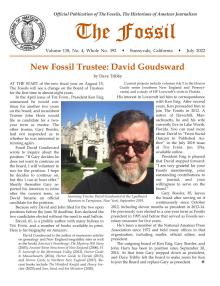
Note that tax-deductible donations and bequests are welcome to the fund that supports the annual care and “maintenance of the largest collection of amateur journals and related materials”, this being held at University of Wisconsin–Madison. See the back cover of the issue for details.
No Lovecraft article this issue, but if you’re interested in the conjunction of Lovecraft / his circle and amateur journalism, I’m sure the Fossils would be interested to hear from you.
12 Monday Sep 2022
Posted in Historical context, New books, Scholarly works
Possibly of interest to those looking into the historical context for Lovecraft’s “Nyarlathotep” (1920), a new McFarland book Radio Psychics: Mind Reading and Fortune Telling in American Broadcasting, 1920–1940. Apparently not well written, according to one review. But it seems snappy enough in the Google Books excerpts I can obtain, and looks well researched.
April 1919 was when “the restrictions were lifted” on U.S. commercial radio, and it then seems to have been something of a free-for-all? The book also notes early phonograph records in the hypnosis line…
Fitzgibbons had been the first to think of making a “hypnotic record” one could play on one’s phonograph, in order to induce hypnosis (“‘Hypnotic Record’ Brings Out One’s Latent Genius”, Talking Machine World 15.6 (15th June 1919)

08 Thursday Sep 2022
Posted in Historical context, Kipling, Podcasts etc., Scholarly works
If you want a taste of what Weird Tales readers found so alluring about ‘star’ author Edmond Hamilton, his “The Metal Giants” (Weird Tales, December 1926) is now a new one-hour reading on Librivox.
Lovecraft called the crowd-pleasing formula writer “indefatigable & repetitious” and he assured a correspondent that, if he were to enter the field of ‘interplanetary fiction’… “you may depend upon it that I shall not choose Edmond Hamilton [as a model]”. That said, in 1926 Lovecraft did admire his “The Monster-God of Mamurth” tale, and I recall that they met at some point and got on well. He was also surprised to find he liked the Hamilton tale “Child of the Winds” in the May 1936 Weird Tales (“Hamilton(!!)” he exclaimed in a letter).
While searching for the name, I found more evidence for the influence of Kipling’s seminal “With The Night Mail” on science-fiction…
“… an article in the February 1922 Science and Invention, ‘10,000 Years Hence’. Howard Brown provided a stunning illustration of floating health cities (like huge health farms) kept aloft in the upper atmosphere by power rays drawing their energy from the sun. Gernsback described how these cities could be directed to move around the Earth [keeping pace with the sun], a concept one might believe inspired two later noted works of science fiction, Edmond Hamilton’s “Cities in the Air” (1929) and James Blish’s Earthman, Come Home (1955), were it not that neither author knew of the article.”
The above is from the pulp/early SF survey book The Time Machines, Liverpool University Press, which does not mention Kipling even once.
Ah, but these authors would have known of Kipling, the obvious source for such ideas. The direct inspiration being drawn from “With The Night Mail” will be obvious to anyone who has read it. Kipling’s cloud-breakers + permanently aloft sun-powered airships = “Cities in the Air”. Kipling’s giant and ascending ‘consumptive’ hospital airships = hospital cities in the upper atmosphere.
Since the article and Hamilton’s “Cities in the Air” (much enjoyed by pulp readers of the time, it seems) are now public domain, they might even be overhauled and retro-fitted to fit with Kipling’s “With the Night Mail” / Aerial Board of Control universe. In fact, much else that was published in the 11 issues of Gernsback’s short-lived Air-Wonder Stories seems on the face of it to be fair game for such a thing.
02 Friday Sep 2022
Posted in Historical context, Odd scratchings, Scholarly works
Or, at least, he might not have been wrong when he held to the idea…
That the human race started on some plateau in central Asia is almost certain” (Selected Letters III, p. 412)
Lovecraft was not alone in this. I note that in the 1920s Roy Chapman Andrews (the model for Indiana Jones) took an expedition to Mongolia, intending to find there the first traces of the human race. Also, the discovery of proto Indo-European (c. 4000 B.C.) had put the origins of the European languages mostly in a massive ancient migration to the Caucasus from the western Eurasian steppe, which would then place Mongolia as a theoretical lost origin-point further east. Apparently some linguists still see evidence for a distant Mongolian relationship for proto Indo-European, circa 12,000 B.C. So by the standards of his time, Lovecraft seems to have been thinking along the right lines.
Somewhere in the bleak steppes of Mongolia, under vast layers of sand & earth & other fossils, we shall probably find in the future the skeletal vestiges of the immensely remoter dawn-men who really were our lineal forbears.” — Lovecraft to Toldridge, July 1929.
But after Lovecraft’s death the consensus on human origins later shifted to Africa, based on the new post-war fossils, even though “consensus” should be a dirty word in rational science. Now comes a hint from this week’s New Scientist magazine (“The Search for Ancestor X”) that ideas may be changing based on new evidence…
The problem is that we appear to have fundamentally misunderstood the way human evolution works. “The idea humans originated from a small region [of Africa] doesn’t make much sense,” says Lounes Chikhi at the University of Toulouse, France. Chikhi says the genetic signals in living humans imply that H. sapiens emerged as a “metapopulation” spread over a wide geographical area where several “subpopulations” were interconnected by genetic exchange [presumably by early trade?]. Each of these subpopulations was characterised by a subtly distinct genetic signature — and potentially a subtly distinct look. [The article concludes that, on present evidence,] Ancestor X could have lived almost anywhere within a truly vast geographical region. … “it could have been in west Asia. It could even have been in east Asia. We just don’t know yet.” [the latter quote is from Chris Stringer at the Natural History Museum in London].
02 Friday Sep 2022
Posted in Historical context, Picture postals
In the last weeks of summer, a trip to the beach with Lovecraft.
The old coastal town of Newport was one of H.P Lovecraft’s favourite places, and the place hosted him for one of the last local trips ever made in his life. It was near to Providence, but was still somewhat costly to reach in summer. It became more affordable to him during the Great Depression, and we know from the Cole letters that he often took the cheap and juddering older boat “Sagamore” from the Providence waterfront to Newport, sometimes in the company of cattle on the lower deck (Galpin letters, p. 62). Lovecraft tells us she had been “re-modelled” for the Providence – Newport – Block Island run which she started in 1928. On the lower and presumably widened decks of this formerly sleek little boat Lovecraft encountered “freight and cattle”. We know it was juddering because Lovecraft tells us he could not write on board, due to the vibration.
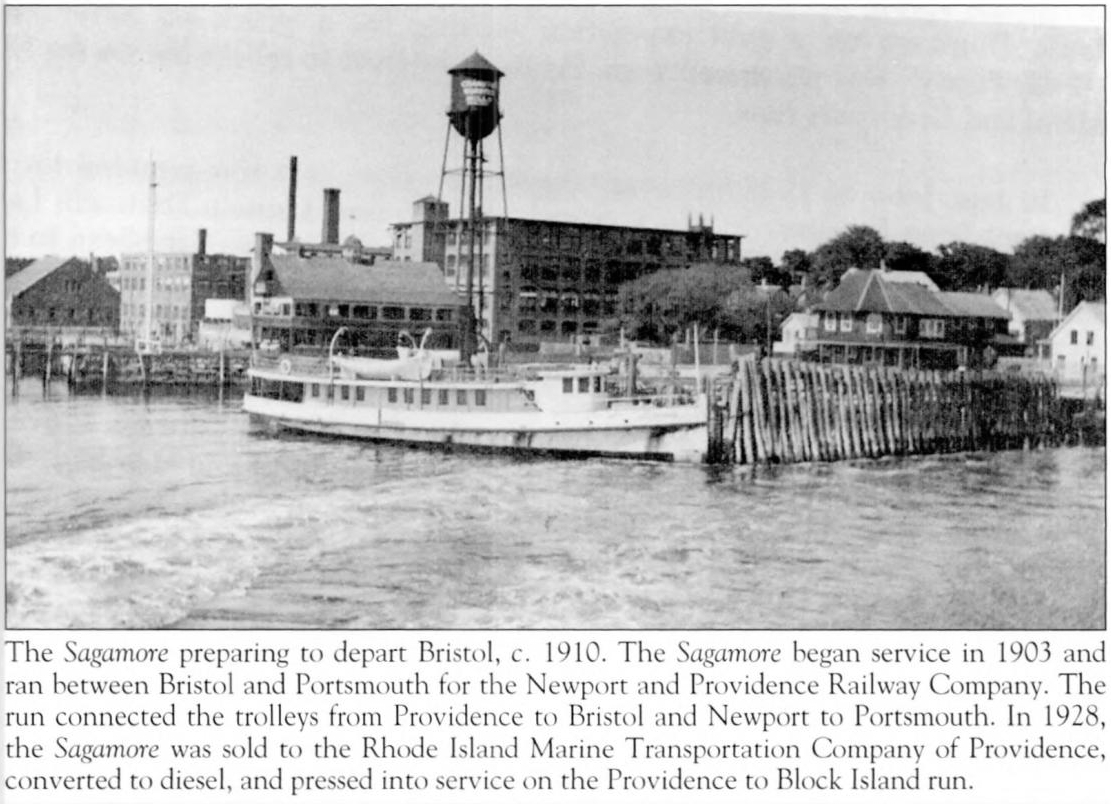
In the depths of the Great Depression this offered a fare as low as 15-cents for a day’s round-trip, and on one occasion he went for three days in a row. This was the route of the “Newport boat” which features in the famous “The Call of Cthulhu”. This could have been, at the time of “Cthulhu”, the “New Shoreham” passenger boat. As seen below, along with its Providence dockside.


The “Newport boat” landing and departure point, Providence.
Though in 1932 he mentioned to Cole that the upmarket 75-cent “Mount Hope” boat was competing with the far cheaper “Sagamore” (the cattle-carrying boat). With at least one guest, for instance Helen Sully in July 1933, he and his guest would take the better of the two Newport boats. So the Sully trip was very likely on the “Mount Hope”, which was warmer. The cheaper boat came back later and was thus colder on the way back, and there was also the risk of encountering cattle on deck. As can be seen here, the “Mount Hope” was a far more substantial passenger proposition than the small “Sagamore”…

Possibly there were even three services at the time of “Cthulhu”, since the “Mount Hope” seems to have made the run as early as the mid 1900s and was still being photographed on the same run in 1934. So the “Newport boat” at the time “Cthulhu” was written could have been either “Mount Hope” or the “New Shoreham”.
Anyway, enough of untangling the boats. Let’s get to the beach. Emerging from hibernation in spring, Lovecraft would take one or other Newport boat and then might hike out from the town “into the Bishop Berkeley country … some four miles beyond Newport beach on the road to Middletown”, through green fields of what he termed “sportive lambkins”. He enjoyed the coastline, beaches and rocks that lay behind and away from the town and the tourists.
Here we see James A. Suydam’s establishing view of this especially favoured place at the back of Newport, the “Paradise Rocks”. The “Hanging Rock” end of these gives a wide firm cleft for sitting and also views to nearby places named by locals “Paradise” and “Purgatory”. The end rock reminds one of the “sizeable table-like rock” in “The Dunwich Horror”.

A detail from a further painting shows the rock’s relation to the wide beaches and ocean, complete with one of Lovecraft’s “sportive lambkins”…

I once had a blog post on these two places, but sadly it was one of the few to perish when the blog blew up. However, I find that I can now recover the sketch-view from that post. This apparently shows “Paradise” (below the artist) and “Purgatory” (a deep cleft, down in the high headland seen across the beach/salt-grass).

Lovecraft visited many times, but also had at least three extended visits with his rock-appreciating geologist friend Morton. There was a Lovecraft-Morton visit in late June 1930, and again in the hot late August of 1932 when they explored the rocky cliffs and knoll and…
discussed the cosmos with Dean Berkeley’s shade
This being a reference to the British philosopher Bishop George Berkeley, a thinker who had especially enjoyed Newport’s “Hanging Rock” two hundred years earlier in circa 1728-32. Berkeley believed, among other things that “reality isn’t separate from perception” and he was a deep thinker on language who was later compared to Wittgenstein. The “Hanging Rock” being where, as Lovecraft put it…
Berkeley used to sit reading, writing, or meditating
In Selected Letters II Lovecraft gives a correspondent precise directions on how to find the place, once out of the town. One then has to assume that the area was not much signposted, and there would be no-one from whom to ask directions.
Here a detail of the “lip” at the “head” of the rocks, where one might perilously picnic or perhaps write competitive poems (Lovecraft recalls such a contest here, with the ocean-loving Wandrei)…

A rough study in oils by the local macabre and stained-glass artist John La Farge (1835–1910) also usefully indicates the highest-point elevation, of the sort on which Lovecraft might have “discussed the cosmos”…
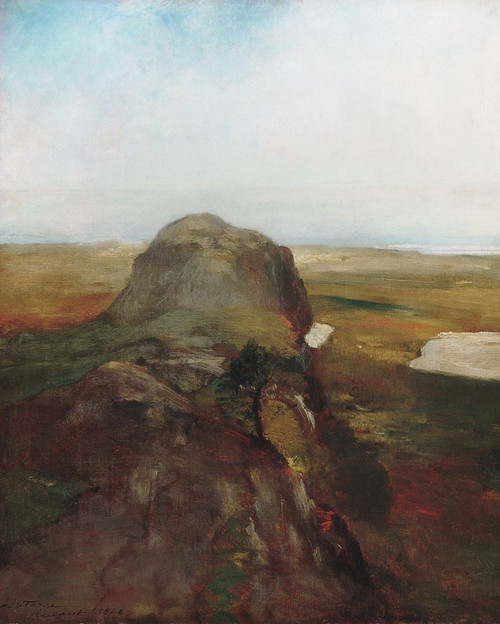
we looked down from our exalted perch — a perch which 200 years ago was a favourite of Dean (later Bishop) Berkeley as he composed his famous Alciphron … We had splendidly hot weather all along — thermometer around 90˚.
26 Friday Aug 2022
Posted in Historical context, Picture postals
These are my notes of interesting points found in the first third of the book Letters with Donald and Howard Wandrei (2019).
The year is 1927. All quoted letters are from Lovecraft unless otherwise stated. This part of the book also gives letters from Wandrei.
p. 26: Among critics of the time, “Their idea of fantasy is the sophisticated snickering of James Branch Cabell”.
p. 29. He gives a short list of the “Utopian things” that he read when young. One of these is named as “Wells’ “The Time Machine””. This is interesting as, according to Letters to Family, The Time Machine was only read by Lovecraft in November 1924. We know now that this 1924 edition was a library copy, borrowed for Lovecraft by Long, and thus did not come from the Wandrei collection of early science fiction. So, did Lovecraft actually read this seminal work when young, forget it, and then re-encounter it afresh much later in 1924? It sound like it.
p. 29. Also on the list of “Utopian things” read when young is “Parry’s “The Scarlet Empire””. This was a satirical novel published 1906. A young socialist tries to commit suicide at Coney Island, but is rescued from the water by Atlantean socialists who secretly dwell offshore. He is quickly shocked into awareness that their socialist city requires a ‘dictatorship of the proletariat’, severely limiting free speech and also persecuting love as ‘reactionary individualism’. A love interest occurs. Escape from tyranny, and destruction of the underwater city by submarine torpedo. The latter point recalling the fate of the reef off Innsmouth.
p. 32. “The Black Cat used to have some excellent fragments of the macabre”. This national news-stand story magazine was the predecessor of Weird Tales, though it seems Lovecraft did not read it all the way up to the crossover date. A footnote give a line from the letters to Barlow. He “began to notice it” about 1904 [approx age 14] and then would “buy that reg’lar like”. So the period to look for such tales from The Black Cat, would be 1904 onward. The cessation date of his reading is is unknown.
p. 54. “My love of the weird dates from fairy-tale days, my curve of taste running [first] through Grimm…”
p. 63. “To my mind, the only really beautiful life which the decaying world can hope to know in the years to come is that of the small, aloof nations with primitive simplicity and strong nationalist self-consciousness; insular centres of ancient, intensively individual & tenaciously vital cultural impulses like Iceland or Ireland. These places are still alive, enjoying unbroken communion with the creative forces behind them…”
p. 65. Among a wider world ‘if only I had the funds’ travel itinerary, he notes various places in northern Europe which he would especially like to visit. “Old England [of course, but also] Nuremberg [in Bavaria], Ratsibon [old name for Regensburg, in eastern Bavaria and with a Slavic culture], Mount Saint Michel, Chartres [both big ancient religious sites in northern France].” Why Bavaria? His recently written Dexter Ward has Baron Ferenczy’s castle, of course, though the location there is “dark wooded mountains” near Klausenburg (a nod to Stoker’s Dracula). But that’s Transylvania. The likely Bavarian interest surely comes rather from the Voss book The Monk and the Hangman’s Daughter which Lovecraft found, though “not weird”, … “makes the wild Bavarian hills and deep woods and hellish lakes quiver with a malign and poignant vitality. … The man who dreamed this scene knew Bavaria from the bottom up.”
p. 67. In 1926 he had acquired the book The Haunted Homes and Family Traditions of Great Britain by John H. Ingram.
p. 77-78. “But still the little ancient lanes lead off down the precipice to the west; spectral in their many-peaked archaism, & dipping to a riot of iridescent decay where the wicked old [Providence] waterfront recalls its proud East India days […] sometimes I venture down into this maelstrom of tottering houses, broken transoms, tumbling steps, twisted balustrades, swarthy faces and nameless odours, winding from South Main to South Water, searching out the docks where the bay and sound steamers [i.e. the ‘Newport boat’ from “Call of Cthulhu” etc] still touch […] the dreaming wharves where Providence Indiamen [i.e. large sailing-ships] used to ride at anchor. Just this week there is a genuine old-time sailing ship in port — a rare occurrence now — and I love the sight of its antique masts above the centuried warehouse roofs.” See also page 98.
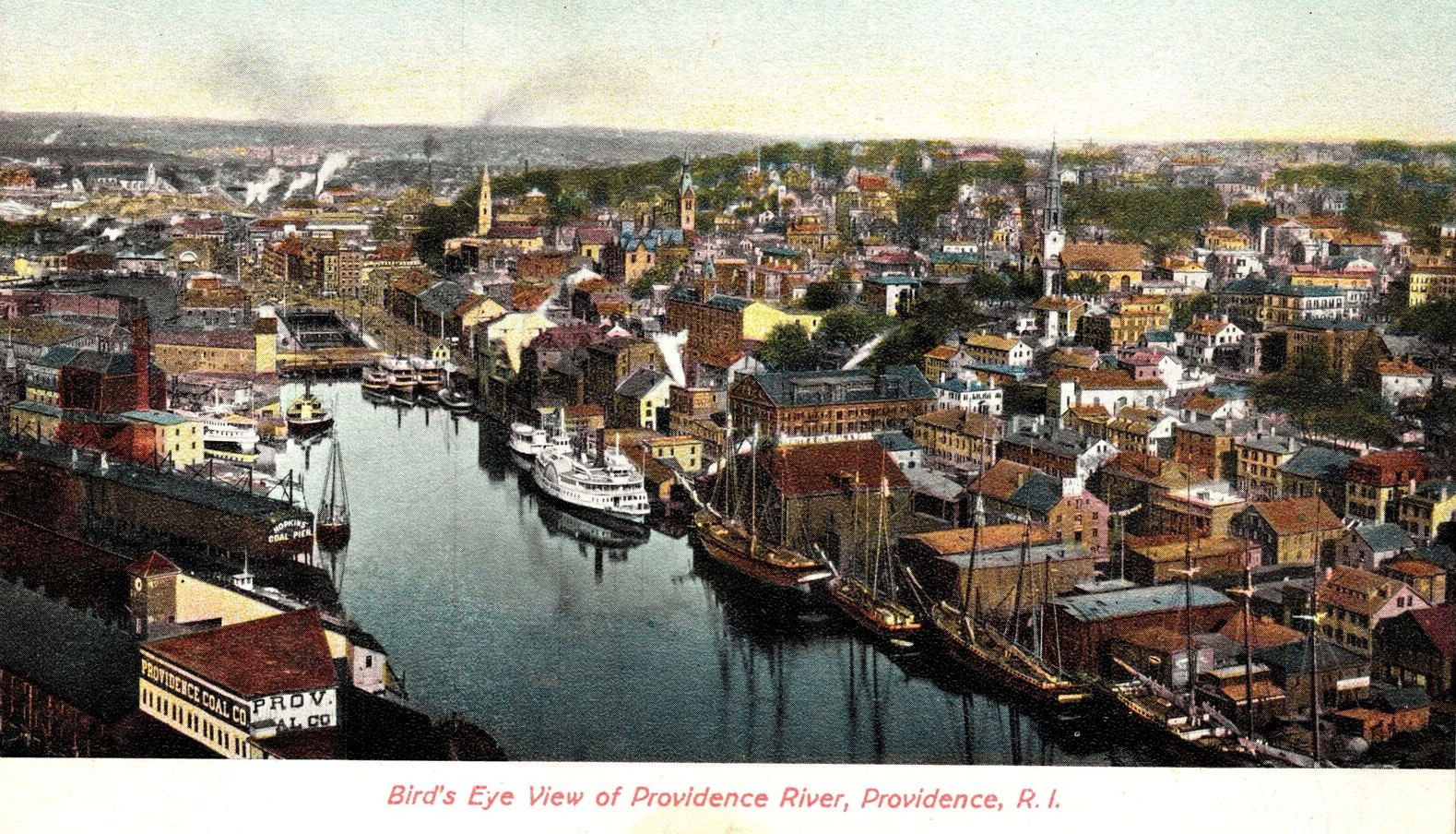
Heavy cargo, coal and oil docks on the left. Passenger docks and ‘non-messy’ freight on the right. Here we only see half the waterfront, since it ran on until it reached Fox Point which was where the New York boats docked.
p. 100. Charles “Fort is a close personal friend of Weird Tales author Edmond Hamilton, to whom he has suggested several story plots appearing in the magazine.”
p. 126. There is a marvellous extended description of his first visions of the ‘dream New York’. In Prospect Park at dusk… “the bronze lions crouch cryptic beside the marble quays of templed lakelets”. These were western-type lions, not Asian ones. He also gave Wandrei an extended two-page itinerary of things and place to see on a first visit to New York City, including Harlem. “Also walk across the High Bridge, which Poe loved”.
p. 131. He lists the used book shops then in Providence. “You will part with many a shilling at Eddy’s, The Old Corner, Gregory’s, Tyson’s, and so on.” Wandrei eventually spent $50 at such shops, then a large sum, and had to hitch-hike home. This develops into quite a hobo travelogue for Lovecraft from Wandrei, and there is a fine passage describing Wandrei’s entrance into Chicago on a powerful motorbike. Wearing goggles and mistaken for plain-clothes police, they were waved through all the city’s grids and jams.
Wandrei appears to have something of a spending problem at this point, as he later purchases two Clark Ashton Smith paintings, which apparently cleaned him out for the next year.
p. 132. At the Metropolitan Museum, Lovecraft recalled he “revelled in the new Wing K — the Roman garden with the statues. A certain austere head of a tight-lipped old Republican Roman is as much a favourite of mine as that effeminately pretty Antinous-type Hellenic head in the corridor is a favourite of Loveman’s.” Wandrei was then in New York with Loveman, and this seems a fairly clear ‘tip off’ to the lad about Loveman’s amorous inclinations.
The Met has pictures of “the Roman garden with the statues”, made in 1925…


p. 141. Confirmation by one who had visited, that Dwyer did indeed live on the lapping edge of a newly-created reservoir [re: “Colour out of Space”]. Wandrei described to Lovecraft… “a little farmhouse near the edge of the Ashokan reservoir which gives New York City its water.”
p. 147. I’ve just read [Wells’] “War of the Worlds” for the first time, in Amazing Stories. … the best thing of H.G.’s which I’ve ever seen”. This is 9th August 1927, and would be Lovecraft’s first encounter with the Wellsian idea of the ‘creeping red weed’.
p. 146, 150-51. Possible relevant to Lovecraft’s “Plan of Foxfield — for possible fictional use”, though never used. Lovecraft plans to visit “the ancient Deerfield region” with an architecture unlike that found elsewhere. He visited circa 19th-23rd August 1927, when he called it “The summit of my earthly ambition — I’ve gone broke on postcards”. Cook added a note that HPL had spent the then-handsome sum of $5 on Deerfield postcards. See: Will Murray’s “Where Was Foxfield?” in Lovecraft Studies No. 33 (1995). I’m uncertain if this suggests a link with Deerfield.


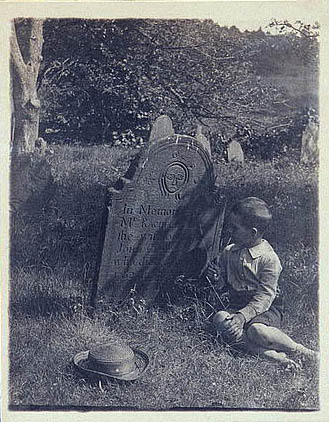
Deerfield Burying Ground, with olde style carved face on gravestone.
p. 156. Lovecraft suffered a night in the primitive YMCA at crumbling Newburyport, at the end of August 1927. This confirmed all of Wandrei’s prejudices about YMCAs, and sounds like a precursor to the overnight room in Innsmouth.
pp. 162 and 167. Lovecraft returns to Jake’s on the Providence waterfront, and discovered there was a “Jake”…
Talman enlightened me concerning the identity on “Jake”. It seems there is a real person by this name — Adam Jacques — who actually pronounces his patronymick Jakes. This is the big boss — and you may be able to recall him as the somewhat thick-set man with the moustache. … Domingo, however, is the life of the place.
Jake’s appeared in the Providence Journal, 10th September 1927. Lovecraft sent a cutting. The letter was 11th September 1927, but the letter and cutting are not in the Brown repository. But apparently the newspaper archives for this date have survived.
Incidentally, I read that Lovecraft later had some criticism of Donald Wandrei, to others. But that was surely later than 1927. In 1927 he’s obviously very pleased to have newly discovered the “new Galpin” and to have successfully introduced him to the Circle.
20 Saturday Aug 2022
Posted in Historical context, New books, Scholarly works
Happy 132nd Birthday, H.P. Lovecraft.
For 2022 my birthday present is a readable edition of the previously uncollected letters of E. Hoffmann Price to H.P. Lovecraft. This 350-page book complements the recently-published edited volume of the letters from Lovecraft to Price.

Download: Get the .PDF free on Gumroad. For the most stable download I’ve put it on Gumroad, which may also help you send it over to your 10″ Kindle.
These letters and many postcards were sent by veteran pulpster Price between 1932 and 1937. Brown has some 15Gb of scans of these… but they needed to be collected as single magazine-sized .PDF ebook. Don’t worry, the scans have been crunched down to just 65Mb total for the book. Please note that my assemblage is intended for convenient reading from a 10″ digital tablet, rather than as a scholarly edited edition.
To discover the archival scan number of a letter or card, download and then extract the PDF with the Windows freeware PDF Image Extractor. The images should still have their filenames, and these will give you the required scan numbers at the Brown Repository. By this same method you can also determine what new pictures I’ve added, as these have no Brown repository numbers. A few layout gaps, caused by the many two-to-the-page postcards, have been occasionally filled by me with new vintage pictures.
My thanks to all those who have been involved in preserving these and making the scans freely available.
Those with the cash to do so could use a service (Lulu, MagCloud, etc) to print-on-demand at a 12″ magazine size, then mark the good bits at leisure in an armchair, and then pass the result to a transcriber to create a less repetitive and more enjoyable “Extracts from…” text book.
19 Friday Aug 2022
Posted in Historical context, Scholarly works
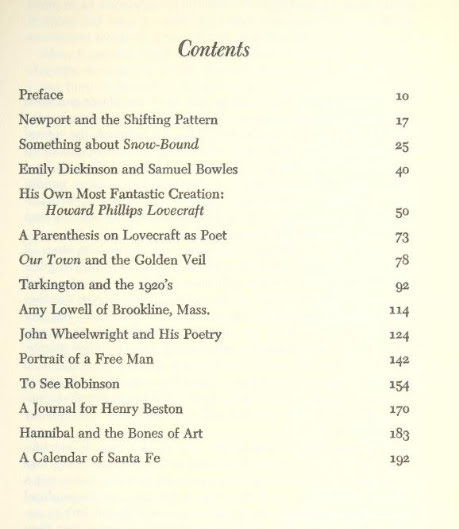
The Christian Science Monitor (1961-09-07) review of a book of essays by Lovecraft’s early biographer-researcher. The reviewer notes the book also muses on a “George Lovecraft”.

The book under review is currently on Archive.org to borrow.
14 Sunday Aug 2022
Posted in Doyle, Historical context
My Patreon patron John Miller asks…
Did HPL read Sherlock Holmes, and what did he think of this character and these stories?
The young Lovecraft certainly read the Holmes tales. As he recalled for Alfred Galpin, in a letter of 27th May 1918…
As to ‘Sherlock Holmes’ — I used to be infatuated with him! I read every Sherlock Holmes story published, and even organised a detective agency when I was thirteen, arrogating to myself the proud pseudonym of S.H. This P.D.A. [Providence Detective Agency] — whose members ranged between nine & fourteen in years, was a most wonderful thing — how many murders & robberies we unravelled! Our headquarters were in a deserted house just out of the thickly settled area…
That would be around 1902/3, the period in which a revolver was constantly carried in the pocket (sans ammunition) and a 99-cent spy-glass was newly on hand. Handcuffs, magnifying glasses, false beards and piercing whistles were also features of the P.D.A. We might suppose that the boys modelled themselves on the Baker Street irregulars, a group of boys found in the Holmes tales. But there may well have been other similar inspirations. He was also at this time reading Railroad man’s Magazine and the early Munsey proto-pulps. Lovecraft himself mentions…
Nick Carter and Old Sleuth, dear to the small boys of other generations, and studied almost invariably without knowledge or consent of the reader’s parents!
A list that Lovecraft made for Moe, recalling the multifarious concerns of the year 1900, includes… “Is Doyle going to write any more Sherlock Holmes books?”. Which suggests Lovecraft was also avid for Holmes in that year too.
The tales also spurred Lovecraft to a sustained period of writing, perhaps his first, as he told Kleiner on 2nd February 1916…
I used to write detective stories very often, the works of A. Conan Doyle being my model so far as plot was concerned.
As I’ve pointed out, the Holmes tales have plenty of gothic elements in them. They are not pure paeans to rationalism and scientific deduction.
In 1918 Lovecraft assumed he had read all of the Sherlock Holmes tales, but a footnote in the new edition of the Galpin letters itemises what he had read by 1927: three collections (Adventures, Memoirs, Return), three novels (Scarlet, Four, Hound) and two unnamed “mediocre” stories appearing circa 1908. I assume these were the 1908 tales “The Adventure of Wisteria Lodge” and “The Adventure of the Bruce-Partington Plans”. This shows that Lovecraft would have been up-to-date to summer 1908, but after that lost touch with the figure.
Which was rather a pity, as he missed the rest of the tales included in the book collections His Last Bow (1917) and all of the tales in The Case-Book of Sherlock Holmes (1927). Therefore it would be a mistake for future scholars to assume that the young Lovecraft had read “The Adventure of the Devil’s Foot”; “The Valley of Fear”; “The Adventure of the Sussex Vampire” or any other of the Case-Book tales.
What he did read may have had some later influence on Lovecraft’s ‘decadent’ phase. In the glimpses we have of this we sometimes sense Lovecraft as a figure not unlike Holmes in his limp ‘down-time’ periods behind the blinds at Baker Street. One might also see touches of this incorporated in “The Hound”, with both languid drug-taking and distant echoes of “The Hound of the Baskervilles” being woven into Lovecraft’s hilarious self-parody.
The boyhood Providence detective band appears to have faded away by 1905, and Lovecraft’s early interest in local ‘crime and grime’ did not continue. For instance he later remarked that as an adult he never read the “police reports” section in newspapers. Though one can see that he kept a ‘watching brief’ open on political crime, as evidenced by tales such as “The Street” (1919). He would also revisit local thuggery in his “The Terrible Old Man” (1920). Later in his life he sometimes took notice of ‘small crimes’. Crimes which may have been ‘petty’ in the eyes of the police, but which meant a lot to those involved. Such as the case of the missing stamp (recently detailed in an episode of the Voluminous podcast), a ‘missing cow’ hunt at Wilbraham, or of curiously missing cats on College Hill. In the latter case Lovecraft strongly suspected a local cat-poisoner, but it seems he did not do as far as to don a deerstalker and investigate Sherlock-style.
He saw, but was very disappointed by, the Sherlock Holmes movie of 1922. This movie did not, it seems, spark a Holmes revival among American boys. Lovecraft’s friend and fellow-writer Whitehead, a close observer of American boy-culture in evening clubs and summer-camps, remarked in a 1922 essay on the…
fact that there is just now growing up a generation of readers for whom the Doyle of ‘Sherlock Holmes’ is an obsolescent figure.
There is some indication that the adult Lovecraft read Doyle’s non-Holmes tales at the end of January 1925. In the 1925 Diary we hear…
home & read Meynell & Doyle
The listing of his library, made at his death, included Doyle’s collections Tales of Long Ago, and Tales of Twilight & the Unseen. (Doyle’s output in the weird line is surveyed in Wormwood #31, “The Dark and Decadent Dreams of Doctor Doyle”).
In September 1925 he told his aunt he intended to see the new movie of Doyle’s “The Lost World”, because it had become a ‘cheap-ticket show’ at the Strand. He notes the original novel had “charmed” him “some fifteen or more years ago”, which would put the reading at circa 1907-10.
We definitely know he borrowed Doyle volumes from the weird collector and friend Paul Cook, in summer 1929…
I am now about to go over the weird short stories of A. Conan Doyle — as many as I could round up in W. Paul Cook’s private library. Some of them I know, some of them I’ve read & forgotten, & some of them I seem never to have seen at all. It is quite possible that my opinion of Doyle as a weird writer will measurably increase within the next week or so!” [Later] “in the Doyle collection Cook lent me I recognised many of the old familiar tales, though there were a few I had not seen before. Doyle doesn’t affect me as powerfully as he did 25 or 30 years ago. In those days I got a real shudder out of things like “J. Habakuk Jephson”, “John Barrington Cowles”, “The Ring of Thoth”, & so on, but now I seem to sense the mechanics & the essential naivete. Doyle lacks some vague quality of mystical potency which Blackwood & Machen & De la Mare possess. But he is a good author for young readers, & I can see why he impressed me so strongly in the golden age of the [18]90’s & early 1900’s.
The latter point dates Lovecraft’s Doyle reading before 1900, into the later 1890s. The 1929 reading was undertaken for his survey of supernatural literature. I get the sense that the later Holmes stories (“Devil’s Foot”; “Valley of Fear” etc) were not included and thus remained unread. The Doyle volumes concerned were, surprisingly, then unavailable in the Providence Public Library. Which may perhaps be another indication of Doyle’s fading-away as a presence in American culture.
Lovecraft knew of Doyle’s well-publicised credulous spiritualist dalliances with everything from ectoplasm-exuding seance fraudsters to bottom-o’-the-garden fairy photography. Lovecraft knew from Houdini exactly how such fraud thrived, ghoulishly preying on the recently bereaved and mourning. He derided…
the cunningly doctored reports of “occult” phenomena popularised by men like [Sir Oliver] Lodge, [Conan] Doyle” (Lovecraft letter to Long, 1930).
To his aunt he lamented the loss of a fine writer to such malign forces…
What a writer Doyle was before he went to seed as a dupe of the spirit-mediums!
Further reading:
“The Problems with Solving: Implications for Sherlock Holmes and Lovecraft Narrators”, Lovecraft Studies #42-43 (Autumn 2001, double-issue).
“Elementary, My Dear Lovecraft”, Lovecraft Annual #6 (2012). (Detailed detection of possible Holmes influences on Lovecraft’s fiction).
The Robert H. Waugh Library of Lovecraftian Criticism, volume 3, reportedly has an essay on “the influence of Sir Arthur Conan Doyle on several Lovecraft tales”.
And see also the vast industry involving the creation of Holmes / Lovecraft mash-ups, something the young Lovecraft and his band of boys would no doubt have been rather delighted to learn about.