• About
  • Directory
  • Free stuff
  • Lovecraft for beginners
  • My Books
  • Open Lovecraft
  • Reviews
  • Travel Posters
  • SALTES

Tentaclii

~ News & scholarship on H.P. Lovecraft

Tentaclii

Category Archives: Historical context

Lovecraft was right, part 459

19 Saturday Nov 2022

Posted by asdjfdlkf in Historical context

≈ 1 Comment

There’s a small error on a point of economic history, found in the most recent episode of the podcast Voluminous. This is re: Lovecraft’s 1930 forecast that…

The workman’s place in this ultimate order [i.e. he seems to imply the emerging form of advanced technological capitalism] will not be at all bad, and may conceivably be so good — with so much leisure — that it will help to solve the problem of the impecunious man of cultivation.”

In the podcast this is said to be wrong. Based on the assumption, presumably, that nothing much has changed for a “workman” since Marx first peered through the grimy windows of an early Lancastrian cotton-mill.

Yet, as usual, Lovecraft was right. In the year he was born, the average U.S. adult worked a week of 61 hours. For a factory worker or farm-hand it could often be 100 hours. By 2021 the average U.S. full-time working week was down to 38.7 hours. The well-documented post-war boom in leisure-time happened, just as Lovecraft predicted. For adults the reduced hours were largely the result of employers competing for skilled labour, allied with their capital investment in machines and better productivity.

Lovecraft’s “problem of the impecunious man of cultivation” has also been somewhat solved, at least for cheese-paring bachelors, by another relatively new phenomenon. The rise of part-time but regular jobs — giving earnings on which it is possible to live something of a writer’s life. Many labour-saving devices (fast-boil kettles, etc) services (food delivery, fast-food etc) and tools (word-processors, Internet research etc) make such a life more viable by freeing up a few more hours. Not only do we have more leisure hours to spare, but we can do more with them (so long as we choose not to waste 24 hours a week being zombified by TV). We also have far more choice.

Such 20th century change looks even better if you work out the ‘disposable percentage of a lifetime’ spent at work, given that our lifespans have greatly increased since the time of Lovecraft’s parents. We now spend only around 10-20 percent of our entire waking lives at work, depending on how you calculate such things (amount of time spent in education, % of each day spent in the workplace, actual life-span, age of retirement etc). One can also add that for most people the age 67-82 (15 years) period of retirement is now a far more healthy and active part of one’s life than it was in Lovecraft’s time. 75% of those aged 65-74 in the U.S. have no disabilities at all.

“Industry, highly mechanised, demanded but little time from each citizen; and the abundant leisure was filled with intellectual and aesthetic activities of various sorts” (The Shadow out of Time)

Lovecraft may yet be proved right twice over. Once we get through the current bumpiness then the world will be at least 350-450% richer by 2099, according to the best U.N. forecasts. With a consequent rise in leisure time and opportunities. That may even entail the rise of a sort of ‘aristocracy of the cultured’ that Lovecraft envisaged for a future leisure society.

Voluminous: ‘Long and Love-Kraft’

19 Saturday Nov 2022

Posted by asdjfdlkf in Historical context, Podcasts etc.

≈ 1 Comment

A new 90 minute Voluminous: ‘Long and Love-Kraft’. This letter features a long discussion of the fave Lovecraft nibble… cheese! See also 2020’s Voluminous: Cats, Cheese and Hawaiians episode for more nibbles at the topic.

From another letter on the topic…

A decade ago I was greatly interested in tracking down some of the idioms I encountered in New York. For example – the phrase “store cheese” – which my palate preferences caused me to run up against continually. In southern New England the expression is – or at least was in 1924 – unknown. Our principal cheeses are the large traditional sort – about a foot thick and two feet in diameter – and the modern tinfoil package or process cheeses run second. Thus the word “cheese” without any trimmings suggests to our mind one of the large ordinary old-fashioned sort. When we allude to the new sort we usually say “process cheese”, “package cheese”, or (in the case of the long tinfoiled loaf) “loaf cheese”. Well – in New York it is just the other way around. The word “cheese” in itself suggests to New Yorkers the modern tin-foil brands, and if you ask for “a pound of mild white cheese” a Manhattan grocer will begin to chop you off a section of a Kraft tin-foiled loaf. These process cheeses (they are artificially cured and not aged) are the principal kinds used in the metropolis, and in many shops no others are obtainable. And where they do keep the standard old-fashioned sort, they call them “store cheeses”. Thus when I was in Brooklyn I used to have to ask for “medium white store cheese” if expected to get my usual kind.

And this was probably a Tom & Jerry-style ‘mousetrap’ wedge, cut from a wheel with a wire and wrapped in grease-proof paper, rather than the rectangular and vacuum-packed plastic block of today…

large wheels of cheddar cheese — often called simply “store cheese” — were kept under glass and sliced into one- or two- pound wedges for customers.” (New England)

Lovecraft’s friend Vrest Orton built an enduring mini-industry in Vermont around such things, which was perhaps even partly inspired by Lovecraft’s antiquarianism and tastes…

I wanted to revive an authentic, old-fashioned, rural operating store [‘The Vermont Country Store’, with] the same merchandise: New England foods, store cheese and crackers, bolts of calico cloth, kitchen knives and cooking forks

Orton even kept alive a certain old British traditions in cheese, something Lovecraft would surely have approved of…

one of the better sage cheeses I have eaten is sold by Vrest Orton, a Vermonter famous for his efforts to preserve the verities of his native state. Mr. Orton does not hesitate to tell his customers that the shipments he makes are “simply our good aged Cheddar with leaves of real sage for flavor.” Among British food lovers for hundreds of years this kind of sage cheese has been a traditional part of the Christmas celebration all over England.” (The World of Cheese)

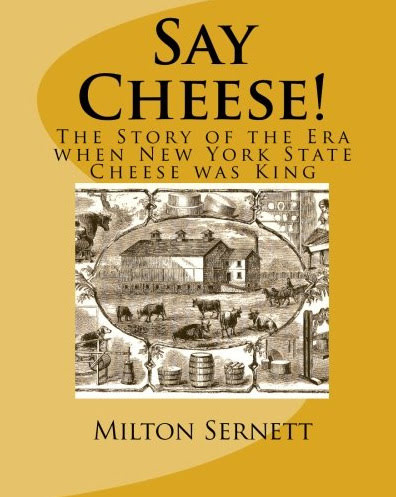
In the Voluminous letter “York State Medium” is stated as being Lovecraft’s favoured cheese-board staple in 1930. This can be found in recipes as “York State cheese” into the 1970s, a full-fat cheese. But perhaps he was abbreviating for ‘New York State Cheese’, in which case it turns out there’s a complete book on the topic…

The Voluminous letter, as read, was previously abridged in Selected Letters III. This episode of Voluminous also gives an account of the process of acquisition of the Long letters for Brown.

The podcast has a small factual error, which I’ve corrected in my post Lovecraft was right, part 459.

Lovecraft on a Comet

04 Friday Nov 2022

Posted by asdjfdlkf in Historical context, Picture postals

≈ Leave a comment

A post title like ‘Lovecraft on a Comet’ might seem a nice co-incidence for Bonfire/Fireworks Night. Though here the Comet in question is a train, and not a blazing hunk of ice hurtling through the cosmos.

Many will recall that Lovecraft had a lifelong love of railway trains. This was not only confined to his youth, when he appears to have read the entire run of Railroad man’s Magazine, made scale-model tracks in the old carriage-house, then taken solo journeys in middle-childhood, and even published his own The Railroad Review ‘zine for family and friends (1901, one issue known) — complete with long humorous verse, perhaps his first really successful original narrative for an audience.

Some of his most enjoyable travels were had by train carriage and railway station, especially when fine landscape views were streaming past his window. Sometimes, an alternative view of a place gave him a completely different and more favourable impression, as when an unfamiliar rail route once took him into his friend Morton’s mundane New Jersey town. He also enjoyed the arrivals and departures, such as riding into New York City above the sidewalks on the famous ‘Elevated’, or departing the city for his honeymoon from the mighty gothic/classical Pennsylvania Station.

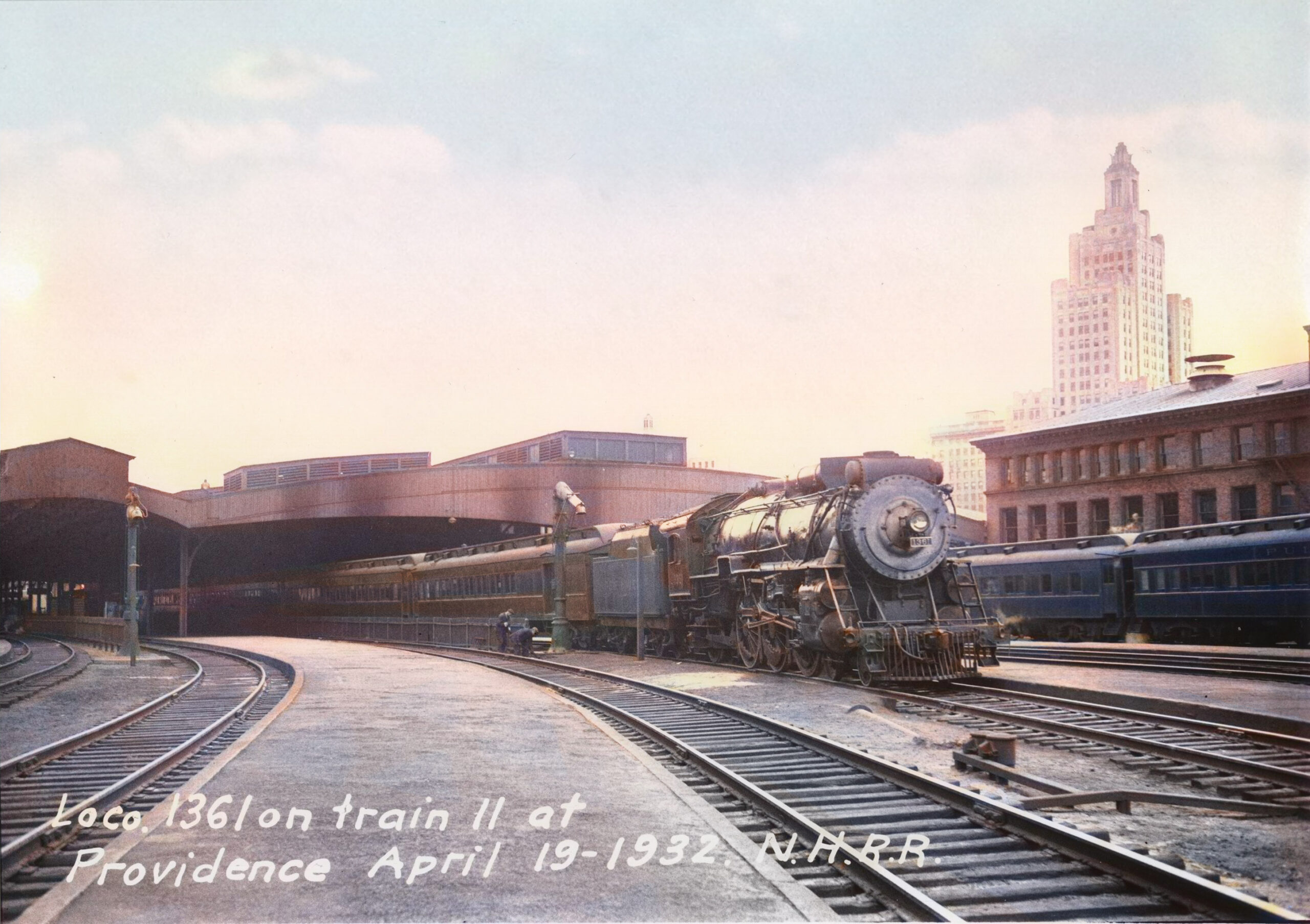
But what of Providence? We have a few wide pictures of the city station frontage, but what about behind the frontage in the last years of the great Age of Steam? I’ve found this vintage 1932 picture which gives a feel for the sort of mighty steam trains to be found there, on which Lovecraft would have departed and entered his city. Here the train is about to head westward and so presumably reach New York City. With thanks to the Providence Public Library. I’ve here colourised their scan of the picture.

[the pronunciation of ‘Cthulhu’] “is more like the sound a man makes when he tries to imitate a steam-whistle…” (Lovecraft).

Late in his life Lovecraft also managed to get aboard a new Providence ‘super-train’ for a guided tour, when the train first arrived in his city. This was a new super-streamlined tubular-aluminium and air-conditioned diesel train named The Comet…

Early artist’s impression of what the new train might look like.

The service in operation.

Sadly I can’t re-find Lovecraft’s account of the tour he was given, but I recall it filled at least a long paragraph or so. It’s in the published Letters somewhere, probably given to one of his younger correspondents. April/May 1935 appears to be the target date, judging by press photos and news coverage at that time. But I can find nothing in the Bloch or Rimel letters.

Apparently the design was a one-off and it was the only train ever designed by Zeppelin in Germany. Some in the press billed it as a “rail-Zeppelin”. In those pre-war days the Germans and Americans could work on such joint projects. Lovecraft no doubt approved of the Teutonic styling, with the train-ends rather resembling Wagnerian helmets. The Comet went into service in June 1935 on the Providence to Boston (South Station) run, making the run in 44 minutes including a stop at Back Bay in Boston. The train was double-ended for a quick turnaround at its destinations. The livery was “blue, silver, and white”, and was very plush inside for its 160 passengers. It was a great success, and proved itself totally reliable during the following 1935/36 New England winter.

Such a ‘new’ train must have seemed a remarkable change from the grimy and older steam-trains Lovecraft was used to, and quite a harbinger of the future. Steam-trains may have their charms. You could slide down the carriage windows for fresh air, for one, and passengers were not sealed in a “pre-paid suffocation chamber” (as Lovecraft once termed air-sealed public-transport). But they were also heavy and noisy, and one might encounter soots and smoke as one boarded.

I don’t know if he ever actually travelled to Boston on The Comet. He preferred a more leisurely landscape view from his train windows, and even a one-way ticket may have been deemed an expensive extravagance. He did visit the Boston area to see Cole and his family, from 3rd-5th May 1935, as he notes for several correspondents (e.g. Rimel letters, p. 273), and did so again some time later. But he would surely have mentioned it to them if he had ridden on the new Comet to reach Boston.

Scriabin and Lovecraft?

25 Tuesday Oct 2022

Posted by asdjfdlkf in Historical context, Lovecraftian arts

≈ Leave a comment

Last week The Scriabin Club had a stab at “Connecting Scriabin, Roerich and Lovecraft”….

At the Scriabin Club we also use [Roerich] paintings for the exact reason of philosophical parallels to the spirit of Scriabin.

Roerich I knew, since he was Lovecraft’s favourite contemporary gallery artist. Lovecraft often visited his gallery in New York City, though so far as I know never conversed with the artist.

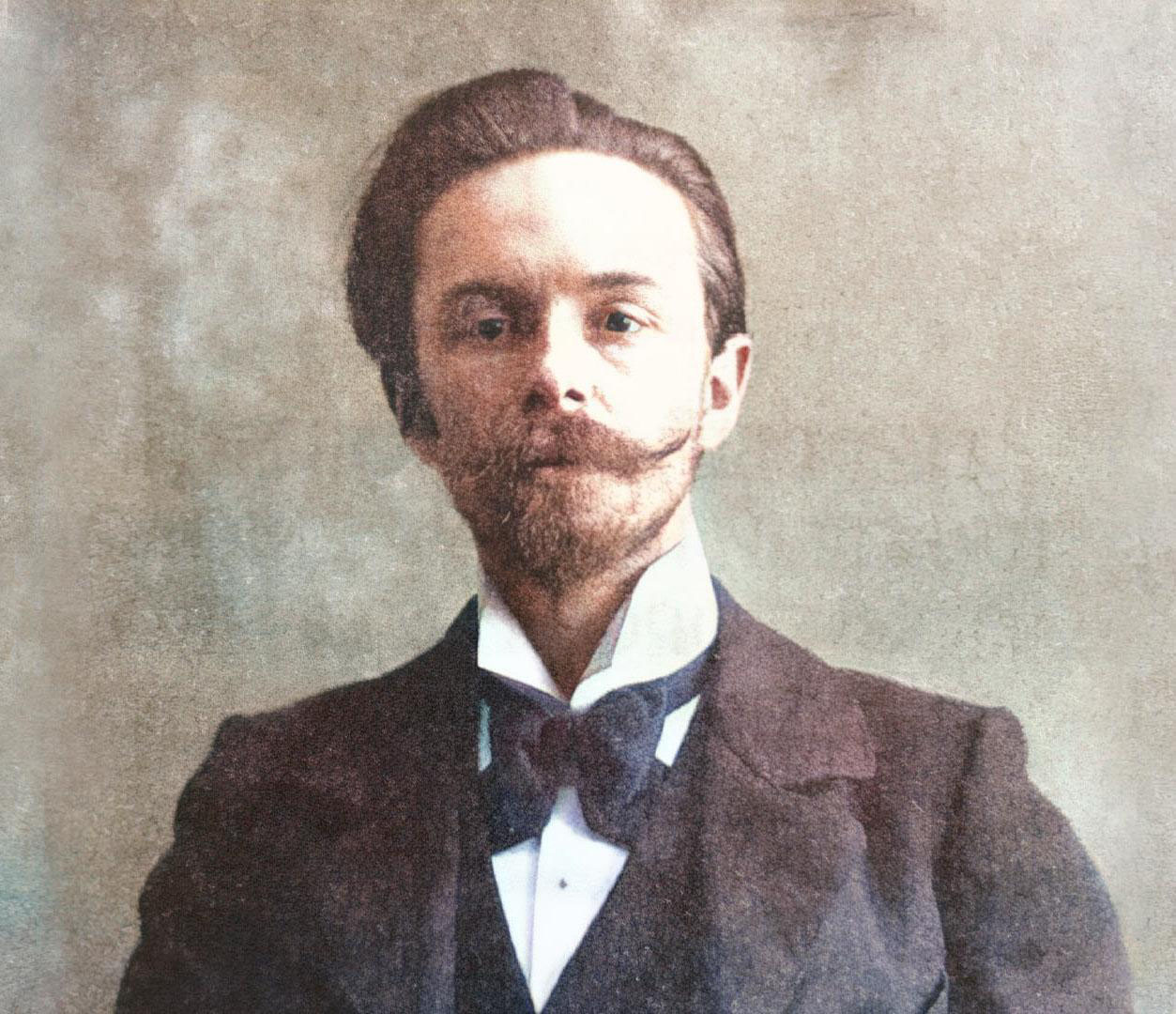
The name Scriabin (1872-1915) was new to me, so I did a bit of research. Turns out he was a pre-communist mystic Russian composer who was enamoured — like Roerich and Lovecraft — with the idea of high and remote mountains and their esoteric denizens.

Relatively famous in his time, he visited the East Coast of America circa 1907. So the seventeen year old Lovecraft might have read press reports of the visit. Perhaps even read of his ideas about synesthetic art. But would not have heard the music, since the first radio symphony broadcasts were then still 15 years away in the USA.

Turns out Scriabin was a pioneer of the synesthetic aesthetic, including performances with a light-projecting ‘colour piano’. He was also influenced by ideas drawn from theosophy. Both of which somewhat align him with Lovecraft. But he’s now equally well remembered for composing darker and darker dissonant music toward the end of his life, including one darkly un-nerving ‘Black Mass’ piece (1912). This was never made public and attempted to enact a sort of effective “musical occultism”. One can encounter musicological writers comparing his late dark works with Lovecraft’s work, though it sounds to me that he was channelling the sordid earth-bound Crowley-esque sex rituals of the era. Rather than cosmic coldness and non-human outside-ness and aloofness.

After the revolution he appears to have been subject to relentless character-assassination by the Soviet communists, to the extent that in the 1925-1945 period many dupes in the West thought that Scriabin had been both insane and deeply depraved. He did run with a satanist and occultist crowd, and was more than eccentric in his old age, which aided the propaganda. His reputation in the West means it’s doubtful Lovecraft heard his music on the U.S. or British radio in the 1930s (he could access some British broadcasts from Providence).

But by the 1960s Scriabin appears to have been rehabilitated by the Soviet regime, and airbrushed to make him seem a harbinger of revolution. Perhaps even (my guess) a herald of Russian cosmicism. Since his “Poem of Ecstasy” music was broadcast as the space pioneer Yuri Gagarin circled the earth in his space capsule. Yes, at the moment of its highest triumph the Evil Empire broadcast… the music of a composer who many in the West still thought of as a satanist.

I’ve found a direct link with Lovecraft, via his young musical friend Galpin. In 1959 Galpin recorded his memories of Lovecraft, including… “of that time we spent in Cleveland” back in August 1922…

At the time, my [musical] tastes could be summed up in a kind of mystical and sensual Wagnerism — I loved the works of Wagner, ‘Tristan and Isolde’, and I appreciated Scriabin also very much…

So it’s then quite possible that Galpin had acquired some Scriabin scores. Though not gramophone recordings of Scriabin, which don’t appear to have existed at that date. There are some apparently rather un-inspiring early piano-rolls, but the earliest popular Scriabin recording I can find is “Prometheus: the poem of fire” / “Poem of Ecstasy” (1932, HMV). By the 1940s there was a cottage-industry in issuing Scriabin recordings in the U.S., and one could get some 50 or more discs. But that was after Lovecraft’s time.

So “Prometheus: the poem of fire” may indicate the sort of thing that Galpin liked in 1922. Though it’s doubtful Lovecraft heard it, except perhaps as some piano-playing from a paper score one night in Cleveland. Even then he would not have been tapping his toe and clicking his fingers to it. Popular ‘show-tunes’ it is not.

So, to conclude. There are broad comparisons to be made (synesthesia, interest in theosophy and the satanist occult, dark and even demonic music, love of remote mountains) and Lovecraft may even have recalled Galpin enthusing about Scriabin when they met back in 1922. But there is no mention of Scriabin in the index of the latest edition of the Galpin letters.

Stellarium 1.0

22 Saturday Oct 2022

Posted by asdjfdlkf in Astronomy, Historical context

≈ Leave a comment

After 30 years as a ‘perpetual beta’, the fine and free Stellarium desktop software is now in version 1.0 stable. It’s a little technical and the UI is initially unfamiliar. But it’s perhaps the most accessible balance of power/usability, for casual night-sky watchers who are not part of the telescope crowd. And its time-travel function is especially valuable for historical researchers and historical-fiction authors.

Numbering is a bit confusing. The stable 1.0 is officially 0.22.3 for Windows 7 warriors, and 1.22.3 for other Windows OS versions.

St. Paul’s Chapel, Broadway and Vesey

21 Friday Oct 2022

Posted by asdjfdlkf in Historical context, Picture postals

≈ 1 Comment

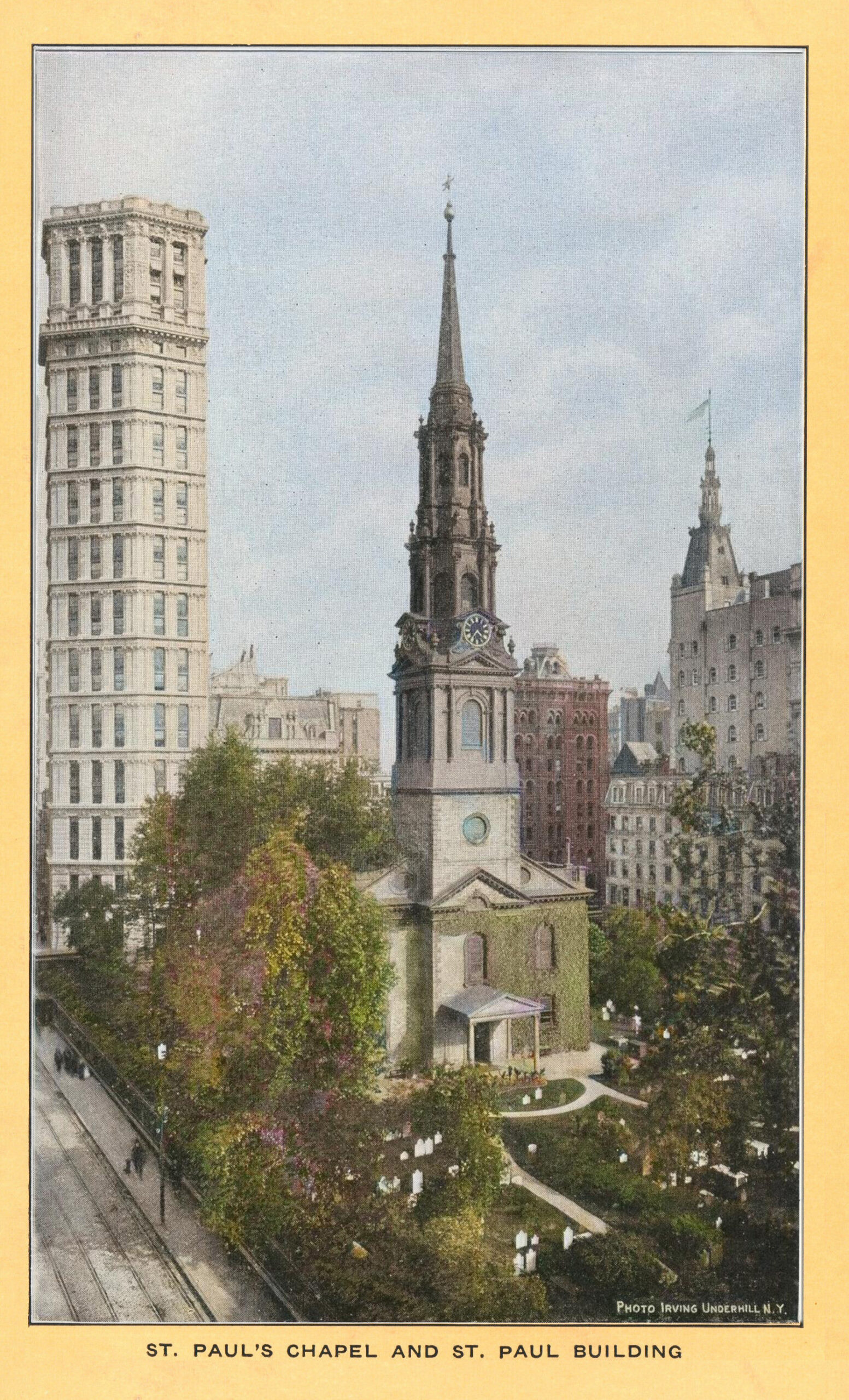
In these unhappy times, a look at a happy moment in Lovecraft’s life. Here are some views of the church chosen for Lovecraft’s wedding on the 3rd March 1924.

As Lovecraft had it…

St. Paul’s Chapel, Broadway and Vesey Streets, built in 1766, and like the Providence 1st Baptist design’d after St. Martin’s-in-the-Fields! [in London] GOD SAVE THE KING!

Neither Lovecraft or Sonia were religious, of course, but in those days a proper olde church it had to be — for a Lovecraft wedding. He appears to have chosen the place not simply for tradition, but also for its Colonial British architecture and family connections. It not only fitted…

most strongly Old Theobald’s traditional and mythological background

… but also echoed (in name only) the St. Paul’s church in Boston where his parents had married.

The cards and photos in this post are a little un-seasonal. March 1924 was famously very dry in New York, with very little early spring rain or snow, and the east coast down to Cheasapeake Bay was “warmer than normal” (Climatological Data for the United States by Sections, March 1924). Despite this and the city’s urban heat-island effect, early in March there would not have been the sort of spring/summer verdancy seen in these churchyard pictures. We might instead imagine a few hints of the very earliest new leaves on the trees, a sparse first flush of new grass after winter, and perhaps a few early un-opened daffodils.

We beat it to the Brooklyn borough hall, and got the [marriage licence] papers with all the coolness and savoir faire of old campaigners [… then ] Eager to put Colonial architecture to all of its possible uses … on Monday, March the Third, [I] seized by the hair of the head the President of the United — S. H. G. — and dragged her to Saint Paul’s Chapel, … where after considerable assorted genuflection, and with the aid of the honest curate, Father George Benson Cox, and of two less betitled ecclesiastical hangers-on [i.e. witnesses], I succeeded in affixing to her series of patronymics the not unpretentious one of Lovecraft.

Here we see the altar, albeit some decades later in time.

There were no friends or relations present…

Having brought no retinue of our own, we avail’d ourselves of the ecclesiastical force for purposes of witnessing — a force represented in this performance by one Joseph Gorman and one Joseph G. Armstrong, who I’ll bet is the old boy’s grandson although I didn’t ask him. With actors thus arrang’ d, the show went off without a hitch. Outside, the antient burying ground and the graceful Wren [designed] steeple; within, the glittering cross and traditional vestments of the priest — colourful legacies of OLD ENGLAND’S gentle legendry and ceremonial expression. The full service was read; and in the aesthetically histrionick spirit of one to whom elder custom, however intellectually empty, is sacred, I went through the various motions with a stately assurance which had the stamp of antiquarian appreciation if not of pious sanctity. Your Grandma, needless to say, did the same — and with an additional grace.

Of course, Lovecraftians now think of it as ‘a doomed marriage’. But perhaps it was not necessarily so. Had Sonia’s ill-advised independent NYC hat-shop been a success (and with the push of ‘the roaring 1920s’ economy behind it), and had her health then not have failed so badly, things might have turned out differently.

Notes on ‘Letters with Donald and Howard Wandrei’, part three

14 Friday Oct 2022

Posted by asdjfdlkf in Historical context, New discoveries, Picture postals

≈ Leave a comment

Notes on the book Letters with Donald and Howard Wandrei, part three.

We open with letters from early 1934.

p. 314. Lovecraft hears his friend Morton, the mineralogist and Paterson museum-keeper, giving a radio lecture on dinosaurs. Morton speaks on each 3rd Monday on “station WOOA”.

p. 326. Lovecraft has a kernel idea for a story involving “an oddly heiroglyphed grave” which was later surmounted and pinned down by a giant boulder.

p. 320. He suffered “measles at 19 and chicken-pox at 25.”

p. 332. Relevant to the writing of “Whisperer”. “I cannot do serious writing away from my books and familiar setting.” See my previous notes-post for this book, for reasons why it might have been something of an experiment for him. Being written piecemeal and while on his summer travels.

p. 335. He stays on the cheap “Rio Vista” in St. Augustine, Florida “on the bay front”. “Canned beans as a heavy staple” in order to economise, and “cutting my food bill down to a minimum”. He had stayed there before, for two weeks in May 1931, with the 67-year old Dudley Newton, a person “about whom we know nothing” according to S.T. Joshi’s biographies. This card gives a flavour of the “bay front”, and “120 Bay Street” is the address I found for the hotel on one Lovecraft letter. In the 1950s it had 71 rooms.

Lovecraft spent a week here in mid August, in the “quiet” hotel…

Am now in ancient St. Augustine — at the same quiet hotel I patronised in 1931. Staying a week — an utterly fascinating town!

Quiet it may have been, but it may also have had a somewhat strong sea smell. Here we see a bit further along the Bay St. sea-wall, in a 1950s slide which reveals what older postcards hide — the shore at low tide…

Despite postcards of the place rather struggling to find many examples of the picturesque, there is an impressive old shoreline fort and Lovecraft adored the rest of this sleepy “city founded in 1565” by Spaniards. Later, after a rather blood-soaked defence of the fort against the French, it was populated and made into a city by Spanish labourers from the lovely but poor island of Minorca, along with some Italians and Greeks. It was a city that Lovecraft felt to be the product of “an elder, sounder, & more leisurely civilisation”.

Who was the Dudley Newton with whom Lovecraft spent two weeks in 1931? He was not Dudley Newton (1845-1907) who was a local architect in Newport, Lovecraft’s favourite local resort. The dates don’t match, as Joshi has Newton as (1864–1954). Find a Grave has a “Dudley C. Newton”, died 1954 in Brooklyn, New York City. He was an amateur in the UAPA at the time Lovecraft joined, though according to an edition of The Fossils he does not appear to have produced his own amateur paper. My 2013 research suggested he was a senior millinery buyer and procurer of Parisian silk-flowers (for hats and bonnets), working on Fifth Avenue in New York City. Thus he could also have professionally known Lovecraft’s hat-making wife in the 1920s. In his retirement — one assumes the two weeks in St. Augustine in May 1931 may have aligned with this at age 67 — he appears to have devised and sold daily crossword puzzles to at least one newspaper.

p. 336. Lovecraft regrets that he keeps on narrowly missing seeing the movie Dr. Caligari, which was evidently circulating in Rhode Island. Later, in early 1937 shortly before his death, he manages to see it at last in a local film season. These screenings must have been some of the last cinema shows that he saw.

I attended a series of film programmes at fortnightly intervals under the auspices of the Museum of Modern Art, among which were The Cabinet of Dr. Caligari, one reel of The Golem, Hands, and a number of minor pieces from the pre-war cinema.

His opinions on these are not also recorded, just the fact that he had at last seen them on the screen. There is no “Museum of Modern Art” in Providence, so he presumably meant the New York MoMA institution, which had recently opened a Film Library and new Projection Room, and was evidently also offering touring shows to New England cities. This means there may be a programme listing in their online archives. Indeed there is, and here it is. “Film in Germany: Legend and Fantasy”…

We now know the full programme for some of Lovecraft’s last cinema viewings, though we still can’t tell which reel of The Golem he saw. Although it seems that, the reels having been packed up and shipped to Providence, Lovecraft’s local screenings were then staggered “fortnightly”. Probably late January and through into February 1937, since the New York “Programme One” premiere was on 9th-10th January 1937. My guess is that each local fortnightly screening was probably augmented in Providence by a short talk and slides — since we know that one of the Brown lecturers was a strong enthusiast for the new film-art at that time. He was also a local Lovecraft acquaintance. I would imagine that Brown was the venue, although it may have been RISD. Perhaps there was a later New York “Programme Two” in the spring that also travelled to Providence, but by then Lovecraft was gone.

p. 338. He was still taking the New York Times, along with the local Providence papers, or perhaps his aunt was paying for it and he also read her NYT. Possibly only a Saturday edition?

p. 355. “Jake’s Wickenden St. joint has reopened”, early September 1936. “I haven’t eaten there yet”. Recent research by Ken Faig Jr. suggests that he never did.

p. 357. “Good old [Arthur] Leeds — ever young despite the existence of grown children somewhere in the dim Chicago background!”

p. 359. Lovecraft senses, but never sees, other Weird Tales readers in Providence… “there must be some, since copies [of WT] eventually vanish from the [news-]stands”.


Back to the end of 1934, for the start of the Petaja letters.

p. 387. While in Paris, Galpin studied music under Vincent d’Indy.

p. 395. Lovecraft reveals some details of the intensive study of olde London he had once undertaken via maps and books. “I am virtually certain [i.e. in my mind] of the shabby and potentially mysterious character of the small streets in Southwark just back of the Bankside waterfront.” The alleys have since been swept away, but they survived into the era of photography and the A London Inheritance blog has indicative pictures of the lost Bankside alleys. They apparently feature heavily in the classic non-fiction book The Elizabethan Underworld.

p. 396. In a survey of “weird material […] Kipling and F. Marion Crawford both come definitely in, for their few weird tales are both typical and important.” There are a number of Kipling collections in that line, and Crawford had a Wandering Ghosts story collection as early as 1911.

p. 406. Lovecraft suggests some invented names for the lad to use, “Yabon, Nagoth, Zathu”.

p. 407. Lovecraft was also in correspondence with a “young man named John D. Adams”, a poet.

p. 428. April 1935. Lovecraft states he had read the book The Last Home of Mystery (1929) “some years ago”. This being… ‘Adventures in Nepal together with accounts of Ceylon, British India, the Native States, the Persian Gulf, the Overland Desert Mail and the Baghdad Railway. Illustrated with a Map and with many Photographs by the Author’. Apparently a bit of an old-school travel writing classic, and the author — a military intelligence man — appears to have many perceptive and informed observations on the local beliefs and lore. The copyright date is 22nd March 1929. So Lovecraft probably read the book circa April 1929 – 1931, by the sound of it. Too late to have influenced Dream-quest.

p. 429. Lovecraft found that the April 1935 issue of Weird Tales had a story by Bernal… “which embodies an idea I had meant to use”. This tale involves “the next development in radio” and “the man who was two men”.

p. 436. Telepathy is “not outside the realm of possibility”, and Lovecraft notes (without approving) the “very recent change of mind” of Freud in favour of telepathy.

p. 449. August 1935. Yes, “the plot of that Chaugnar story came from a suggestion of mine”. Frank Belknap Long has created the alien Chaugnar Faugn, and presumably “Horror from the Hills” (1931, Part One and Part Two) is then the story. A book survey of vampire tales states it has “a plot that staggers the imagination”, and we know it also incorporated Lovecraft’s “Roman dream” letter. And, by the sound of it, some “plot” suggestions from the master. Curiously there appears to be no YouTube or other accessible audio reading of this Weird Tales appearance. There was later a 1963 book version from Arkham House, which may be preventing audio versions? I’m uncertain if the book was expanded and revised, though one blurb does note “expanded for book publication”.


That’s not the end of the book of letters, so there’s still some more to come.

Bicycle racing in Providence

12 Wednesday Oct 2022

Posted by asdjfdlkf in Historical context

≈ Leave a comment

Lovecraft bemoaned that he, as an adult, could not ride a bicycle in Providence. It was not the done thing, for grown-ups. But Small State, Big History makes the remarkable point that in 1925 the city opened the grand Providence Cycledrome, 1925-1934…

bicycle racing was a major sport. … The Cycledrome, built in 1925, had bleacher seats that could accommodate 10,000 fans.

The site was perhaps a bit out-of-the-way for Lovecraft, though…

Located on the Providence-Pawtucket line off North Main Street

… and he was away in New York City when it was built and opened. Not that he would have visited for the races.

There may be a circumstantial link to such things though, since…

even earlier than the Cranston cycledrome was another stadium specifically built for bicycle racing constructed in Providence off Broad Street. Known as the Colosseum, it was built by local theatrical impresario [Colonel] Felix Wendelschaefer, who was also the manager of the Providence Opera House. Built in 1901, the Colosseum’s wooden grandstand was said to accommodate nearly 10,000 spectators.

It didn’t last long, as Small State, Big History states that the last races there were in “September of 1903”.

But the timing is right. I imagine that the 11-13 year old “veritable bicycle centaur” Lovecraft, and his gang of cycling boys, were only too aware of such a thing. Lovecraft had a number of connections with the Opera House in his youth and teenage years. Having the pre-Wendelschaefer manager as a family friend, and later calling the place a “second home”.

Funny old Wright

04 Tuesday Oct 2022

Posted by asdjfdlkf in Historical context

≈ Leave a comment

Once around the Bloch: an unauthorized autobiography of Lovecraft correspondent Robert Bloch, on Archive.org to borrow.

A couple of interesting points. In the earlier part of the 1920s, living in suburban Chicago…

Children’s books were not yet a major concern of the publishing industry: as a result of the cultural lag, libraries offered favorites of a previous generation. Tom Swift was still inventing, and G.A. Henry’s heroes were busily saving a vanishing British Empire. My father would introduce me to the dime-novel demi-gods of his own boyhood, buying reprints which detailed the exploits of Buffalo Bill, Nick Carter and Frank Merriwell.

This would seem to somewhat contradict Whitehead’s statement that many American boys were no longer aware of the Sherlock Holmes stories, although admittedly Holmes had by then gone off the boil and is not mentioned by Bloch. Lovecraft’s friend and fellow-writer Whitehead, a close observer of American boy-culture in evening clubs and summer-camps, had remarked in a 1922 essay on the…

fact that there is just now growing up a generation of readers for whom the Doyle of ‘Sherlock Holmes’ is an obsolescent figure.

But perhaps there were regional and urban/rural differences in consumption at that time, and urban Chicago was not the same as semi-rural Florida in term of boyhood reading tastes or availability. Possible also a difference between summer-camp boys and those who had to work through the summer.

The teen Bloch later visited the Weird Tales offices. On editor Farnsworth Wright and his business manager at Weird Tales…

Both men had a rare sense of humor, which is probably why they tolerated a teenage interloper like myself.

We don’t tend to think of Wright as having “a rare sense of humor”, but apparently he did in person.

Providence from the North, 1849

01 Saturday Oct 2022

Posted by asdjfdlkf in Historical context

≈ 3 Comments

Providence from the North, 1849, a Library of Congress print. Here cleaned and rectified, and reduced to a more sensible size.

Arkham House guide

24 Saturday Sep 2022

Posted by asdjfdlkf in Historical context, Lovecraftian arts, Scholarly works

≈ Leave a comment

New on Archive.org to borrow, Horrors and unpleasantries : a bibliographical history & collectors’ price guide to Arkham House (1982). Probably superseded now, as a price-guide, but other aspects of it may interest some.

New book: The Occult and the Sciences in Modern Britain

22 Thursday Sep 2022

Posted by asdjfdlkf in Historical context, New books, Scholarly works

≈ Leave a comment

An open-access review of Physics and Psychics: The Occult and the Sciences in Modern Britain. “Modern” here meaning early modernity, from the 1870s through to the 1930s…

On the whole we cannot see the turn to psychical research as a momentary lapse of reason on the part of late Victorian physicists. [And] we should not be embarrassed or surprised by the interest that leading physicists had in the occult.

← Older posts
Newer posts →


Please become my patron at www.patreon.com/davehaden to help this blog survive and thrive.

Or donate via PayPal — any amount is welcome! Donations total at Easter 2025, since 2015: $390.

Archives

  • November 2025
  • October 2025
  • September 2025
  • August 2025
  • July 2025
  • June 2025
  • May 2025
  • April 2025
  • March 2025
  • February 2025
  • January 2025
  • December 2024
  • November 2024
  • October 2024
  • September 2024
  • August 2024
  • July 2024
  • June 2024
  • May 2024
  • April 2024
  • March 2024
  • February 2024
  • January 2024
  • December 2023
  • November 2023
  • October 2023
  • September 2023
  • August 2023
  • July 2023
  • June 2023
  • May 2023
  • April 2023
  • March 2023
  • February 2023
  • January 2023
  • December 2022
  • November 2022
  • October 2022
  • September 2022
  • August 2022
  • July 2022
  • June 2022
  • May 2022
  • April 2022
  • March 2022
  • February 2022
  • January 2022
  • December 2021
  • November 2021
  • October 2021
  • September 2021
  • August 2021
  • July 2021
  • June 2021
  • May 2021
  • April 2021
  • March 2021
  • February 2021
  • January 2021
  • December 2020
  • November 2020
  • October 2020
  • September 2020
  • August 2020
  • July 2020
  • June 2020
  • May 2020
  • April 2020
  • March 2020
  • February 2020
  • January 2020
  • December 2019
  • November 2019
  • October 2019
  • September 2019
  • August 2019
  • July 2019
  • June 2019
  • May 2019
  • April 2019
  • March 2019
  • February 2019
  • January 2019
  • December 2018
  • November 2018
  • October 2018
  • September 2018
  • August 2018
  • August 2015
  • July 2015
  • April 2015
  • March 2015
  • February 2015
  • January 2015
  • December 2014
  • November 2014
  • October 2014
  • September 2014
  • August 2014
  • July 2014
  • June 2014
  • May 2014
  • March 2014
  • February 2014
  • January 2014
  • December 2013
  • November 2013
  • October 2013
  • September 2013
  • August 2013
  • July 2013
  • June 2013
  • May 2013
  • April 2013
  • March 2013
  • February 2013
  • January 2013
  • December 2012
  • November 2012
  • October 2012
  • September 2012
  • August 2012
  • July 2012
  • June 2012
  • May 2012
  • April 2012
  • March 2012
  • February 2012
  • January 2012
  • December 2011
  • November 2011
  • October 2011
  • September 2011
  • August 2011
  • July 2011
  • June 2011
  • May 2011
  • April 2011
  • March 2011
  • February 2011
  • January 2011
  • December 2010
  • November 2010
  • October 2010
  • September 2010
  • August 2010
  • July 2010

Categories

  • 3D (14)
  • AI (70)
  • Astronomy (70)
  • Censorship (14)
  • de Camp (7)
  • Doyle (7)
  • Films & trailers (101)
  • Fonts (9)
  • Guest posts (2)
  • Historical context (1,094)
  • Housekeeping (91)
  • HPLinks (61)
  • Kipling (11)
  • Kittee Tuesday (92)
  • Lovecraft as character (56)
  • Lovecraftian arts (1,618)
  • Lovecraftian places (19)
  • Maps (70)
  • NecronomiCon 2013 (40)
  • NecronomiCon 2015 (22)
  • New books (962)
  • New discoveries (165)
  • Night in Providence (17)
  • Odd scratchings (985)
  • Picture postals (276)
  • Podcasts etc. (430)
  • REH (181)
  • Scholarly works (1,461)
  • Summer School (31)
  • Unnamable (86)

Get this blog in your newsreader:
 
RSS Feed — Posts
RSS Feed — Comments

H.P. Lovecraft's Poster Collection - 17 retro travel posters for $18. Print ready, and available to buy — the proceeds help to support the work of Tentaclii.

Proudly powered by WordPress Theme: Chateau by Ignacio Ricci.