• About
  • Directory
  • Free stuff
  • Lovecraft for beginners
  • My Books
  • Open Lovecraft
  • Reviews
  • Travel Posters
  • SALTES

Tentaclii

~ News & scholarship on H.P. Lovecraft

Tentaclii

Author Archives: asdjfdlkf

Legal Lovecraft Stories

25 Saturday May 2024

Posted by asdjfdlkf in New books, Scholarly works

≈ Leave a comment

The new University of Michigan Press book Legal Stories: Narrative-Based Property Development in the Modern Copyright Era has a chapter on Lovecraft’s works and copyright. “From Yog-Sothery to Property: H.P. Lovecraft and the Making of the Cthulhu Mythos”. The author appears to be a comics copyright specialist, and the chapter is of substantial length (pages 74-122). Due at the end of July 2024, but Google Books already has a preview of some of the interior pages.

Lovecraft and Charles Fort

24 Friday May 2024

Posted by asdjfdlkf in Astronomy, Historical context

≈ 3 Comments

A Patreon patron question for May 2024:

In “The Whisperer in Darkness” HPL mentions “the extravagant books of Charles Fort”. What did he actually think of Fort the man, and Fort’s influence on the topic of ‘phenomena that fall outside current understanding’?


Late in his life Lovecraft wrote to Fritz Leiber, Jr….

“I note your reference to the late Charles Fort — some of whose books I have read with extreme interest. I don’t think his scraps of bizarre reporting made out much of a case against accepted science, but I do tremendously admire the zeal & consistency of his delvings. He makes magnificent weird source-material!” (November 1936).

Hmmm, possibly used as source material? For Lovecraft? Interesting. In which case… which Fort books were read, and when? Well, Lovecraft first encountered Fort via The Book of the Damned (1919).
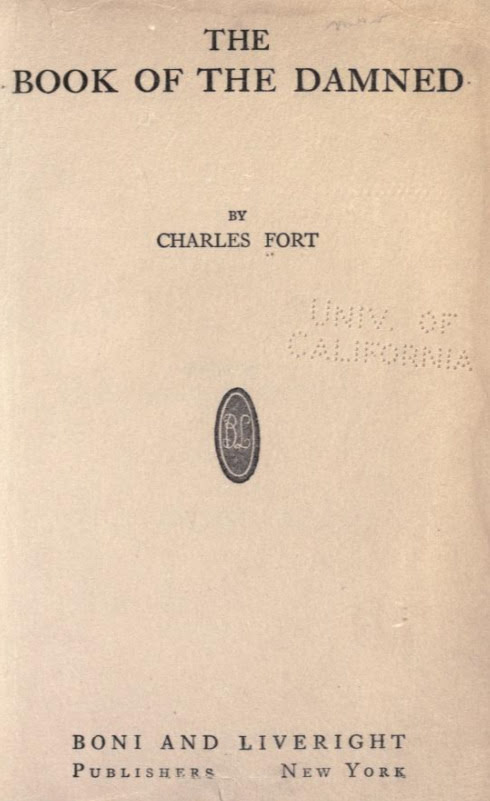
But exactly when was long unknown. Joshi stated several times (e.g. in Primal Sources) that he could not pin it down. We knew he read Damned because in September 1927 Lovecraft read Fort’s later book New Lands (1923), yet states he… “didn’t find it as interesting as [the earlier] The Book of the Damned” (Selected Letters II). Actually, “read” is misleading. Lovecraft states elsewhere that he… “skimmed over Charles Fort’s New Lands” rather than read it closely. The introduction by Booth Tarkington perhaps helps explain this skimming…

“Of his attack on the astronomers it can at least be said that the literature of indignation is enriched by it”

Lovecraft was an astronomer. One can see how, encountering the coruscation head-on in chapter two, Lovecraft might have skimmed the rest.

He could have read The Book of the Damned at any time between August 1926 and early 1920 (published December 1919, and it’s unlikely the master would have grabbed the book ‘hot off the press’ from New York). The timing of the book’s publication was opportune, with Fort presenting his material to the public on the cusp of modernity — between the dissolution of old certainties and the wavering establishment of the new modern ‘hard’ sciences.

However, we now know that Fort did not seed Lovecraft’s 1919-1926 period of writing. As S.T. Joshi writes in I Am Providence…

“Lovecraft, although having previously heard of Fort, did not read any of his work until Donald Wandrei lent him The Book of the Damned in March 1927.”

Right, so there we have it. Book of the Damned (1919) read in March 1927, and New Lands (1923) read by September 1927. It turns out that Lovecraft had…

“heard of him for years, but never read his stuff […] and now [Frank Belknap] Long, who has just encountered the material, tells me that it is marvellously weird and imaginatively captivating. Ford appears to be a man of some culture & ability, far above the usual run of ‘flat-earthers’ & kindred eccentrics.” (29th January 1927).

So here Lovecraft’s sentiment about the man is being filtered through Long’s gush. On actually reading Fort, Lovecraft’s impression was less positive…

“He is a fine author to skim, but an impossible one to read! What a fascinating jumble of rumours and traveller’s tales he has assembled & what a delicious set of conclusions he has drawn from them. He is distinctly above the average of such bizarre eccentrics & seems well versed in philosophy, though weak in science, psychology, & archaeology. I can understand why Long raved so violently about him [for Fort] is full of imaginative provocation, though the style is utterly hopeless.” (27th March 1927).

Here Lovecraft values Fort greatly as a collector, and somewhat as a dazzle-eyed wanderer in the realms of mysterious phenomena. But not as a writer, even a semi-surrealist one at times, and certainly not as a scientist dissecting “phenomena that fall outside current understanding”.

Incidentally, the books were apparently best-sellers. While the Providence Public Library may have been sniffy about stocking them, they cannot have been hard to find. But it seems Lovecraft needed Long’s spur, and then loans from Wandrei’s growing library, to actually obtain and read copies. The reading dates, now known to Lovecraftians, mean that Fort cannot have had an influence on the depiction of the correlation of widely separated mysterious events, such as in “The Call of Cthulhu” written a year or so earlier. The inspiration there is far more likely to lie back in Lovecraft’s boyhood reading of detective mysteries, and in his own collection of curious and weird cuttings in his scrapbooks. He kept his own voluminous scrapbooks, but they have not survived. Lovecraft states that he finally had his cuttings well-sorted and assembled into scrapbooks by October 1926, a long anticipated labour but one which required enough spare money to buy a large number of empty scrapbooks — and thus the process depicted in “Cthulhu” partly reflects his own sorting of his mounds of cuttings into ordered scrapbooks.

Did Fort’s books offer anything of special interest to Lovecraft? Well, take your pick from a wide range. But as Lovecraft states…

“No idea has ever fascinated me so much as that of the wafting of alien life across space, & I have enjoyed reading about these doubtful phenomena in books like Charles Fort’s eccentric Book of the Damned & New Lands!”.

So there is a possible slight influence on “The Whisperer in Darkness”, and Fort is certainly mentioned in the text. But ‘slight’ because Lovecraft was dealing in the transfer of life between systems well before he read Fort. Also because the Theosophists had similar ideas, as did the pulps. But perhaps Fort himself was an inspiration, since in “Darkness” the hero Wilmarth appears to spend much time in countering believers in Fortean phenomena. This perhaps hints at Lovecraft’s desire to put some distance between himself and “Fort’s influence on the topic” of an apparent abundance of ‘real-world weird’ material, as the master’s fan-base grew to encompass the many youngsters being influenced by Fort.

“The more I laughed at such theories, the more these stubborn friends asseverated them; adding that even without the heritage of legend the recent reports were too clear, consistent, detailed, and sanely prosaic in manner of telling, to be completely ignored. Two or three fanatical extremists went so far as to hint at possible meanings in the ancient Indian tales which gave the hidden beings a non-terrestrial origin; citing the extravagant books of Charles Fort with their claims that voyagers from other worlds and outer space have often visited earth. Most of my foes, however, were merely romanticists…” (from “The Whisperer in Darkness”).

But, as he wrote to one of these young fans — Emil Petaja — in 1935, Lovecraft the rationalist clearly saw such apparent mysteries through the prism of science. As misunderstandings, or as things logically explained… if one knew enough about physics, meteorology, natural history, and the cynicism of dime-extracting journalists.

“Assorted marvels like those in the eccentric books of Charles Fort are not hard to account for. Fort scraped up all sorts of press anecdotes of a certain type — which in turn were typical misstatements, misinterpretations, exaggerations, & distortions of actually observed things, or else hallucinations or fabrications. Track down any one of them to its reported place of occurrence, & the marvel evaporates. Unusual atmospheric effects, natural phenomena like the ‘fairy crosses’ of western Virginia, optical & chemical properties of dust storms & kindred things — these are the real sources of much of the Fort data. Another fruitful source is conscious press sensationalism — the kind of hokum peddled by the flamboyant American Weekly (of which [the writer] A. Merritt is associated!) or the Hearst rags. It ought to be significant that no genuine man of science has ever taken Fort seriously.” (31st May 1935, Selected Letters V).

A little later, in a letter to Petaja in June 1935, Lovecraft presses home the point for the lad. Fort is… “a curious nut, probably sincere — but infinitely gullible […] his books are interesting as a source of weird ideas, but have no other value.”

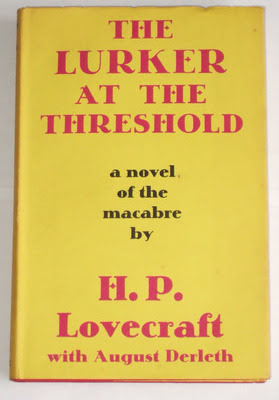
But did most of Lovecraft’s postumous fans know of Lovecraft’s faint distaste for Fort’s influence on youngsters? Perhaps not, for many decades. Since August Derleth’s popular best-seller The Lurker at the Threshold, supposedly written by/with Lovecraft, offered what appears to be a public endorsement of Fort. This could have been taken by many pre-1990s readers as reflecting Lovecraft’s own sentiments, rather than Derleth’s or the narrator’s…

“a very large, though usually suppressed, body of occurrences antipodally contradictory to the total scientific knowledge of mankind … some of which have been collected and chronicled in two remarkable books by […] Charles Fort — The Book of the Damned and New Lands — I commend them to your attention.”
So there we have it. As a man, Fort was deemed an admirable researcher, collector, and curator of a modern ‘cabinet of curiosities’, all of which allowed him to display a vivid imagination worthy of the master’s praise. As a publisher of what are said to have been 1920s best-sellers, Lovecraft might even have been a little envious, though he is silent on that point (other than to note in passing in spring 1931… “have you noticed how much more attention the fantastic and picturesque Charles Fort is receiving of late”). As a writer, Lovecraft did not admire Fort. Of course a writer is a sort of conjurer — with one hand he reveals himself in his text, while with the other he conceals. But Lovecraft does not seem to have detected any personality traits in the writing, beyond an obvious kookery and the limitations of Fort’s education and reading.

Lovecraft never met Fort in person, and so far as I know he never met anyone who had. He and Fort did not overlap while in New York City. In 1921 Fort set sail from New York City for London, Great Britain. There Fort quietly beavered away in the British Museum Library, supported by a timely inheritance from an uncle. Fort did not return to his home in NYC until 1929, by which time Lovecraft was long gone from the city.


Further reading:

The Fortean Influence on Science Fiction (2020).

Lovecraft & Fort: Martian Falcon (mystery dieselpunk novel set in New York in 1925, Lovecraft teams up with Fort).

Fish – Man

23 Thursday May 2024

Posted by asdjfdlkf in Scholarly works

≈ Leave a comment

An amusing (but true) new arrival on Archive.org, Our face from fish to man (1929) from a Columbia University professor. One wonders if Lovecraft saw it, or a review of it, before writing the ending of his “The Shadow Over Innsmouth” (1931).

With 119 illustrations.

Also seeming somewhat relevant to ye olde fishy-ones, news that “Pluto’s Subsurface Ocean is 8% Denser than Seawater on Earth”. Yup, “in recent years, scientists have gathered evidence suggesting Pluto likely contains an ocean of liquid water beneath the ice”, ice which provides “a blanket of protection that likely keeps the inner ocean from freezing solid.” Who knew? Not me. But it appears that the real Yuggoth has a liquid ocean habitat, of sorts.

“Whatcha thinka the NEW PLANET? HOT STUFF!!! It is probably Yuggoth.”” (Lovecraft to Morton, on the discovery of Pluto).

Poems from Providence

22 Wednesday May 2024

Posted by asdjfdlkf in Lovecraftian arts

≈ Leave a comment

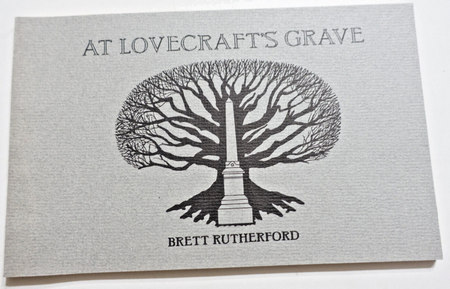
An eBay listing sent me in search of a 1980s poetry chapbook, being sold there…

I found something better and far larger. The author’s Poems from Providence (20th Anniversary Edition). Under Creative Commons, free on Archive.org, and seemingly posted there by the author himself.

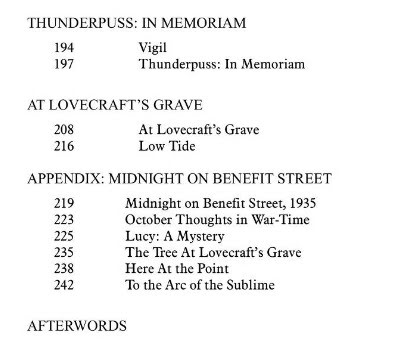
a huge compendium of all the poems American poet Brett Rutherford created during his first years in Providence, Rhode Island (1985-88)

These poems near the end appear to be the most Lovecraft -focused, judging by the titles…

Premiere – The Great Dreamer Suite

21 Tuesday May 2024

Posted by asdjfdlkf in Lovecraftian arts, Podcasts etc.

≈ Leave a comment

From Italy and ‘Stereonomicon’ (Marco Zanelli), the premiere of his “The Great Dreamer Suite: Hommage a Clark Ashton Smith”. It aired yesterday, live on YouTube.

On the silver dream…

20 Monday May 2024

Posted by asdjfdlkf in Scholarly works

≈ Leave a comment

A new “personal call” for pointers to scholarly items relating to Lovecraft’s cinema.

Shakespeare vs. Cthulhu

19 Sunday May 2024

Posted by asdjfdlkf in AI, Lovecraftian arts

≈ Leave a comment

Now crowd-funded and in development, Shakespeare vs. Cthulhu, a solo RPG based based on the well-reviewed 2016 book of stories. This new adaptation will offer an…

“interactive, branching narrative, solo-RPG gamebook”

And the author has created such choose-your-own-adventure / RPG books before, including for Dracula, Beowulf, and Alice. The new Shakespeare vs. Cthulhu sounds fun, and will also presumably work well.

Of course this sort of thing is going to be susceptible to AI in the near future — in terms of real-time generated AI voices / character-depth/back-story, on-the-fly music and ambience FX, and AI control of branching storylines. We’re likely to see these possibilities spawning new low-cost interactive AI audio-adventures, at least for an audience which can bring their own visual imagination to the party and doesn’t need to be spoon-fed with expensive visuals.

Until then, Shakespeare vs. Cthulhu is old-school paper and dice. Due in April 2025.

Key of Dreams review

18 Saturday May 2024

Posted by asdjfdlkf in Lovecraftian arts

≈ Leave a comment

Key of Dreams reviewed, in “Fantastical 24-hour immersive experience like no other”…

Taking place in a beautiful 17th century manor house deep in the Welsh countryside […] Inspired by the works of weird fiction authors like H.P. Lovecraft and M.R. James, guests took on the role of Friends of The Miskatonic University, heading to the manor house to investigate the strange goings on. Arriving in time for lunch, my companion and I were greeted by a mysterious man dressed in Victorian clothing known simply as The Collector.

A long participant-review in The Express. A UK tabloid newspaper notorious for its over-claiming piffle ‘news’, but here quite reasonable.

Armitage Symposium deadline

17 Friday May 2024

Posted by asdjfdlkf in Scholarly works

≈ Leave a comment

The submissions (not bookings) deadline is fast approaching for The Armitage Symposium part of NecronomiCon. The deadline is 24th May 2024. The event is at the Omni hotel in Providence, 15th-18th August 2024.

Tolkien Gleanings #200

17 Friday May 2024

Posted by asdjfdlkf in Odd scratchings, Scholarly works

≈ Leave a comment

I’ve now reached Tolkien Gleanings #200 with my Tolkien news-round-up posts.

The Great Race

17 Friday May 2024

Posted by asdjfdlkf in AI, Lovecraftian arts, Picture postals

≈ Leave a comment

This week on my regular ‘Picture Postals’, a change from the usual (though, in a way, following on from the recent ‘comic-strip’ themed post). I’ve used Photoshop to isolate Lovecraft’s own sketch drawing of The Great Race (“The Shadow out of Time”) from its surrounding notes and also from the blue lined paper on which it was drawn.

Original

Extracted and cleaned, as a 2196-pixel .PNG file. Still a bit mucky down at the base, but I reckon a mollusc is ‘gonna get gloopy’ down there.

Feel free to try to use this as a Controlnet guide input for an AI image generation. Though, good luck in writing the prompt description.

Letters to Wilfred B. Talman – the sixth set of notes

16 Thursday May 2024

Posted by asdjfdlkf in Scholarly works

≈ 1 Comment

My sixth set of notes on the book of Lovecraft’s Letters to Wilfred B. Talman and Helen V. and Genevieve Sully (2019). Lovecraft is still writing to Talman, at this point in the book. Thee notes begin at the end of July 1936.

p. 255. “Walked to Hunt’s Mills yesterday and did a lot of writing on the rocks beside the falls.” This is Lovecraft venturing into relatively new local territory, late in his life. See also p. 273 for other walks to new local places.

p. 255. “The latest issue of The Californian has a long fantasy which utterly surprised me with its fine rhythm, poetic imagery, & cosmic imagination”. This was by Barlow, “A Dim-remembered story”.

p. 260 and p. 262 and p. 267. Lovecraft gives substantial charts of parts of his family tree.

p. 264. “Site of Jake’s still vacant”. This being Jake’s cafe, a favoured cheap haunt which HPL would often take visitors to. In a slightly later letter of 25th August 1936, HPL reveals he had been down to their “slum” Wickenden Street branch on the edge of Fox Point, which appears to have serviced the Fox Point dockside trade, and found it closed. It had formerly remained open while the central branch had shut, as evidenced by a September 1935 letter to Wandrei…

I have discovered the slum branch of Jake’s is still open, so that if the call of old times is sufficiently strong, we can plunge down South Main St. & tank up with the familiar overdoses in a hardy waterfront section where the sparrows chirp in bass & the policemen go in carbine-bearing squads.” (November 1935, the volume of Wandrei letters, page 345). [carbine-bearing = bearing rifles].

But even this outpost of Jake’s was gone by August 1936, presumably a late casualty of the Great Depression.

p. 271. Due to a sloppy publisher, Lovecraft has lost… “my only lendable copy of ‘Hypnos’ and much irreplaceable N.A.P.A. [amateur journalism papers] matter to boot”. This was apparently due to unprofessional behaviour at “Loring & Mussey” the publisher. I Am Providence reveals that Mussey’s wife read the submissions and “doesn’t like the stories”. The proposal for a book was thus turned down, and from what Lovecraft says here it appears that his unique submitted material was not returned.

p. 272 and p. 275. Lovecraft speculates at length about writing a novel, but gives no indication of the setting or theme. “I shall probably be trying some novel of the given kind eventually, whether or not any market exists for it.” p. 276. “I have for the last few weeks been trying to clear my programme for another of my seasons of fictional experimentation […] it is quite possible I may arrive at the novel-synopsis stage”. But this was November 1936, and more stories and a novel were not to be.

p. 277. He was then living on “$10.00 to $15.00 per week”, and writes that he will soon have to do “some sort of job-hunting outside writing. I may run an elevator”. In those days large elevators (lifts) had uniformed male attendants in hotels and large business enterprises.

p. 281. Arthur Leeds last known address, as known to HPL in January 1936, was “228 Henry St., Brooklyn.”

And then a short further letter of 28th February — “constant pain” — and that was the last sent to Talman.


The letters to Helen V. Sully then begin, the first dated the end of July 1933.

p. 287-88. Advice on what to see in Quebec. Champlian St. in Quebec… “The region (with empty, gaping cellars on one or both sides) appears to be wholly deserted, & some still tenanted by a squalid population. The spectrally sinister air of this hideous backwater — isolated from the healthy world & crowded between the brooding gulfs of the sea & the sullen bedrock of Mother Earth — is of ineffable imaginative fascination.” On p. 293 he recalls that “most of my circuit of the Isle d’Orleans (Île d’Orléans) was accomplished amidst pouring floods”. The isle was a traditional Quebecois island near the city, which old guidebooks say is “surrounded by reefs and shoals”.

p. 289. The price-competing Providence-to-Newport boats. “Old Sagamore is down to 50c … & Mount Hope has met Nelseco II‘s 75c.” “If rates get down to a quarter I shall become a virtual commuter!” Nelseco II is a new one to me, though it appears to have been too expensive for Lovecraft. Evidently it was competing for the upmarket trade in the summer of 1933. Fast and exclusive, by the look of it…

Nelseco II

The big Mount Hope. Apparently had a ballroom on board!

p. 293-97. Extensive and evocative memories of his Quebec trip, which should be appended to any reading of his guidebook to the city.

p. 296-97. “A feature of constant interest was the sky — the grotesque and mystical cloud effects of a sort peculiar to the far north. [… this] indubitably plays a part in the mystical temperament of northern as distinguished from southern races. [The surviving myths and legends of the North] are all products of a climate whose mists and vapours, & capricious gradations of light and shade, conduce to feelings of cosmic uncertainty, vague expectancy, & the imminence of unseen marvels.”

p. 299. Isolated Marblehead had an unusual character partly due to the people as well as the isolation, being settled by… “Channel Islanders rather than the East Anglian stock dominant among the Puritans”.

p. 286. “So far as I can see the destruction of values leads only to net impoverishment of life; since new values of real, subconscious validity cannot be created over night”. p. 308-09. “The trouble is that substitutes can’t be devised over night. They have to grow by gradual accretion through long centuries of homogenous & continuous experience before they can dominate the subconscious mind & provide that sense of direction and purpose which alone saves life from becoming a nightmare”. […] It is then our task to save existence from this [current modern] sense of chaos & futility by rebuilding the purely aesthetic & philosophical concept of character & cosmic pseudo-purpose — re-establishing a realisation of the necessity of pattern [which can be found most easily in Christianity]. The framework it has bequeathed will serve a useful purpose — ensuring for the increasingly non-religious ethics of the future that force of traditional continuity which realists recognise as so essential to any real working system of action or emotion.”

p. 309. “It would have been better if we had kept our classical conception of ethics as a matter of beauty, good sense, & taste — the province of the non-supernatural philosopher — for its survival would not then have been so imperilled by the decline of religion.”

p. 320. November 1933. The communist culture of the Russian Soviets is being made by… “under-men who never really belonged to any civilisation. They were too primitive and close to bare animal struggle for subsistence to share any but the crudest and simplest attributes of the old culture. It is because they had so little anchorage in the past that they are now able to devote themselves so wholly to an unknown future”.

← Older posts
Newer posts →


Please become my patron at www.patreon.com/davehaden to help this blog survive and thrive.

Or donate via PayPal — any amount is welcome! Donations total at Easter 2025, since 2015: $390.

Archives

  • February 2026
  • January 2026
  • December 2025
  • November 2025
  • October 2025
  • September 2025
  • August 2025
  • July 2025
  • June 2025
  • May 2025
  • April 2025
  • March 2025
  • February 2025
  • January 2025
  • December 2024
  • November 2024
  • October 2024
  • September 2024
  • August 2024
  • July 2024
  • June 2024
  • May 2024
  • April 2024
  • March 2024
  • February 2024
  • January 2024
  • December 2023
  • November 2023
  • October 2023
  • September 2023
  • August 2023
  • July 2023
  • June 2023
  • May 2023
  • April 2023
  • March 2023
  • February 2023
  • January 2023
  • December 2022
  • November 2022
  • October 2022
  • September 2022
  • August 2022
  • July 2022
  • June 2022
  • May 2022
  • April 2022
  • March 2022
  • February 2022
  • January 2022
  • December 2021
  • November 2021
  • October 2021
  • September 2021
  • August 2021
  • July 2021
  • June 2021
  • May 2021
  • April 2021
  • March 2021
  • February 2021
  • January 2021
  • December 2020
  • November 2020
  • October 2020
  • September 2020
  • August 2020
  • July 2020
  • June 2020
  • May 2020
  • April 2020
  • March 2020
  • February 2020
  • January 2020
  • December 2019
  • November 2019
  • October 2019
  • September 2019
  • August 2019
  • July 2019
  • June 2019
  • May 2019
  • April 2019
  • March 2019
  • February 2019
  • January 2019
  • December 2018
  • November 2018
  • October 2018
  • September 2018
  • August 2018
  • August 2015
  • July 2015
  • April 2015
  • March 2015
  • February 2015
  • January 2015
  • December 2014
  • November 2014
  • October 2014
  • September 2014
  • August 2014
  • July 2014
  • June 2014
  • May 2014
  • March 2014
  • February 2014
  • January 2014
  • December 2013
  • November 2013
  • October 2013
  • September 2013
  • August 2013
  • July 2013
  • June 2013
  • May 2013
  • April 2013
  • March 2013
  • February 2013
  • January 2013
  • December 2012
  • November 2012
  • October 2012
  • September 2012
  • August 2012
  • July 2012
  • June 2012
  • May 2012
  • April 2012
  • March 2012
  • February 2012
  • January 2012
  • December 2011
  • November 2011
  • October 2011
  • September 2011
  • August 2011
  • July 2011
  • June 2011
  • May 2011
  • April 2011
  • March 2011
  • February 2011
  • January 2011
  • December 2010
  • November 2010
  • October 2010
  • September 2010
  • August 2010
  • July 2010

Categories

  • 3D (14)
  • AI (70)
  • Astronomy (70)
  • Censorship (14)
  • de Camp (7)
  • Doyle (7)
  • Films & trailers (101)
  • Fonts (9)
  • Guest posts (2)
  • Historical context (1,095)
  • Housekeeping (91)
  • HPLinks (74)
  • Kipling (11)
  • Kittee Tuesday (92)
  • Lovecraft as character (58)
  • Lovecraftian arts (1,626)
  • Lovecraftian places (19)
  • Maps (70)
  • NecronomiCon 2013 (40)
  • NecronomiCon 2015 (22)
  • New books (966)
  • New discoveries (165)
  • Night in Providence (17)
  • Odd scratchings (984)
  • Picture postals (276)
  • Podcasts etc. (431)
  • REH (184)
  • Scholarly works (1,469)
  • Summer School (31)
  • Unnamable (87)

Get this blog in your newsreader:
 
RSS Feed — Posts
RSS Feed — Comments

H.P. Lovecraft's Poster Collection - 17 retro travel posters for $18. Print ready, and available to buy — the proceeds help to support the work of Tentaclii.

Proudly powered by WordPress Theme: Chateau by Ignacio Ricci.