HPLinks #105.
* A short Hungarian Masters dissertation The Shadow over New York: The Strain Vampires (2026) sees Lovecraftian themes and ideas in The Strain Vampires TV series (2014-2017). Freely available online, and it turns out to be in English.
* Narrative and the Uncanny from Hoffmann to Lovecraft: Desire and the Phantom Self (2026), a new book from Bloomsbury…
… develops an aesthetic of the uncanny that draws together elements of hauntology, psychoanalysis, aesthetics, and ideology. In terms that reconcile Freud’s theory of the uncanny with Lacan’s analysis of desire, he also puts forth an analysis of the uncanny in fiction that delineates the ideological implications of narrative technique.
* New and in Portuguese, the journal article “O Medo Do Desconhecido. Jung E A Compreensao Do Medo E Sua Representacao No Horror Cosmico De Lovecraft” (‘The Fear Of The Unknown: Jung’s Understanding Of Fear And Its Representation In Lovecraft’s Cosmic Horror’). Freely available online.
* Also new in Portuguese, the journal article “Clausurando lo sublime en la vineta. Los cuerpos monstruosos de At the Mountains of Madness, de H.P. Lovecraft, en las adaptaciones de Gou Tanabe e I.N.P. Culbard” (‘Enclosing the sublime in the comic strip: The monstrous bodies of H.P. Lovecraft’s At the Mountains of Madness, in the [graphic-novel] adaptations by Gou Tanabe and I.N.P. Culbard’). The URL is currently unresponsive, but almost all Latin American journals are open-access.
* New in the journal The Polar Journal, “Historic and scientific detail in early Antarctic speculative fiction” (captcha and $ paywall).
* The new journal article “Did communist women dislike comic books? Motherhood, communism, and moral panic in the 1950s?”. Unearths evidence that the 1950s moral panic about horror comics was in part fuelled by Soviet-aligned communist groups and their fellow travellers.
* A new issue of Mythlore, freely available online. Includes among others the article “Conservative Demons and Countercultural Creators: Hellish Societies in the Dark or Modern Age of Comics”.
* On YouTube, this year’s annual Halloween look at The Horror Stories of Robert E. Howard, from the REH Foundation.
* Taskerland reviews the Barlow and Lovecraft collaboration “The Hoard of the Wizard Beast”.
* Fandom Pulse on “Forgotten Legends: Robert Silverberg”, specifically Silverberg as an editor and gatekeeper.
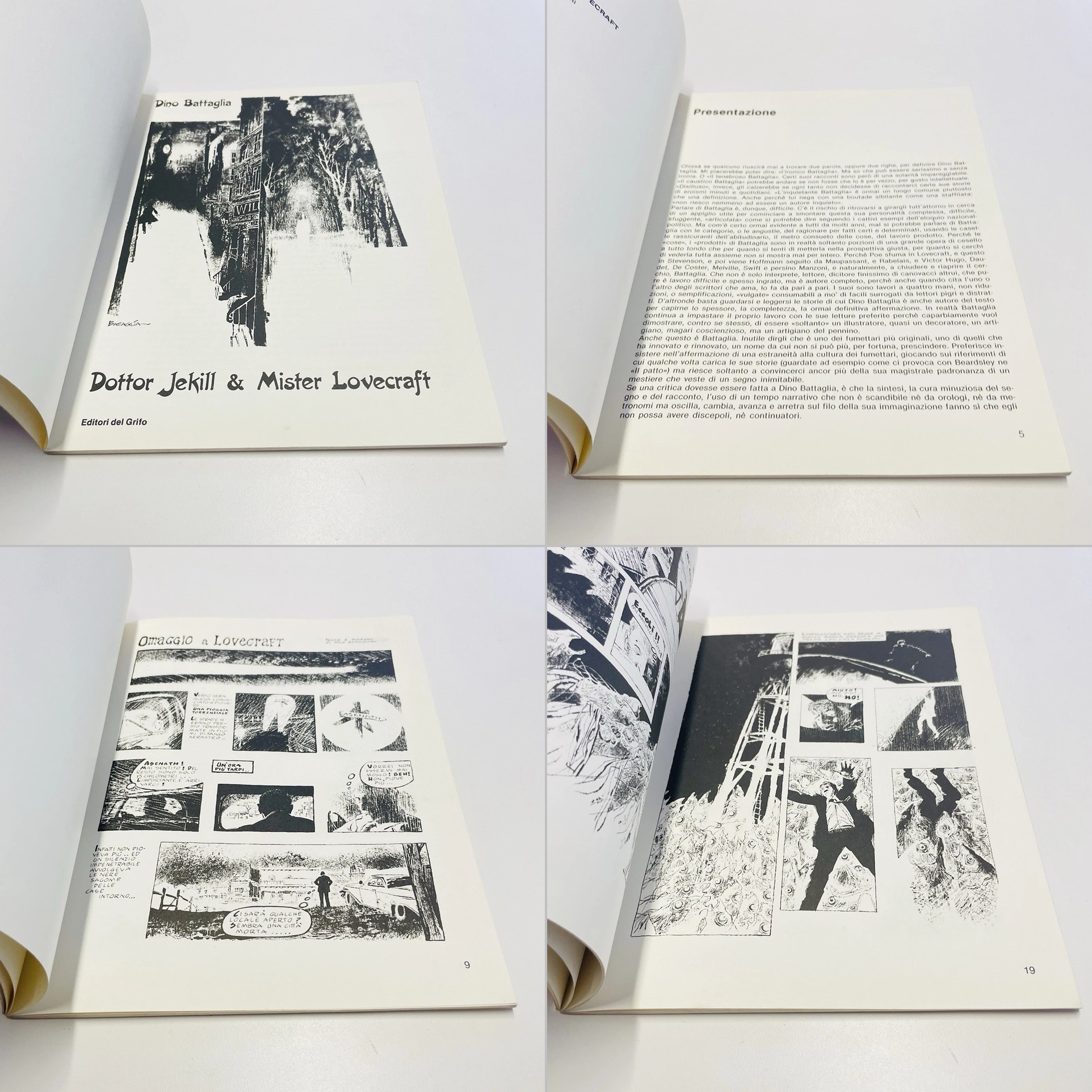
* An unusual item on eBay, Dino Battaglia‘s Doctor Jekill & Mister Lovecraft, a 1983 ‘BD’ eurocomic with a double-bill of two tales. So it appears that it’s not “Dr. Jekyll meets Lovecraft the man”.
* On YouTube, The Rybrary recalls “My Weekend at the H.P. Lovecraft Film Festival”.
* A call to Register for PulpFest 2027.
* S.T. Joshi’s new blog post notes… “plans to publish the scripts of the Open Circle Theater adaptations of Lovecraft’s works”, staged decades ago in Seattle. He also notes that 65 Prospect Street (formerly 66 College Street) is now up for sale for piffling $1.25m (American house prices look so cheap, from here in the UK). Surely an amount that’s not beyond a crowd-funder, these days? And I guess it’s not impossible it could be moved again.
* An Edmund R. Whitcomb has three new chunky paperback-only books new on Amazon, Who’s Who in H.P. Lovecraft: A Guide to the Characters, Families, Scholars, Explorers, Occultists, and Narrators in His Fiction; and A Gazetteer of H.P. Lovecraft: A Guide to the Cities, Towns, Streets, Rivers, Buildings, and Other Places of Lovecraft’s Fiction; and The Lovecraft Bestiary: A Guide to the Creatures, Races, and Beings in His Fiction. The blurbs don’t reassure me that ChatGPT has not just assembled the 1000+ pages of the three volumes, which is rather off-putting. Could be the labour of a lifetime, now seeing publication at last… or could be the product of a day merrily spent burning tokens with ChatGPT? Who knows?
* And finally, an interview from the latest Providence Journal newspaper, “How an acclaimed opera singer became Providence’s Bride of Cthulhu”. No region-block or captcha for me, but you may not be so lucky.
— End-quote —
As a youth… “I acted ‘plays’ innumerable in the library at home, to the music of my own whistling — substitute for the enthralling orchestra at the Opera House. The best of my plays was Elizabethan — ‘The Tragicall Historie of ye Emperour Caracalla’. I rather shocked everyone by my ferocious delineation of the murder of Geta, the Emperor’s brother.” — Lovecraft to Rheinhart Kleiner, November 1916.
“What a second home the old Opera House used to be to me!” — Lovecraft in Letters to Family. He had also trodden the boards, when as a youth he had “slung from the stage” of the Opera House great slabs of a Shakespeare tragedy, given with “vigorous, orotund delivery”.
“Much remains to be discovered about the suggestibility of the human imagination, & this ‘occult’ business deserves minute examination. […] Of the nature of that magic, the investigations & the duplicating feats of the late Houdini give at least an opening clue. I saw him do on the stage of the Providence Opera House only a fortnight before his death things impossible according to the known laws of the physical world.” — Lovecraft to Derleth, October 1936. The Opera House had been torn down in 1931.