
HPLinks #103.
* The unfinished documentary Lovecraft: When the Stars are Right has been funded on Greenlit, albeit with only £10,000 of the target £20,000. It seems a target doesn’t have to be hit for Greenlit to release the funds? Good to know.
This is the first film ever made about H.P. Lovecraft — and almost no one has seen it. Shot in 1989–90, it features unique interviews with Lovecraft’s friends and colleagues. It has sat unfinished for more than thirty-five years.

* S.T. Joshi has republished his 1982 Starmont introductory book on Lovecraft as an budget-priced ebook… “under the title H.P. Lovecraft: A Short Critical Analysis and …
In this edition I have added my lengthy discussion of Lovecraft’s correspondence (“A Look at Lovecraft’s Letters”).
* Joshi’s latest blog post also notes a new ‘Lovecraft as character’ novel, albeit in Italian. “Stefano Varanelli has written a novel about Lovecraft and Houdini”, Sotto la Piramide (2026). The author is an accomplished TV writer in Italy. A translation of a blurb accompanying a podcast interview with the author (spoilers) reveals the framing…
The year is 1927. After months of mourning the sudden death of his wife, Bess, Harry Houdini reconnects with an old associate: H.P. Lovecraft. Orphaned and recently expelled from boarding school for very good reasons, Houdini’s niece Anna finds herself unwillingly swept up in the adventures of Houdini and Lovecraft, who become — albeit imperfect — surrogate father figures to her. Invited to a coastal Rhode Island manor, this mismatched trio must piece together a centuries-old chain of events surrounding the disappearance of the estate’s owner, the inventor and entrepreneur Randolph Baxter. […] The novel balances between historical reality — known in detail yet also the stuff of dreams — and fantasy, fueled by the genre’s conventions as well as by true history.
* A new PhD thesis from Manchester Metropolitan University, England, Towards a Weird Hydropoetics: Hybridity, Thalassophobia, and Transcorporeality in Modern and Contemporary Oceanic Weird Fiction (2026). The first half of the thesis looks at the history of “The Weird and the Sea”, and then in this light examines Lovecraft’s tales “Cthulhu” and Innsmouth”. Freely available online.
* The French newspaper Le Monde has an article noting new books of Lovecraft’s tales. It’s a shallow example of the typical hasty journalist’s potted ‘Lovecraft for absolute beginners’ article. But it usefully makes me aware of a substantial new French edition of Lovecraft. The collection being noted turns out to be published by the newspaper as a set, with the books seemingly using the text of the recent and acclaimed new translation — but here issued as a handsome but affordable multi-volume set. Of most interest to English-speaking readers will be the artwork extras, such as the accompanying poster and prints sets.
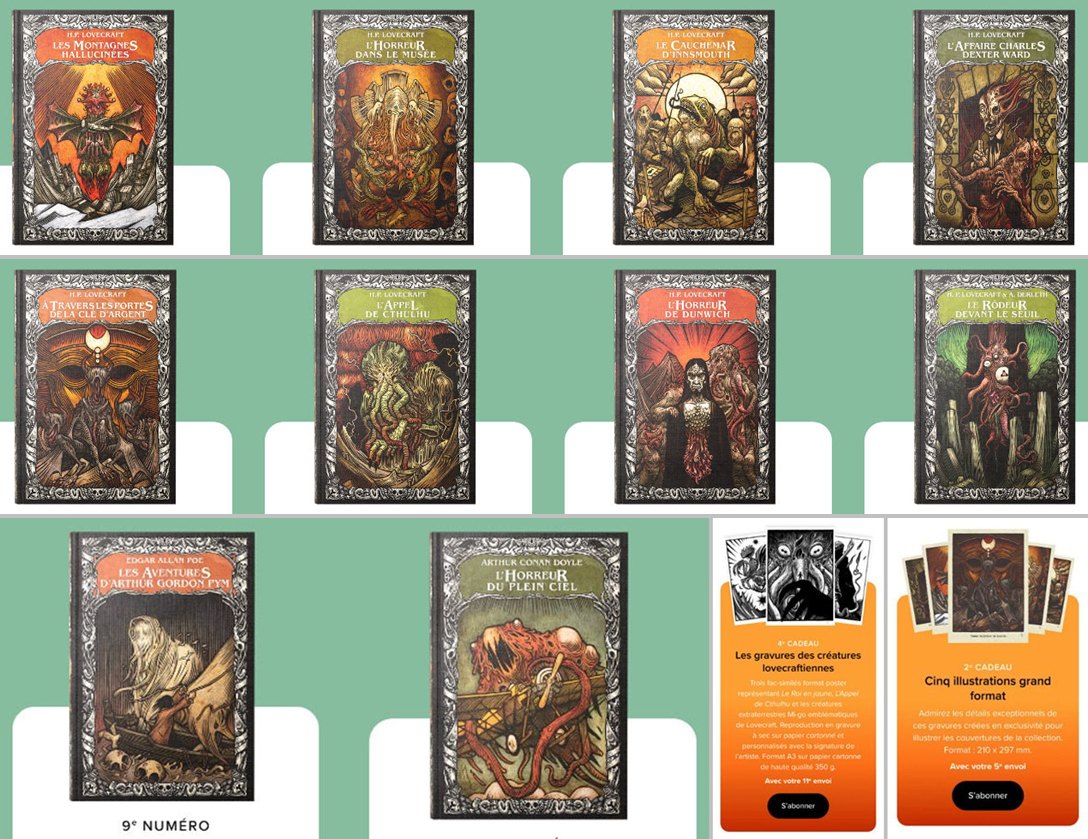
Le Monde also has a short interview with the cover artist Tomas Hijo…
I like to think that my illustrations capture something of the brutality and naivety of those early images [in pulp magazines, yet at the same time Lovecraft’s imagination evokes] … impossible geometries, nonexistent colors, illogical structures [so…] I wanted to draw on certain now-traditional representations of the bestiary and transpose them into a universe of unsettling shapes and colors, which suggest these qualities described by Lovecraft. [The linocut style was chosen to work for] “stories full of grimoires, ancient manuscripts, and works that one can easily imagine being illustrated using a technique of this kind, like medieval codices.
* Jason Thompson, who made a fine complete graphic novel of Lovecraft’s Dream Quest along with a Dreamlands wall-map, has a new book due in 2027. Dungeons! Illustrated Maps of Classic Dungeons & Dragons Adventures.
* New from McFarland, the book Myth and Fabulation in the Fantasy Fiction of Neil Gaiman, which started life as a 2012 French PhD thesis. The blurb suggests it may overlook Lovecraft as a key influence, though…
Available in English for the first time, this wide-ranging critical study examines Neil Gaiman’s fiction through the lenses of intertextuality, metafiction, and cultural context. Informed by comics, novels, short stories, and film, Camus situates Gaiman’s oeuvre within a literary network that includes Alan Moore, Shakespeare, Borges, Philip Jose Farmer, Jack Kirby, and Winsor McCay. The study explores how myth operates across Gaiman’s fiction as both an inherited narrative and an evolving cultural practice, shaping the meaning and structure of his works.
* Florida’s 48th International Conference on the Fantastic in the Arts has the theme “Fantastic Appetites” and is now calling for papers, with “hunger for knowledge” being one the suggested themes. Deadline: 31st October 2026.
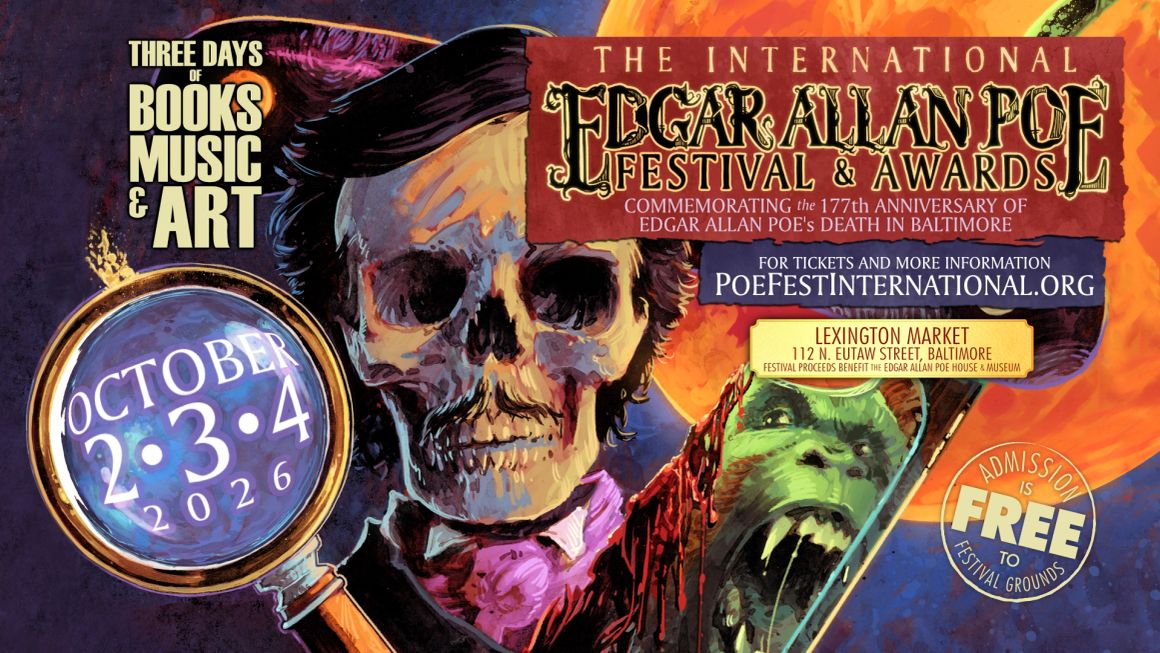
* Coming this weekend, the 2026 International Edgar Allan Poe Festival. Tickets still available.
* Jules Burt has a YouTube tour of the recent Innsmouth Literary Festival, a gathering of UK Mythos writers…
We tour the dealers room and have a close look at the tables of Dorset Bob and many other exhibitors and authors. We get to interview artist Les Edwards, editor and publisher Trevor Kennedy and author and editor Stephen Jones.
* Some advance details of a ‘sound novel’ videogame of “Ex Oblivione — Lovecraft’s 1921 text, dreamed six ways”.
H.P. Lovecraft’s prose poem of the same name, read in full, and then dreamed five more times. Each dream retells the same eleven paragraphs, and each takes one of the senses away, in the order the Tibetan Book of the Dead gives for dying. There is no combat and there are no puzzles. There is text, a voice (Lani Minella narrates every dream), and a dark ambient score by Last Offices that dissolves along with the senses. It comes to Steam in 2027, with a demo during Steam Next Fest in February. Follow here for news, and for glimpses of how a sound novel is built.
* Taskerland considers “The Slaying of the Monster: Lovecraft, Barlow and a Misread Protege”…
Written during the autumn of 1933, “The Slaying of the Monster” (full text) is only six paragraphs long and appears not to have been formally published until the mid-1990s when an effort was being made to exhume all of the work to which Lovecraft had contributed. The story is insubstantial and its author thought so little of it that he never got round to submitting it for publication, but it is biographically significant as the first official collaboration between Lovecraft and the boy who would eventually be selected as his literary executor.
* Brett Rutherford has personally uploaded his poetry collection An Expectation Of Presences to Archive.org under Creative Commons. Including poems such as “H.P. Lovecraft at the Newsstand”.
* Also new on Archive.org, a newly uploaded 20-issue archive of Starlog’s spin-off magazine Future Life, from the late 1970s/early 1980s. Sadly it passed me by at the time, perhaps because it was never distributed here in the UK? But I see it had a 31-issue run, showcasing cosmic optimism rather than cosmic horror. As such it seems an interesting view of a moment when some tried to push back against the doomsters. (Update: Thanks to John Coulthart, who points me to the full run of 31 issues).
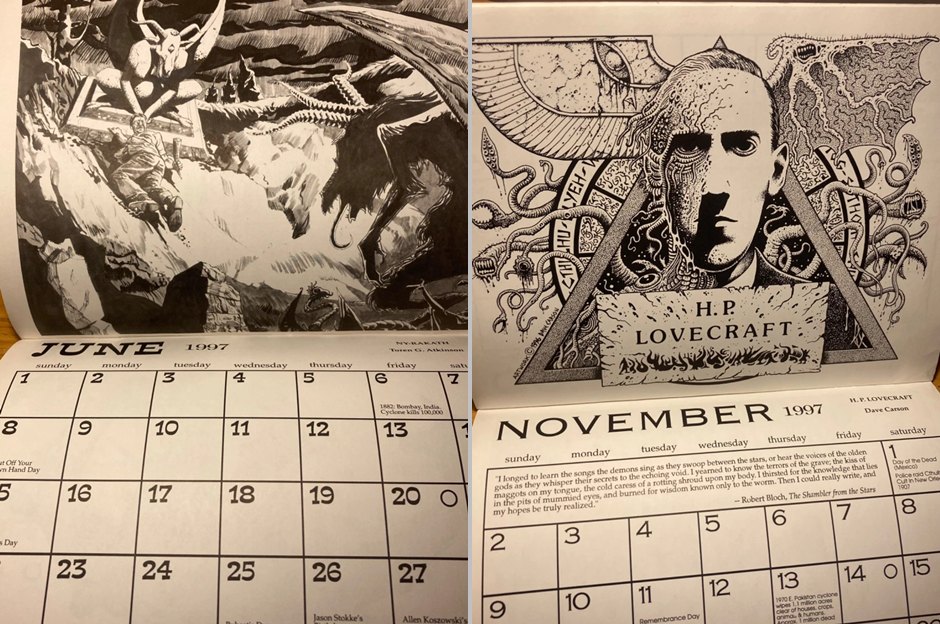
* Talking of vintage publications, eBay currently has the 1997 Cyber Cthulhu Calendar issued by the Lovecraft band The Darkest Of The Hillside Thickets. With sample images (various artists in b&w).
* Reel & Rock is waiting for the bus with H.P. Lovecraft.
* Chaosium invites you to submit questions for the forthcoming official podcast on the new Encyclopedia Cthulhiana edition… “Our host Bridgett Jeffries will be talking with Encyclopedia Cthulhiana author Dan Harms.”
* Currently on Humble Bundle (software bundles sold for charity), STL Lovecraftian Miniatures Mega Bundle. Collections of digital files for 3D printable miniature figures, intended for Lovecraftian tabletop adventures. STL also have a current Kickstarter for their forthcoming collection “Worshippers of the Waning Moon” (Leng in the Dreamlands: Moon-Beasts, Men of Leng, investigators, and the High Priest Nyarlathotep). You need a 3D printer for these, though I imagine the .STLs will load in any good 3D editor, and then a grey render could be used as a reference image for generative AI.
* The excellent new generative video model Minimax H3 now has a 1920s horror LoRA along with an ‘aged film’ slider LoRA (two variants, oxidisation or scratches). LoRAs help guide the video generation onto the style you want, in combination with your text prompt. All free, as is the way with local AI.
* And finally, eBay has a picture new to me of the Arcade in Providence, one of Lovecraft’s favourite places in childhood and later. The image provides a context I wasn’t previously aware of – right next door was the twice-daily + Sunday newspaper the Providence Daily Tribune. The young Lovecraft published astronomy articles in the newspaper.

— End-quote —
The young Lovecraft is saved from a watery suicide in the Seekonk, by the Providence Daily Tribune… “[19]06 …. or very possibly, ’07. About then I had a nervous breakdown (winter ’05-’06) & had to stay out of school for months, & my lack of energy stopped my even thinking about anything. Then the Providence Tribune was founded, & I learned that I had a good chance of breaking into print at last … contributing monthly astronomical articles just like Prof. Upton’s [of the Observatory] in the [Providence] Journal & Bulletin. One couldn’t miss a chance like that! Let suicide wait! And the articles landed…” — Lovecraft to Vernon Shea, February 1934. The articles can be found in Collected Essays: Science.