
Newly popped up on eBay, the original study for “Longitude East” in Charleston, meaning Longitude Lane looking east, near Adger’s Wharf. By Sydney Richmond Burleigh (1853-1931, founder of the Providence Art Club).
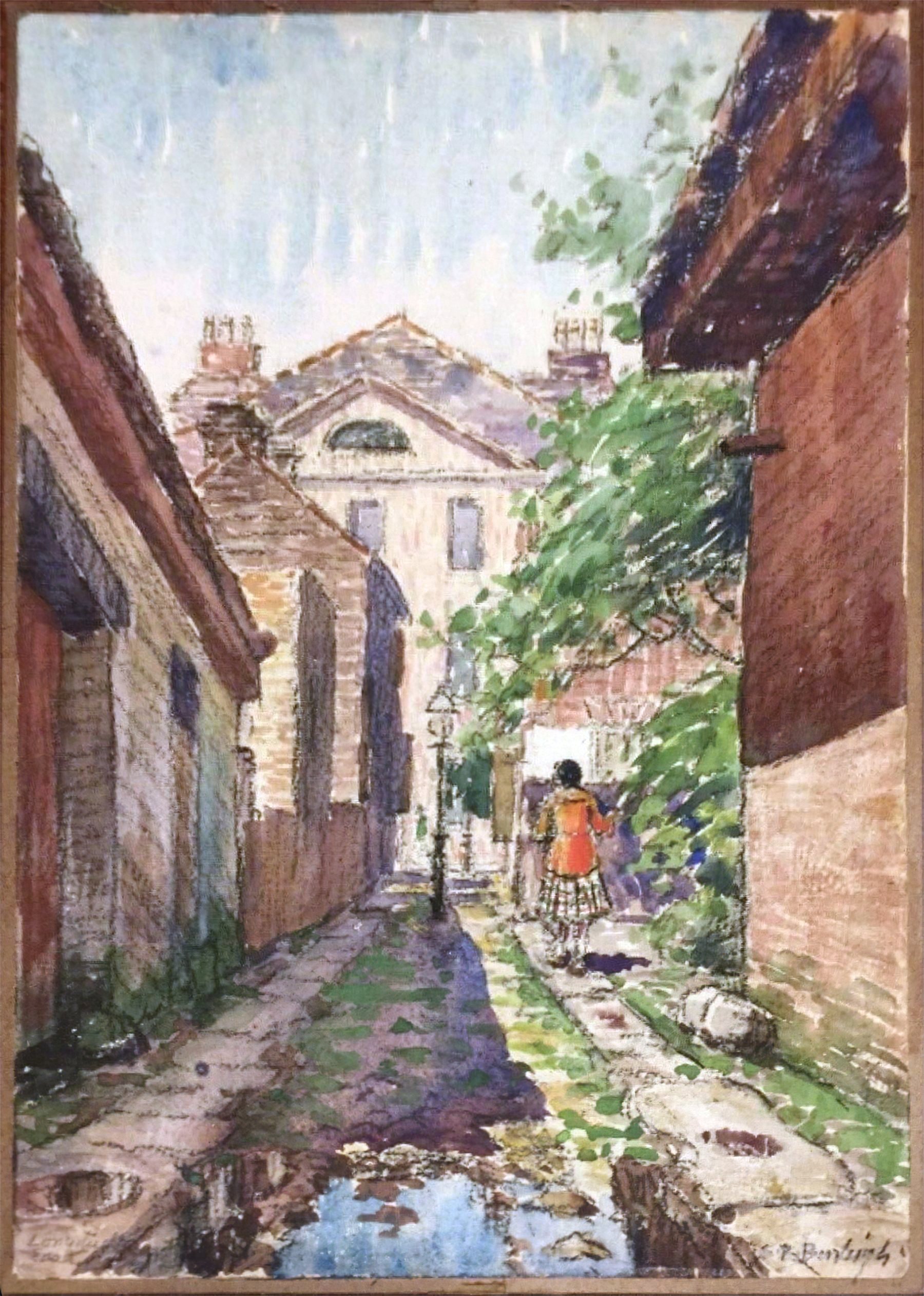
His dates and the girl’s clothes suggest the post-Victorian period, so this seems more or less as Lovecraft saw and described it on his trips…
We soon come to Longitude-Lane, leading back to Church-Street … turning into Longitude-Lane, we pass by the moss-grown brick walls of abandon’d cotton warehouses; noting the cobblestones set for mules’ feet, the flagstones for the dray-wheels, and the snubbing-posts at the warehouse doors. One of these posts is an old ship’s cannon. To the writer this place has a melancholy charm of a very acute sort.” (H.P. Lovecraft, on Charleston, in Collected Essays Vol. 4: Travel)
Lovecraft…
recognised that the heart of colonial Charleston is the relatively small area south of Broad Street between Legare and East Bay, including such exquisite thoroughfares as Tradd, Church, Water, and the like; the alleys in this section — Bedon’s Alley, Stolls Alley, Longitude Lane, St. Michael’s Alley — are worth a study all their own.” (S.T. Joshi, I Am Providence)
One even wonders if Lovecraft’s hymns to Charleston reached the ears of Burleigh in Providence, and sent him down there himself in his old age. Though doubtless such charming and warm places had already been discovered by older artists who were averse to the Providence winters.
Hi. I own this painting. I’m wondering where you got this information. I can’t find an image of the finished Longitude East that this work was an initial study for.
Thanks
Hi. I have a vague memory that I triangulated from Lovecraft’s names of the various streets, and either used Google Street View or an old photograph to confirm the direction-of-view details. Ah yes, this is it… https://www.charlestonmuseum.org/research/collection/longitude-lane/3BC26745-651A-46E4-960E-178355049401
I would imagine that this may have been the final ‘on-the-spot’ painting, one of many that day, rather than a study for a worked-up final painting. The dress style suggests it was toward the end of the artist’s life, and he had probably lost interest in full-blown gallery paintings by then. Just my guess, based on the dates.
But it may be that I had also found the final version at some museum website, which is why I called it a “study”.
Thanks so much for the additional information.