
HPLinks #102.
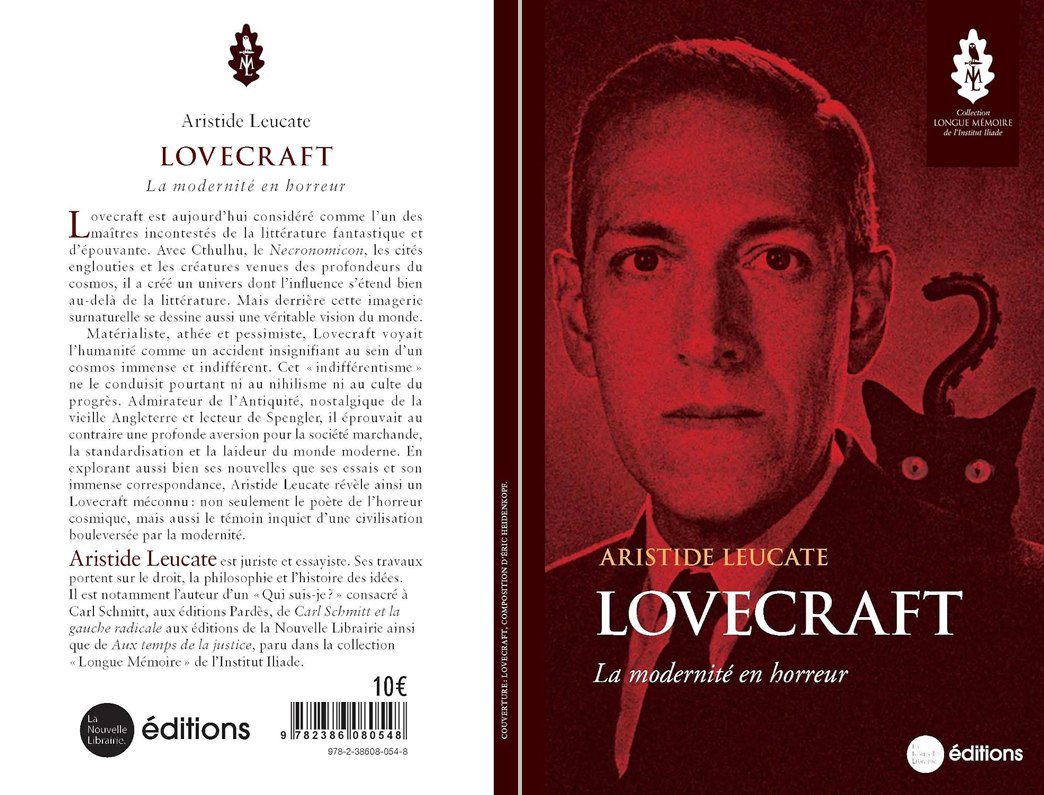
* A new book in French from the essayist Aristide Leucate, Lovecraft: La modernite en horreur (2026)…
Lovecraft’s ‘indifferentism’ led him neither to nihilism nor to the cult of progress. An admirer of classical antiquity, nostalgic for old England, and a reader of Spengler, he felt a profound aversion to consumer society, standardization, and the ugliness of the modern world. By exploring both his short stories and his essays and his immense correspondence, Aristide Leucate reveals a little-known Lovecraft: not only the poet of cosmic horror, but also the worried witness of a civilization disrupted by modernity.
* Johnny Lighthouse considers H.P. Lovecraft’s Hidden Optimism. He sees Dream Quest as a fundamentally optimistic and constructive narrative, in which Lovecraft ultimately holds to the unique benefits and beauty that are intrinsic to his own inherited life-world, and in which he is deeply immersed enough to find enjoyments that are free and accessible — and which can even hint at subtle and fantastic wonders. On Lovecraft and optimism, see also the Sully letters. Also Matthew Beach’s “Lovecraft’s Consolation” in Lovecraft Annual 2019, which is a follow-up to his earlier “Lovecraft’s Optimism” in Lovecraftian Proceedings #2. Link.
* Deep Cuts is delving deep into the post-Lovecraft pulp tales influenced by the master, and digs up “Why Abdul Al Hazred Went Mad” (1950) by D.R. Smith.
* A bargain spotted, one that regrettably a reader here in the UK can’t obtain without substantial shipping costs. But one lucky Tentaclii reader in the USA will get the fine hardback The Lovecraft Letters Vol 1: Mysteries of Time and Spirit: Letters of H.P. Lovecraft & Donald Wandrei for just $35.
* New on YouTube, Unboxing Lovecraft’s Fungi from Yuggoth, in the form of a new fine press chapbook from Obsidian Cortex Press.
* Also on YouTube, the first half of PCB’s latest podcast enthuses about “Why every Lovecraft fan must watch this forgotten German adaptation”…
Hard to find and barely seen, Schatten aus der Zeit is a German TV movie from 1975 that brilliantly adapts Lovecraft’s Shadow Out of Time.
* Wyrd Britain has a short review of the book Ghost Signals: The Shadowlands of British Analogue Television 1968 – 1995. Wyrd finds that the author is…
a digger extraordinaire, so alongside those old favourites there are a couple of tantalising treats of programmes I had no idea existed – ‘A Pattern of Roses’, ‘Shades’, ‘The Plant’ – and his analysis are ever cogent, and insightful, mining details from his subjects that make for fascinating reading.
* A new book which may interest Tentaclii readers, How to Build a Haunted House: The History of a Cultural Obsession (2026).
* Black Gate looks back at “The Birth of Conan Scholarship”.
* PulpFest now has copies of The Pulpster No. 35 for order.
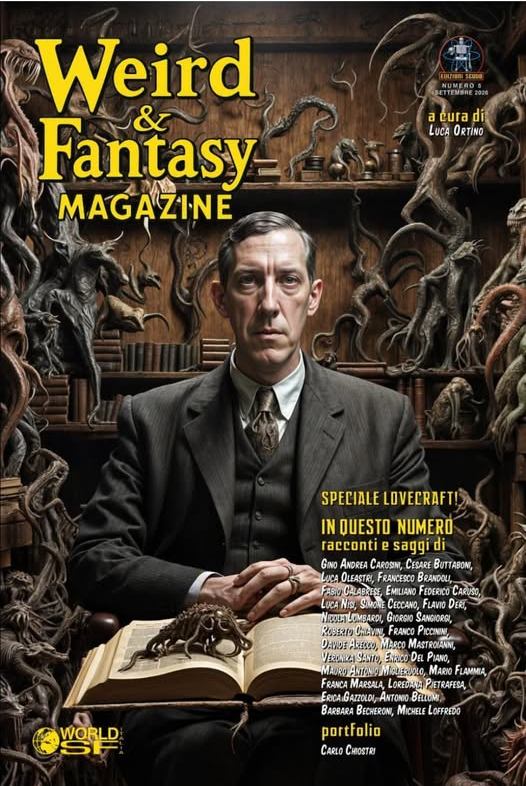
* Italy’s latest Weird & Fantasy magazine is a Lovecraft special…
* Eric Williams surveys Automata in Weird Fiction.
* Peter Stanfield surveys the 1970s rock/pulp fiction of Mick Farren.
* Set for the start of October 2026, the Portland wing of the H.P. Lovecraft Film Festival.
* At the Eastman Museum, the famous Eastman Kodak photography museum in upstate New York, a mini Lovecraft film season for Halloween.
* “Guillermo del Toro Explains His Strategy for H.P. Lovecraft Adaptations”…
During a September 2026 Reddit AMA held to commemorate the 20th anniversary of his ‘Pan’s Labyrinth’, the Academy Award-winning director explained that he believes the majority of Lovecraft’s bibliography is better suited for shorter, episodic storytelling.
* Talking of film, Lovecraft would surely have enjoyed the news that a “New Documentary Brings the Battle of Rhode Island (1778) to Life”. Possibly a relatively easy way for Lovecraftians to learn about a topic that Lovecraft often discusses in his letters?
* Screenrant notes a 2021 Netflix series I’d never heard of, The Silent Sea…
Across its eight episodes, The Silent Sea becomes one of the strongest homages to Lovecraftian cosmic horror currently available to stream.
* And finally, make your own movie. For the amazing new video-generator Minimax H3, for which an entry-level 3060 12Gb graphics-card is perfectly feasible, a new 1980s Horror Movie LoRA, along with the new Day-Night Slider LoRA and a Video Age ‘Aged Film’ LoRA for making the video look old. LoRAs are relatively small files that help in guiding the video generation into the desired style or look. All free, as is the way with local AI.
— End-quote —
A few outtake quotes that didn’t make it into my recent Lovecraft Annual journal article “Eating Anarchist Spaghetti With Lovecraft”.
“… did I ever tell you that I ate dinner with a real Italian nobleman as early as 1922? If not, I may mention that about a year ago I saw an item in the paper stating that our old Cleveland confrere Raoul S. Bonnanno, — the guy who taught me how to eat spaghetti at Luccione’s — had fallen heir to 18 titles, several sulphur mines in Sicily, & sundry estates, through a decision of the Italian courts. He is still a member of the [the amateur journalism organisation] N.A.P.A. (there’s the democracy of true rank for you!), though I haven’t heard from him since the old Birchdale days. Whenever, nowadays, anyone criticises my way of gulping spaghetti, I am prepared to come back with the withering retort that I was instructed by a real dago of title — no mere peasant or tavern-keeper!” — Lovecraft to Galpin, October 1933.
S.T. Joshi, from I am Providence… “In late August [1925] he sampled minestrone soup for the first time, liking it so much that on many subsequent occasions he would go to the Milan in Manhattan and make a meal of a huge tureen of minestrone for 15¢” [the ‘Milan’ was at Eighth Avenue and 42nd Street … Joshi then quotes Lovecraft to Aunt Lillian, as saying] “I never order anything but spaghetti & minestrone except when those are not to be had — & they really contain an almost ideal balance of active nutritive elements, considering the wheaten base of spaghetti, the abundant vitamines in tomato sauce, the assorted vegetables in minestrone, & the profusion of powdered cheese common to both.”
“Naturally, in casual conversation one doesn’t use the precise and elaborate language of a book. The proper thing is a plain simplicity; and so far as I can see one seldom incurs the charge of affectation when he practices it, no matter who his audience may be. Would you say ‘Nice-a day, Beppo! Breeng-a me one plate spaghet’ weeth meat-a sauce, pleece!’ when ordering food of an Italian waiter?” […] — Lovecraft to Woodburn Harris, February-March 1929.