X Typewriter a Free Font by GGBotNet. Now with language support and a huge set of 148 glyphs. Free on Itch.io, or ‘pay what you want’.


04 Saturday Jun 2022
Posted in Fonts
X Typewriter a Free Font by GGBotNet. Now with language support and a huge set of 148 glyphs. Free on Itch.io, or ‘pay what you want’.
03 Friday Jun 2022
Posted in Lovecraftian places, Maps, Scholarly works
Along with the forthcoming mega-index to the completed volumes of Letters, it struck me that we could also use a companion volume containing maps. ‘Orienting’ maps, in outline but still somewhat detailed. Map that quickly tell readers where one place was in relation to another. I’d suggest the following:
1. Lovecraft’s Providence (the topography and places known as a boy)
2. Lovecraft’s Providence (post-1914).
3. Lovecraft’s College Hill and Marketplace (including tunnels).
4. ” Places near Providence (Dark Swamp etc).
5. ” Brooklyn.
6. ” New York City.
7. ” New England coastline.
8. ” Dots-on-the-map. A general ‘dot-map’ of Lovecraft’s excursion and trip destinations east of the Mississippi and up into Canada.
9. ” Florida and his southern excursions.
10. ” Circle locations (their origins, places).
11. ” Far-flung Empire (his interest in particular far-flung places, places used in fiction etc).
Appendix: Map and mapping sources known to have been owned, used, consulted by Lovecraft.
Appendix: Bibliography of maps known to exist, relating to the original Lovecraft material (i.e. not the wider and later Mythos).
Appendix: List of important addresses in Lovecraft’s life.
Might be done in a suitable period style…

03 Friday Jun 2022
Posted in Historical context, Picture postals
This week on ‘picture postals’, a hunk o’ the actual place. Fulton Street, Brooklyn, to be exact. Or as good as, in the form of a .PNG cutout (i.e. on transparency) for Tentaclii readers.
This follows on from last week’s discovery of the location of Lovecraft’s fave restaurant at 7 Willoughby Street, just around the corner from Fulton.
Preview: 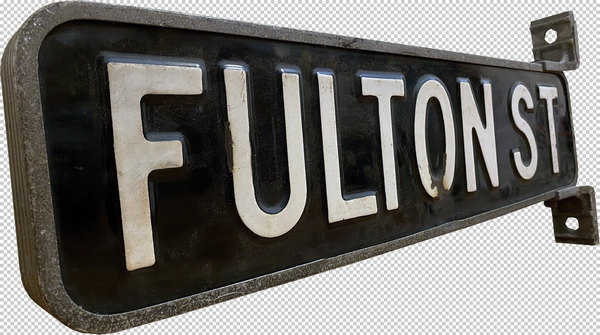
Download: fulton-st-cutout.png
Also, a couple of Willoughby Street ‘out-takes’ from my recent posts on John’s. These are ten years before Lovecraft’s New York sojourn, and are from the 1915-16 pictures made to forestall any damages litigation before the subway was dug.

Here we look along Willoughby Street, in 1915, from what is now No. 15 down to No. 1. The theatre (by then a cinema) is still on the corner at that point, but by Lovecraft’s time in the city would have become the Edison Electric Co. office building that still stands today as No. 15. The Elevated railway can be seen in the distance, as it swings around the Brooklyn Citizen newspaper building and heads down Fulton. The second barber pole seen here about marks the site of 7 Willoughby Street, later John’s, and part of its “Hungarian Restaurant” sign can be seen.
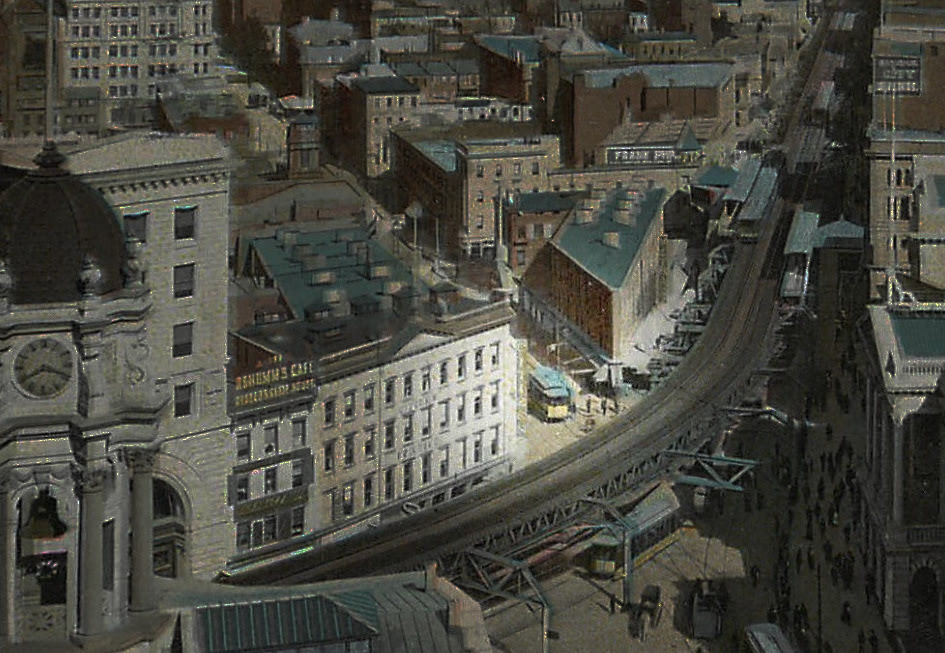
Here we look across the foot of Willoughby Street at that same point in time. The spot is seen on the bird’s-eye view.
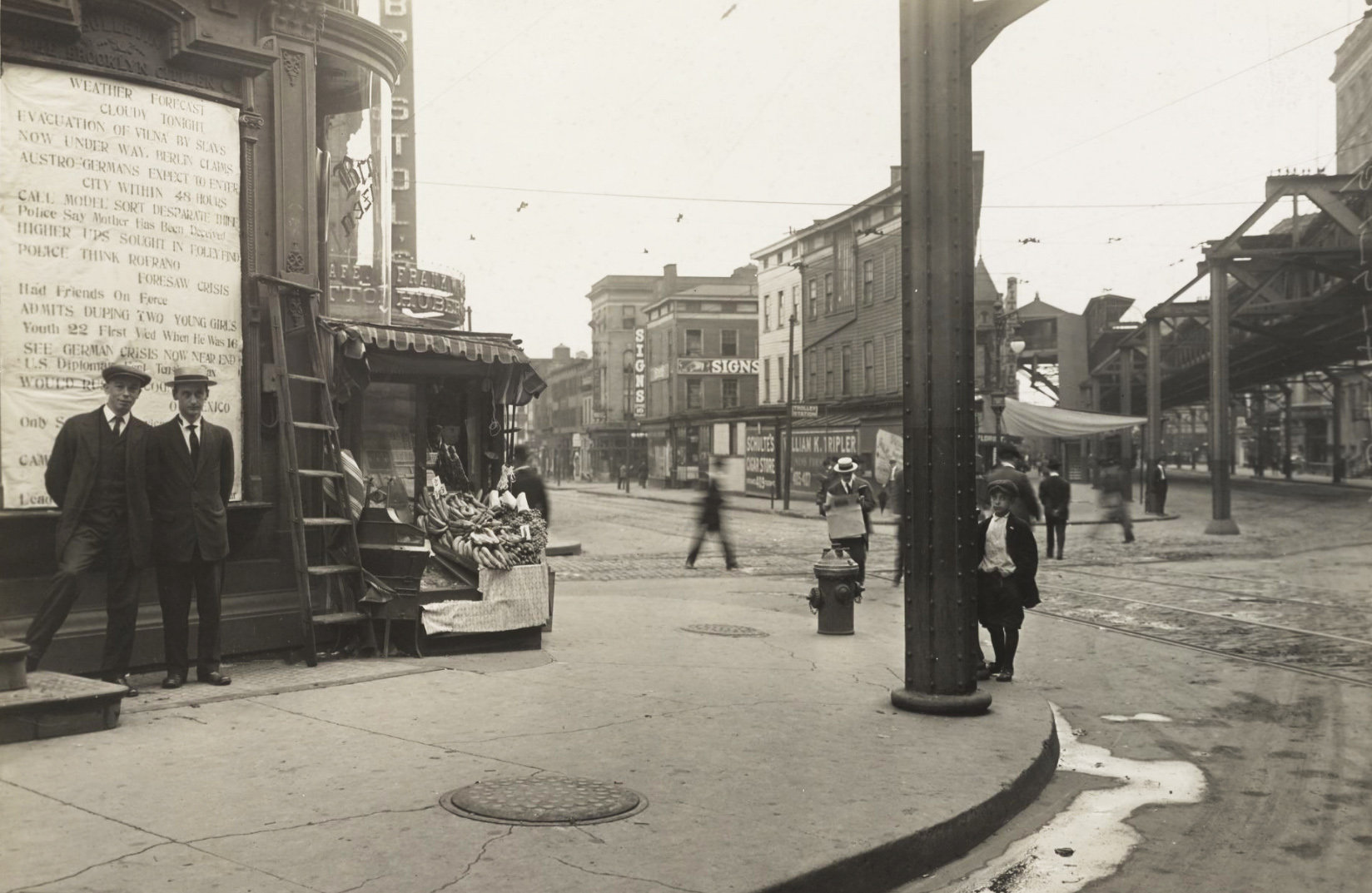
The Brooklyn Citizen newspaper building is in the immediate foreground on the left, and their hoarding gives the news headlines. It looks like three newspaper hawkers are waiting for the early-morning newspaper bundles to land on the sidewalks. Behind the edge of the Citizen we can just see the signs that indicate the start of Willoughby Street, including Bristol’s restaurant at No. 3. The middle-distance of the picture shows roughly the stores that would have been opposite John’s. Note that the run of stores directly opposite are neatly boarded up, presumably in advance of the subway work, and (as seen on other pictures) their frontages tell people to use an entrance around on Fulton.

The Elevated railway on the right of the picture heads down into Fulton, but we see a passenger stop and the steep stairs up to the platform. Perhaps this was a frequent station for Lovecraft and friends, when John’s was the “spaghetti headquarters”… though of course the trains it served may have been headed the wrong way for some of the ‘gang’. The bird’s-eye postcard view, however, also reveals a station platform opposite and going the other way.
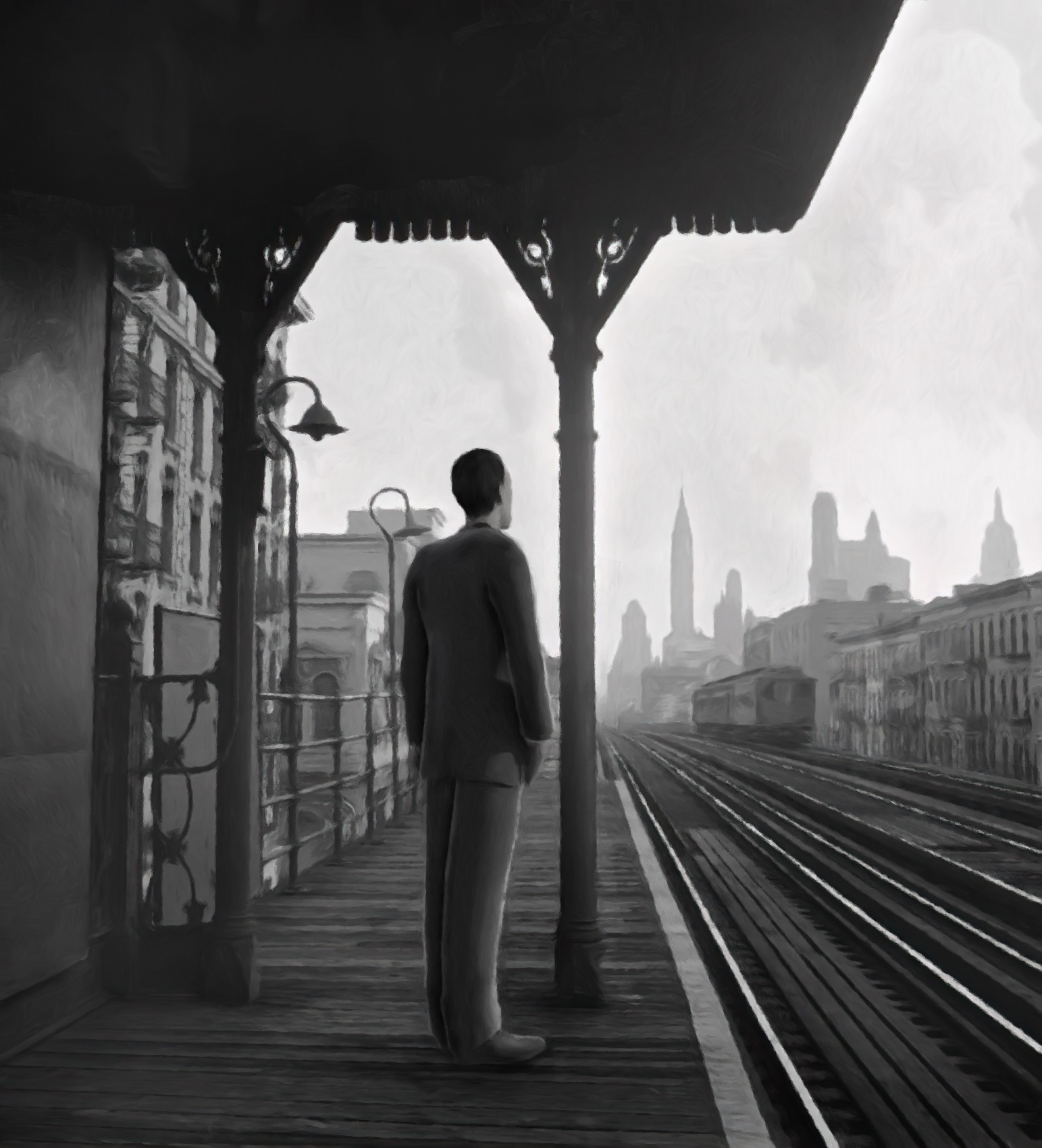
“Sunday morning elevated”, Lovecraft on the platform of the Elevated.
02 Thursday Jun 2022
Posted in Odd scratchings
I see that The Silver Key (blogger-scholar and author or Flame and Crimson: A History of Sword-and-Sorcery) is also off Facebook, and has a few observations…
passive scrolling, and ‘likes’, which is what Facebook / Instagram / TikTok, etc. encourages, eats up your time in an insidious fashion, far more than you know.
He’s now powering into LinkedIn though, which I guess is kind of Facebook for the business crowd. I’m not on LinkedIn either. Or Instagram or Twitter. In my case, my departure from Facebook (abruptly blocked for the cryptic reason of having the “potential to reach too many people”) has seen me continue to post all the useful localist information that I used to fillet-and-post. But instead of on my Facebook Groups, all that’s now at a WordPress-powered hyperlocal called The Potteries Post.
01 Wednesday Jun 2022
Posted in Odd scratchings
Time for another monthly round-up of items miscellaneously Tentaclii-fied.
In my regular Friday ‘Picture Postals’ posts I completed my photographic stroll around Lovecraft’s beloved Japanese Garden at the Brooklyn Botanical Gardens, discovering among other things that it was far larger than imagined and also had vast hot-houses. A possible partial inspiration of “The Shadow out of Time”, and definitely inspiring for his friend Belknap Long’s later wartime Curator of the Interplanetary Gardens series for boys. I looked into where the Eddy Jr. tale “Black Noon” might be found today, which spurred a ‘Picture Postals’ post on both the Dark Swamp and the adjacent Durfee Hill, with a new composite map and a side-trip (as Lovecraft did) into Pascoag and pointing up its “Red Hook” connection. One small new discovery was made, indicating why Morton might have wanted to visit Durfee Hill.
In other pictures, a picture was found of the 132 Wickenden Street branch of Lovecraft favoured “Jake’s”, and I mused on if he might have ever set foot in this branch. Faig Jr. suggests not, and it certainly looks like there’s no evidence. But I pointed out the proximity to the New York boat docks. Rather usefully, I also found the opening times for both this and the main branch. The ferreting away at “Jake’s” then led me to discover a very nice picture of the main site at 9 Canal St. Providence, and not just an exterior either. A superb interior with customers and owners, which I promptly cleaned and colourised. To top this discovery, later in the month I found the very elusive “John’s” in Brooklyn, though sadly not as an interior. Also “Bickford’s”, another Brooklyn favourite. This formed a quartet of posts — Bickford’s, Johns, pictures of John’s, and then ‘who John was’. With many new discoveries and pictures along the way. Now we at last have the addresses and names it’s possible that other Lovecraftians, especially those who know the history of New York City and have access to paid U.S. newspaper databases and city archives, will be able to find more in the future.
In scholarly work, there was news via S.T. Joshi of the two new volumes Miscellaneous Letters and Letters to Woodburn Harris and Others, set for August 2022. The Spanish edition of Joshi’s I Am Providence is out. The German Lovecraftians reported the imminence of their scholarly volume on the “cultural interplay between H.P. Lovecraft and Germany”. Which I assume will be issued in German, though hopefully someone will be translating it soon. Leslie Klinger’s annotated The Call of Cthulhu and Other Stories appeared, an affordable cut-down one-volume paperback version of the previous volumes. The selection and ordering looks very suitable for beginners, and I believe he used the Joshi texts.
In my reading and note-taking on the Selected Letters I got as far as ‘Notes on Selected Letters II – part one’. The concluding part two is coming soon. I made the seemingly new discover about the strong likelihood that his reading of New Lands by Charles Fort influenced “The Colour Out of Space”. If he read it before and not after March 1927, that is.
In matters relating to historical context, I linked to useful blog post elsewhere about William Dean Howells, musing on which added to my knowledge about censorship in Lovecraft’s era. A PulpFest post also had me thinking about Lovecraft’s role in networking the productive end of early SF fandom, and thus ultimately in the exploration of space (via SF’s influence on the Space Race). I also spotted a scholarly book on Theosophy’s wider cultural impact, which I assume must include Weird Tales, Lovecraft and some of the circle.
In open archival material, I grabbed and rectified a nice new eBay scan of the Old Brick Row in Providence. A useful simplified map of Providence was found. The newly online archives of the Year Book of the American Society of Bookplate Collectors and Designers, 1923-1931 may also hold some as-yet undiscovered treasures. I also discounted the notion that Lovecraft might have known the novel The Mummy! A Tale of the Twenty-Second Century, but along the way discovered a very interesting bit of proto-sci-fi.
As for the Lovecraft Circle, I noted the new Collected Letters of Robert E. Howard: Volume 2, and that J. Vernon Shea’s late memoir of Lovecraft is online as printed in Fantasy & Science Fiction (May 1966) with interesting surrounding context. Fritz Leiber’s collected and collectable science-fiction cat stories, Gummitch and friends, turned up to “borrow” as a scan on Archive.org. I did some digging re: the facts on an obscure and as yet untranslated 1980s mythos anthology from Spain.
Not much in the arts this month, though I don’t track the waves of videogames and Lovecraftian films. But I see there’s a “Quest of Iranon” opera production set for the stage in June 2022. Tanabe’s Innsmouth No Kage manga graphic-novel is to be published by Dark Horse later in the year. The overlooked ‘Lovecraft as character’ novel, Martian Falcon (2015) was discovered and it looks rather fun.
The only podcast this month was in the form of the welcome return of Robert M. Price’s The Lovecraft Geek — and with a cracker of an episode.
In scholarly software, PDF Index Generator 3.2 looks well worth having. The AI auto-coloriser DeOldify can now be run without Internet access, via a Windows installer. Also rather handy for some, you can block the drop-down suggestions on Google Scholar. These block lines are what I cooked up for uBlock Origin and they currently work on Scholar…

Also handy is a Web browser UserScript to Display the total time for a YouTube playlist. The old one had stopped working, but this one works for now. Try it with the new ‘best of’ Tom Shippey on Tolkien playlist.
As usual, please consider becoming my patron on Patreon, as these days every little helps. Despite Prime Minister Boris firing various “big bazookas” of money at the public over the last three years, not a penny of it has yet reached me. So the monthly Patreon is very useful. Thankfully there have been almost no departures of patrons due to Tentaclii’s recent domain change-over. Mentioning and linking to Tentaclii is also useful, and costs nothing except a moment’s time.
Many thanks, and stay clear of the Monkey Pox!
31 Tuesday May 2022
Posted in Odd scratchings
I’d never heard of Jaroslav Foglar before, but the writer has an exhibition on in Prague until 4th September 2022, “The City As A Phantom: Prague inspirations of Jaroslav Foglar”.

Foglar’s lived and worked in Prague as a young child, eagerly absorbing the atmosphere of the places where he lived, worked or met with friends. Then he transformed it into the mysterious city of his novels. Foglar elevated the seemingly mundane urban scenery into a mystical and mysterious labyrinth, connecting many time-layers, each living their own lives and fascinating and enticing to explore. Such an image of the city [based on Prague] opens up to the reader in many of the author’s novels, most notably in his most famous trilogy, which motivated a whole generation of readers to search for the original motifs and locations of the book.
So he sounds like a mix of an authentic (rather than ersatz modern ‘young adult’) ‘urban fantasy’ and the typical Scouting-type boy-adventures of the 1930-40s. Although written for boys his novels have apparently… “left a deep trace in Czech popular culture”, despite his work being banned under first the Nazis and then communism from 1950 – circa 1968. With a brief respite in the early 1960s when he seems to have been permitted to work on a newspaper comic-strip. One biography of growing up under communism states that boys would avidly seek out his ‘banned’ books in the city’s second-hand bookshops.
A 2017 article, on his concurrent strong influence in Eastern Europe on outdoors education, notes he is… “mostly unknown to the international audience” either as a writer or educator. It also offers a useful one-line summary of his themes…
Foglar’s specific outdoor adventure characteristics include timelessness, place, romance, mystery and challenge, and traditions with rituals.
From what I can tell after a quick scoot-around he also appears to have influenced comics too. There was a 2018 comics tribute to his work and characters…
For the ‘Amazing New Adventures’, dozens of contemporary authors and illustrators from the Czech Republic and Slovakia came up with 50 different visions of how to continue the tales. Some of the authors were even born after the original series ended, and only know it in retrospect, while others lived in the 1960s and even 1950s. These new adventures range from stories set back in the 1940s with the same basic look and lettering as the original series to very modern takes on the themes, with science fiction, horror or comic aspects and freestyle illustrations reflecting new trends in graphic novels.
Sounds interesting… but his fiction and comics have never been translated into English if Amazon is anything to go by. I’m guessing the original books don’t work well outside of Eastern Europe and perhaps their “mystical and mysterious” aspects may not have aged well?
31 Tuesday May 2022
Posted in Kipling, Odd scratchings, Scholarly works
Online Books recently catalogued The Mummy! A Tale of the Twenty-Second Century, which it had spotted in a nice clean .TXT version at Gutenberg. A fascinating curiosity, it seems, is Mrs. Loudon’s The Mummy! A Tale of the Twenty-Second Century (1827). A lively proto-steampunk and partly aerial adventure by all accounts, albeit stretching over three volumes. And perhaps thus a possibility for adaptation to expand Kipling’s Aerial Board of Control (“With the Night Mail”) universe, on which Tentaclii has had several posts.
Three volumes is a bit daunting though. Has it been abridged? Yes, it has, “The only modern edition is abridged” says L.W. Currey, but doesn’t name the edition. Amazon reveals this as a “University of Michigan Press; Abridged edition (1995)”, aka “Ann Arbour”. Google Books reveals it was a paperback and also “illustrated”.

The SF Encyclopedia has “one of the very earliest Proto SF texts … a somewhat melodramatic plot”. Sounds great, and apparently lots of early sci-fi inventiveness too.
The SF Encyclopedia perhaps usefully comments on the University of Michigan edition is a “much cut bowdlerization”, basing this on one negative review. Some 100 pages cut and touches of new smoothing added at the joins, it seems. I’m fine with that, for reading enjoyment rather than scholarship. If the feminists who claim her (very much ‘in passing’) want to produce a sumptuous critical edition of the three volume table-trembler, then go ahead.
It looks like the abridged University of Michigan edition sells for £30 on eBay, and would be tricky to get via Amazon. Since there’s Amazon’s usual utter confusion on editions, and you might end up buying some public domain shovelware you could get free elsewhere.
Archive.org refuses a search for “The Mummy! A Tale of the Twenty-Second Century”, presumably because of the ! mark, and has “No results matched your criteria” for “A Tale of the Twenty-Second Century” in the title. So it’s difficult to compare editions there. But eventually, via Google and then an author search, deep down the Archive.org results (she wrote a lot about gardening after her marriage to a botanist) one finds the University of Michigan Press edition is available to borrow.
Also there is an 1828 second edition of the three-volume work: I, II, and III. But Gutenberg’s clean .TXT compilation of all three volumes will be preferred for some e-ink devices such as the original Kindle 3. This, together with judicious skimming, is perhaps the best option for reading.
I should also note the 18 hour LibriVox recording, which again is a bit daunting.
It never seems to have been adapted for media or comics.
I’m not alone in only just hearing about this novel. A 2018 blog post by Gothic Wanderer (not linked due to absolutely massive plot spoilers) remarks that she is vastly superior to Mary Shelley. And, yet despite being claimed by feminists…
The novel has received almost no critical attention. I have spent twenty years reading and studying Gothic fiction and yet I only learned of the novel’s existence in the last year. It is time for it to be studied more.
S.T. Joshi observes, in his weighty survey Icons of Horror and the Supernatural, that Loudon does not share Shelley’s radical politics — which may perhaps explain some of the neglect. Joshi also points up a few of the horror passages, before passing on to Poe in his survey of early mummies.
It seems that Lovecraft and his circle did not know the novel.
30 Monday May 2022
Posted in New books
The Collected Letters of Robert E. Howard : Volume 2, 1930-1932 has a publication date of 14th June 2022 on Amazon UK. As a £20 paperback from the Robert E. Howard Foundation Press.

29 Sunday May 2022
Posted in Historical context
Yesterday I at last firmly located the elusive “John’s”, the favourite Brooklyn spaghetti hang-out of H.P. Lovecraft and his circle.
Here again is the ad, from a 1925 radical magazine. “John’s” at “7 Willoughby”.

Who was John Pucciati (1885-1967), who ran John Pucciatti’s Spaghetti House (popularly known as “John’s”)? He was a quite a character in 1910s and 20s New York, and is still remembered to this day. Difficult to research via Google, though. Because for some reason Google Search dumbly insists on removing the quote marks from “John Pucciatti” after the first page of results. But thankfully there’s eTools, which has no such dumbness built in.
The basic details are:
“Established in 1908 by John Pucciatti, an immigrant from Umbria, its menu offered an appetizer, main dish, dessert, and cup of coffee for under a dollar.”
He was an early Italian anarchist. Lovecraft knew a few of these…
There’s nothing about ‘anarchists’ to be afraid of! … they are very harmless folk. … Despite their bold talk they are timid & ineffectual creatures, most of whom would not hurt a fly if they could. I know many of them … [such as Morton, and likely also Loveman in a rather closeted way.] [They are to be distinguished from the Greenwich Village ‘radicals’ who adopt] a slovenly insincerity & cheap posing habit, which merely uses the guise of radicalism as an easy way of attracting attention.” — H.P. Lovecraft, July 1929.
Pucciatti was perhaps of a different order than Morton or the posers at New York parties. Maybe more syndicalist, depending on how much experience he had of the dramatic and very sudden industrialisation of Italy, before leaving for America. Though we can’t be sure, since he doesn’t appear to have left any writings. On him Radical Gotham: Anarchism in New York City can only offer that his restaurant was one of…
… a multitude of Italian cafes and restaurants offered cheap meals and distraction, serving as important social and political centers. Founded in 1908 by John Pucciatti, an immigrant from Umbria, John’s on East 12th Street was legendarily known as “the favorite meeting place of free thinkers of all nationalities”. Other popular anarchist hangouts included Albasi’s grocery on East 106th Street and the Vesuvio restaurant on 3rd Avenue near 116th Street in East Harlem, where for one dollar radicals could enjoy a cheap meal while debating politics and socializing.
Another book, Making Italian America, has the same and adds a little more from a recent biography of the socialist labour-organiser and editor Tresca…
In the United States, the sovversivi’s most popular hangout was John’s Spaghetti House on East Twelfth Street in New York City (now simply John’s), which was commonly advertised in Italian radical newspapers as ‘the favorite meeting place of free thinkers of all nationalities’. Established in 1908 by John Pucciatti, an immigrant from Umbria, its menu offered an appetizer, main dish, dessert, and cup of coffee for under a dollar. Carlo Tresca, Arturo Giovannitti, and other famous sovversivi regularly ate there, often holding special radical banquets at John’s private apartment upstairs.
At the time he started his main branch, aka ‘John’s of 12th Street’, the Wild West was still wild and Butch Cassidy and the Sundance Kid were rooming just around the block. Pucciatti had at least one local artist fresco the walls, paid in free meals. The place was classy, a formal white-tablecloth Italian restaurant with apron-ed waiters. But by the early 1920s the place seems to have slipped over from idealistic tub-thumping 1910s Italian anarchism to illegal tub-brewed booze… and thus the first wave of U.S. gangster-ism. The slide being quite evident from 1922. John’s became a popular watering hole for proto-mafia gangsters such as Lucky Luciano. Who was not so ‘lucky’ one night as he left the place, being gunned down outside. At this time it…
also operated as a well-known speakeasy [i.e. illegal booze purveyor] during prohibition. The ground floor continued as a restaurant, while wine and whiskey were made in the basement and served in espresso cups on the second floor.
Entrance to the upstairs was via a hidden staircase. Head hooch-brewer Mama John had a candle lit in the window when the fresh booze was ready to be served. Any sign of the cops in the area, and the candle went out. One article states that John’s on 12th Street was “ground zero” for the subsequent growth of the Italian Mafia in the U.S. This may explain his low-profile as a business during prohibition, keeping out of directories and not advertising except in journals likely to bring the right type of clientele.
After the war the main John’s catered to off-Broadway actors and the theatre crowd, and continued to be considered one of the top Italian eateries in America. As shown by a tourist Guide Book…
John’s at the corner of 2nd Ave , and 12th St. (the heart of the off-B’way theatre area) has been satisfying the palates of folks for 50 years. Under the guidance of Dan and Ann Pucciatti, the north Italian hostelry…
The 2009 book Restaurant Startup & Growth magazine tells us that his son…
Danny Pucciatti, took over day-to-day management of the [main] restaurant in the 1950s when his parents retired. Eventually he sold the establishment to current owners Mike Alpert and Nick Sitnycky in 1973.
It’s still there today, and still a leading place to eat good food.
But what of Brooklyn? Nothing seems to have passed into New York restaurateur lore about the 1925-30(?) Brooklyn branch, which is presumably why it has eluded Lovecraftians until now. The opening of this branch can however be dated by the 24-month block of adverts which John took out in Worker’s Monthly. In March and April 1925 his first adverts appeared, but the Brooklyn branch was not advertised. “Indian” here is perhaps a typesetter’s mistake, later corrected to “Italian”?

Then in May 1925 the Brooklyn branch appears on the ad, and the ads (inc. Brooklyn) continue on through February 1927 when they cease. I assume the 24-month block-booking was over. So the Brooklyn branch opened in spring 1925, and it was still in existence in early 1927. John’s first appears in Lovecraft’s 1925 Diary on 4th May, so that both fits and confirms. Possibly there was a grand 1st May ‘May Day’ opening day, something that would be most suitable for an anarchist. Lovecraft returned to John’s to eat on the 6th and 7th May, and frequently thereafter. In the letters a typical encounter with “John’s — the Italian joint around the corner in Willoughby St.” is…
stopping only at twilight, when I wended my homeward way, pausing at John’s Spaghetti place for my usual Sunday dinner of meat balls and spaghetti, vanilla ice cream, and coffee. Incidentally — not many doors away, on the other side of Willoughby St, I found a restaurant which specialises in home-baked beans.
This fits the facts, as the “home-made baked beans” shop was further up and on the other side as can be seen on 1940s.nyc. But John’s remained Lovecraft’s spaghetti “headquarters”, as he later phrased it. He was getting the best that 1920s New York could offer, made by cooks born in little hill-villages in the old country. Which must have been quite some spaghetti. He would afterwards find it difficult to get a comparable ‘New York flavoured’ spaghetti meal in Providence.
Back in New York, John’s had closed before summer 1931. On page 937 of Letters to Family Lovecraft states it was “defunct” by July 1931…
All three now set out for dinner — at the old Bristol Dining Room in Willoughby Street near Fulton, next door to the now defunct John’s, which was my Brooklyn headquarters for spaghetti in the old days.
Was John ever on the premises? Unless any Lovecraft letters can show otherwise, back in the mid 1920s it may well have been that John Pucciatti — the anarchist who looked like a Roman nobleman but who was actually from the “little medieval village of Bevagna, between Spoleto and Assisi” — wasn’t sitting down at a table to chat philosophy and art with Lovecraft. He appears to have lived and worked at his main branch. Still, he might have popped in now and again, when he wanted to escape from the big-name gangsters and the fumes of Mama John’s back-yard hooch-brewing.
29 Sunday May 2022
Posted in Historical context
Here are pictures for “John’s”, located at Willoughby Street, Brooklyn, from May 1925. A regular and favourite New York City haunt of H.P. Lovecraft, from that date.
Here we see Willoughby at numbers 5 – 15 on part of a Library of Congress architect’s photograph made in 1932. It shows the Edison Company’s 1924 offices, with the shadows lifted by myself to reveal a shadow-hidden truck and also some of the detail on the adjacent stores. A corner of a closer building’s roof partly obscures the view.
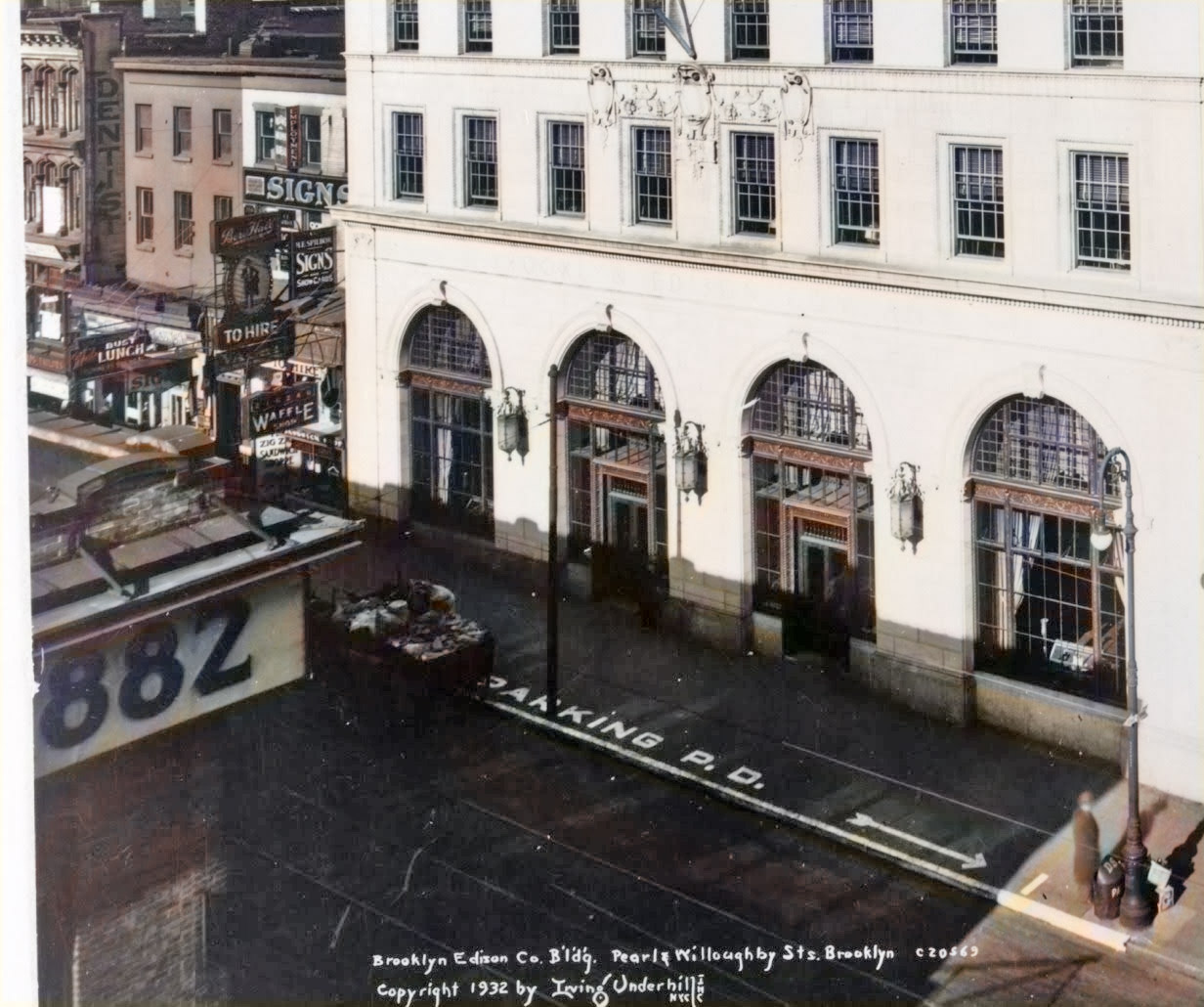
No. 7 is on the right. Still offering “Lunch”.
No. 5 can be identified by its architecture as seen on other pictures, and is half-seen on the far left of the picture. Circa 1924 it held the office of Lovecraft’s New York writer friend La Touch Hancock. Then we simply count along the row. Numbers 11-13-15 were obviously subsumed by Edison into a single “No. 15”, a building which is still there today and has the same number. Some modern sources erroneously date the Edison Company offices here to “1960”, but that is the date of a building record-photo, not of the building’s 1923/24 erection.
This show us what the street looked like in Lovecraft’s time, with the Edison building there already by 1924-26. Here is the detail, and it suggests John’s was no longer John’s by 1932. I seem to recall that Lovecraft mentions somewhere in a letter that it had closed by the 1930s, but I can’t find that mention. By 1932 it certainly has a ‘cabin’ frontage added, and is the “Busy Lunch” with what might be a “Trommers” or “Drummers” Bar incorporated. 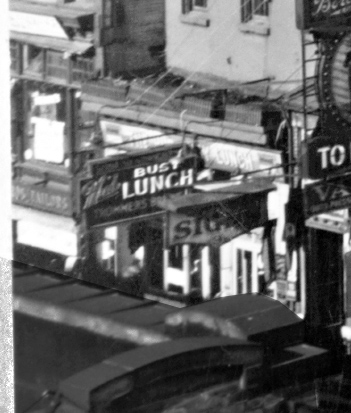
It feels like John had departed, and indeed he had. On page 937 of Letters to Family Lovecraft states of July 1931…
All three now set out for dinner — at the old Bristol Dining Room in Willoughby Street near Fulton, next door to the now defunct John’s, which was my Brooklyn headquarters for spaghetti in the old days.
By the late 1930s it was a Wines and Liquor store, as partly seen on the right of a badly mis-placed 1940s.nyc picture. A Lovecraft-like man crosses the street to the art-deco “Automat” which had by then replaced 3-5 Willoughby Street.

A further picture I have shows that No. 7 was still there in 1954, along with No. 1, and 3-5. The Automat at 3-5 was then being gutted and — appropriately enough — the former John’s appears to have become a “Pen Clinic” for ink pens. Lovecraft, always in pursuit of the perfect ink pen-flow, would surely have approved of what appears to have been the final fate of John’s.
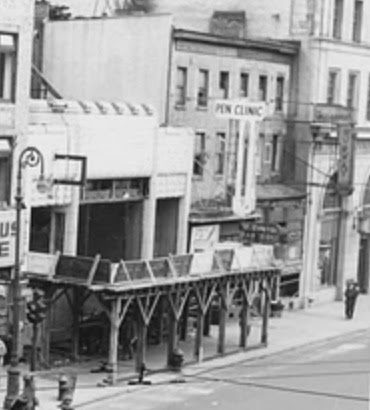
1954, what looks like the final years for numbers 1 to 9.
With these pictures in hand I’d say that the modern layout places the site of No. 7 about at the very edge of the plaza, or maybe a little further out into the highway…

The plaza is small, cramped and over-cluttered… and thus the safest hassle-free place (the city is currently subject to a massive wave of street-crime) for any Lovecraftian tour-guide gathering and talk would appear to be in the far corner of Columbus Park. Which is seen here, after my having ‘virtually’ crossed the highway from No. 15 and its small plaza. I’ve here indicated the continuing line of the ‘lost’ Willoughby Street in a soft orange…

What did it look like in circa 1925-27? We can’t know, until more pictures are found. But we do have the Subway Construction pictures of 1916, presumably made on lovely large glass-plates so as to forestall any spurious compensation claims in litigious New York City. Good prints of these can now be had from the city’s Transit Museum. They show a place very different from the makeover it had by the late 1930s, so I guess ‘the unknown 20s’ are some way between the two sets of pictures.
But we should be thankful we have three very good pictures of No. 7 as a Hungarian restaurant in 1916, with various vacant units around about. The place would have made a natural transition to an Italian eatery, with newer signs in a slightly more 1920s style and probably a spruce-up in Italian type colours, probably red and green and white rather than what might have been a Hungarian blue and white.

Here we half-see No. 7, but head on, while picturing No. 9. Also seen is a part of No. 11, which by Lovecraft’s time had been lost to the Edison Company’s 1924 offices.

The full circa 1900 run from the original 3 – 15, including the Bristol Dining Room which Lovecraft patronised in the 1930s after John’s closed, can be seen here…

And finally, this wonderfully clear 1916 view of the entrance, looking down the foot of Willoughby toward the Citizen building (hardly to be seen) and the Elevated railway as it curved around and into Fulton. I’ll colourise this at some point, but automation doesn’t even remotely do it and I don’t have the time to do it justice at present.

It was still the same Hungarian place in 1918, when a further small picture shows the subway air ducts being dug.
Some of the (to our eyes) superb signs and sign-writing had no doubt gone by the mid 1920s, perhaps some of the lower vacant units would have become fruit-sellers and the like, and the whole corner would have had a distinctly more seedy and gangster-ish feel about it. Especially after John’s opened. On which, more in the next post.
28 Saturday May 2022
Posted in Historical context
Following on from yesterday’s Bickford’s, Brooklyn post, another try at finding the very elusive John’s, one of Lovecraft’s favourite eating and supping places in Brooklyn. Which I’ve searched for before…
the letters vaguely talk of the corner of Fulton and Willoughby Street, and the western end of Willoughby St and even “in Willoughby St”.
First, I found some new data about restaurants low on Willoughby, from court records…
FRITZ’S: “on or about the 24th day of March, 1902, the defendant conducted and now conducts a restaurant at No. 7 Willoughby street, Borough of Brooklyn”. In 1901… “7 Willoughby Street, known as Fritz’s restaurant”.
AUTOMAT: In 1936, “Horn and Harart Company … in the restaurant business … located at 3-5 Willoughby Street in the borough of Brooklyn, New York City” … “the defendant The Horn & Hardart Company owned, operated and controlled a certain restaurant commonly known as the Automat, located at No. 3 Willoughby Street in the Borough of Brooklyn”.
The Brooklyn Historical Society then gave me the location of this Automat, in an early-1940s picture and I usefully spotted that this aligned with an adjacent picture of The Brooklyn Gazette building. This gave me a very useful orientation point…
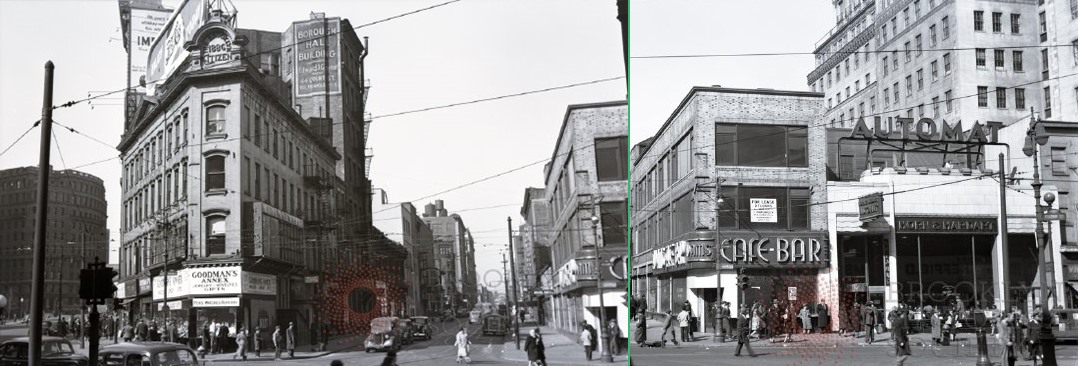
With thanks to the Brooklyn Historical Society. These are not on the 1940s.nyc site and are later on in the 1940s. Prints can be had.
Just to check, in the following picture we look at the same place but from the left-hand side. From the Fulton Street facing side of the Citizen building in 1916, we look across the end of the street and see an anchor sign peeping out from across the road. This can be tallied with a picture of “No. 1 Willoughby”, on which the very same sign is seen. These are New York Board of Transportation pictures, made before the subway construction in 1916. No. 1 would be the “Cafeteria” by the late 1930s, and then the slightly renamed “Cafe-Bar” by the early-mid 1940s.
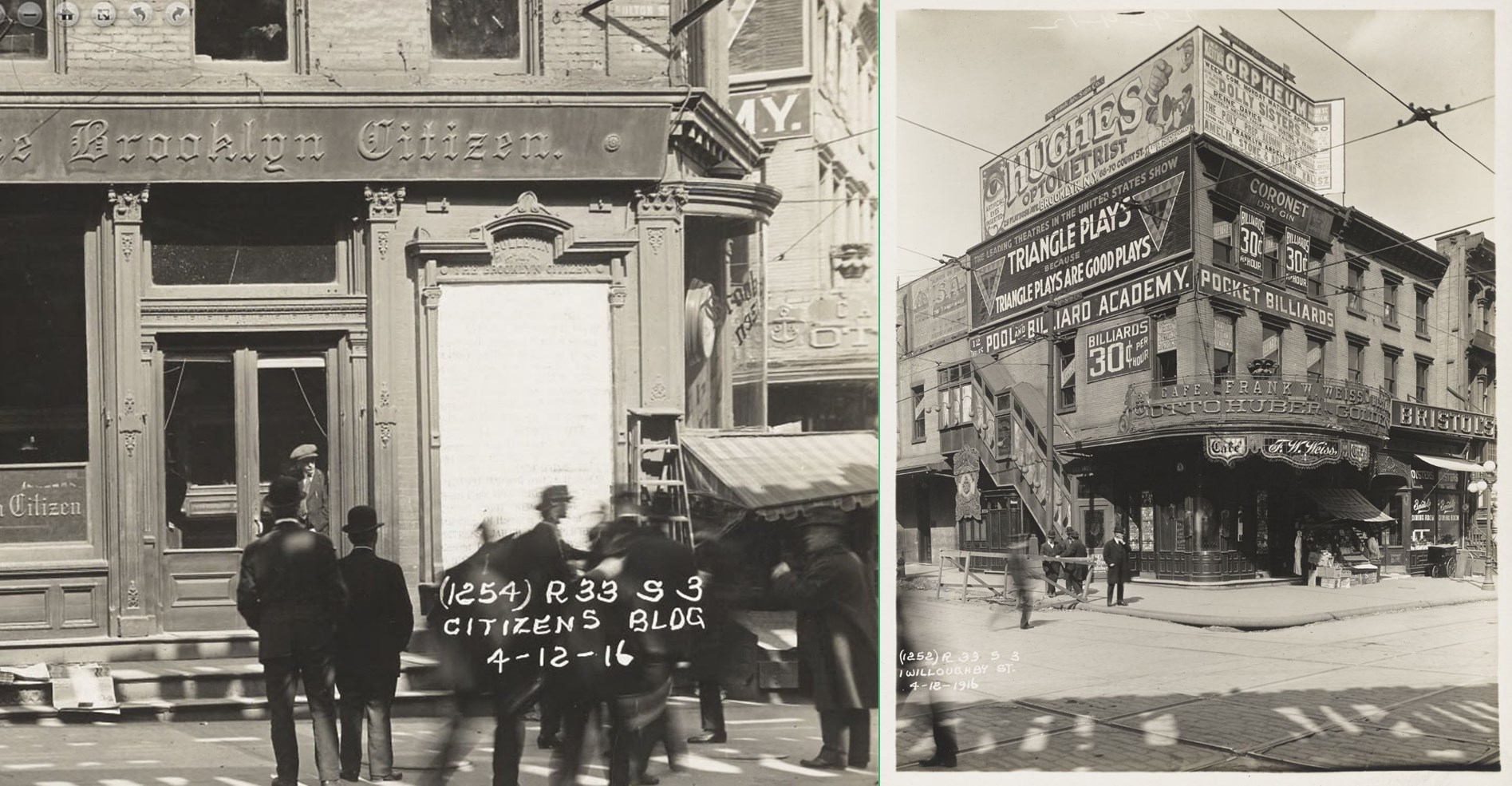
These are also now in the public domain and held by the New York Transit Museum, if you want nice prints made. Again, they are not on 1940s.nyc.
With those two composite views of the same site established, I needed a wider view from the period. Because a great deal has changed by today, and the approximate 1940s.nyc tax-photos map is quite misleading as well — as well as being not very useful on pictures at this particular location. Today Willoughby Street starts with a cursory new plaza containing only No. 15, this being the former Brooklyn Edison Co., built as electricity company offices in 1923/24 (site of the vaudeville/cinema Royal Theater at 11-16 Willoughby, corner of Pearl). Today the rest of the bottom of Willoughby Street, along with the Citizen newspaper building, has been wiped out by the huge multi-lane highway and the plazas either side.
Here’s the more useful orienting bird’s-eye 1910 postcard, and also a 1940s/50s map showing street layouts along with what are probably the subway lines. I think the Elevated railway down Fulton had been dismantled, by then?
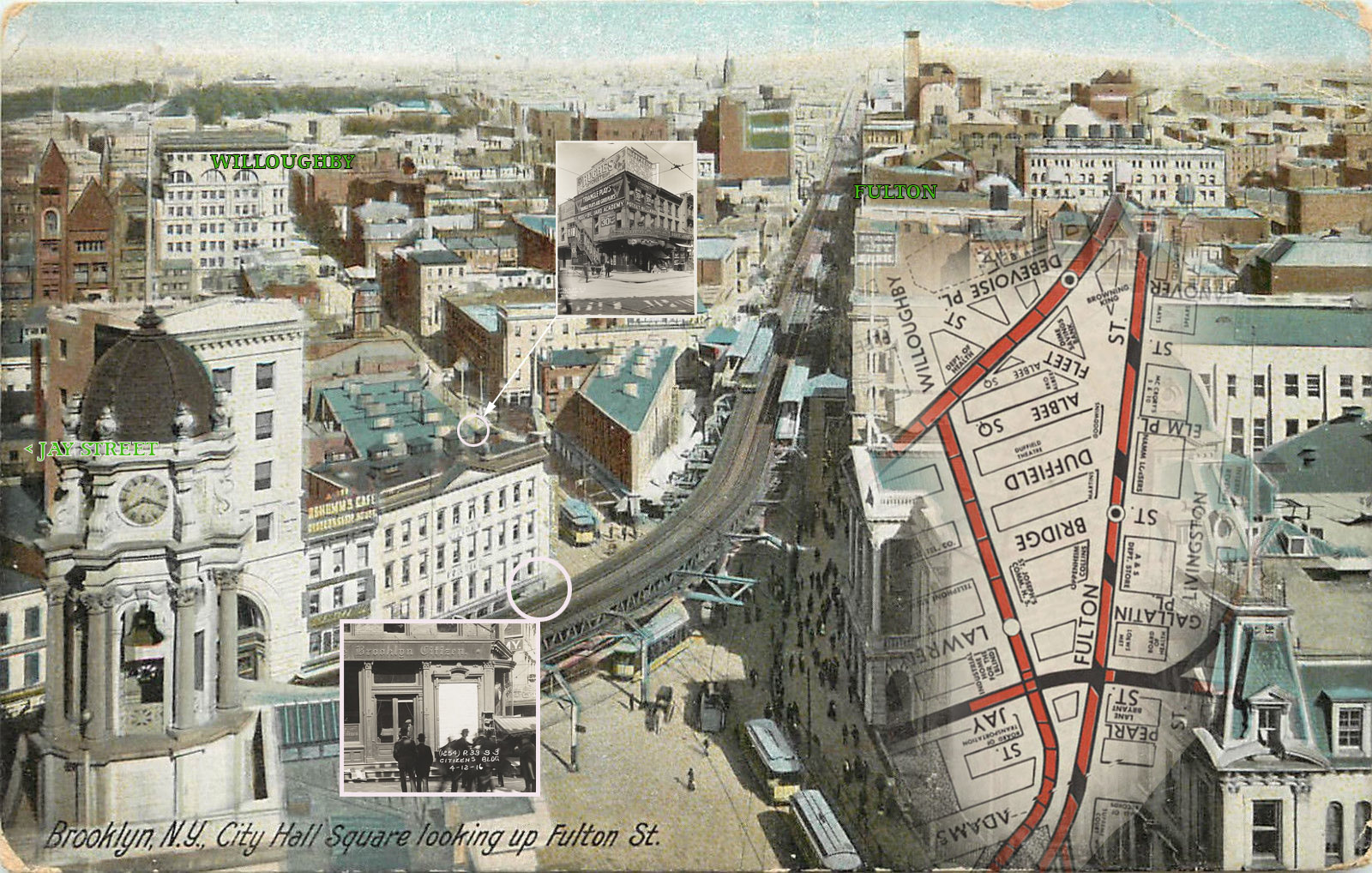
With the location established, I now move along and up the street on the same side, again using the excellent and free 1916 New York Board of Transportation pictures. Here you can see a tiny bit of No. 1 (note the anchor sign), and 3 and 5, in 1916. Note that the number 5 can be seen.
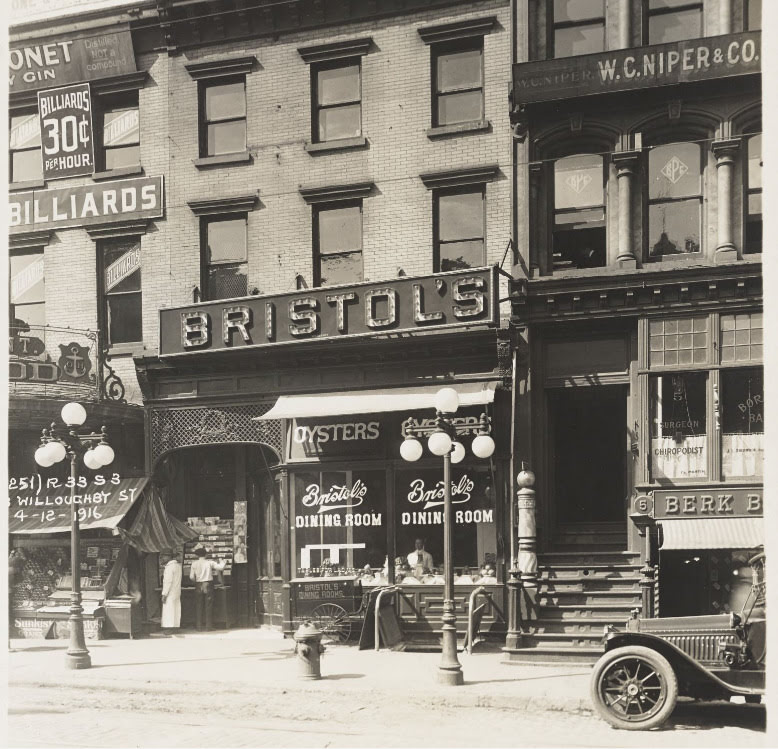
From January 1916 No. 5 was the new Headquarters of the Brooklyn Press Club. Doubtless the proximity to the Citizen newspaper helped there, and also nearby was the best private Directory and Guide-book library in the city. I have also discovered that upper floors of No. 5 later held the office of none other than Lovecraft’s New York friend La Touche Hancock, professional versifier and fellow British Empire loyalist. Here we see him advertising at this address in Student Writer, with such ads running from 1922-24 and also in at least one movie magazine…

By 1931 No. 5 was the “American Book Exchange”. Photographic evidence shows the “Automat” was not there in 1932, but a little later 3-5 was be completely re-made as the wholly new art-deco “Automat”. Thus the “Automat” only appeared after Lovecraft left New York City…
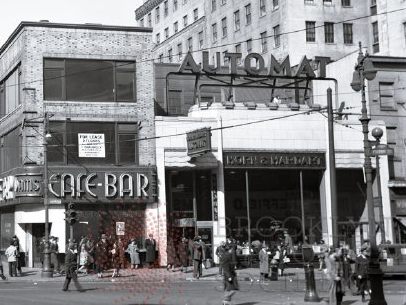
Here in the early 1940s we also see a little glimpse of No. 7, just peeping in at the right-hand edge of this early 1940s picture. It had survived Lovecraft, and appears to be looking much the same as the mid 1920s.
Hmmm. Hang on a minute. “Bristol’s” at No. 3? Sounds familiar. On page 937 of Letters to Family Lovecraft states of July 1931…
All three now set out for dinner — at the old Bristol Dining Room in Willoughby Street near Fulton, next door to the now defunct John’s, which was my Brooklyn headquarters for spaghetti in the old days.
Yup, same place. From Lovecraft’s own words, Bristol’s was “next door to the now defunct John’s”. So… John’s must be either 1, 5, or 7. Yes, I’ve found it was at 7…
Found at last. This ad for John’s is from 1925, at the required “7 Willoughby”. His branch opened in Brooklyn early May 1925, and the owner was the spaghetti-maestro John Pucciati. Who, as it turns out, was also a leading Italian anarchist in New York City, and by that time deep into running one of New York’s key illegal speakeasy joints. More on John tomorrow, and more of the relevant building pictures.
This picture is No. 7 in 1916, nine years before John took it over in May 1925. As we can see in this picture it was a bit pokey, it terms of getting a table with a view…

This lack of views raises a problem. How did Lovecraft sit in John’s and look out at the Brooklyn Citizen building? Which it’s likely he did. Because that was where and how he spotted his cheap suit from Monroe Clothes, across the street from John’s in an upper window. A 1922 copy of The New York Times (thanks Archive.org) brings this Monroe location a little closer than it was in my previous fruitless search for John’s. The NYT has the Monroe Clothes chain’s main Brooklyn branch at 413 Fulton Street, aka the Citizen newspaper building…
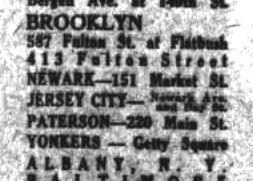
So, it appears that I was led astray by their earlier 1917 “Fulton and Hoyt” address for Munroe, which I looked for some years ago now. It now looks like they moved further up Fulton Street toward Borough Hall at sometime between 1918 and 1922. The company then failed in December 1925 – June 1926 after being “dragged into bankruptcy” by a vexatious creditor. When the official receiver was appointed for the Monroe Clothes bankruptcy in June 15th 1926, it was usefully listed at “409-21 Fulton Street”. This then is further confirmation that they were indeed at 413 Fulton Street by 1922. 413 was likely their main ground-floor entrance, and then they had sales and stock rooms above that stretched across No. 409-21. They were a purely “upstairs” men’s suits store, which is how they offered their famous cheap prices.
But how could Lovecraft have seen the Citizen building when eating at John’s at No. 7? I can only assume that No. 7 had some kind of extended rental across the upper roof-space, in order to have more tables and also more ‘tables with a view’. Which would look something like this…

So, the Citizen building would have been in view, if this was the arrangement. As I’ll explain tomorrow, John had some tight ‘mob’ connections by this time, and thus could have ‘swung’ such an extension across the upper floors, even had the other owners been reluctant. More on John tomorrow, along with fine photos of No. 7.
27 Friday May 2022
Posted in Historical context, New discoveries, Picture postals
This week, another try at finding H.P. Lovecraft’s New York City cafes and eateries. Today Bickford’s, tomorrow… John’s.
H.P. Lovecraft mentions that a favoured eatery in Brooklyn was “Bickford’s” near Borough Hall. The place was found early during his New York City sojourn. He had abandoned the Tiffany, whose wood-panelled decor he favoured, after he discovered that the clients just could not be ignored in favour of the decor…
the clientele was past enduring … young toughs and gangsters … I got all my stomach could stand after three or four months and thereafter switched to Bickford’s – near Borough Hall.” (Selected Letters II, page 259).
The early switch is confirmed by his 1925 Diary, which notes “Bickford’s”.
In the early 1920s Bickford’s was part of a small but growing chain, with the owner Samuel L. Bickford known for his work with and fund-raising for the Boys Club in Brooklyn. He had also run the New England Waldorf’s Lunch chain in the 1910s, and since these were one of Lovecraft’s favourites he could have been familiar with Bickford’s name in that way. In New York Mr. Bickford offered the unbeatable combination of good cheap food, fast service, and long hours. His chain was a success and in the 1920s branched out into even faster service with self-service automats, it seems, if the New York City branches listed in directories as ‘Bickford’s Lunch System’ are anything to go by. He ended up with a large successful chain.
The Chain Store Age trade magazine tells us that a Bickford’s branch wasn’t located at 425 Fulton Street until 1927. Thus the 58 Court Street branch must have been Lovecraft’s haunt in the Red Hook years, and it is indeed very “near Borough Hall” being just a few steps away down Court St. He calls this branch of Bickford’s a “one-arm”, meaning both cheap and that it had ‘side-arm’ tables just wide enough to hold your plate of food.
In its better days 58 Court Street had been the home to Mr. Edward Greaf, first-class dealer and importer of wines and also the Curator of Entomology at the Brooklyn Institute. But by the 1940s it was the Concord Cafeteria, with a Chop Suey hall above…

As can be seen here in the late 1930s. The former Bickford’s is now the Concord cafeteria and is partly seen on the left. The 25-cent Chop Suey restaurant is above…

Today Street View shows the site as a seedy “Dunkin’ Donuts” hole-in-the-wall next to a failed “General Nutrition” health-food store. However, most of the pleasing stonework and a classic Brooklyn metal fire-escape remain above, evoking a touch of the past.
The above 1940s picture is the nearest in time and place to the 1920s I can get. Not quite as Lovecraft would have known it some 15 years earlier, but I note that since 1917 Bickford’s branches all had the same classy architect and designer, one F. Russell Stuckert. Thus the Court Street branch would probably not be too different from the following frontage in design and logo and perhaps also the use of stained glass. Here we see his design work in the post-1927 frontage for the nearby 425 Fulton Street branch, located a little to the west of Borough Hall…

“Hot Turkey” on the menu. The frontage is deceptive as to the size, since inside it was vast and went back and back and back again — as I’ll explain in another post. The smartness of this 1927 branch, seen here in the late 1930s, may not quite reflect that of the earlier and more worn Court Street branch circa 1925.
David W. Dunlap wrote about the cultural aura of the Bickford’s chain in 2000 in The New York Times, then a reputable newspaper of record. He noted that in the 1950s Ginsberg’s Howl beat generation… “sank all night in submarine light of Bickford’s” (Howl, Ginsberg), and that the great Woody Allen later revered the chain… “I got no money. I’ll go sit in Bickford’s.” (Getting Even, 1971, his breakthrough book collection). Other New York creatives also mentioned it over the years. But Dunlap didn’t pick up on the fact that one H.P. Lovecraft had, as usual, got there first.

