HPL ‘zine, 1972-74

My thanks to Gregory for letting me know that Meade and Penny Frierson’s HPL ‘zine (1972-74) is now free and public on Fanac.org. 144 pages, plus three supplements together totalling around 170 pages. Supp. #1 is letters, in response to HPL.

It’s rich stuff, with HPL #1 fronted with memoirs as well as having fiction in the back. There’s also “HPL and Films” by Shea. Here are just a few biographical highlights:


Interview with Frank Belknap Long:

SCHIFF: What was your impression of him when you met him?

LONG: Well, he was sitting on the stoop outside Son­ia’s apartment. He was very stout at that time. He became stout briefly for about 2 or 3 years. He looked much older than he was – he was only about 32 at that time, but he looked 40 or more. I knew it was Lovecraft as I approached and he was very glad to see me and we went inside and I met Sonia for the first time. As I recall, we spent a very pleasant afternoon. … But he was not much given to relaxing, and being casually human or jolly. Back-thumping and a bone­-crushing handclasp were alien to his nature he had a very good voice for reading supernatural horror stories. You see, a horror story could hardly be read by a Babbitt or a guy who’s a Rotarian. His voice was that of a cultivated New Englander and it went very well with the stories. [On viewing old towns and sites, such as in Newport and Providence in summer] what a wonderful guide Howard was [when] touring these ancient by-ways. [Impressions of HPL] Every individual has qualities that are lost forever when he dies. You can’t bring them back by just describing them. I don’t think I’d attempt to — I’d simply say you get to know him best by reading his letters and his stories. He had the qualities that you usually associate with a man of genius.

Long’s letter in Supp. #3 adds a little more…

I can no more picture him so much as bending and tracing a Cabbalistic circle on the floor with a piece of chalk, even whimsically and half in jest, than I can imagine him draped across a bar in the last stages of alcoholic stu­por.

[HPL]”Wasn’t as prudish as is commonly assumed. In fact, he wasn’t prudish at all. But he was puritanic, which in many ways is quite a different thing. The early New England Puritans were the opposite of prudes – could be candid, even coarse, in the realm of sex. Prudery as we know it today, largely, came in with the Victorians. It constituted a Victorian hang-up and Howard loathed everything Victorian.

I’m sure old Mrs. Brundage’s drawings [for the later covers of Weird Tales] merely caused him to chuckle with wry amusement. He thought them commercially shoddy and flamboyant, but he never would have dreamed of tearing off the covers of WT.


Price has a long “Astrological Analysis” which should not be overlooked due to its esoteric nature. In his earlier 1949 “Stars” version of this Price had slipped in many perceptive biographical observations of HPL, among with the astrological flummery.

Followed by “Reminiscences” of HPL by Price, as transcribed from a 1971 convention panel which was sadly cut very short. An earlier speaker had been allowed to over-run and the convention lunch was looming. Not in Lovecraft Remembered.

The Puritan [HPL] was as much at home with the Vieux Carre crowd as he was in his sedate native Providence. One would have thought that he had spent all his life with wine-bibbers and people addicted to riotous living. Some say that he was at ease because he drank spiked punch, not realizing that it was spiked. This is error! We never served punch in the Vieux Carre. HPL needed no grog. The guests gathered about HPL. He held them fascinated. It was beautiful to see how he was charming them. They did not know who he was. He didn’t bother to tell them. His presence was enough.

Price makes it clear that at that time the New Orleans district was a mix of long-time residents as well as artists and writers, and it was far from being gentrified and thus un-liveable for ordinary “every-day standard folk”. He also distinguishes his area from the neighbouring district of brothels.


Supp. #3 has a letter from Price, but nothing is added. #3 also has the long “A MEMOIR OF JACK GRILL By George T. Wetzel”, Grill being a key early Lovecraft collector.


Also of interest at Fanac.org, Howard Phillips Lovecraft – Memoirs, Critiques and Bibliographies (1955).

More Doctor Who

The two Doctor Who technicolor movies have been restored to 4k “in a brand new restoration”, and are getting UK cinema screenings as well as a Blu-ray. The double-bill Blu-ray for Dr. Who and the Daleks (1965) and Daleks’ Invasion of Earth 2150 A.D. (1966) is out now.

Both of the widescreen cinema movies feature movie-star Peter Cushing as The Doctor (he never played the character on TV). They are not at all ‘canon’, in that they played very fast and loose with rather pointlessly ‘re-imagining’ key things in the series, much to the chagrin of the millions of fans of the weekly TV episodes. Still, the movies are likely to be enjoyable vintage British sci-fi for those otherwise unaware of Doctor Who.

The new releases are well timed for me, but even so I think I’ll skip them. Since — having now finished up a ‘lockdowns’ Baker and Davison “best of” re-watch of Doctor Who — I’m now embarking on a “best of” watch from the very first episodes. Namely those with Hartnell through to Troughton as The Doctor, and then into the Pertwee years up to his regeneration into Tom Baker. Which will brings things full-circle. Thus I have plenty of the real-thing to be going on with, without adding the rather jarring mid-1960s movies on top. There should be enough here to last me well into the next lockdown (which is increasingly likely, now that Boris has gone).

For what it’s worth, here’s my current selected watch-list for the vintage TV Doctor, in order. I’ll update the episodes with comments, when seen…


Hartnell:

* An Unearthly Child. WATCH. Excellent, surprisingly good for 1963. I was expecting something very creaky and blurry, and I was wrong.

* The Daleks. WATCH. The first Daleks. A little padded out for length (six episodes), but very watchable.

* The Edge of Destruction. SKIP. A bizarre attempt at a weird Pinter-esque stage drama in two parts. Everyone acts out of character and it doesn’t work.

* The Dalek Invasion of Earth. WATCH. A slow start for a six-parter, but it gets better and better. Excellent.

* The Rescue. SKIP. A weak two part story, slotted in at the last minute to quickly introduce a newly-cast companion (who sticks around for a few serials). Just read up on the plot.

* The Space Museum. WATCH? An interesting environment and amusing enemies, but definitely not vital. Introduces the idea of the ‘time conundrum’, and also a device which is used in the next story.

* The Chase. WATCH. A long six-parter. Good in parts, and it definitely gets better as go into the second half. Two long-time companions depart at the end, so it has to be seen.

* The Time Meddler. MUST WATCH. Excellent. Usually the medieval stories don’t quite work. This one is superb, and mixes past and future. Aka ‘The Meddling Monk’. New male companion.

(In a skipped serial the girl companion found in ‘The Rescue’ departs with a local hunk in the ancient city of Troy, and then over the next few serials the Doctor begins to rapidly go though numerous girl companions)

* The Daleks’ Master Plan. OPTIONAL. An epic 12-parter resembling 1930s early Space Opera, running five hours though substantially reconstructed around the original audio. Starts well, and continues from the missing/lost one-off episode ‘Mission to the Unknown’. Sags heavily into scattergun plotting in the middle of the five hours, and then descends into farce for a Christmas Special set in the era of the silent movies. Improves toward the end. Could be skipped, but has many good parts. You may want to find a skip/watch list just for this epic.

* The Massacre. PARTIAL. Only audio still exists. Read the plot, and then watch the end part (16:50 onward) of the reconstructed fourth episode for a rare introspective speech by Hartnell and also the arrival of a new companion.

* The Ark. WATCH. Very good, and thankfully still complete and intact. First full outing for the new girl companion Dodo, a British orphan from 1966 picked up at the end of serial (‘Massacre’).

* The War Machines. WATCH. Not great, partly because of the ridiculous machines. Held together by good acting and a UK setting. More new companions, this time long-term.


Troughton:

* Tenth Planet. WATCH. Only partly survives, reconstructed. A great idea, poorly executed and trapped in a predictable and a gratingly ‘shouty’ military scenario.

* The Power of the Daleks. WATCH. A six-parter that only partly survives, reconstructed. Good fun throughout, though has a rather cursory ending.

* The Moonbase. MUST WATCH. Excellent, though it only partly survives and is reconstructed. A strong setting and enemy.

* The Evil of the Daleks. WATCH. Animated, reconstructed. To understand what’s going on at the start, you need to read the plot summary for the previous ‘The Faceless Ones’ serial. This also explains why assistants Ben and Polly are no longer around. ‘Evil’ is a seven-parter that starts well, sags-and-pads in the middle, and then has excellent 2 x concluding series-finale episodes.

* The Tomb of the Cybermen. WATCH. New series starts. A little creaky in places, but a good setting and very watchable. New assistant, Victoria.

* The Abominable Snowmen. WATCH. Sadly most of this is reconstructed from stills, but it’s still excellent. Would be a classic, if only it was intact.

* The Web of Fear. MUST WATCH. A classic six-parter, and almost all intact. First UNIT, first Lethbridge-Stewart. Continues from ‘The Abominable Snowmen’.

(Victoria Screamer departs in the lost ‘Fury from the Deep’, then in the mostly-lost ‘The Wheel in Space’ the new and quieter assistant Zoe is picked up on a space station).

* The Dominators. WATCH. New series starts. Excellent, and complete. Not a classic but still very enjoyable, if you overlook the very silly Quark robots (bizarrely the BBC thought they could merchandise them as toys??). First use of the Sonic Screwdriver.

* The Mind Robber. SKIP. One of those Prisoner-era “take a set of nonsensical psychological tests, in another dimension, none of which matter” serials. A mid-series filler, padded out to five episodes.

* The Invasion. OPTIONAL. Eight episodes, set on Earth with UNIT. Two missing episodes are animated. Lots of action, but it’s all rather predictable and over-long.

* The Seeds of Death. WATCH. Creaky and sags a bit, here and there, since what should be a four-parter is being padded to six parts.

* The War Games. OPTIONAL. A massive ten-parter, in which there’s a whole lot of repetition of the tired old ‘doctor captured as spy’ sub-plot. Has its moments, but is often tedious.


Pertwee:

* Spearhead from Space. MUST WATCH. Excellent. This is what ‘The Invasion’ should have been, short (four episodes) and sweet. Pertwee’s first full outing, fun and with a fine calm new assistant.

* The Silurians. OPTIONAL. The Doctor’s car, Bessie, is introduced to the series. Slow, spread over seven episodes, and marred by bad alien costumes. But quite watchable, and with an interesting Derbyshire Peak setting.

* Inferno. OPTIONAL. A bit of a hodge-podge, and an unwelcome return to the “shouty” tone of the Troughton years. Seven episodes that drags and sags in the middle, as lazy scriptwriters slump into the stock and very tedious “doctor mistaken for a spy, condemned to death” sub-plot. Some fans think ‘Inferno’ (1970) is a Pertwee high-point, but I didn’t.

* Terror of the Autons. WATCH. A very watchable four-parter, brisk and entertaining but not vital to see.

* The Daemons. WATCH. A bit strained here and there, and the five episodes means not enough room for development of interesting secondary characters (the white witch, the technician). But it just about hangs together.

* The Sea Devils. WATCH. Fun, and even gripping in places. As with ‘The Silurians’, the alien costumes are rather bad. The series obviously ‘has it in’ for complacent mandarins from Whitehall, but the lads of the British Navy get prime-time recruitment footage.

* The Three Doctors. WATCH. Excellent.

* Frontier in Space. WATCH. Quite watchable, with some fine make-up and costuming. But leaves the war story on an unresolved cliffhanger and goes off into what is effectively another story in the following ‘Planet of the Daleks’. Apparently the outcome of the war situation has yet to be explained in any other Who-universe content. So be prepared for an unsatisfactory ending. Read the “Production” section on the episode’s Wikipedia page, to find out what the ending should have been.

* The Green Death. WATCH. Excellent. One you might want to re-watch.

* The Time Warrior. WATCH. Start of the final Pertwee season. Meets Sarah Jane, so a ‘must watch’. The quality of the acting and delivery holds it together and make it fun, despite the wobbly sets. Might be better to call the Pertwee run quits here, while you’re ahead.

* Invasion of the Dinosaurs. OPTIONAL. A sorry sort of send-off for Pertwee.

* Planet of the Spiders. OPTIONAL. Not great, but it leads you into the regeneration and the new Doctor, Tom Baker.


Many of the early episodes were destroyed or lost by the BBC, and thus some stories from the Hartnell / Troughton years will have a partial reconstruction via animation / audio / script.

‘Picture postals’ from Lovecraft – the view from Columbia Heights

A return to New York City for this week’s ‘Picture Postals’. To Columbia Heights, and the view of the river and city from there.

Here we see a preliminary study in oils of New York Bay from the rooftops of Columbia Heights, 1923. The artist is unknown. Samuel Loveman was living at 78 Columbia Heights from 1924, near Hart Crane who had then been at 110 Columbia Heights for some years. It was from the latter address, on his first visit, that Lovecraft had…

my first sight of the illuminated Manhattan skyline [being] from its roof!

Thus this picture gives some notion of what that view might have been like, albeit in the daytime and looking away from the city towers and from the famous Brooklyn Bridge.

We get a feel for the other side of the view from this rooftop picture of the poet Hart Crane at No. 110.

Those wishing to track down a really good glass-plate early-1920s view at night should be able to triangulate from this. To see how close the Brooklyn Bridge view is to the elevation and distance seen here. The above painting should also help with location. For a view featuring one of the most photographed bridges in history, the chances seem good of finding a large panorama picture made in the early evening circa 1916-1926.

Over time Columbia Heights was the site of one of several evening ‘dream-visions’ of the city towers, ethereal and faery in the river-mists at dusk with the lights coming up. Lovecraft at first found the city…

delightful to visit on account of its faery pinnacles & wealth of museums & the like

The Woolworth Tower, seen here at night in 1923 perhaps exemplifies the spirit of Lovecraft’s views, if not the actual initial view of massed towers across the water as seen from Columbia Heights. Though Lovecraft did also ascend this tower, then the highest skyscraper yet built in the city, and would have had many ground-level and Elevated railway views of it in the dusk from various angles.

Despite his later sentiments about the city, Lovecraft still sighed in 1933 when he recalled his old response to such sights…

I shall never find another Dunsanian city of wonder as utterly unreal & linked with incredible cloud-mysteries as the exotic & unexplored labyrinth of sea-born towers that was the dim, half-fabulous Manhattan of 1922.

Of course his later experiences of living in the city year-round gave him quite another view of the place, and it became for him “the pest zone”. The experience left with him with…

the abiding terror of him who comes to New-York as to a faery bower of stone & marble, yet finds only a verminous corpse — a dead city of squinting alienage

Again, an old postcard helps evokes this sentiment — Luna Park (Coney Island) at night with gargoyle-dragons…

SALTES

SALTES, a custom search-engine for Lovecraftian researchers. Not great at present, partly because Tentaclii is not yet properly re-indexed by Google (e.g. search: “waterfront”). But it covers the basic URLs and it’ll grow over time. You can also jump off the end of the search results, to run the same search on the main Google Search.

News from Germany

The German Lovecraftian society has posted their June update.

* In German books… “BookRix has published Selected Essays on H.P. Lovecraft by S.T. Joshi as an eBook. A print edition is expected to follow in August.”

* They anticipate starting their own podcast in the near future, which may interest German-speaking readers of Tentaclii.

* On 18th and 19th June, the Lovecraftian live horror radio play “Off the Ancient Track” was performed at the Galli Theater in Frankfurt. Next performances 6th and 7th August. Booking now.

Bradbury’s “The Exiles” (1950) – the Lovecraft version

My thanks to ‘Susmuffin’ for locating Ray Bradbury’s Martian story “The Exiles” (1950 version), featuring Lovecraft as a character. It appeared in Fantasy & Science Fiction, Winter/Spring 1950. Though a Mars story it is not formally part of The Martian Chronicles, being set long after the end of that cycle. By that time Mars has been abandoned by humans, but the first new colonists are now arriving and they encounter what might be Martian ‘ghosts’ in human form. Ironically, given the censorship theme of the story, the Lovecraft section was excised for later printings of the story.

I’ve extracted it in a printable plain-text form as a PDF, in the hope that a reader with a talent for voices might make it an audio recording for YouTube: Bradbury_The_Exiles_1950.pdf

The Dark Brotherhood (1966) and “The Lamp of Alhazred” (1954)

Don Herron usefully notes an occurrence of Lovecraft-as-character in his new blog post “Two-Gun Bob: In Memoriam?”

Derleth himself also engaged in the fun, as in “The Dark Brotherhood” from 1966, a masterful parody in which he dropped ‘Arthur Phillips’ for Howard Phillips [Lovecraft] … A tale not openly about Lovecraft.

From the story’s opening…

The police have been beset by the usual number of cranks, purporting to offer information about the matter, none more insistent than Arthur Phillips, the descendant of an old East Side family, long resident on Angell Street

A quick glance at the Archive.org copy shows that much is made by Derleth of Providence at night, and Lovecraft’s night-walking. Not knowing Derleth, except from having read a few in the 1970s Panther paperbacks at around age 14, I hadn’t realised this was a Providence-set Lovecraft-as-character tale. It’s to be found on YouTube in a good 80-minute audio reading from Aaron Strouse.

Robert M. Price in an old copy of Crypt of Cthulhu touches briefly on Lovecraft in Derleth, usefully noting that in Derleth…

‘Ward Phillips’ in “The Lamp of Alhazred” is obviously and transparently Lovecraft.

Sadly “The Lamp of Alhazred” is not on YouTube except in Spanish. The text is however available and The Weird Tales Podcast reading from 2019 has it as an .MP3 download. Downloads are best because the pitch and speed can be shifted in the AIMP player, as well as having the graphic equaliser on the ‘Headphones’ preset. In this case it’s too fast and a little high and thus the speed needs to be slowed and the pitch shifted accordingly.

So there you go, an audio double-bill of ‘HPL as written by Derleth’. Though I have to say that I gave up on the slow and ponderous “The Dark Brotherhood” after three and a half chapters. The character is obviously Lovecraft, in all but name and a Sonia-a-like also appears. But I doubted there would be much more biographical ‘reveals’ as the story progressed moved on into Derleth-land. The much shorter and earlier “The Lamp of Alhazred” is more engaging, and not without some charm at the end.

Incidentally a local search for “The Lamp of Alhazred” (1954) also led me to Reader’s Guide to the Cthulhu Mythos (1973), which briefly noted Bloch and Derleth’s uses and also added that…

HPL appeared in one of Ray Bradbury’s “Martian Chronicles”, indulging in one of his (Lovecraft’s) favourite pastimes, eating ice cream.

I don’t recall that at all, from my fairly complete re-listen to the Martian Chronicles some five or six years ago now. Anyone know which story?

Patrick base mesh, and kitty

“Patrick base mesh” is new on ArtStation, affordable and with a permissive licence. It shouldn’t take too much work in a 3D package like ZBrush or Blender to turn this into a toon H.P. Lovecraft.

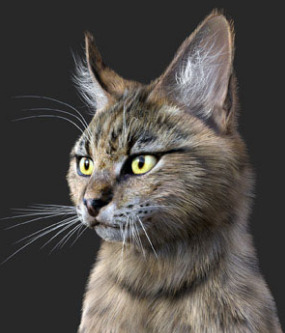
Also a fabulous new contender for an Ulthar kittie, although not toon, in the form of the new Savannah Cat (requires the base Cat Mars) for the 3D software DAZ Studio. Also a contender, via a sci-fi coat re-colour, for one of the “Cats of Saturn” heard about in Dream-quest.

Recordings from Howard Days 2022

Audio recordings from the 2022 Howard Days sessions are now being posted on the blog of The Cromcast: A Weird Fiction Podcast. Donations for future annual Howard Days events are always welcome, if you enjoy them. Eight so far, as posts:

* The REH Influence on Gaming.

* Robert E. Howard in the year 1932.

* The Glenn Lord Symposium. Three papers and panel.

* Guest of Honour speech at The Robert E. Howard Celebration Banquet.

* Late Night ‘In Conversation’ at the Pavilion, Cross Plains.

* Conan the Barbarian at 40. (Reminiscences of making the first two Conan movies).

* Rusty and Shelly Burke at the Cross Plains Public Library.

* What’s Up with REH? (Latest developments in Howard’s characters, in publishing and entertainment). Wrong media is linked on the post. The required audio is here. Some of the reveals: A “Red Nails” prequel novel by a top writer, The Blood of Serpent, as the first big ‘splash’ release in October 2022 to coincide with the 90th anniversary of Conan. Sounds good, as long as the action sounds like Howard. And a big sumptuous Conan artbook. Also a new monthly Titan Conan comic-book with top talent, to be released around the same back-to-uni time, now that Disney/Marvel has thrown the character overboard.

* A Chat with Matt John of Rogues in the House games podcast

Beware the Creative Commons licences, which are muddled. On the blog posts the audio is all very usefully placed under full Creative Commons Attribution. However, the licence is regrettably different on the Archive.org mirror-copies, adding the show-stopper of “No Derivatives”.

Lots of ‘bathroom’ echo on the main speaker’s audio for “What’s Up with REH?”, so I used it as a test-file for the Izotope RX 7 AI-powered audio repair software — which for months now I have been meaning to get around to installing and testing. Specifically for its ‘Dialogue De-reverb’ module. Works fine. I applied this preset on the standard ‘General Reduction’ preset, and after 25 minutes of re-rendering the audio and three minutes of saving the file I had a much more listenable version. This version is now on Archive.org and, though it’s a ‘derivative’ I’ve assumed the blog’s original CC Attribution licence applies.

Another comics adaptation of Dream-Quest of Unknown Kadath

Another comics adaptation of Lovecraft’s The Dream-Quest of Unknown Kadath, set to be in the comic-book stores as a #1 ‘floppy pamphlet’ comic-book in mid September 2022. By Florentino Florez, Guillermo Sanna, and Jacques Salomon. No mention of how many issues. The usual run on this sort of thing is five or six. But I’d guess about eight (192 pages) might do it more justice. Nice #1 cover-art, which reminds me a bit of late-1970s Dave Gibbons on 2000AD.

New on Tentaclii in June 2022

Time for another monthly round-up for Tentaclii. As always, please try to support me via Patreon or an occasional PayPal donation or even an Amazon Gift Voucher. Also, please note that I may well be looking for additional regular-monthly paid work from September 2022. If anyone can use my talents for $500 a month, please enquire. Digital magazine production and historical research work are a speciality. At present I’m producing Digital Art Live magazine each month, and have been for years now. To contact me, just post a comment on Tentaclii and I’ll see it.

This month on Tentaclii, in ‘Picture Postals’ I took more deep dives into Lovecraft’s New York City: strolling along Willoughby / Fulton Street, Clinton Street, and also popping into Automats pre and post-Deco. In the most recent posts in this series I put the final touches to the discovery of Lovecraft’s favourite cafe and grocery in Brooklyn, with a useful map, the names of businesses and business-men surround the cafe, and new vintage photos of 169 Clinton Street. I think this burst of New York research is pretty much done now. It adds to the story of Lovecraft’s cafes, most of which turn out to have unusual characteristics or unusual characters who ran them.

I also posted research essays on Lovecraft and Haldeman-Julius’s censorship-busting “Little Blue Books” of the 1920s and 30s, and on Lovecraft’s passing adoration of the now-obscure French writer Remy de Gourmont at the end of his ‘decadent phase’. A question from a Patreon patron also resulted in the short essay “Lovecraft and E.E. ‘Doc’ Smith”. E.E. Smith being a contemporary cosmic tale-weaver but of a very different sort.

I linked to a scan of the Lovecraft poem “New England Fallen”, new at the Brown Repository and not in the collected poetry. A new collection of mid 1960s sci-fi convention programmes being posted on Archive.org enabled me to put a face to Lovecraft’s biographer L. Sprague de Camp. I also found a small new 1923 item by Everett McNeil, “oldster” of the Lovecraft Circle, the non-fiction “The Feast of the Dead”.

I posted my lengthy “Notes on Selected Letters II: Part Two”; “Selected Letters III”, and “Selected Letters IV”. I’m now starting on the final Volume V, again making notes as I go. Relating to a recent ‘Picture Postals’ post, I was pleased to find evidence that Lovecraft did see the hothouses at the Brooklyn Botanic Gardens. The Letters also offered more evidence for his early love of florist’s shops and fine ornamental gardens.

New scholarly books noted this month included Ken Faig Jr, Pike’s Peak or Bust: The Life and Works of David V. Bush (Lovecraft’s major revision client in the 1920s); S.T. Joshi published The Parameters of the Weird Tale, with some Lovecraft-related essays not in his recent volume collected essays on Lovecraft; and also Cosmicism and Neocosmicism in H.P. Lovecraft (forthcoming). New in Spanish was H.P. Lovecraft: poesia fantastica completa (‘the complete fantastic poetry’). I suggested the need for a volume of Lovecraft’s maps, alongside the forthcoming mega-index to the volumes of Lovecraft’s Letters, and outlined a contents-list.

In the arts, the opera A Dream at the End of Time, a Lovecraft musical was staged in Los Angeles for a week’s run. Various forthcoming TV and movie adaptations of Lovecraft were noted. A number of new public-domain audio readings were linked, including The Strange World of Harry Houdini from 1920s issues of Weird Tales. The useful typewriter font ‘X Typewriter’ was found and linked.

In terms of free research materials, this month I found a run of the journal Old-Time New England, 1910-1981 on Archive.org. And as for research tools I made a home-brew mouse-gesture to fix the Opera browser’s problem with Google Search + spellcheck (only relevant if your browser can’t do spellcheck on search-terms you type into the Google Search box).

I was ill for two weeks this month, and so my Doctor Who Tom Baker watch or skip list was updated. Some months back I had stalled in my re-watch at the end of Season 14. But now I’ve also seen series 15, 16, 17 and 18 and have updated the watch/skip list accordingly. I’ve now also ferreted out the ‘watch’ list for the subsequent Doctor Who, Peter Davison (1981-84) which totals 11 stories.

That’s it for June, onward to July!