New book: The Monstrous Dreams of Mr. Providence

A new review by Arciapod of the graphic novel The Monstrous Dreams of Mr. Providence (2022), albeit reviewed from one of those annoying highly-compressed…

free preliminary, and likely unedited copy of this book

…of the sort that gets sent out for a graphic-novel review.

But his review usefully reveals that…

One’s enjoyment of this book is directly proportional to how much somebody likes or knows about H.P. Lovecraft. … people familiar with his works will get a far better appreciation for this story than others, and honestly without knowing a bit about him, the finer points of this may fly right over their heads.

Sounds good. Warning: the review has some big spoilers. The Arciapod review has only just been published, but it turns out the book has actually been out since June 2022. I had noticed it in passing, but until now had not heard about the direct Lovecraft connection.

Now… a while back Tentaclii noted the similar-looking ‘A Bestiary of the Twilight’ (Le Bestiaire du Crepuscule, June 2022), a French ‘BD’ (i.e. oversized graphic novel, often in hardcover) also featuring Lovecraft as a character. The French Lovecraftians had mentioned it, and I assumed it had not yet been translated.

Yet I now see that this ‘BD’ has the same 120 page-count as Mr. Providence, and has the same Parisian artist/writer in Daria Schmitt. A little digging finds European comics sources noting the name change. Yes, Le Bestiaire du Crepuscule has been re-titled as The Monstrous Dreams of Mr. Providence for the English edition, and since summer 2022 can now be enjoyed by English readers.

Only as an ebook, admittedly, but at a very reasonable price (probably around $5, for U.S. readers). If you want the dead-tree version it seems you’d have to get the French ‘BD’ and a phrasebook.


The news of this prompted me to see if there was an ebook of the graphic novel biography Some Notes on a Nonentity: The Life of H.P. Lovecraft. No, still just an out-of-print 2017 hardback.

Notes on ‘Letters with Donald and Howard Wandrei’, part three

Notes on the book Letters with Donald and Howard Wandrei, part three.

We open with letters from early 1934.

p. 314. Lovecraft hears his friend Morton, the mineralogist and Paterson museum-keeper, giving a radio lecture on dinosaurs. Morton speaks on each 3rd Monday on “station WOOA”.

p. 326. Lovecraft has a kernel idea for a story involving “an oddly heiroglyphed grave” which was later surmounted and pinned down by a giant boulder.

p. 320. He suffered “measles at 19 and chicken-pox at 25.”

p. 332. Relevant to the writing of “Whisperer”. “I cannot do serious writing away from my books and familiar setting.” See my previous notes-post for this book, for reasons why it might have been something of an experiment for him. Being written piecemeal and while on his summer travels.

p. 335. He stays on the cheap “Rio Vista” in St. Augustine, Florida “on the bay front”. “Canned beans as a heavy staple” in order to economise, and “cutting my food bill down to a minimum”. He had stayed there before, for two weeks in May 1931, with the 67-year old Dudley Newton, a person “about whom we know nothing” according to S.T. Joshi’s biographies. This card gives a flavour of the “bay front”, and “120 Bay Street” is the address I found for the hotel on one Lovecraft letter. In the 1950s it had 71 rooms.

Lovecraft spent a week here in mid August, in the “quiet” hotel…

Am now in ancient St. Augustine — at the same quiet hotel I patronised in 1931. Staying a week — an utterly fascinating town!

Quiet it may have been, but it may also have had a somewhat strong sea smell. Here we see a bit further along the Bay St. sea-wall, in a 1950s slide which reveals what older postcards hide — the shore at low tide…

Despite postcards of the place rather struggling to find many examples of the picturesque, there is an impressive old shoreline fort and Lovecraft adored the rest of this sleepy “city founded in 1565” by Spaniards. Later, after a rather blood-soaked defence of the fort against the French, it was populated and made into a city by Spanish labourers from the lovely but poor island of Minorca, along with some Italians and Greeks. It was a city that Lovecraft felt to be the product of “an elder, sounder, & more leisurely civilisation”.

Who was the Dudley Newton with whom Lovecraft spent two weeks in 1931? He was not Dudley Newton (1845-1907) who was a local architect in Newport, Lovecraft’s favourite local resort. The dates don’t match, as Joshi has Newton as (1864–1954). Find a Grave has a “Dudley C. Newton”, died 1954 in Brooklyn, New York City. He was an amateur in the UAPA at the time Lovecraft joined, though according to an edition of The Fossils he does not appear to have produced his own amateur paper. My 2013 research suggested he was a senior millinery buyer and procurer of Parisian silk-flowers (for hats and bonnets), working on Fifth Avenue in New York City. Thus he could also have professionally known Lovecraft’s hat-making wife in the 1920s. In his retirement — one assumes the two weeks in St. Augustine in May 1931 may have aligned with this at age 67 — he appears to have devised and sold daily crossword puzzles to at least one newspaper.

p. 336. Lovecraft regrets that he keeps on narrowly missing seeing the movie Dr. Caligari, which was evidently circulating in Rhode Island. Later, in early 1937 shortly before his death, he manages to see it at last in a local film season. These screenings must have been some of the last cinema shows that he saw.

I attended a series of film programmes at fortnightly intervals under the auspices of the Museum of Modern Art, among which were The Cabinet of Dr. Caligari, one reel of The Golem, Hands, and a number of minor pieces from the pre-war cinema.

His opinions on these are not also recorded, just the fact that he had at last seen them on the screen. There is no “Museum of Modern Art” in Providence, so he presumably meant the New York MoMA institution, which had recently opened a Film Library and new Projection Room, and was evidently also offering touring shows to New England cities. This means there may be a programme listing in their online archives. Indeed there is, and here it is. “Film in Germany: Legend and Fantasy”…

We now know the full programme for some of Lovecraft’s last cinema viewings, though we still can’t tell which reel of The Golem he saw. Although it seems that, the reels having been packed up and shipped to Providence, Lovecraft’s local screenings were then staggered “fortnightly”. Probably late January and through into February 1937, since the New York “Programme One” premiere was on 9th-10th January 1937. My guess is that each local fortnightly screening was probably augmented in Providence by a short talk and slides — since we know that one of the Brown lecturers was a strong enthusiast for the new film-art at that time. He was also a local Lovecraft acquaintance. I would imagine that Brown was the venue, although it may have been RISD. Perhaps there was a later New York “Programme Two” in the spring that also travelled to Providence, but by then Lovecraft was gone.

p. 338. He was still taking the New York Times, along with the local Providence papers, or perhaps his aunt was paying for it and he also read her NYT. Possibly only a Saturday edition?

p. 355. “Jake’s Wickenden St. joint has reopened”, early September 1936. “I haven’t eaten there yet”. Recent research by Ken Faig Jr. suggests that he never did.

p. 357. “Good old [Arthur] Leeds — ever young despite the existence of grown children somewhere in the dim Chicago background!”

p. 359. Lovecraft senses, but never sees, other Weird Tales readers in Providence… “there must be some, since copies [of WT] eventually vanish from the [news-]stands”.


Back to the end of 1934, for the start of the Petaja letters.

p. 387. While in Paris, Galpin studied music under Vincent d’Indy.

p. 395. Lovecraft reveals some details of the intensive study of olde London he had once undertaken via maps and books. “I am virtually certain [i.e. in my mind] of the shabby and potentially mysterious character of the small streets in Southwark just back of the Bankside waterfront.” The alleys have since been swept away, but they survived into the era of photography and the A London Inheritance blog has indicative pictures of the lost Bankside alleys. They apparently feature heavily in the classic non-fiction book The Elizabethan Underworld.

p. 396. In a survey of “weird material […] Kipling and F. Marion Crawford both come definitely in, for their few weird tales are both typical and important.” There are a number of Kipling collections in that line, and Crawford had a Wandering Ghosts story collection as early as 1911.

p. 406. Lovecraft suggests some invented names for the lad to use, “Yabon, Nagoth, Zathu”.

p. 407. Lovecraft was also in correspondence with a “young man named John D. Adams”, a poet.

p. 428. April 1935. Lovecraft states he had read the book The Last Home of Mystery (1929) “some years ago”. This being… ‘Adventures in Nepal together with accounts of Ceylon, British India, the Native States, the Persian Gulf, the Overland Desert Mail and the Baghdad Railway. Illustrated with a Map and with many Photographs by the Author’. Apparently a bit of an old-school travel writing classic, and the author — a military intelligence man — appears to have many perceptive and informed observations on the local beliefs and lore. The copyright date is 22nd March 1929. So Lovecraft probably read the book circa April 1929 – 1931, by the sound of it. Too late to have influenced Dream-quest.

p. 429. Lovecraft found that the April 1935 issue of Weird Tales had a story by Bernal… “which embodies an idea I had meant to use”. This tale involves “the next development in radio” and “the man who was two men”.

p. 436. Telepathy is “not outside the realm of possibility”, and Lovecraft notes (without approving) the “very recent change of mind” of Freud in favour of telepathy.

p. 449. August 1935. Yes, “the plot of that Chaugnar story came from a suggestion of mine”. Frank Belknap Long has created the alien Chaugnar Faugn, and presumably “Horror from the Hills” (1931, Part One and Part Two) is then the story. A book survey of vampire tales states it has “a plot that staggers the imagination”, and we know it also incorporated Lovecraft’s “Roman dream” letter. And, by the sound of it, some “plot” suggestions from the master. Curiously there appears to be no YouTube or other accessible audio reading of this Weird Tales appearance. There was later a 1963 book version from Arkham House, which may be preventing audio versions? I’m uncertain if the book was expanded and revised, though one blurb does note “expanded for book publication”.


That’s not the end of the book of letters, so there’s still some more to come.

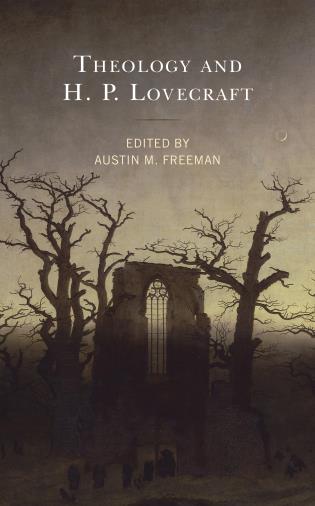
New book: Theology and H.P. Lovecraft

New to me, the scholarly book Theology and H.P. Lovecraft (August 2022), a multi-author book in the ‘Theology, Religion, and Pop Culture’ series from Fortress Academic.

This collection of fourteen essays is the first sustained academic engagement with H.P. Lovecraft from a theological perspective.

The book follows 2021’s survey Theology and Horror, from the same publisher.

Bicycle racing in Providence

Lovecraft bemoaned that he, as an adult, could not ride a bicycle in Providence. It was not the done thing, for grown-ups. But Small State, Big History makes the remarkable point that in 1925 the city opened the grand Providence Cycledrome, 1925-1934

bicycle racing was a major sport. … The Cycledrome, built in 1925, had bleacher seats that could accommodate 10,000 fans.

The site was perhaps a bit out-of-the-way for Lovecraft, though…

Located on the Providence-Pawtucket line off North Main Street

… and he was away in New York City when it was built and opened. Not that he would have visited for the races.

There may be a circumstantial link to such things though, since…

even earlier than the Cranston cycledrome was another stadium specifically built for bicycle racing constructed in Providence off Broad Street. Known as the Colosseum, it was built by local theatrical impresario [Colonel] Felix Wendelschaefer, who was also the manager of the Providence Opera House. Built in 1901, the Colosseum’s wooden grandstand was said to accommodate nearly 10,000 spectators.

It didn’t last long, as Small State, Big History states that the last races there were in “September of 1903”.

But the timing is right. I imagine that the 11-13 year old “veritable bicycle centaur” Lovecraft, and his gang of cycling boys, were only too aware of such a thing. Lovecraft had a number of connections with the Opera House in his youth and teenage years. Having the pre-Wendelschaefer manager as a family friend, and later calling the place a “second home”.

‘The Oblique City’ – Lovecraft in Quebec

“The Oblique City: H.P. Lovecraft, New France and Quebec”, a new gallery exhibition by comics (BD) artist Christian Quesnel. At the Galerie Montcalm in Canada, running until 8th December 2022…

The latest work by Christian Quesnel, ‘La cité oblique’, a free interpretation of the Quebec travelogue by H.P. Lovecraft … sprawling mists, forgotten deities and poignant creatures

Also I found a podcast interview with the artist, though it doesn’t appear to be in English.

The blurb for the podcast usefully reveals that the works are also in a print volume…

his [BD] album La Cité oblique, published by Editions Alto

Tracking this down, one finds that the book appeared in August 2022 and the blurb reveals more…

Christian Quesnel spent several years creating this magnum opus, which is enriched by Ariane Gelinas’s soaring prose … a parallel history of Quebec … [Lovecraft’s] wanderings through “the city of enigmas walled behind the closed shutters of dream” combine brilliantly with a Lovecraftian tale of the brave deeds of Qartier and Loui Heyber. The result is a highly hallucinatory tribute to the father of the Cthulhu Mythos, as well as a fascinating reworking of the past.

Sounds great. I look forward to seeing the book appear in English.

Forthcoming McFarland books

Why do publishers make it so difficult to find out about forthcoming books? For instance, the McFarland website has no way to search by all books + latest, by date. But after some naughty URL-hacking by me, they do now. Though even then you still have to manually open the book blurb fold-away section for each and every page. And then another section to get the publication date. Sigh. Oh, for a unified all-publishers news-feed for all forthcoming non-fiction books in English. Hint: it’s definitely not Amazon, which is rubbish at that and also clogged up with shovelware and ‘blank notepads’ junk.

Anyway, some possible forthcoming or just-out McFarland titles of interest to Tentaclii readers. As always with McFarland, some will be gems, some clunkers…

Ancient Stone Sites of New England and the Debate Over Early European Exploration (2nd Edition)

Reading the Great American Zombie: The Living Dead in Literature

The Dark Side of G.K. Chesterton (“explores the darker fringes of his wild imagination”)

Music and the Paranormal: An Encyclopedic Dictionary

Fantastic Serial Sites of California: Science Fiction, Horror and Fantasy Locations, 1919–1955 (screen filming locations)

How to Misunderstand Tolkien: The Critics and the Fantasy Master

Beowulf in Comic Books and Graphic Novels

The Writer and the Cross: Interviews with Authors of Christian Historical Fiction

The Knights Templar in Popular Culture

Frank Drake (1930-2022)

It’s sad to hear of the death of Frank Drake, originator of the famous Drake Equation.

Of course Lovecraft never lived to hear his November 1961 equation, or even an intimation of it in early science-fiction. He never put its weightings so precisely, but I do recall that in his letters he sometimes put his mind to thinking along the same logical step-by-step lines, about the chances of other intelligent and enterprising beings elsewhere in the galaxy. I seem to recall a passage in which he estimated the likely time between the emergence of each new sentient species, and from that logically extrapolated according to the astronomy of his day (which was still discovering basic matters about the universe), concluding there was a good chance of other intelligences.

Though re-finding the relevant quotes would take a long time. Roll on the unified mega-index of Lovecraft’s letters, which will hopefully have entries for concepts such as “Extraterrestrials, likelihood of actual existence”. Possibly the forthcoming ‘Lovecraft and astronomy’ book will also have some identification of the relevant letters.

Digital Art Live magazine #72

Available now, the new Digital Art Live magazine #72 (October 2022). I’ve newly expanded it, with ten new additional features and the issue runs to a chunky 108 pages in PDF. Few are in the mood for a gloomy Halloween issue at present, so the October theme is “Costume”. With a focus on fun and futuristic clothes, mostly in 3D rather than 2D painted. Though there are a few “Halloween” touches, here and there.

DAL72

It’s important that this issue sells. It’s the first being sold for $5 per-issue. Admittedly the theme lacks Lovecraftian appeal… but any appropriate publicity you can give the Gumroad link in your own digital arts forums, on suitable Facebook groups, art-blogs, will be most welcome.

If this issue sells then the November issue will be on the new AI image generator tools. If any Tentaclii reader has good contacts with the developers of such, I’d welcome an introduction — with a view to an interview done via email (a list of questions is sent).

Lovecrafter #9 and #10

The German Lovecraftians report that…

The new double-issue (9 + 10) of The Lovecrafter magazine was sent out this month by our hard-working cultist Andre. It should have reached our members’ mail-boxes by now.

The theme of the double-issue is “Lovecraft’s Geography” / “Dreamlands”, and TOCs include…

* “Somewhere in the middle of nowhere” examines various locations from Lovecraft’s works in detail.

* Another article goes “the opposite way and describes how role-playing games mix geographical reality and fiction”.

* A further article goes “in search of lost species”.

* An article on “the Cthuloid book portfolio of the Nighttrain publishing house”.

* An interview in which “Rahel and Rene talked extensively with Huan Vu about the current status of the shooting of his Dreamlands project.” (movie?)

* Many RPG game scenarios and game reviews, and more.

They also report a new book…

in [German publisher] Festa’s Weird Fiction series. In November, Dunkle Pforten will be the first of a total of six volumes that will [eventually] contain all the stories by Robert Aickman (1914-1981) in German for the first time.

Long and Voluminous

A new Voluminous podcast reads a Lovecraft letter to Frank Belknap Long, 25th February 1924. It’s part of the new Long cache deposited at the John Hay Library, and apparently it’s largely new here…

A couple of excerpts from this letter were published in Selected Letters I, but it is not yet available in the Brown Digital Repository, which means that except for a very small handful of people, you are among the first to experience the complete version since Frank Belknap Long opened the envelope 98 years ago!

The reading is followed by a good interview with the John Hay librarian in charge of the Lovecraft materials. It’s revealed that the collection has un-digitised collections from the Lovecraft Circle, and they welcome endowments specifically targeted at Lovecraft and the Circle (which, I guess, might enable scanning). It seems they can’t dip into the general university funds to pay for such things, and Special Collections relies on endowments and donations.

The S.T. Joshi Fellowship at Brown is revealed to have re-opened to scholars. That was mentioned in the podcast as being “1st October”, but it seems this was a slip of the memory. The S.T. Joshi Endowed Research Fellowship Web page states 1st November 2022, so there’s still time to apply. A point to keep in mind for applications is that Brown is said (in the interview) to favour applications to work with un-digitised areas of collections. It was thus interesting to hear that they have un-digitised Circle materials, and also one of the world’s largest collections of Silver Age U.S. comics, in that respect. So potentially one might track the early emergence and evolution of Lovecraftian themes in comics.

Another factor revealed in the interview is that, as of NecronomiCon 2022, scanning of the new Long letters has not yet started. So presumably they won’t be arriving online very soon.