“I leaned back, waiting whatever ghostly demonstration might appear…”

Dark Adventure Radio Theatre’s “The Black Stone” has its cover artwork, and gives every impression that it’s available for download (if not quite yet a shipping CD). Including two 8th December reviews.

Presented with their usual 1930s-style radio drama approach and panache, it’s Howard’s loving-crafted 1931 homage to Lovecraft.

Through the Hell Gate

It was through a ‘Hell Gate’, appropriately enough, that H.P. Lovecraft entered New York City for the first time. The Hell Gate. In Letters to Family (p. 420), a September 1925 letter explains that…

[Queens Plaza] was the very first spot on Long Island that I ever saw; being at the portal of the great Hell Gate railway bridge, over which rolled my train on my initial metropolitan advent of April 1922.

Here are two pictures. One indicates and evokes the approach to this bridge, while the other looks down and off to the side of it.

The view has Hell Gate bridge on the far right, and the Queensboro Bridge on the left. The river is out of sight, down below both. Typically, Lovecraft tells his aunt that he recalls that in 1922 he had immediately noted from the train window “a huddle of nondescript wooden houses” down below, and filed them away for some future moment of antiquarian investigation. These later proved to be the “old time Astoria”. So his antiquarian interest in New York City had begun even before he stepped off the train in 1922.

The bridge is also known as Hells Bridge or Hell’s Bridge, Hell Gate Bridge, or the Hellbridge.

Lovecraft’s 1926 letter continues, describing a sight just seen on the same route…

I noticed en route [to Queens Plaza, across the Hell Gate in September 1926] a very attractive sight — the misty skyline of New York all grey and fairy-like as on the first occasion of my seeing it, three and a half years ago. The Queensboro Bridge loomed up deliciously in the middle-distance […] & the whole was glorified by slanting shafts of sunlight […] which dropt from an opening cloud to the vaporous regions of earth.

We actually have a fine mid-1930s National Archives public-domain picture of almost this very view… from the foot of the Hell Gate pilings, looking through the Queensboro Bridge at the grey towers of New York City in the distance beyond. I’ve here cleaned and toned it.

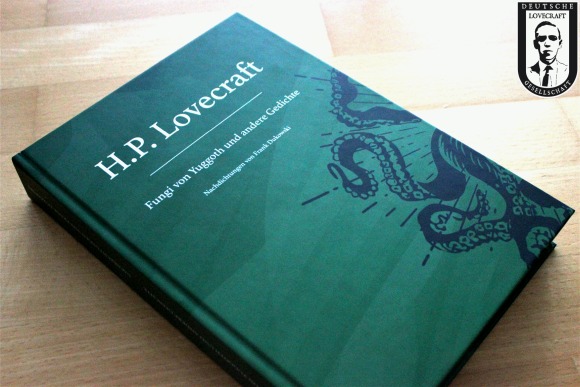
New book: Fungi by Yuggoth and Other Poems (German)

The German Lovecraftians have proof copies of their forthcoming volume of Lovecraft’s selected poetry, translated and presented in a handsome 300-page edition…

With the publication of the volume of poems Fungi by Yuggoth and Other Poems, some of these verses are now available in German for the first time.

The editor and translator is said to have followed the ‘suggestions for arrangement’ of a poetry volume, from the lists which Lovecraft had set down for Barlow in the 1930s.

The new book is not available yet, but they say “we hope the presses will soon be running at full steam” for this, ready for shipping in spring 2023.

Also, their regular podcast has lost their key editor/uploader due to his work-pressures. They have replacements for now, but let them know if you can offer regular German-speaking help.

Dark Valley Destiny

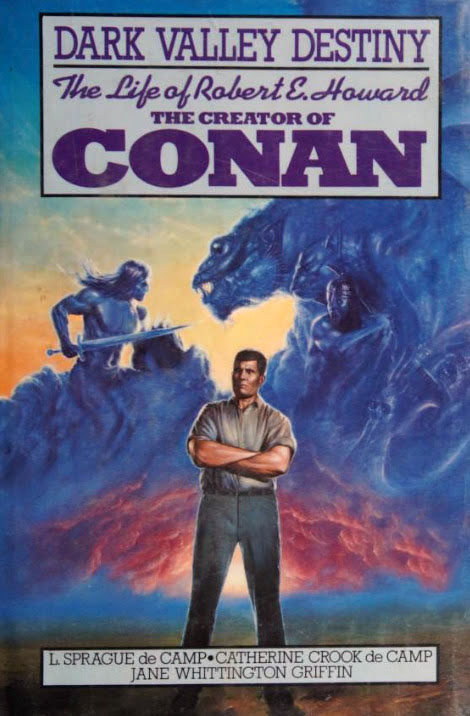
New on Archive.org, and there for the first time, de Camp’s early Dark Valley Destiny: the life of Robert E. Howard. Howard scholars appear to have disliked the book’s Freudian ‘digging’ for neuroses and more, the fashionable ‘armchair psychoanalysis’ of the sort quite common in 1970s biographies. Seems to have been partly written 1970-74, at a guess as an offshoot of de Camp’s Lovecraft biography. Then published as a full book in a popular edition in 1983.

Revelations of a Spirit Medium

Revelations of a Spirit Medium (1891) was a tell-all book which debunked the tricks of the spiritualist ‘mediums’. In doing so the book deeply inspired the teenage Houdini. Long suppressed by ‘buy and burn’ spiritualists, the book was then released in a handsome new 1922 facsimile edition complete with bibliography and glossary. This week it has also appeared as a new full public-domain audio reading on Librivox…

the most wonderful of the ‘medium’s’ phenomena will be so thoroughly explained and so completely dissected that, after reading this book, you can perform the feats yourself

I don’t see it listed in Lovecraft’s library or noted in the Letters, but given the date of the 1922 edition and the Houdini influence, it would certainly have been familiar to Lovecraft’s Providence friend C.M. Eddy Jr. (he was often in the employ of Houdini, as an undercover agent in disguise). At a guess, Lovecraft may have skimmed it when preparing The Cancer of Superstition. Which as Joshi explains…

appears to have been a collaborative revision on which Lovecraft and C. M. Eddy worked at the instigation of Harry Houdini

Also Houdini related, Deep Cuts has been lucky enough to get a copy of Miscellaneous Letters and looks at “Her Telegram To Lovecraft: Wilhelmina Beatrice ‘Bess’ Houdini”

Lovecraft does not mention any further communication with Bess Houdini; while it is possible he sent her a note of condolence on her husband’s death, or that they exchanged a final note on The Cancer of Superstition, if that is the case those letters do not survive. All we have is a single telegram, the text of which is reproduced in Lovecraft’s Miscellaneous Letters.

Agent Civil 1940-50

More Lovecrafty 3D pose-able figures for free, suitable for 1930s-40s RPGs and more. I featured one back in July. Now comes a new set from the same creator, Agent Civil 1940-50, low poly II, with accessories, skins and more. You need a copy of Poser 11 ($52) plus the old Michael 3 base figure aka “M3”. You’ll also want some extra head character morphs (many are free), to get Michael 3 away from the default “showroom dummy head” look.

“Low-poly” mean they don’t put much demand in your PC, and so you can have many of theme in one crowd or office scene. They’re intended for background use in a large scene, not close-ups.

Once installed, found in the Poser Library under: Figures | !DieselPunkUniverse | Character Male | Agent. There are zillions of M3 poses available, once you go looking. M3 will also take standard .BVH motion-capture files. Poser also has b&w line-art and Sketch capabilities, so you’re not stuck with normal 3D rendering. Poser now incorporates the same renderer as Blender, so if you want photoreal then you’re also not stuck with the “1990s videogame look” seen here.

November on Tentaclii

Another month gone, and Christmas on the horizon. It feels a strange time for the ‘every four-years’ soccer World Cup to be happening, though I guess Qatar would have been too hot at other times of the year. Sadly I can’t reciprocate the waves of desert heat (the only football I ever watch is recordings of the World Cup matches, every four years), since it’s another winter when my heater has to stay off due to the cost. Thankfully it’s been relatively mild so far, here at Tentaclii Towers.

This month in my Friday ‘Picture Postals’ posts I looked up the side of College Street; down the Seekonk River; tapped the wheels of Lovecraft’s changing railway travel experience; and peered into the Providence pictures of Beth Murray. The latter caused me to discover the existence of her This is Providence: Photographs (1947), and its companion for Newport.

On the L.W. Currey site this month, three new pen-drawings of Providence, inked into a letter by Lovecraft. Apparently there are four more pictures, also new to the world, as yet unseen. You only get to see them if you buy the letter from Currey. Perhaps if someone were to create a book of all of Lovecraft’s drawings, for sale, that could raise enough to get the letter?

I concluded my “Notes on Letters with Donald and Howard Wandrei”, with my fourth and final such posting.

New books noted this month included Miscellaneous Letters and Letters to Woodburn Harris and Others, two new volumes of Lovecraft letters. Also noted were Mist and Mystery: Recovered Stories and Essays by Arthur Machen; a new volume of Lovecraft in Estonian; The Collected Letters of Robert E. Howard, Volume 3 (1932-1936) (but apparently there is a printing problem, so check before you buy); and the French had the fifth volume of their sumptuous new Mnemos edition/translation of Lovecraft. Also, the forthcoming Two Hearts That Beat as One: an Autobiography by Sonia H. Davis book was successfully funded via a crowd-funder.

In journals, the Wormwoodiana blog alerted me to the existence of the mostly-free Caerdroia journal on mazes and their cultural manifestations. I also discovered the open-access Messengers From The Stars: On Science Fiction and Fantasy, and the open-access Kaiak: A Philosophical Journey (latest issue themed as “Weird”). I overhauled and updated my JURN search-engine this month, fixing 404s on the directories, and plugging the above journals and more into the index. Though a full URL re-check awaits.

The Pulpster #32 journal called for 2023 contributions, and the German Lovecrafter annual likewise called for new assistants and contributors for 2023. Nearer to home, the worthy SF Crowsnest is now recruiting unpaid reviewers and is Lovecraft-friendly.

Items popping up to borrow on Archive.org included the important and very out-of-print Lovecraft Circle item So Many Lovely Days: the Greenwich Village Years. Also The Twentieth Century British Supernatural Novel (1958); Four Centuries of Cat Books: a bibliography, 1570-1970 (1972); Brooklyn and the world (1983) inc. a comprehensive annotated bibliography including film; and Cross Plains universe: Texans celebrate Robert E. Howard (2006).

In podcasts, the new ‘Long and Love-Kraft’ episode of Voluminous caused me to look at the master’s tastes in cheese, and more importantly also his views on the ‘leisure society’ in terms of its prospects for the future and eventual actual outcomes.

There was very little new activity this month in the Lovecraftian arts, though a new AI Time Machine service let you DIY such things. I was pleased to find the archive of old-school Lovecraft art made by Steve Lines, and the archive of Pietro Rotelli who makes the covers for the Italian Studi Lovecraftiani journal. Gou Tanabe’s 2020 Innsmouth 480-page graphic novel was released, though only in Italian. Elsewhere, the usual tidal-wave of videogames and RPGs of course, and indie films, but those are not covered at Tentaclii.

In audio, the vintage story anthology Weird Tales Presents: Mad Science! was released free on Librivox, and I was pleased to find The Literary Catcast, a podcast about cats in literature. There was a call for applications to undertake a Ph.D. in Music and Multimedia Composition at Brown University, which has obvious Lovecraftian possibilities.

I noted a few Black Friday items likely to appeal to Tentaclii readers. Also noted was that the budget DTP software Affinity Publisher v.2.0 has added footnotes. Though I discovered that it has a fixed un-scalable user-interface, and is thus more than a bit squinty for older eyes.

Over on the shores of Middle-earth I started a new occasional Tolkien Gleanings ‘tracking’ news-posting. This is currently filling up with low-hanging fruit from 2021/22, though it will slow down as these are used up and it may even become a small monthly thing. No-one else was tracking the more traditionalist work on Tolkien, other than the first-edition book collectors looking for prime baggables. So I guess I had better do it, now I’m also a Tolkien scholar. Though the Gleanings won’t be comprehensive. Don’t expect any coverage of arcane Elvish linguistics or the deep-history intricacies of The Silmarillion. Someone else more suited to such things will have to do that.

In a strange cosmic feedback-loop involving cats, my Tolkien researches led me to make a major discovery about why Lovecraft might have chosen to use the name ‘Grandpa Theobald’.

“… the Philharmonic Concerts were also well attended”

At the New York Philharmonic premiere of Connesson’s “Les cites de Lovecraft”… Icelandic pianist Vikingur Olafsson impresses in his New York Philharmonic debut

Connesson is one of the most widely performed French composers today. His ‘Les cites de Lovecraft’ was a co-commission of the Orchestre National de Lyon and the Netherlands Philharmonic Orchestra, which premiered it in 2017. The work was inspired by the writings of American author H.P. Lovecraft … Deneve led the NY Philharmonic in a performance of this scintillating music that was stunning for its textural clarity and brilliance. Wave after wave of sound, ranging from brass fanfares to shimmering cascades from the harp and celesta, swept over the audience. It is music that is obviously close to Deneve’s heart, as he cradled the score in his arm and patted it when acknowledging the audience’s applause.

Lovecraft would no doubt have been rather amused to learn that symphonic paeans to his work would one day be rolling through a major New York concert hall.

Commonplace #10: ‘Dream of flying over city’

Here are two U.S. Army Corps of Engineer record-pictures, part of a navigation improvement survey of the Seekonk in Providence. These pictures have inadvertently recorded two of Lovecraft’s places, albeit from a bird’s eye view. I’ve here colorised the pictures.

The first is from 1982 with College Hill on the right edge of the picture. It records the wooded bluff above York Pond, part of the long shoreline Blackstone Park. The bluff was where Lovecraft liked to sit in summer and write letters.

The boat-house can just about be seen. Around here were the sylvan faun-haunted woodland rides of his childhood, that ran down to the river’s edge. Here is a Whitman Bailey pen-sketch of one such, from 1916.

At the present moment I am seated on a wooded bluff above the shining river which my earliest gaze knew and loved. This part of my boyhood world is unchanged because it is a part of the local park system — may the gods be thanked for keeping inviolate the scenes which my infant imagination peopled with fauns and satyrs and dryads!

On a high wooded bluff above a broad river a mile west of my house — a spot unchanged since I haunted it in infancy.

Since I’ve long ago established that the bluff on one side of York Pond was heavily graded in the building of a better road, this can only leave the other side as being the untouched relic of his childhood years. In the 1930s it was likely not so heavily wooded as it was fifty years later in the 1980s, and a c. 1910 postcard and some 1930s WPA road-building pictures at the boathouse seem to confirm this.

The second U.S. Army record-picture is a few years later in 1986. It zooms into the first, and swings around a bit, to record the Twin Islands and the bridge above them…

I used to row considerably on the Seekonk … Often I would land on one or both of the Twin Islands — for islands (associated with remote secrets, pirate treasure, and all that) always fascinated me.” — Lovecraft in a letter to Rimel, April 1934.

The railway bridge seen here was not there when Lovecraft was rowing on the Seekonk. As, according to a blurb in the press, the bridge was only built in 1908 when Lovecraft was 18…

railroad drawbridge connecting the East Side of Providence to East Providence across the Seekonk River … built in 1908 to carry the New York, New Haven and Hartford Railroad line.

Interestingly, Lovecraft may have crossed the bridge as a passenger, since…

Until 1938, the bridge and tunnel were used regularly by passenger trains travelling from Providence to destinations including Bristol, Rhode Island and Fall River, Massachusetts.

Today the defunct bridge is scheduled to be removed, with demolition pencilled in for 2026-2027.

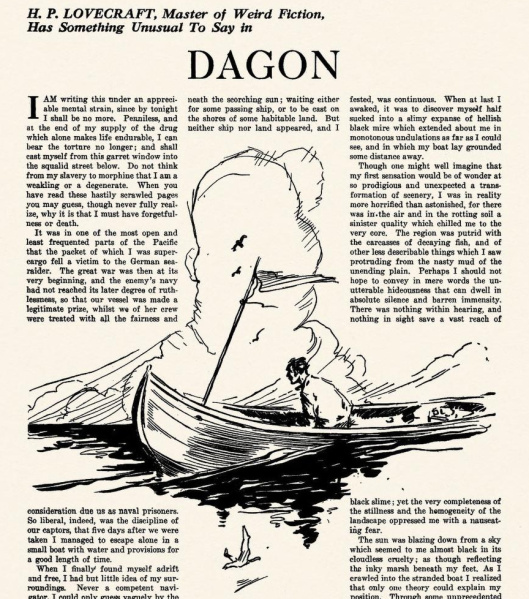
Below is another picture in which we look back the other way, at an earlier time. Perhaps the time of Lovecraft’s young childhood. Here one can see the Twin Islands on which the teenage Lovecraft would land, and one gets a better impression of the wide sweep of the Seekonk. The sweep of the water would have felt even wider from a low row-boat. In his landings in the sticky mud of the islands, amid the wide waters, there may well be the genesis of the later tale “Dagon” — and thus of the Mythos.

Bradofsky and Others

A new blog post from S. T. Joshi gives the title of… “the next volume in the Lovecraft letters series”. It’s to be Letters to Hyman Bradofsky and Others. The book’s text is evidently still in the process of being assembled and edited, though, at present.

Bradofsky was an amateur journalist active in the NAPA, a collector of amateur journalism, and editor of his accomplished amateur journal The Californian.

After that book of letters should come the two-volumes of Long letters, and then the mega-index.