Sounds from the vault…

An audio curiosity from the vaults has popped up on Archive.org, as Three Stories By H.P. Lovecraft. These being 1971 recordings of full-cast performances by The Breadline Theatre, as aired on Seattle’s KRAB-FM counter-culture radio station. The stories are: “Beyond the Wall of Sleep”; “From Beyond”; and the short “Ex Oblivione”.

I also looked to see if they ever aired some Tolkien. They did. But regrettably KRAB-FM’s one-hour 1966 Tolkien show is not online as a recording. Perhaps it was never recorded…

WEST OF MORDOR. The verse of J.R.R. Tolkien is read by Deborah Jewett and Mitchell Taylor.

Also new in audio, a new edition of Voluminous: The Letters of H.P. Lovecraft. Distinctly more fun, compared to recent heavyweight podcasts in the series.

Notes on The Conservative – April 1915

Notes on The Conservative, the amateur journalism paper issued by H.P. Lovecraft from 1915-1923.

Part One: the April 1915 issue.

This first issue opens with a poem. The casual peruser might at first dismiss this poem as a comedic effort for the amusement of amateur journalists, since it has do with spelling, printers and the sort of prickly reviewer who delights in the public revelation of small errors in typesetting and spelling. In a way, that is what it is. Yet just 15 lines into the poem, Lovecraft’s key future-themes of madness, knowledge and language emerge strongly. While out walking he encounters a scholarly “sage” made raving mad by his own scholarship. Out of a desire for some relief from complex language and thought, this madman has devised a ‘simple spelling’ system in which errors are not to be considered errors. Lovecraft buys into this one-man cult and thus becomes abandoned in his writing, until his “amorphous letters pass as language pure”.

The wartime essay “The Crime of the Century” follows, an essay relatively well-known to Lovecraftians and evidence for his close alignment with the common race-thinking and terminology of the time. Collected Essays 5 has one footnote for it, on the “Thomas Henry Huxley” who was one of the first to grasp and endorse Darwin’s principles of evolution. In passing Lovecraft also appears to endorse the theory that the Viking-discovered Vinland (“Vineland”) was indeed located in New England or thereabouts. Such ideas and their ideological hinterland are still contentious today, as evidenced by the recent removal of this picture from the walls of the National Gallery in Oslo1 due to its ‘colonialist’ political incorrectness…

Christian Krohg’s “Leif Erikson discovers America” (1872).

The Krogh painting was itself a replacement for a painting (originally on the museum’s grand staircase) banished because deemed even more politically incorrect.2. This was “The Ride of Asgard” (Asgardsreien) (1872) by Peter Nicolai Arbo. All this reminds one that the defunct political and ethnographic commonplaces of Lovecraft’s youth still have a curious power to induce fear, even today. It is not to be found only in his horror stories and darker poetry.

In a note immediately following the essay Lovecraft, expecting attacks, wittily warns his would-be critics that he has closely studied both Pope’s Dunciad and…

Paul J. Campbell’s ‘Wet Hen’

The latter was a quarterly humour magazine which bore a customarily risque cover, being produced by the journalism fraternity of the University of South Dakota. I assume Lovecraft had it by mail via amateur contacts, possibly editor Campbell himself, of whom no trace can be found. It was presumably mailed in a plain brown wrapper, the rules on the U.S. mail then being rather strict. If Lovecraft was indeed a subscriber in 1915 then it had a long run, because mention of this quarterly can be found right through into the 1950s. It is not online except in very occasional eBay listings, though the University’s Archives & Special Collections has it in archival boxes — if anyone wants to spend a merry hour hunting for unknown Lovecraft letters or perhaps even a jaunty poem or two. Wet Hen looks to be similar to Home Brew, to which Lovecraft would later contribute.

Lovecraft then introduces his readers to the newest UAPA recruit and his boyhood friend Chester P. Munroe. While Lovecraft is still “secluding himself amidst the musty volumes of his library”, Chester has grown into a man of the world and is living in South Carolina. The reader learns that Chester would write stories at the Slater Avenue school they both attended, and he later wrote “an unpublished novel”. His “charming younger brother” Harold is now Deputy Sheriff of Providence County, which gives Lovecraft an interesting early connection with the local police (even though he never read the police report pages in his local newspaper).

Lovecraft next admires Leo Fritter’s astronomical-philosophical essay on “The Spiritual Significance of the Stars” in the amateur journal Woodbee. Again, this is not online. One assumes no taint of astrology was to be found in this essay. Since elsewhere in The Conservative Lovecraft endorses Fritter for the role of UAPA President.

Lovecraft reports he has read Dench’s new booklet “Playwriting for the Cinema”, finding it “terse and readable”. The full title is Playwriting for the Cinema: dealing with the writing and marketing of scenarios (1914). No scan is online, but one can discover it to be a substantial 76-page booklet. Both Arthur Leeds and Everett McNeil were professional scenario writers in the movie business, then centred in New York City. Over a decade later Dench will become one of the lynch-pins who brings together the Lovecraft Circle in New York City, including Leeds and McNeil.

Lovecraft greatly admires J.H. Fowler’s poem “The Haunted Forest”, encountered in the British amateur journal Outward Bound. It…

shows a marvellous and almost Poe-like comprehension of the dark and sinister

This poet was the schoolman, anthology editor and de Quincey expert John Henry Fowler (1861-1932). I can find no volume of his own poetry. Conan Doyle may have poked fun at him in the classic mystery story “The Secret of Goresthorpe Grange” (1883), and if so then this hints that (at age 22) he was becoming known among writers and publishers for his interest in such things…

J.H. Fowler & Son, Dunkel Street, suppliers of mediums to the nobility and gentry; charms sold — love-philtres — mummies — horoscopes cast.

In The United Amateur, Lovecraft expands on the poem…

The Haunted Forest”, a poem by J.H. Fowler, is almost Poe-like in its grimly fantastic quality. We can excuse rather indefinite metre when we consider the admirably created atmosphere, the weird harmony of the lines, the judicious use of alliteration, and the apt selection of words. “Bird-shunned”, as applied to the thickets of the forest, is a particularly graphic epithet. Mr. Fowler is to be congratulated upon his glowing imagination and poetical powers.

I see that Lovecraft much later slips this same wording into his story “The Haunter of the Dark”…

… what might still be lurking in the bird-shunned shadows?

  1.   “Storm blows around art banished to the new National Museum’s cellar”, Norway’s News in English, 20th February 2023.
  2.   Peter Nicolai Arbo and Artistic Hybridity in the Nineteenth-century (2018), page 58

Deep Cuts on Hart Crane, Loveman and Lovecraft

Deep Cuts has a fine new article which takes a long look at Hart Crane, Loveman and Lovecraft, and with the benefit of being able to consult the new second edition of Loveman’s Out of the Immortal Night and a full collection of the volumes of the Lovecraft letters. A key point is only made briefly and at the end, where it might have been usefully expanded a bit and threaded through the article. To be actively gay at that time and place, even in bohemian enclaves such as Greenwich Village…

was often not just illegal and met by violence

… and I would add by blackmail, ranging from a quasi-friendly ‘borrowing money’ to outright thuggish extortion. Gay men were also targeted for such treatment. In 1931 for instance, Loveman was earning very good money (“$60.00 per week”) as a book cataloguer at Dauber & Pine, and would have been a prime target for such things.

I can add a few more relevant quotes to the Deep Cuts article, drawn from previous Tentaclii posts…

1. The Wandrei letters, p. 132. At the Metropolitan Museum, Lovecraft recalled he… “revelled in the new Wing K — the Roman garden with the statues. A certain austere head of a tight-lipped old Republican Roman is as much a favourite of mine as that effeminately pretty Antinous-type Hellenic head in the corridor is a favourite of Loveman’s.” Young Wandrei was then in New York with Loveman, and this seems to me a fairly clear but discreet ‘tip off’ to the lad about Loveman’s amorous inclinations.

2. Letters to Family & Friends, page 632. Lovecraft remarks that his friend Loveman had many young proteges… “He had with him one of his numberless prodigy-proteges, a quiet blond youth whose accomplishments seem to be, so far, appreciative rather than creative”. Again, a rather telling but discreet hint.

3. Lovecraft’s New York Circle, page 28. An item in ‘Kirk’s Diary’, said of a cafe table meeting of the Lovecraft Circle… “one was a homo, one an avowed fetishist, one quite nothing were sex is concerned”, wrote Kirk of the unnamed participants at the table (likely a cafe table, and thus not a meet-up in McNeil’s room). I’ve established that Lovecraft can’t have been present at that precise point (he was in Elizabethtown), so presumably Loveman was ‘out’ at least to Kirk and possibly to the other two unknown attendees.

Fungi von Yuggoth

S.T. Joshi has received a copy of the German Lovecraft’s new Fungi von Yuggoth volume, and he calls it…

One of the most impressive editions of Lovecraft’s work (both from a physical standpoint and from the standpoint of academic rigour) [and it has] a translation of my notes to the poems in question, taken from The Ancient Track (2nd ed. of 2013).

He also reveals the Lovecraft correspondents to be included in the forthcoming Letters to Hyman Bradofsky and Others.

Tentaclii in February

The UK has seen the usual February wobbling between promising signs of early springtime and raw blasts of chilly weather. This seems to have influenced my ‘Picture Postals’ posts. My ‘Return to Copps Hill’ post revisited Lovecraft’s snowy visit to Boston’s Copp’s Hill Burying Ground. My Photoshopped ‘Vint-o-Vision’ picture had Lovecraft shivering at the controls of the Ladd Observatory telescope, Providence. More authentically I found two choice pictures of College Hill (under snow) and Angell Street (in the earliest spring). To thaw out shivering Tentaclii readers (I hear it’s still bitterly cold in much of the USA) there was then a visit to and inside the hothouses of the Brooklyn Botanic Gardens, leading into some choice quotes which establish ‘gardens’ as a key interest for Lovecraft in his imagination, dreams and reality. Sadly he never lived to fully explore the theme, although some in his circle took the idea and ran off with it in the direction of pulpy ‘sci-fi horror plants’.

Very little in new research or discoveries this month on Tentaclii, but I was pleased to find and recover a new ‘lost’ backwoods yarn by Lovecraft’s friend Everett McNeil. He certainly could spin a yarn, and I still wonder (despite having written his life) where he had the experience to write such tales. I suspect either during his walking to New York, or during his stint in the armed forces.

In books the action was overseas this month. Lovecraft’s letters appeared in Spanish for the first time. The French have the new volume Selection de lettres (1927-1929). The Germans published their handsome new book of the translated poetry, based around Lovecraft’s “Fungi from Yuggoth”, and this book earned the coveted Joshi ‘stamp of approval’ some weeks later.

There was however advance notice of some 2023 books in English, including: Lovecraft’s Letters to Hyman Bradofsky and Others, an untitled “book on Arkham House ephemera from the Classic Years”; a Miskatonic University Monograph: “The Discovery of Fragments of Kitab al-Azif at Harran”; an untitled book of letters from the Lovecraft Circle but not sent to Lovecraft; and the academic William Hope Hodgson and the Rise of the Weird: Possibilities of the Dark. Looking further ahead, NecronomiCon Providence announced the 2024 dates.

In scholarly work, I linked a couple of journals with interesting new items on sea-monsters seen in the light of contemporary academic theory. Which is the more scary, I wonder? Some Deleuze Seminars were dug up, containing his 1975-1976 thoughts on Lovecraft. The German annual Lovecrafter Nr. 3, a “50 years of Lovecraft in Germany” special-issue, became available in PDF and thus is now potentially machine-translatable.

Posts on artwork were wide-ranging this month, from August Derleth’s “cinderella’ stamp” to the latest Ian Miller artwork. Miller is still making masterpieces like this at age 70+, which is an encouragement to us all. There was also a link to a new article on the huge and sustained success of the Call of Cthulhu RPG in the Far East. Who knew?

In comics, Unknown Kadath had a trade paperback release date in May 2023. I linked to a new Dark Worlds Quarterly surveying vintage Lovecraft comics adaptations published in black & white.

In audio, lots of relevant items are still appearing on Librivox. Lovecraft’s friend Henry S. Whitehead is obviously getting some deserved and noticeably regular attention, here and there. We even had “The Fantasy Fan: The Complete Writings of Clark Ashton Smith” this month.

From the archives, some 1981 issues of Cultural Correspondence popped up on “Lovecraft, Surrealism”, with contributions from an elderly Frank Belknap Long. I also noted some choice Ray Bradbury items appearing, and then came the mammoth Collected Fiction of Henry Kuttner (an influence on Bradbury) and to celebrate I found and tweaked/colorised a picture of the young Kuttner. I also tracked down the three fannish/scholarly texts on Kuttner’s work.

As for me… still no joy on the job front. It appears there comes a certain birthday after which no-one wants to interview you for a monthly-paid job, regardless of how impressive your C.V. or wide-ranging your skill-set is. Three months of looking and applying, and not a single interview. Except one as a night-shift warehouse picker / pallet-stacker in Stoke-on-Trent, which was arranged via a special jobs fair… which meant they didn’t need to see my C.V. Despite having done 18 months of such manual work, many decades ago, I didn’t even get that job. The UK’s supposed talent shortage and ‘huge demand for over 50s’ appears to be a figment of the government’s imagination, so far as I can see. If such demand was really there, a 1990s first-class graduate like myself would by now have had a dozen or more interviews. What’s really needed seems to be guaranteed “double your dole money” jobs for over 50s who want to work. I’d be perfectly happy to pick the local litter (US: ‘trash’) for three days each week, for £700 a month. That’s all I need. And the city of Stoke-on-Trent certainly needs such an all-year army of litter-pickers, I can tell you.

Anyway, that’s it for the shortest month. Onward to March and warmth!

50 years of Lovecraft in Germany

Now available as a PDF for the first time, the German Lovecrafter Nr. 3, a “50 years of Lovecraft in Germany” special-issue. It has some in-depth and well-researched articles, by the sound of it. Obviously you’d need to translate, but there’s no indication that the PDFs have their text locked. In which case you could probably auto-translate.

Several other early issues are also now available this way, and I imagine that the following issue had some responses to the previous year’s ‘Lovecraft in Germany’ information.

Inside the Botanic Gardens glasshouses

This week on ‘Picture Postals’, a peek inside the glasshouses of the Brooklyn Botanic Gardens. The ornamental Japanese Gardens there became one of the key places that Lovecraft loved the most in New York City, a refuge from the harsh city outside. I’ve previously had posts here on the Brooklyn Botanical Gardens – part one and part two and I noted various influences, including on his New York friend Belknap Long via Long’s wartime “Curator of the Interplanetary Gardens” series of sci-fi plant yarns for boys.

The glasshouses were very near the Japanese Gardens, on the terraces that ran into them, and we know from the letters that Lovecraft went inside.

Seen here before, my newly colourised view of one of the conservatories (aka glasshouses, greenhouses, hothouses or now just ‘houses’) as seen in 1936. Probably the “Palm House”.

But now we can follow Lovecraft inside. Here we see an admittedly later view, on the painted cover of New Yorker magazine from 1950. It appears to also be the “Palm House”.

There was also an “Economic House” (fruits and useful produce), which has this superb 1927 archival view of the interior by Louis Buhle. Near perfectly timed for showing us what Lovecraft encountered in the mid 1920s. I’ve here colorised it…

As with the boys seen here, Lovecraft was early fascinated with such things and recalled…

“In childhood I used to haunt such places [florists’ shops] about February, when the strain of hated winter became unbearable. I liked to walk through the long greenhouses & imbibe the atmosphere of warm earth & plant-life, & see the vivid masses of green & floral colour. One of my early doggerel attempts was a description of an hypothetical glass-covered, furnace-heated world of groves & gardens …” (Selected Letters Vol. III, page 138).

Something which would appear in the alien gardening of his seminal science-fiction story “The Shadow out of Time”…

“The omnipresent gardens were almost terrifying in their strangeness, with bizarre and unfamiliar forms of vegetation nodding over broad paths lined with curiously carven monoliths. Abnormally vast fern-like growths predominated; some green, and some of a ghastly, fungoid pallor. Among them rose great spectral things resembling calamites, whose bamboo-like trunks towered to fabulous heights. Then there were tufted forms like fabulous cycads, and grotesque dark-green shrubs and trees of coniferous aspect. Flowers were small, colourless, and unrecognisable, blooming in geometrical beds and at large among the greenery. … Fungi of inconceivable size, outlines, and colours speckled the scene in patterns bespeaking some unknown but well-established horticultural tradition.” — “from The Shadow out of Time”.

His poetry is abundantly seeded with arboreal nooks and verdant pastoral scenes, although except for a few strange fungi these are usually cultivated within the fences of poetical convention. Part of the attraction of such garden places was often the sense of their being frozen in time…

“I am very fond of gardens — in fact they are among the most potent of all imaginative stimuli with me” [real] “old-fashion’d gardens, stone walls, sloping orchards, and picturesque lines of barns and sheds became so overwhelmingly pervasive that one felt almost opprest for lack of opportunities for instant lyrical utterance. Here, indeed, was a small and glorious world of the past completely sever’d from the sullying tides of time” (Selected Letters III).

In the Wandrei letters (p. 252, 253, 265) we also encounter various extended musing on his ‘ancestral’ memories of deep woods, forests, including “vast-boled, low-branching, palaeogean forests”. But his ideal was a cultivated dream-garden, as if encountered deep in his Dreamlands…

“the experience of walking (or, as in most of my dreams, aerially floating) through aethereal and enchanted gardens of exotick delicacy and opulence, with carved stone bridges, labyrinthine paths, marble fountains, terraces, and staircases, strange pagodas, hillside grottos, curious statues, termini, sundials, benches, basins, and lanthorns, lily’d pools of swans and streams with hers of waterfalls, spreading gingko-trees and drooping, feathery willows, and sun-touch’d flowers of a bizarre, Klarkash-Tonick pattern never beheld on land or beneath the sea.” “… a type of dreamlike scene which I have always envisaged as a sort of imaginative phantom — The Gardens of Yin, as it were” (Selected Letters III).

“There is somewhere, my fancy fabulises, a marvellous city of ancient streets & hills & gardens & marble terraces, wherein I once lived happy eternities, & to which I must return if ever I am to have content.” [Returning down] “bewildering avenues to all the wonders & lovelinesses I have ever sought, & to all those gardens of eld whose memory trembles just beyond the rim of
conscious recollection”. (Selected Letters II).

He was lucky enough in his life to encounter two real ornamental gardens that came very near to his ideal.

A new short yarn by Lovecraft’s friend Everett McNeil

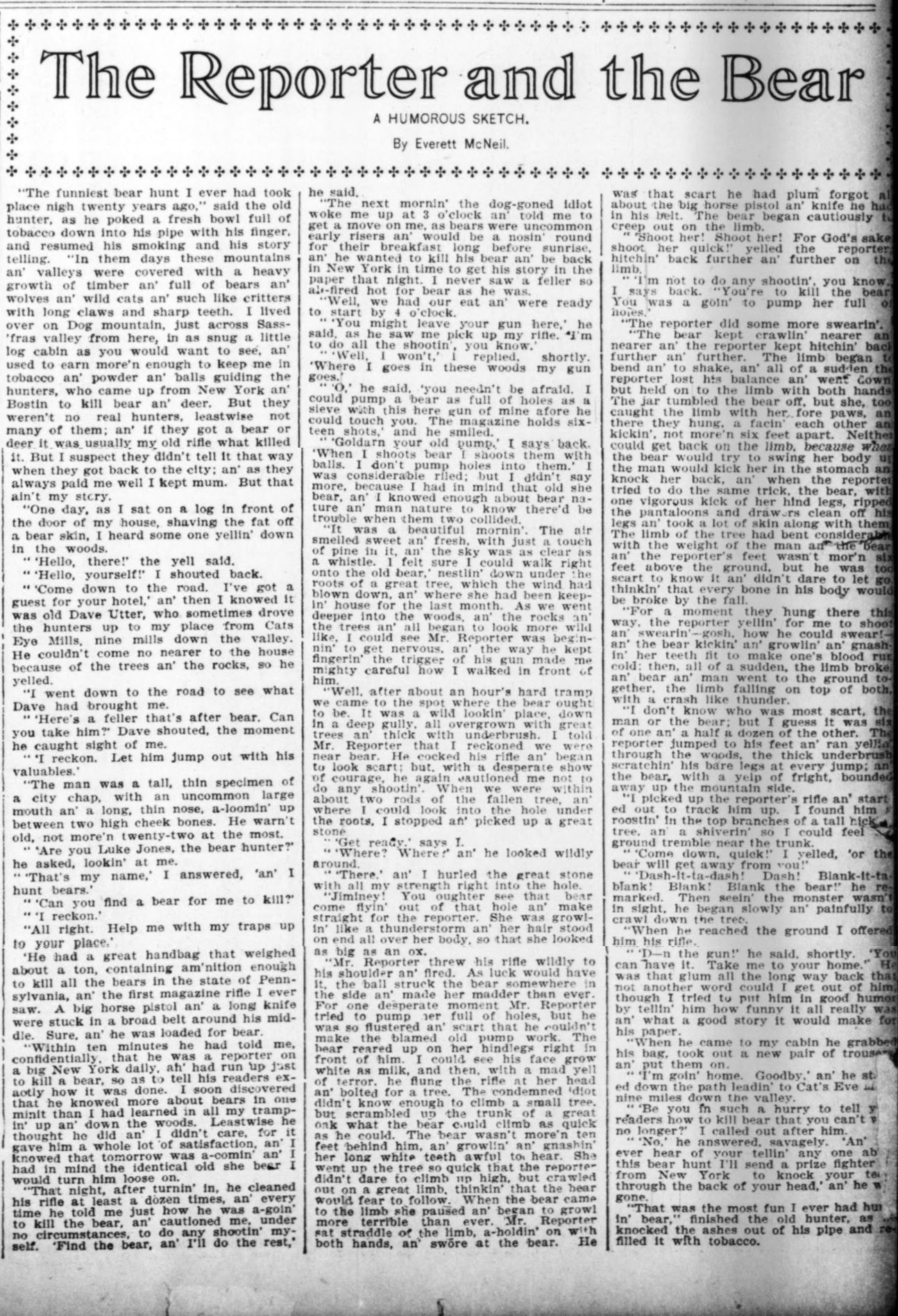
I found a new short yarn by Lovecraft’s friend Everett McNeil. Sadly it’s not an unknown fantasy to add to those in his Dickon Bend-the-Bow and other Wonder Tales, but rather one of his early wry ‘backwoods America’ yarns titled “The Reporter and the Bear”. It appeared in The Atlanta Constitution for 2nd July 1899, and has popped up now because Archive.org has been ingesting newspapers on microfilm. Thankfully it’s readable. In my biography of McNeil, Good Old Mac (2013) I listed this as known but not seen…

The Reporter and the Bear”, Salt Lake Herald, July 1899

Now it can be read again.

The Man with a Thousand Legs (1927)

New on Librivox, a public domain reading of Frank Belknap Long’s “The Man with a Thousand Legs” (Weird Tales, August 1927 — warning: full-view header illustration is a plot-spoiler).

“… a completely unrepentant shocker from 1927 that calls itself ‘The Man with a Thousand Legs’ and lives 100 percent up to its title.” (The Magazine of Fantasy and Science Fiction, 1973)

“… that marvel of many viewpoints, ‘The Man with a Thousand Legs'” (Pulp Magazine Thrillers, 1998)

“… we must remember it was written in 1927, and is rather good SF for that period” (Luna Monthly, 1972)

A couple of years ago Dark Worlds Quarterly had a long appreciation and summary of the tale. The tale’s fragmentary pieced-together structure and its opening illustration (see that full heading after reading the tale) might seem at first glance to be bouncing off a reading of Lovecraft’s “The Call of Cthulhu”. Although to Weird Tales readers it might have appeared that the February 1928 published “Cthulhu” was actually following Long, rather than other way around.

As Dark Worlds usefully points out there was a later slightly revised version of “The Man with a Thousand Legs” in Magazine Of Horror And Strange Stories (August 1963), which removed a few touches that made it sound dated in the early 1960s. Later it was included in the Arkham House collection of Long’s stories, The Rim of the Unknown (1972). Presumably that was the 1963 version.

“Erich Zann” adapted by Roy Thomas

Dark Worlds Quarterly has a fine new survey, with a few predictably gory examples, of vintage Lovecraft in Black & White. This being a survey of b&w comics that have, over the decades, adapted various Lovecraft tales.

I especially liked the look of the opening splash page for “The Music of Erich Zann” adapted by Roy Thomas, in the short-lived Masters of Terror #2 (September 1975). Masters of Terror was a b&w magazine-format comics anthology published under Marvel’s Curtis cover-imprint, offering reprints.

I tracked it down online and found the same (final) issue also had “Pickman’s Model”, again adapted by Roy Thomas…

A rather good “Zann” reprint then, but from where? A little digging finds it was originally in colour under the title “The Music From Beyond” in Marvel’s regular-sized Chamber Of Darkness (issue #5, June 1970). This issue had nice Kirby pencilled cover-art, and a Kirby tale inside, so is collectable and thus pricey today.

Miller meets metal

“Ahah”, I thought, “this new metal album’s cover artwork is a superb emulation of ‘Ian Miller channelling Lovecraft'”.

Turns out, it’s actually by Ian Miller himself. His blog has the full cosmic vista…

Encyclopaedia Metallum reviews the album Anthronomicon, by the band Ulthar, and immediately finds…

“We’re off to battle right away against the Lovecraftian hordes!”

After that, it’s apparently much of the same old-school metal pace right through to the end. Delivered with all of the skill of a leading Californian metal band on their third album.

Turns out this is not the first cover Miller’s done for them. A little more digging discovers their two earlier albums with Miller covers…

The orange one reminding me instantly of the art for one of Miller’s classic 1970s paperback covers for Panther. Is this the picture that was lost and had to be recreated? Anyway, if you don’t fancy framing the album cover(s) then this one can be had as a fine art print direct from Miller.