Train culture

A thoughtful U.S. essay about “Finding and Losing Train Culture”, something that Lovecraft was often immersed in. First as a railroad enthusiast, then an eager train traveller of various types. And finally as someone who somewhat lost that train culture, as poverty forced him onto cheaper buses and long-distance coaches. Which were made more enticing from spring 1932, since the coach and bus lines slashed prices as the Great Depression deepened.

From the thoughtful article…

The nice thing about trains is that they bring people and things to your community and take them from your community to the wider world without erasing your actual community. Trains come in at one or two points, and leave by those same points, on a more or less regular, but distinctly limited schedule.

I’m not sure if there are any bus or train tickets in the new Arkham Investigator’s Wallet Prop Set from the HPLHS. But if not you can pick up a few on eBay easily enough. Even a corpse needed a train ticket, it seems.

Dunedin, Florida

As summer settles in nicely (at least here in England), this week’s ‘Picture Postals’ follows Lovecraft down to the sunny Florida coast. In this case to the summer retirement and fruit-shipping town of Dunedin, Florida.

Dunedin centre, possibly late 1940s or early 1950s?

In the early 1930s this was the home of his friend and fellow writer Henry S. Whitehead. With freight-train loads of citrus fruit growing nearby and shipping from the rail-yard at the back of the town. The devastating winters of the early 1890s had however denuded the area of much of its population (they had moved away, rather than died) due to the abrupt failure of the citrus industry. According to the history of the local Episcopal church, by the 1920s the area’s church-going population had yet to fully recover and the depopulation problem seems to have continued into the 1930s. As such, I’d add, the local church was perhaps lucky to get a man of Whitehead’s calibre and experience with children. As Lovecraft wrote to his aunt…

He seems to be the idol of everyone in Dunedin, & especially of the small boys — whose psychology he understands very minutely as a result of long experience in directing boys’ summer camps.

There is a local official archival site for pictures, but they use that stupid “Checking if the site connection is secure” check-wall, which never resolves. So I’ve had to draw on other sites and postcard sellers. Including this gem showing the local bus. Lovecraft went on several local trips, and was probably tootled around in this bus wearing a tropical ‘safari’ type suit. Though sadly he did not also sport a British Empire-style pith-helmet…

In fact, he writes that he wore no hat at all with the suit, which was unusual for him. Actually Lovecraft may not have seen much of the small urban retail centre in Dunedin during those weeks, since Whitehead preferred to shop in the larger town of Clearwater.

As Lovecraftians will recall, it was a relatively brief friendship in person. With Lovecraft meeting and staying with Whitehead for many weeks in summer 1932, finding him an ideal host and rather usefully someone of the same bodily-build — Lovecraft was thus able to wear one of Whitehead’s old white tropical suits when the heat became too much even for him. It appears to have been a very productive visit for Lovecraft, physically and psychologically. As evidenced by letters and the poignant poem “To a Young Poet of Dunedin” (the 17 year old Allan B. Grayson, who was staying with Whitehead) of 30th May.

Finding there was a relative paucity of antiquities, Lovecraft appears to have turned his attention to the town’s many cats and to the wealth of exotic flora and fauna. Especially birds including, curiously, whippoorwill birds…

Whippoorwills? I’ll say we have ’em down here! Exotic ones too with a liquid rolling note apparently more complex than that of their northern kinsfolk… I first heard them in the mystical dawn outside my window, and half imagined that they were voices calling across the ultimate void from Beyond.” (Lovecraft to Derleth)

Last night we saw the white tropic moon making a magical path on the westward-stretching gulf that lapped at a gleaming, deserted beach on a remote key. Boy! What a sight! It took one’s breath away!” (Lovecraft to Derleth)

Dusk on the shore at Dunedin.

Lovecraft also visited the nearby Anastasia Island, seeing a seething mass of alligators. Here “surians” = alligators…

Tall trees casting a sinister twilight over shallow lagoons — funeral garlands of trailing Spanish moss ‐ and the whole ground surface alive with scaly, wriggling saurians”.

Doubtless we’ll get the full story and backdrop in the forthcoming book on Lovecraft in Florida.

I’ve found a location of the church for which Whitehead was rector (Lovecraft uses the work “rector”)…

Episcopal Church Church of the Good Shepherd (Episcopal), located on the southeast corner of Edgewater Drive and Albert Street.

It would have been in the southern edge of the main settlement at that time. However, it seems the church has since been moved. The Web page for the history of this church has…

In 1958 land was purchased to provide for future expansion and the church was moved to its present site and further enlarged.

Thus I suspect this card shows the 1958 site and expansion…

Perhaps 1958?

The core 1899 structure still stands (though greatly expanded since the early 1930s, and on a new site), and is now one of the historic sites included in town tours.

The Web page for the church also has the “old vicarage” moving…

in 1955 … the old vicarage and Parish House were moved away and a new Parish House built on the site.”

So the “old vicarage” would likely be the house Whitehead had in the early 1930s? It’s unclear if the Parish House is now on that site/address, though. Also, possibly the current church authority there is not aware of the history re: Whitehead, as it has…

Into the 1940’s the small congregations at Safety Harbor, Tarpon Springs, New Port Richey, and Dunedin were served by a single priest or, at times, a seminarian. Our first resident priest, the Rev. Cannon Eric Robinson, arrived in 1947. The Reverend Charles Folsom-Jones came in 1953 as Good Shepherd’s first full-time vicar.

Yet surely Whitehead was resident? And “rector” appears to = “priest” for Episcopalians. Joshi has it that… “the Gulf of Mexico was only a few feet from Whitehead’s front steps”, so the rector’s house was presumably somewhere nearby on the ocean-fronting Edgewater Drive. But possibly Whitehead is missing because the church doesn’t have the church records for the 1930s?

He arrived to take up his post in October 1929, according to a local newspaper report on his first reception event where he met all the other local churchmen. Thus, when Lovecraft was there, Whitehead had been rector for around two and a half years.

The sort of gnarled trees and verdant foliage one might have encountered in the back-gardens of Dunedin.

It’s possible that Whitehead’s “vicarage” (if that’s where he was living) lacked either a shady garden and/or a sea-view, since Lovecraft was generously offered the any-time use of a “tastefully landscaped” seaview garden next door. This was offered by the Metzen neighbours from Detroit, who had a retirement place “on the shore, a trifle north” of Whitehead. I’ve been unable to locate this, which might have helped identify the actual Whitehead address.

Along the shoreline.

I am at this moment on the sun-baked gulf shore under a palm tree.” (Letter to Henry George Weiss)

The Lovecraft-Whitehead correspondence is no more, with Lovecraft’s letters destroyed and Whitehead’s lost. By December 1932 Whitehead had unexpectedly died, and Lovecraft remarked in a letter…

Many stories of his remain unpublished, including a new series centring in a sinister and decaying old New England town (a kind of Arkham) called Chadbourne.” (Selected Letters IV)

Could this be a lost section of the early Lovecraft-inspired Mythos? All I can find is the posthumous “The Chadbourne Episode” of 1933. But, according to Lovecraft, there was a “series” of these tales.

Strange sounds from Germany…

Some of the news from the German Lovecraftians, this month.

1) They have posted a new interview with author Gary Hill

In 2006, Gary Hill wrote The Strange Sound of Cthulhu, an extensive study of Cthuloid and Lovecraft-inspired music. Fellow cultist Dennis questioned Gary about his book project and related topics.

In German, but easily auto-translated.

2) Also…

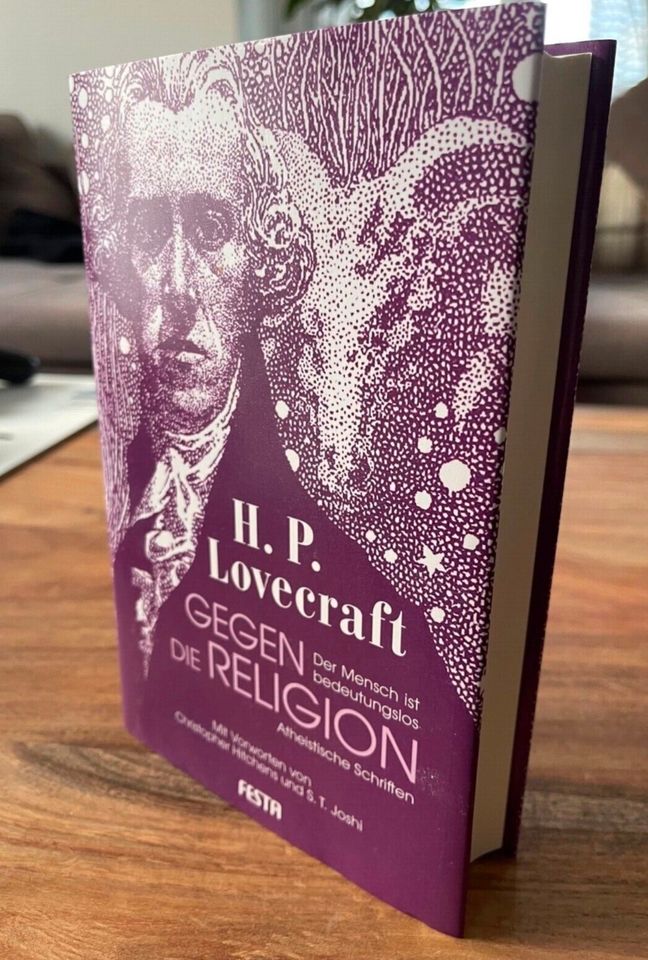
The scholarly non-fiction anthology H.P. Lovecraft and Germany is on the home stretch: the manuscript has been completed and is now going to our publisher, the Wissenschaftliche Buchgesellschaft. There the book is first laid out and then checked by our editorial team – once this has happened, nothing stands in the way of printing.

Free book – Victorian Alchemy: Science, magic and ancient Egypt

Another book of possible interest to Tentaclii readers, and like yesterday’s book also in open access. The book Victorian Alchemy: Science, magic and ancient Egypt (2022) has a substantial chapter surveying “Weird physics: visible light, invisible forces and the electromagnetic spectrum” in the Victorian and Edwardian period and in relation to Egyptomania. This builds on some thirty or so years of scholarly interest in and around the topic, but is here angled towards the fervent interest in Ancient Egypt during the period. It can’t not mention Lovecraft’s “Nyarlathotep” (1920), but that’s obviously outside the time frame and thus the mention is very brief.

The book has a “Creative Commons Attribution NonCommercial” licence.

Lovecraft was right: part 844

The new DreamDiffusion, being a working ‘brainwaves to AI generated pictures’ headset.

Quantitative and qualitative results demonstrate the effectiveness of the proposed method as a significant step towards portable and low-cost ‘thoughts-to-image’

Suddenly, Lovecraft’s early “Beyond the Wall of Sleep” (1919) seems rather prescient…

[I] place[d] upon his head and mine the two ends of my cosmic “radio”; hoping against hope for a first and last message from the dream-world in the brief time remaining. […] As I gazed, I perceived that my own brain held the key to these enchanting metamorphoses; for each vista which appeared to me, was the one my changing mind most wished to behold.

Though he never thought of hooking up a dreaming octopus. Oh, wait… actually he kind-of did do that, with Cthulhu’s worldwide emanation of dream-visions into the minds of men…

There lay great Cthulhu and his hordes, hidden in green slimy vaults and sending out at last, after cycles incalculable, the thoughts that spread fear to the dreams of the sensitive and called imperiously to the faithful to come on a pilgrimage of liberation and restoration.

Occult detective work in Cincinnati

As well as announcing the forthcoming The Weird Cat anthology, S.T. Joshi’s latest blog post also trails a new book by leading Lovecraft scholar Ken Faig Jr. This being a…

second volume of Ken’s essays on ‘Lovecraftian People and Places’ … scheduled for release next year [2024]

He also notes that Ken Faig, Jr.’s Seven Hills has also just been published, being a book of lesbian-detective tales set in Cincinnati. This gets the Joshi seal-of-approval, being… “rollicking good fun”. Amazon reveals it as Seven Hills: Cincinnati and Other Midwestern Cases, weighing in at 520 pages and with an affordable $5 ebook version. The blurb also reveals that the heroine is more of an ‘occult detective’, specialising…

in the probing of ghostly or supernatural phenomena, using psychics, seances, and other paranormal means to solve the mystery

Weather Influences

New on LibriVox, an audiobook of Weather Influences (1904) by Edwin Grant Dexter of the University of Illinois. Being “An empirical study of the mental and physiological effects of definite meteorological conditions” published for the general reader by the reputable MacMillan publishing company. Thus this is relevant to Lovecraft, in terms of the effects that weather had on his very special physiology and biochemistry.

The book opens with a look at time-worn weather proverbs, animal weather lore, and “Weather Influences in Literature”. It may also interest those interested in the effects of the weather on mental states. The book is also of possible interest to those whose professional interests involve deciding the most receptive time to release new information.

Also online as a ebook in a good Wellcome Library scan. There was a review in the journal Nature in June 1905.

A more contemporary judgement is given in a 2015 article on Dexter, “Edwin Grant Dexter: an early researcher in human behavioral biometeorology”, which states that…

Dexter’s Weather influences, while demonstrating an exemplary approach to weather, health, and behavior relationships, came at the end of a long era of such studies, as health, social, and meteorological sciences were turning to different paradigms to advance their fields. For these reasons, Dexter’s approach and contributions may not have been fully recognized at the time and are, consequently, worthy of consideration by contemporary biometeorologists.

A place Lovecraft never went?

New on honest Abe’s site, five issues of Driftwind as produced by Walter J. Coates. All with Lovecraft contributions.

Looking quickly through my resources, I’m not sure that Lovecraft ever actually visited Montpelier in Vermont, to see Coates and his Press ‘at home’. They met, but Coates had to travel some hundred or so miles to talk with Lovecraft. Cook at least once made the trip to Montpelier, but quite possibly Lovecraft never made it?

Lovecraft commented on Coates being present at an amateur meeting… “Coates, [who has travelled] all the vast way down from the Montpelier region”. In another letter he has… “the indefatigable Walter J. Coates of Montpelier (editor of Driftwind) came down nearly a hundred miles to mingle in the throng.”

Which suggests Montpelier was rather inaccessible. Postcards from Cook were postmarked ‘North Montpelier’, and presumably so were letters to Lovecraft. Which might lead one to think that Coates was in the hills somewhere at the back of the town, as seen here…

However, Google Maps has North Montpelier / East Montpelier closely abutted together, a small narrow river-valley settlement located about five winding miles east of the main town. So perhaps there’s just a postmark / postbox confusion here. Possibly Coates used the Post Office at North Montpelier because it was the nearest, but where was he really?

I have however managed to get and colourise a card of “North Montpelier” itself, which suggests a rather sleepy place. Possibly we see here the main ‘one man and a dog’ stores and Post Office.

The place was on the often flooded Winooski River, and of that I found an evocative postcard which may interest Mythos RPG makers in need of photo-props for a 1920s ‘Whisperer in Darkness’ type adventure…


Update: The East Montpelier Historical Society has online a detailed historical essay on the Coates little magazine and its editor, including several photographs. Thanks to a prompt from a reader I’ve now been able to re-find this (the link had been broken) and it reveals the Coates / Driftwind location…

In November 1922, he and Nettie purchased the George Pray store in North Montpelier, and the Coateses and son John continued as the storekeepers.

Thus the store seen in the above picture would soon become the Coates store, as one can see the “Pray” signboard.