New from Hippocampus

Newly listed on Hippocampus Press website (now accessible from the UK without a VPN, I’m pleased to see) are…

For the Outsider: Poems Inspired by H.P. Lovecraft which collects… “a plethora of poetic tributes from friends, colleagues, and disciples” and later acolytes. What a great idea. The listing page has the full list of included poems.

Those wanting even more poetry can find it in the new Spectral Realms No. 19, which I’m pleased to see includes “The Nightmare” by Erasmus Darwin as a classic reprint. This must be an extract from the famous The Botanic Garden: the Economy of Vegetation. This section (if given in full, rather than just the ‘demon chapel’ scene) is set near to me in the Staffordshire Moorlands. The section follows the river underground (it vanishes underground each summer). Interestingly, it’s also the very same valley used as the setting of the final part of the supernatural classic Sir Gawain & The Green Knight. Though Erasmus had no idea about Gawain at that time. My recent book Strange Country: Sir Gawain in the moorlands of North Staffordshire. An investigation has the details.

And… hurrah… another table-trembling slab of letters from Lovecraft, in the form of the near 600-page H. P. Lovecraft: Letters to Hyman Bradofsky and Others. We also get letters to… “Richard Ely Morse, Margaret Sylvester, John J. Weir, and a pair of brilliant weird artists, Virgil Finlay and Frank Utpatel.” Despite the page-count it’s currently on Amazon UK at £22.95, rather than the now-usual £30+ price for the books of letters I don’t yet have.

2024 anniversaries

As we turn the year and start to look toward 2024, what anniversaries might one want to start preparing for?

Here are a few. Perhaps Tentaclii readers can add more?

1944: 80 years

Winfield Townley Scott and others. Lovecraft’s likely long-term influence starts to be felt.

* Scott, W. T. “Howard Lovecraft’s Lengthening Shade.” The Providence Sunday Journal, 109, No. 47 (21st May 1944).
* Scott, W. T., “His Own Most Fantastic Creation : Howard Phillips Lovecraft” (1944).
* Fritz Leiber, Jr.,, “A Literary Copernicus”, Acolyte, Fall 1944.
* U.S. soldiers carry “The Dunwich Horror” into and across Europe, in Derleth’s special military paperback edition.
* Edmund ‘always dismally wrong’ Wilson attempts to blast Lovecraft’s emerging reputation, in The New Yorker in May 1944.

1924: 100 years

* Lovecraft leaves for New York City, marries Sonia. Begins his ‘New York exile’.
* Lovecraft completes “Imprisoned with the Pharoahs” for Houdini.
* Lovecraft writes “The Shunned House”.
* The ‘Kalem Club’ attains its recognisable form.
* Publication of “The Rats in the Walls”.

1874: 150 years

* Births of Charles Fort, Houdini.
* Lovecraft’s father all-but vanishes from the historical record. He turns up again in 1889 for his Boston marriage.

Return to Innsmouth

Previous Tentaclii picture posts on Newburyport — a key inspiration for Lovecraft’s “Innsmouth” — have included Along the Innsmouth shoreline, Newburyport – part one and part two. The images are now restored on these posts, after the site-move.

For this week’s regular ‘Picture Postals’ post I wondered if, some four years later, other pictures had become available? They had.

For context, above we see Newburyport showings its relation to its salt marshes and ocean coastline, on a U.S. Geological Survey map of 1934. Newbury and Ipswich are just south of this map.

This fine picture I found is probably fairly close to what the ‘local bus to Innsmouth’, which features in the famous tale, would have looked like. This combination carrier / bus is destined for a working life around Newbury, just south of Newburyport and in the middle of the marshes. The picture looks like it’s about the right time-period too.

Curious doings at Newburyport. A pamphlet by the aptly named H.P. Davis. Probably the same as the interior of haunted schoolroom in the photo I found and fixed in 2019.

On the Rocks, off Plum Island.

A curious Marsh Scene, Plum Island. Not one of the early pre-Photoshop montage ‘farm cards’.

School Street, Newburyport.

Inn Street. Newburyport.

An unusual garden, at the back of the High Street, Newburyport.

A (the?) tug-boat, Newburyport. 1930s?

And finally, readers will recall the U.S. submarine in “Innsmouth”. I couldn’t find one off Newburyport, but here’s one off the relatively nearby Newport.

Well, those are some newly found ‘picture postals’ that seem to chime with elements / atmospheres in Lovecraft’s “The Shadow over Innsmouth” (1931).

Letters to Wilfred B. Talman – the second set of notes

Below is my second set of notes on Lovecraft’s Letters to Wilfred B. Talman and Helen V. and Genevieve Sully. The book is a hefty 580-page slab, and I’m currently half way through and have reached October 1933. But in the notes below I open in April 1927 and run through to early July 1929.


Page 68. Lovecraft suggests, with a certain amount of levity, that he and some others should form a… “ways and means committee for inaugurating the counter-revolution & establishing the reign of American Fascism”. Said in the context of the context of a newly Soviet-ised, bloody-handed and internationalist communism.

Page 68. Lovecraft is familiar with the “little Benefit St. grocery”, which is likely to be gone soon.

Page 69. He gives more descriptive and demographic details on the slum area he has newly discovered on walks in Providence (see my first set of notes). Much later in the book, in 1934, he briefly notes it has been swept away by the city developers.

Page 70. “the unknown outside clawing at the rim of the known … There are things more terrible to the imagination than any phenomena connected with the nature, passions & aspirations of mankind”.

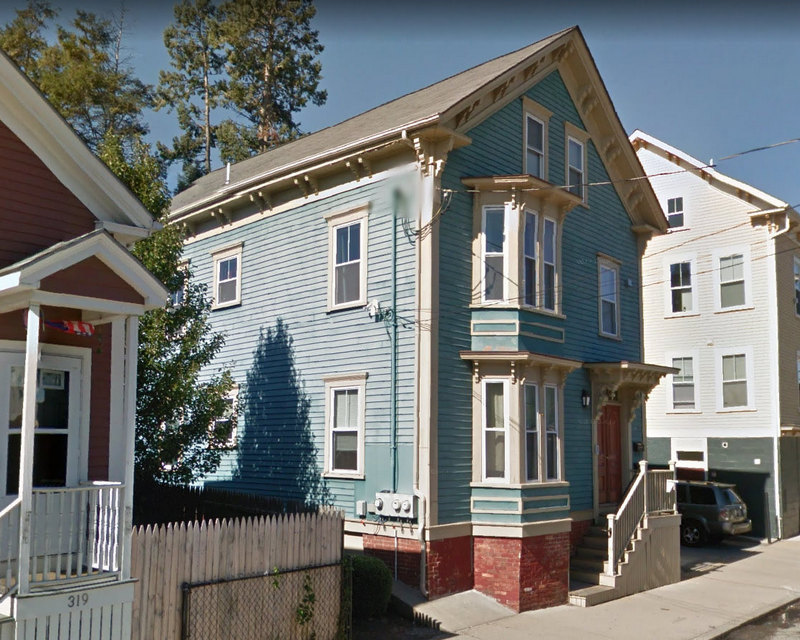
Page 71. Eddy Jr. is back, at least temporarily, invited over (probably not by Lovecraft himself) to a ‘gang’ meeting in Providence. Only in July 1932 (page 212) do we hear of Eddy again, when things seem to have been patched up between them and Lovecraft is visiting with the Eddys at their house. As I’ve established (Lovecraft Annual 2022), the Eddys were almost certainly then at 317 Plain Street, Providence (address given in a letter to Ghost Stories magazine for April 1929). This house can still be seen on Google StreetView. A delightful structure to British eyes at least, though perhaps rather mundane and samey in American eyes…

The similar next-door corner-house at No. 319 (seen here as the white one) sold in May 2023 for $225,000 (£171k). Pretty good by UK prices, it would likely be twice that in a comparable English city south of Crewe. New England seems a bit of a paradise by the standard of old England. Crazy-high professional salaries, but crazy-low house prices.

Page 76. Lovecraft had been reading about the modern-folkloric creature known as ‘The Jersey Devil’, and had “concluded that IT was an overgrown mosquito”. There is more on page 178-79.

Page 84. His distorted understanding of how own work begins to show up, since here he thinks “The Rats in the Walls” is “barren and obtrusively mechanical”. Similarly he thinks “The Horror at Red Hook” to be the “dullest” of his works (page 88) despite it being immediately picked up for hardback re-publication.

Page 84. A little more detail about the stock of ‘Uncle’ Eddy’s bookshop (see my essay in Lovecraft Annual 2022). Cook was about to invest in 70 old volumes of Harper’s magazine. Cook returns to Providence and Eddy’s on page 90.

Page 86. Lovecraft especially likes ‘survivals’ rather than ‘restorations’ in antiquities, and he makes the distinction between the two. A survival is “a lingering bit of the past [such as] the lane back of the Athenaeum” in Providence. Ah, so the mysterious little path at the side of the Athenaeum which I spotted in a photo recently may have led up to that olde lane?

Page 90. HPL was revising a tale called “In The Confessional” for de Castro. The original 1893 version of this survives, but Lovecraft’s revision of it is lost.

Page 91. January 1928. He “stopped reading” Amazing Stories “several months ago”. But will now have to glance at it again, since readers are still talking about a little something he wrote called “The Colour Out of Space” (September 1927, Amazing Stories).

Page 95. Brooklyn libraries. The Montague branch library was the nearest to him in New York City, and he had a card for it… “though I actually spent more time at the NY one in 42nd St. and 5th Ave.” Still there today, the one with the lions outside…

Page 97. He read Witch Wood by John Buchan. One of Buchan’s novels best-liked by his fans, once they step beyond the usual Thirty-Nine Steps etc spy novels. A 1927 novel of devil-worship and evil forests in seventeenth-century Scotland. Apparently rather more subtle and interestingly macabre than the usual occultist devil-worship mumbo-jumbo, and influenced by Blackwood and Machen. Be warned, however, that according to S.T. Joshi… “The dialogue portions of John Buchan’s enormously long novel Witch Wood are almost entirely in Scots dialect”. Which is not easy reading, even for a Scot.

Page 98. “Sydney R. Burliegh, the goof responsible for that monstrosity [the Fleur-de-Lys building in Providence] […] he draws historical and traditional maps in the Ortelian manner […] I have his Providence one and am about to get his South Country one. He lives in a real colonial house on College Hill.” I can’t immediately find these maps online.

Page 101. June 1928. He hasn’t been out of the house for nearly six months. “I haven’t been out since Jany. 2nd [2nd of January], and don’t know when I can ever get out again”.

Page 102. The all-night lunch wagon was invented in Providence “about 50 or 60 years ago” [early 1870s?] and is “now a standard institution” in the city. This seems relevant to Lovecraft’s night-walks in his city, in terms of his coffee / donuts-supply logistics when cafes were shut. The street carts began as a service to the semi-nocturnal newspapermen of the city. Back then, daily newspapermen worked through the night to get ‘the early morning edition’ out.

Page 107. He sees the Boston Museum with Loveman, and especially their new historical room reconstructions including a “genuine Tudor room of 1490” and medieval English stained-glass.

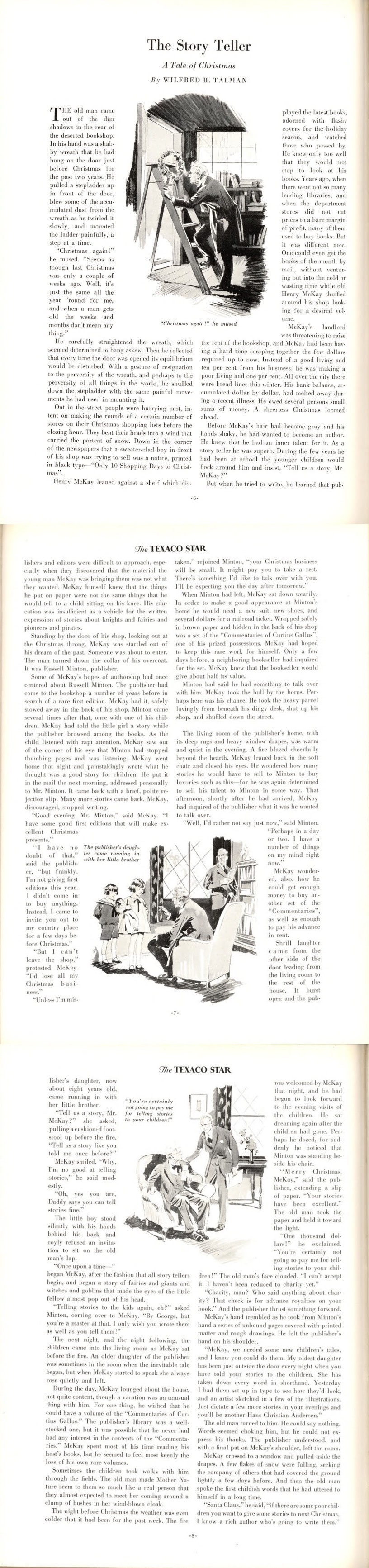
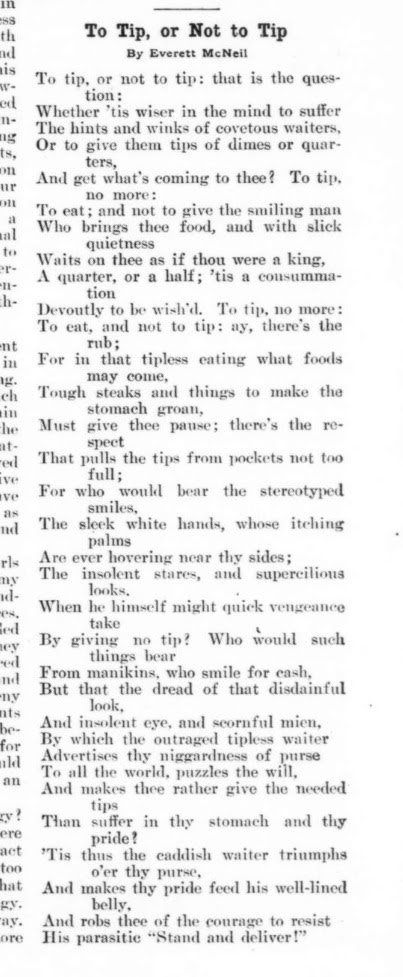
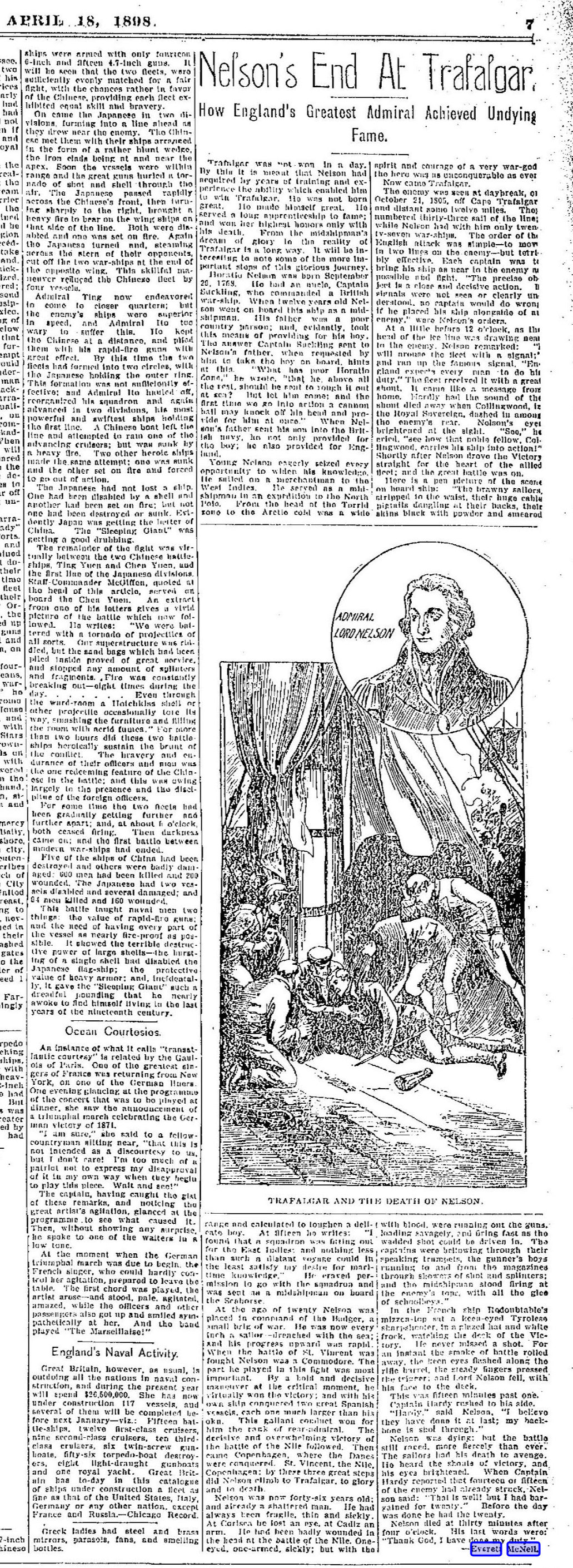
Page 112. Old Everett McNeil was in “Sinjin’s Hospital”, but had then been transferred (once they found he was a war veteran) to the Naval Hospital. Lovecraft sends him letters with his “legal name” of Henry. Thus genealogists should search for a Henry in birth records.

Page 113. Lovecraft describes further correspondence with a ‘Harold’ at June 1929, who is described as an “exotic cultist” who reveals alleged prehistoric Mayan lore and secrets in his articles and pamphlets. Lovecraft found him to “shine to saner advantage” in his letters, and “he seems a remarkably pleasant chap — perhaps destined to become an interesting correspondent.” Page 116 mentions “Harold’s dashing psychic method of exploring the primal past”.

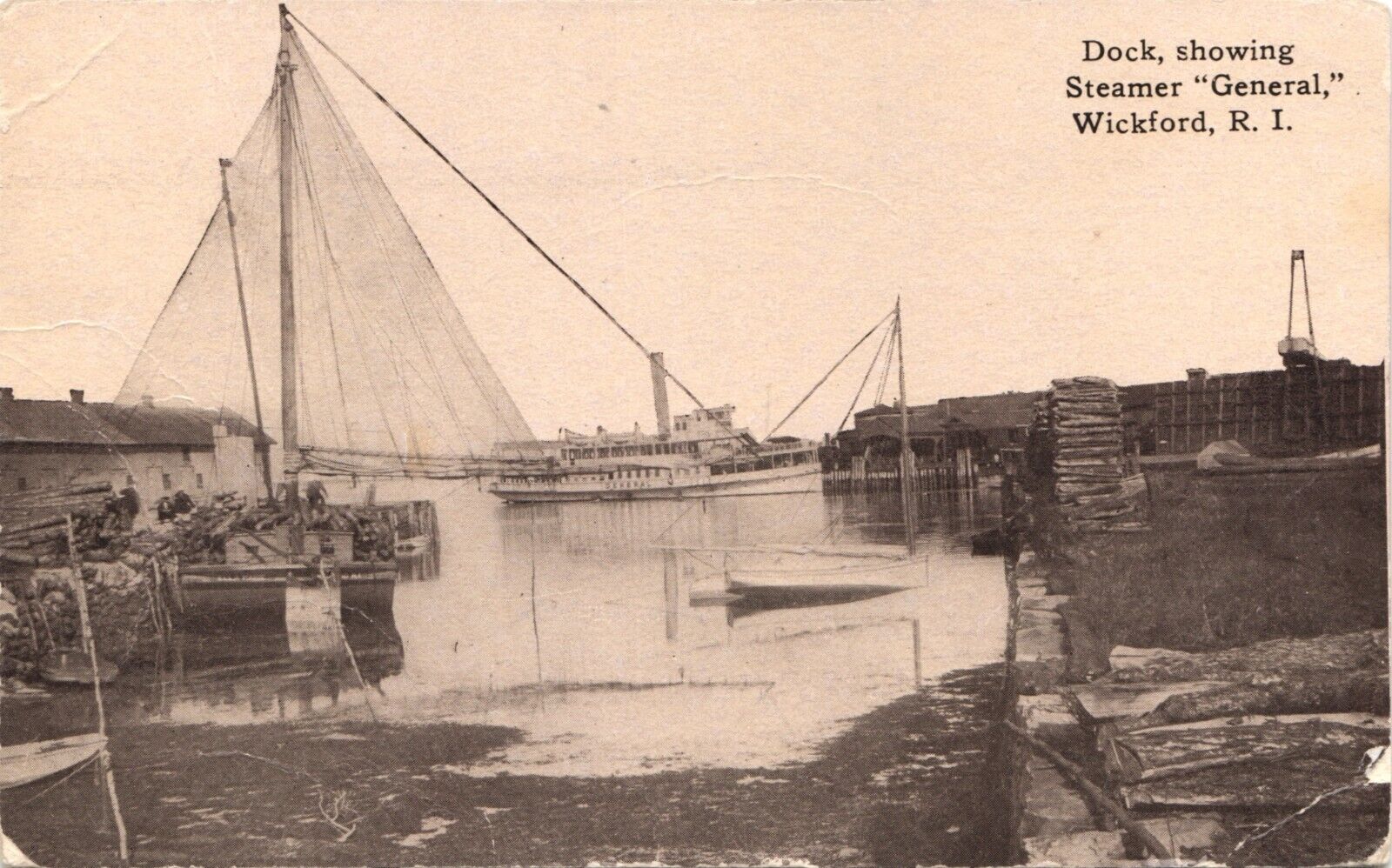
Page 117. Lovecraft sees Wickford again, and remarks that he had not seen it in 21 years. Which puts the first visit at circa 1908 at age 18. This must be the village of Wickford on Wickford Cove at North Kingstown, Rhode Island. About 14 miles south of Providence down the western shore and formerly “Updike’s Landing”. One assumes that this 1908 visit would have been seen on one of his epic solo trolley (tram) excursions at that time. Possibly he was in search of what another of his letters calls “the Pequod Path, ‘the great road of the country’, and just north of Wickford Harbor”. A snippet of biography which may interest Mythos writers. Another letter reveals its later charms… “we explored ancient Wickford with its crumbling wharves, great elms, & centuried white houses”.

Crumbling wharves at Wickford, Rhode Island.

The Dream and the Nightmare

Italy’s Black Widow record label has released a heavy metal tribute album to Lovecraft. Nothing unusual in that, but the booklet that comes with the double-album vinyl is reportedly quite substantial, ‘The Dream and the Nightmare: life and works of H.P. Lovecraft’.

Here’s part of an Italian review, translated from a page that can’t be linked to due to EU cookie-madness…

Life and Works is just spectacular. The illustrations show us the bizarre sculptures by Andrea Bonazzi, dark and particular character, talented sculptor and visionary of the crazy Lovecraftian deities. We also find drawings by Luca “Laca” Montagnani. Also in the booklet there is an ample account of the journal Studi Lovecraftiani curated by Pietro Guarriello, one of the leading Italian experts of H.P. Lovecraft. […] In the limited vinyl edition we also have Paul Roland’s biography of Lovecraft as a free extra.

The double-album’s music is also explicitly about Lovecraft’s specific tales (rather than vaguely Lovecraftian) and the reviewer calls it…

one of the most beautiful musical tributes I’ve ever heard. The contextual booklet and iconography of the work makes it unmissable.

Sounds like Lovecraft collectors — especially those interested in sculpture — might want to have a copy, even if they don’t read Italian.

Summer of Lovecraft

The German city of Hamburg appears to be enjoying a “Summer of Lovecraft”. With at least three outdoor theatre productions in the city’s main park. Stagings of “Innsmouth”, “Dagon”, which have seemingly already happened. And now a possibly localised or new “The Horror of Hamburg”. This latter being a promenade “theatrical walk through Hamburg’s city park”, with an appearance by HPL himself…

An eerie theatre walk through undiscovered corners of the park. Actors stand at special places in the park, presenting particularly famous Lovecraft stories as monologues, while the master personally provides clarifications and biographical facts.

10 performances across 22nd, 23rd, 29th and 30th July, free admission.

After Engulfment reviewed

A substantial chunk of a July 2023 review in Science Fiction Studies for the book After Engulfment: Cosmicism and Neocosmicism in H.P. Lovecraft, Philip K. Dick, Robert A. Heinlein, and Frank Herbert (2022). The rest of the review is behind the Project MUSE paywall. Amazon UK has no reviews, and this is the first I’ve seen or can find. But note there’s now a Kindle ebook edition, which means you can get the first 10% of the book on a Kindle as a free sample.

Also looking at Lovecraft from a theoretical angle, a short article on “H.P. Lovecraft and Hubert Fichte” with some interesting things to say about bodies and flows.

The Fossil for April 2023

A new edition of The Fossil, journal for the history of amateur journalism. This April 2023 issue has some Lovecraft interest for items relating to Lovecraft’s friend Maurice W. Moe. There’s a reprint of Moe’s “Amateur Journalism and the English Teacher”, a newly discovered item. This was his address to the National Council of Teachers of English in 1914. Ken Faig, Jr. follows with a short biography of Moe, with a focus on his amateur journalism work.

Miscellaneous Writings

New on Archive.org to borrow, Miscellaneous Writings. Most will have access to this material elsewhere. But some may want to look up old ‘page-number references’, found in scholarly writing on Lovecraft, that they have been unable to check due to lack of access.

Talking of once-obscure items, S.T. Joshi brings news of a “major auction of books and other matter devoted to the field of weird fiction”, set for Halloween 2023 at Bonhams in Boston. Sounds like the plot of a Mythos story, already. What may interest readers of Tentaclii is that Bonhams are still seeking consignments of quality/rare eldritch items for the auction. In that regard, don’t forget there’s also PulpFest 2023 in August.

Joshi’s latest blog post also spots a late ‘Lovecraft as character’ appearance, at the end of the movie Incident in a Ghostland (2018), and he useful identifies the actor.

‘Picture Postals’: Dunwich

This week my regular ‘Picture Postals from Lovecraft’ post visits Dunwich. Or rather, visits “The Dunwich Horror” country in the form of the region around Wilbraham, Mass. Lovecraft visited here for eight days, and the terrain and atmosphere inspired one of the best-loved horror tales of the 20th century.

Far to the west, across marshy meadows where at evening the fire-flies dance in incredibly fantastic profusion, the benign bulk of Wilbraham Mountain rises purple and mystical. The region, being very old and remote, is full of the most extraordinary folklore; some of which will certainly find lodgment in my future stories” (Selected Letters II) … “this mountain & all the land for miles around belonging to Miss Beebe” (Letters to Family).

This, for him, was Wilbraham. The two Wilbraham settlements shown on the survey map of the era were quite distant from his spot, away over the other side of a long and rolling mountain range. These settlements were North Wilbraham (on the rail tracks) and Wilbraham (a few miles south of North Wilbraham). A neighbour’s Ford farm truck was sent by Miss Beebe to collect Lovecraft from the train station at North Wilbraham, and this ran him down to the Beebe place — which was quite a way east of and on the other side of the mountain(s) from Wilbraham.

In the following 1917 view of the local fair we almost certainly see Miss Beebe, who Lovecraft stayed with in Wilbraham. We have good pictures of their place (see my Lovecraft in Historical Context #4). As Lovecraft tells us, Beebe owned a lot of land and was the ‘queen bee’ among the women of the district. She was very central to all its social events such as this, coordinating matters extensively via the telephone that also features prominently in “The Dunwich Horror”.

As such I’d say Beebe is likely to be the blonde middle-age woman with the up-do hair, seen in the middle of the picture. The tall well-dressed woman adjacent is likely the local school teacher, who also appears in a local history book’s picture of Beebe planting a tree at the local school.

Miss Beebe, along with her cousin Mrs Miniter, was a mine of local lore and had a large antiquarian collection. Which Lovecraft reports filled almost every nook of the house when he visited. Including little glass bottles…

She began saving [glass] bottles when they were the despised […] her method of hanging them in windows, known for years as “Beebe style” is now generally adopted. (“Extensive collection of antiques of late Evanore O. Beebe is sold”, The Springfield Republican, 1929).

Possibly also salt and pepper shakers, since a remarkable shaker collection popped up in Wilbraham shortly after the death of Miss Beebe and the sale of her collections…

I wonder if this was Miss Beebe’s collection, purchased and re-housed circa the early / mid 1930s? As one can see here in a ‘for sale postcard’ from this mini-museum, some would have had a somewhat surreal aspect — had Lovecraft seen them.

Lovecraft also visited nearby Hampden and the large town of Monson (approved of), and on the way visited “the other side of the mountain”. This being Wigwam Hill in the centre of the range, which according to the map sat directly opposite the Beebe place. The low “strangely domed” mountains run in a long chain, as is made clear by the geological maps and some of the photographs of the time. But on this “other side” he noted the blasted heath where nothing grew. There is of course no postcard of this site, although a geologist recorded the crest thus…

Along the crest of Wilbraham mountain there are found numerous bands of hornblende, of the same age as the Chester amphibolite. This hornblende is fissile and splits into thin layers. The surface shows a black, satiny appearance by reason of the interlacing needles of hornblende crystals.” (Copeland, Our County and its People, 1902)

The above quote might give some geologist readers a clue about why the ‘blasted heath’ might have been blasted of life. As Lovecraft described it…

A strangely blasted slope where grey, dead trees claw at the sky with leafless boughs amidst the abomination of desolation. Vegetation will grow here no longer — why, no one can tell.” (Lord of a Visible World, first hb edition, page 241)

… the vegetation never came right again. To this day there is something queer and unholy about the growths on and around that fearsome hill.” (“The Dunwich Horror”)

Some readers may also be interested to learn, re: “Colour Out of Space”, that there was a Wilbraham Mountain Spring Water Co. that failed. Of course his “Colour” was written March 1927, before the first Wilbraham visit (there were several others). But the influences of the “blasted slope” and the water co. might have come via a letter from Mrs Miniter and Miss Beebe.

He almost certainly also saw this…

This “grotto” was in the Academy grounds. We know that Lovecraft made one outing when he and his friend Mrs Miniter took a woodland trail behind the private prep school (Lord of a Visible World, first hb edition, page 241). Thus he likely saw this evocative spot. The extensive grounds of the Academy also took in “The Dell”…

“Cold Spring Glen”, anyone? There was also a wooded reservoir, presumably also part of the same woodland walk.

I can’t find this particular detail, but I assume that since Mrs Miniter grew up in Wilbraham she was thus educated at its large Academy. And would have known the young ladies’ dorm, here newly colorised…

Here we see the main entrance to the Academy, perhaps 1920s or 30s. Newly colorised. Note the curious ‘Turban’ like effect of the globe above the sculpted head.

And finally, I also found this from Wilbraham on eBay. Possibly the 1930s? Difficult to date, but the sharpness of the lens and the probably-remote location suggests post-1930s. Could have been made by an old glass-plate camera and superb lens left over from a past era, but who would lug one of those up a mountain? Might even be the early 1950s, with a camera brought back from Germany.

Anyway, we see some of the many rocks. Some of these around Wilbraham were and presumably still are, huge… though now probably orc-scrawled with graffiti. One example is the ‘Whale Rock’ seen below. Though if Lovecraft saw these larger rocks is not known.