The Vancouver Film School has a new Flickr set for their green-screen production of five stories by Lovecraft.


20 Friday Aug 2010
Posted in Lovecraftian arts
The Vancouver Film School has a new Flickr set for their green-screen production of five stories by Lovecraft.
20 Friday Aug 2010
Posted in Lovecraftian arts

My new finished portrait. Click on the image for the full-size 1090 x 1200px image. Many thanks to the Powerhouse Museum (man’s torso) and Tracey Olson (mist-tentacles) for the Creative Commons elements.
19 Thursday Aug 2010
Posted in Historical context, Lovecraftian arts, New discoveries
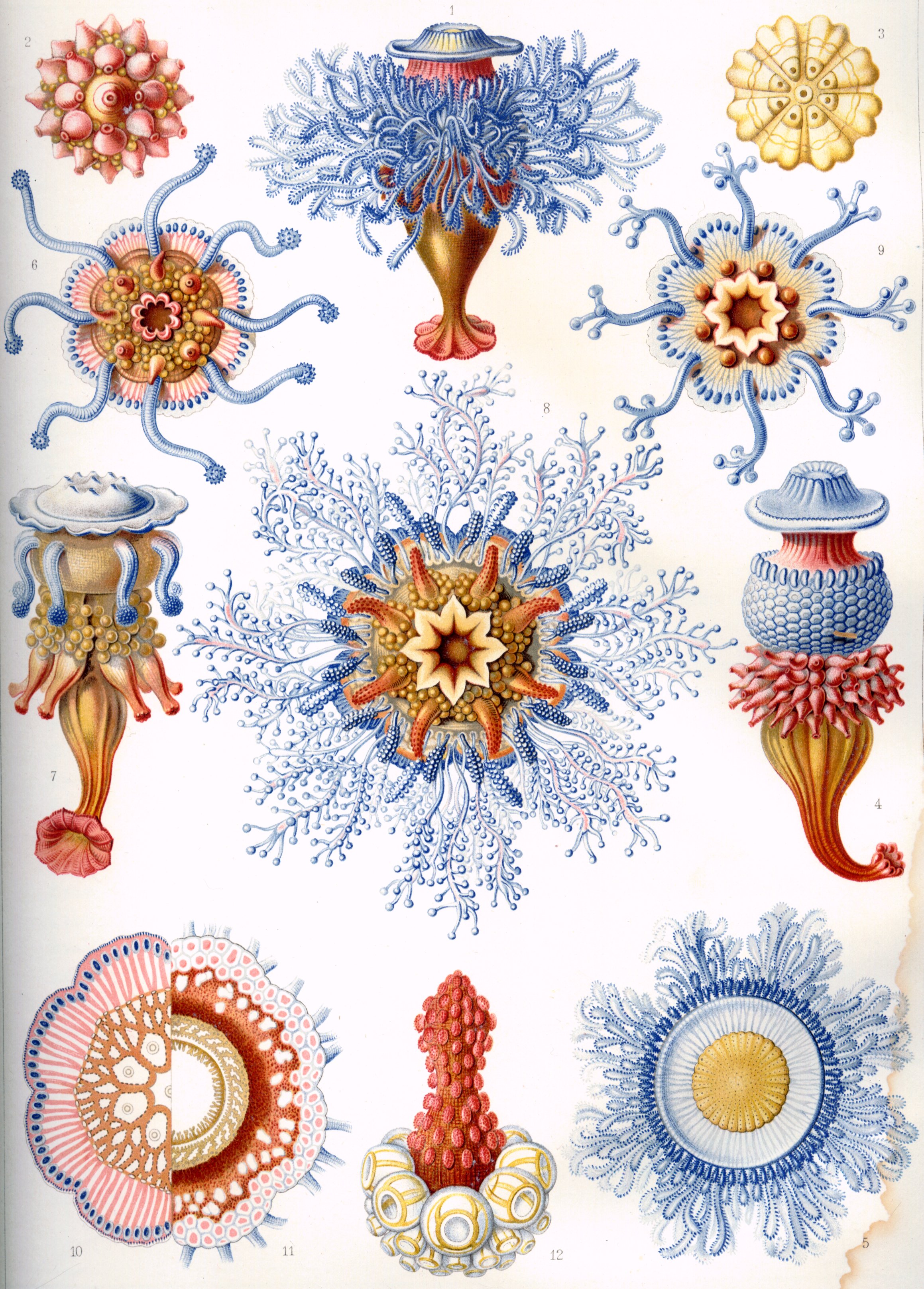
Ernst Haeckel’s prints of the small and microscopic biological specimens collected by the British HMS Challenger expedition, printed in book form in 1904, can be found on Wikimedia…

Some of the plates may have been an inspiration to Lovecraft, especially in relation to the look of the Elder Things (Old Ones) and their Shoggoths.
19 Thursday Aug 2010
Posted in Lovecraftian arts
Now on at the Academy of Natural Sciences in Philadelphia in the USA, Creatures of the Abyss (to 6th September 2010). It sounds rather kiddy-oriented and thus likely to be over-run by little monsters and their mothers, but it’s said to have…
“Full-scale models, preserved specimens, exploration vehicles, and a bioluminescence theater”.
… and there are some (presumably) kid-free evening openings.
It’s accompanied at the same venue by the exhibition A Many-Colored Glass: Ethereal Images of Microscopic Marine Life — the catalogue for which is available via print-on-demand at Blurb.

An illustration for At the Mountains of Madness? No, it’s a scientific photomicrograph of some ascorbic acid and liquid crystalline xanthin gum. (Not part of the exhibition).
If you’re in London, England, then the Natural History Museum has the similar major summer exhibition The Deep (to 5th September 2010). Review with photos

18 Wednesday Aug 2010
Posted in Historical context, Lovecraftian arts
A new Monster Talk podcast: “Cryptozoology & Science, Part 1“…
“What is cryptozoology? Is it science? Is it folklore? Does it make predictions? In part 1 of a 2-part series, MonsterTalk examines cryptozoology as a field, including speculation on the cryptids most likely to turn out to be real. Guest Dr. Darren Naish, paleontologist and science blogger, makes some surprising statements about the field, its role in science and culture, and the intersection of amateur and professional science.”

Illustration: “Basilisks, Dragonelles and Dragonettes from the Neville Colmore Collection”, part of the Colmore Fatagravures.
18 Wednesday Aug 2010
Posted in Historical context
“Pre-orders are being accepted via eBay for The Fantasy Fan, which will be published next month. This hardcover volume features the complete run of all 18 issues, dating from September 1933 to February 1935, and contains original published stories and poems by Weird Tales authors Robert E. Howard, Clark Ashton Smith, H. P. Lovecraft, and others. […] The publication was the first weird fiction fanzine.”

17 Tuesday Aug 2010
Posted in Historical context
A lively discussion has been triggered by Mike Duran’s new blog article, “On ‘Christian Horror’ and Atheist horror“. I know little of contemporary religious tensions in American fandoms, but the article seem to me to be an ideological attempt to build a sharp fence around something called “Christian horror”, a form that appears to have been incipient for about 18 months now, and to isolate it from ‘infection’. Matt Cardin chips in his article length commentary on his The Teeming Brain…
[…] what Lovecraft and the other writers working in the vein of fantastic or weird horror have done is not necessarily […] to dispense with religion or supernaturalism altogether in favor of “atheist dread,” but to find and convey something resembling, fundamentally, a true sense of Otto-esque numinosity in the very fact of their stories’ worldview-upending and -exploding conceptions […].
Lovecraft’s view seems very clear to me — worshipping believers are power-seeking degenerates or weak-minded primitives. But the springboard that takes him beyond religion or supernaturalism is that these cultists are not simply deluded zombies, such as might in other hands serve as a convenient plot device to allow a glamorous female to be rescued by a jut-jawed hero. The horror really is there, even though the cultists often worship it only indirectly via the medium of idols and chanted names — rather than truly comprehending ‘the terror of monstrous chaos’ that lies behind it. For a man of science to discover the same horrific truths of cosmic-indifferentist beings — to coldly see past the half-glimpsed cultist deities to the bigger picture, and to realise the insignificance of mankind — that is to invite madness. Lovecraft does have a touch of the human-centric in the fact that (a certain advanced part of) mankind has evolved to such a pitch that they can really ‘know of’ such things against a scientific background.
Lovecraft was in that sense almost making a sort of ‘inoculating vaccine’ for mankind — required if our insatiable scientific curiosity about the elder places of the earth or the reaches of outer space was not to risk springing the trap of civilisational madness. For Lovecraft, growing knowledge of ancient civilisations seems to have implied a twofold risk to ‘belief’. On the one hand if Western civilisation stepped beyond a surface admiration of ancient architectures to a true understanding of the minds and belief-systems of the builders, then it risked unleashing a cultural relativism into the yearning void left by the collapse of Christian belief — which would accelerate the decay of Lovecraft’s beloved rationalist Western civilization. On the other hand there was danger in the knowledge that the most sparkling and worthy ancient civilisations had been swept away by a seemingly inevitable decay and collapse. This risked infecting the fragile Western civilisation of the 1920/30s with self-doubt about its own ultimate fate, a doubt that could develop a dangerous symbiosis with cultural relativism. In all this Lovecraft was part and parcel of the Zeitgeist of the late-1920s/1930s.
I’m still a beginner at Lovecraft, but it seems to me that he cared deeply about ‘belief’, but it was not religious belief. Superstition was just a springboard which enabled him to express his fears for a more ineffable and dangerously-fragile ‘civilisational’ self-belief.
17 Tuesday Aug 2010
Posted in Historical context
Rear entrance of the Newport Historical Society…

17 Tuesday Aug 2010
Posted in Podcasts etc.
Need royalty-free dark ambient music for your H.P. Lovecraft podcast or audio-zine? Composer Mark Morgan kindly has 24 tracks of his finest dark ambient music — for free. The Vault Archives album is Mark’s music from the first two Fallout videogames, remixed and remastered in full-spectrum gorgeousness. If you’re looking for quality horror / thriller / eerie background music, this is it. It’s free to use for non-profit purposes. There are also some more bitter-sweet tracks such as “Dream Town”, and some that would suit the night-time “travelling” scenes in a downbeat road movie. Download from Archive.org.

17 Tuesday Aug 2010
Posted in Lovecraftian arts
Grognardia delves into the prehistory of the Cthulhu tabletop RPG game…
“Sandy Petersen and Lynn Willis’s roleplaying masterpiece, Call of Cthulhu, was in fact the second Lovecraftian RPG Chaosium attempted but the first one to be completed and actually published.”
16 Monday Aug 2010
Posted in Podcasts etc.
The Drabblecast : short stories from the far side of the weird, has a new free audio reading of Lovecraft’s “The Outsider”.

Also extracts from the “The Fungi From Yuggoth” sonnet sequence. If their embedded Quicktime trips you up, their plain MP3 download links are here.
I’ve added Drabblecast to the ‘Fiction magazines’ category on my “Lovecraft on the Web” directory.
16 Monday Aug 2010
Posted in Historical context
Panorama of Providence, 1903. One of 6,000 items (almost all historical) on the Providence Public Library Flickr stream.
 Providence in 1903.
I had assumed that Lovecraft never set foot on a sea-going vessel, but looking at the pictures there seems to have been a thriving commuter service by steamboat to New York. Did he always travel to New York by train, or sometimes by steam-boat? [Update: it seems he never went to New York that way, but friends such as Morton and Loveman did.]
 Reference reading room, Providence Public Library.
 Children’s reading room, Providence Public Library.
 Ladd Observatory, Providence. Frequented by Lovecraft in his youth.
 Quinsnicket, one of Lovecraft’s favourite parkland/woodland walks in Providence.