The Dunwich Horror theatre show, London

New theatre production of “The Dunwich Horror”, set to be staged this Autumn in London England…

“This production has been in development for over a year, from a script completed after extensive work-shopping. The premise was to keep extant as much of the text from the original story as possible, while opening up the piece to an engaging theatrical experience. The production will take place as part of the London Horror Festival at the Courtyard Theatre [Hoxton, London UK]”

No dates or box office yet, but the Festival dates are 25th Oct – 27th Nov 2011.

Spawn of the Green Abyss

This sounds fab. S.T. Joshi’s fave mythos stories collected in one volume (forthcoming)…

Spawn of the Green Abyss

“The House of the Worm” (1933) by Mearle Prout.
“Far Below” (1939) by Robert Barbour Johnson.
“Spawn of the Green Abyss” (1946) by C. Hall Thompson.
“The Deep Ones” (1969) by James Wade.
“The Franklyn Papers” by Ramsey Campbell.
“Where Yidhra Walks” by Walter C, DeBill, Jr.
“Black Man with a Horn” by T.E.D. Klein.
“Nethescurial” by Thomas Ligotti.
“Black Brat of Dunwich” by Stanley C. Sargent.
“The Phantom of Beguilement” by W.H. Pugmire.
“…Hungry…Rats” by Joseph S. Pulver, Sr. (new in this edition).
“Virgin’s Island” by Donald Tyson (new in this edition).

Lovecraft Annual 2011 now shipping

Shipping now, the Lovecraft Annual No.5 (2011).

Locked Dimensions out of Reach: The Lost Stories of H. P. Lovecraft

Cosmic Maenads and the Music of Madness: Lovecraft’s Borrowings from the Greeks

Blacks, Boxers, and Lovecraft

On H. P. Lovecraft’s “The House”

From Bodily Fear to Cosmic Horror (and Back Again): The Tentacle Monster from Primordial Chaos to Hello Cthulhu

Lovecraft and I

Lovecraft and the Sublime: A Reinterpretation

Lovecraft: A Gentleman without Five Senses

Endless Bacchanal: Rome, Livy, and Lovecraft’s Cthulhu Cult

“Cool Air,” the Apartment Above Us, and Other Stories

Lovecraft’s “The City”

Lovecraft and the dragons

In 1926 the Bronx Zoo exhibited some captured “dragons” (250-pound carnivorous Komodo dragons), which Lovecraft and his circle went along to see…


From Wonders of Animal Life, circa 1930s.

Interestingly, the dragon exhibition also directly inspired King Kong


From: King Kong: the history of a movie icon from Fay Wray to Peter Jackson, by Ray Morton.

They don’t seem to have directly inspired Lovecraft, unless perhaps you count the description of Cthulhu…

“a scaly, rubbery-looking body, prodigious claws on hind and fore feet” — “The Call of Cthulhu”.

Lovecraft may also have seen evocative photos of their habitat in the magazines…

“Ugly roots and malignant hanging nooses of Spanish moss beset them, and now and then a pile of dank stones or fragment of a rotting wall intensified by its hint of morbid habitation a depression which every malformed tree and every fungous islet combined to create.” — “The Call of Cthulhu”.

Why did 1990s Cthulhupunk fail?

Ross. E. Lockhart, over at Night Shade blog, muses on Cthulhupunk, in which a short-lived attempt was seemingly made to fuse SF cyberpunk with Lovecraftian tabletop RPG games in the 1990s.

I can see the many points of connection with Lovecraft’s original fiction: isolated alienated semi-powerless not-really-heroes with a mystery to solve; underground routes in the cultural landscape that lead to forbidden knowledge when hacked; blurring at the boundary of the real/unreal; a ‘reality’ that is outside the code of language; alternate/multiple planes of existence; flying around through weird multi-coloured glowing geometries; a degraded contemporary society stratified by class and race; mind transfer and personality augmentation; unknowable artificial intelligences pulling the strings behind the scenes and projecting their avatars into the real world. Throw in some bio-engineering and gene-splicing ‘gone wrong’ for sea-dwelling humans… could be awesome. Lots of literary potential for crossovers and mash-ups there, I’d say.

Perhaps the failure was more of a market failure on the side of the RPG game marketeers in their rather constricted “durh, Lovcraft iz black magik?” market, than a failure of the imagination on the part of writers? Correct me if I’m wrong (I’ve been away from literary SF for a while) but literary writers have never really had a go at such a melding?

Lovecraft’s Brooklyn cafes

I’ve already written a note on Lovecraft and the Double-R Coffee House. Here are some more notes on the other coffee houses and cafes Lovecraft is known to have frequented…


* Cairo Gardens, Brooklyn.

Owned, probably in the late 1930s and 40s, by Joseph Oppedisano….

“He was a former teacher at Albany High School and Ravena-Coeymans High School. He later owned his own restaurant, Cairo Gardens, in Cairo, N.Y. and was also an area [local] musician in his own band called The Manhattans.” — from his obituary in the Albany Times Union from 8th-10th October 2004.


* Tiffany’s, Brooklyn.

Lovecraft calls this “my regular” in the 1925 letters. Apparently (perhaps later) it was the occasional hangout of young roughs, since a Lovecraft letter of 1927 states that the police had arrested some youngsters for possessing guns at the cafe. Although, one wonders if perhaps they were just attempting to extort ‘protection’ money from the owner?

Tiffany’s obviously also sold food, since Lovecraft states in a letter that he “dined” there with friends. Elsewhere in his letters he calls it the “Tiffany Cafeteria”.

Some might think that the movies Breakfast At Tiffany’s has something to do with the place, but the Tiffany’s in the movie is a jewellery store not a cafe.


* Tontini’s, Brooklyn.

Nothing known. Seems to occur only in Kirk’s letters. Could this actually be Kirk’s mis-spelling of the name of the ‘legendary’ Totonno’s on Coney Island, which was originally… “on Neptune Ave off Coney Island Ave in Brooklyn”?…

“Since 1924, Totonno’s pizzeria has been a beacon on the block, remarkable for its longevity and for the deliciousness of its food.” — New York Times, March 2009.


* Unknown. Spanish restaurant on Fulton Street, sometimes visited on Sundays for lunch.


Lovecraft and the gang would also frequent the ice-cream parlors. These were apparently very sparkly, and a woman in the 1920s was once described as… “glittering like an ice-cream parlor”.

Daniel Fuchs’s Brooklyn story “Low Company” (1937) gives us a vivid portrait of two burglars in a closed ice-cream parlor, a decade after Lovecraft was in New York…

Lovecraft and the gang also paid at least one visit to Coney Island, which had plenty of ice-cream parlors.

Amazingly, the famous anarchist Emma Goldman once opened an ice cream parlor in Brownsville, Brooklyn. It went bust within three months.

Lovecraft’s Double-R Coffee House – photo

The Double-R Coffee House was a fairly regular hangout of Lovecraft and the Kalem Club in New York City. This is what the interior looked like when it opened…
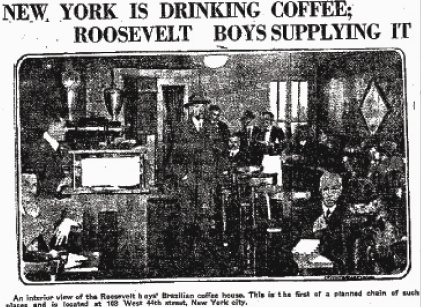
This is a little potted history of it…

“Members of the family of the late Colonel Roosevelt began to promote a Brazil coffee-house enterprise in New York in 1919. It was first called Cafe Paulista, but it is now known as the Double R coffee house, or Club of South America, with a Brazil branch in the 40’s [this is Lovecraft’s 112 West Fortyfourth Street haunt] and an Argentine branch on Lexington Avenue. Coffee is made and served in Brazilian style; that is, full city roast, pulverized grind, filtration made; service, black or with hot milk. Sandwiches, cakes, and crullers are also to be had.” — William Harrison Ukers, All About Coffee (1922).

“Upon entering the long narrow shop, a patron saw portraits’ of Voltaire and Shakespeare on opposite sides of the room. The walls were decorated with green and gold wallpaper containing a Brazilian bamboo plant design. The room contained 30 small oak tables and matching chairs with a large oak counter in the center where freshly ground coffee was made.” — The Rough Writer, Volume 9, Issue 3

It seems to have lasted about ten years under the first owners, and seems to have been set up to take advantage of Prohibition. It sold coffee, postum (a sort of decaf coffee substitute before decaf), pastries and cakes, sandwiches, and offered “a daily Brazilian dish”. It seems the manager was Brazilian.

There were “Expansion plans of Double-R Coffee House” (New York Times, 1923) which presumably meant the new Lexington Av. branch, but the venue was sold in 1928 (Tea and Coffee Trade Journal, 1928) to a Mr. and Mrs. Zivko Magdich — at which time the New York Times described it as a…

“gathering place for aspiring playwrights, actors, artists and musicians.”

The letters of George Kirk are a little more explicit on its artistic nature. It seems that, at least part of the week, the Double-R Coffee House served as a discreet queer meeting place…

“If you had been longer in NYC you’d know that there are many boys and many girls both male and female. My dear Double-R is claimed to be a hangout for these half and halfers.” — George Kirk, Letter of 17th Feb 1925.

Lovecraft wrote a poem to the place…

 Here may free souls forget the grind
   Of busy hour and bustling crowd
And sparkling brightly mind to mind
   Display their inmost dreams aloud

   — extract from “On the Double-R Coffee House” (1st February 1925)

It was also rather smoky, since Lovecraft writes in the same poem…

   Mids’t them I sit with smoke-try’d eyes

   — “On the Double-R Coffee House” (1st February 1925)

He also talks in one of his letters of the… “nicotined atmosphere”.

The full poem is to be found in The Ancient Track: The Complete Poetical Works of H.P. Lovecraft. It somewhat contradicts his very sour view of the artists of Greenwich Village in the short story “He”, although the fact that the coffee shop was a queer meeting place may throw new light on the line in Lovecraft’s New York story “He” (1925)…

“… uncommunicative artists whose practices do not invite publicity or the light of day.”

The Greenwich Village quill of 1921 very briefly mentions the Double R, so it seems that it was ‘on the map’ of the Greenwich Village crowd at that time.

The Double R apparently had a post-closure ‘media ghost’, since it seems to have been recreated as a setting in the TV series Twin Peaks. I’ve never seen the series, so I don’t know how faithful it might have been to the original. Presumably it was a covert Lovecraft reference by the makers.

Necronauts

I’ve found a interesting-looking 64-page comic novelette featuring Lovecraft as a character. Necronauts (2007, Rebellion) is by Gordon Rennie and Frazer Irving…

“In 1926, while practising a new trick, Houdini has a near-death experience, awakening the mysterious Sleepers. Meanwhile, Lovecraft is visited by a talking raven, and a seance that Sir Arthur Conan Doyle is attending is attacked by a strange force that possesses the medium.”

Sounds groovy, although the used print edition has become rather pricey in just a few years. The art looks fabulous, like Berni Wrightson on speed…

On the Cthulhu figurine

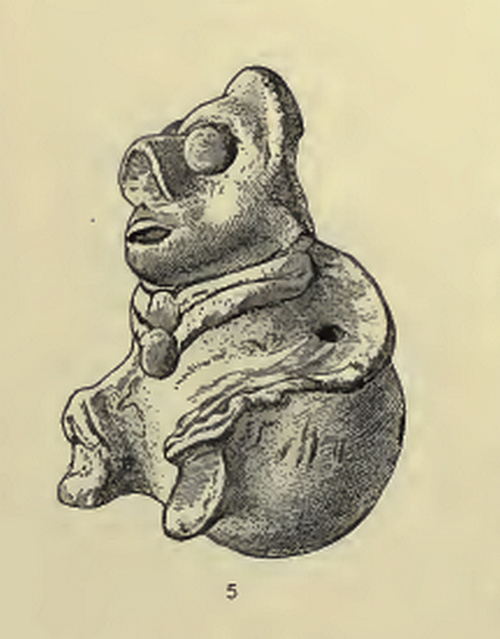
A hat-tip to Christophe Thill, who has pointed out the existence of an interesting octopoid bas-relief from Equador, South America. It seems that this has been written about before as a possible source for the figurine in “The Call of Cthulhu”. Nothing shows up on Google Books or Amazon Look Inside, so possibly there is an essay on this in Lovecraft Studies, Crypt of Cthulhu etc. But those are very expensive now, and I don’t have access to them. So here’s my quick re-tracking down of some of the key facts and images…


Both from The Antiquities of Manabi, Equador (1907) (Incidentally, an excellent example of why scanned books should not be discarded after mass scanning — the picture quality is rubbish).


The same picture given again in G. Eliot Smith’s book Evolution of the Dragon (1919). It has eight “arms” like an octopus, even though the arms are very straight rather than curvy.


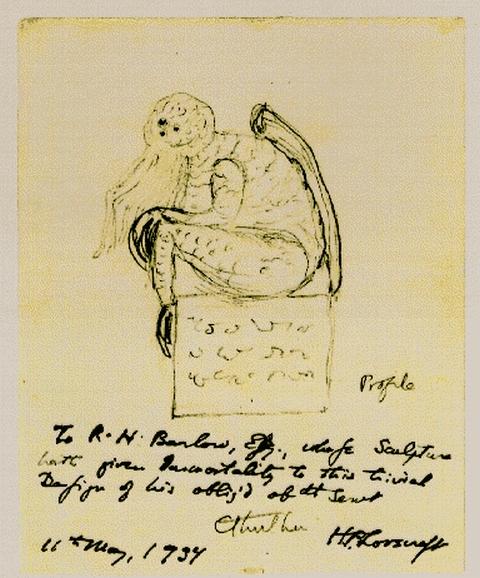
Lovecraft’s own pen-sketch of the Cthulhu figurine in the story.

Frank Belknap Long’s major mythos story “The Horror from the Hills” was written 1929, and first appeared as a two-parter in Weird Tales, Jan & Feb 1931. It is set in a New York museum, and Long mentions ‘The Manabi monoliths’. Although Lovecraft apparently gave written permission for one of his dreams [given in, among others, a letter to B.A. Dwyer of Nov. 1927] to be used in the story, as far as I can tell the story was not one of Lovecraft’s revision works. The late date and the seemingly tangential Lovecraft involvement thus suggests that there’s no actual proof that the Lovecraft circle may have known about the South American Manabi sculptures before 1927/9. Possibly some of Manabi works were on show in museums Long visited to research the story.

Yet… the Evolution of the Dragon was called a “highly acute and sensitive” (The Nation, 1919) work in the reviews of the time, and was even reviewed in Nature (1919), so it would seem strange if Lovecraft had not badgered the Providence library to obtain a copy. Or later tried to obtain a copy when he haunted the used bookshops and libraries of New York. Christophe Thill says that… “A picture of it [the Manabi octopoid] was published in Nature in 1924″, so it was obviously commented on. It is certainly very suggestive in the respect of the 1919 date that the famous entry in the Commonplace Book (entry No. 25, circa 1919, from a dream) describes not a squatting figure but a bas-relief like the one shown in Evolution of the Dragon

“25. Man visits museum of antiquities — asks that it accept a bas-relief he has just made—old and learned curator laughs and says he cannot accept anything so modern. Man says that ‘dreams are older than brooding Egypt or the contemplative Sphinx or garden-girdled Babylonia’ and that he had fashioned the sculpture in his dreams. Curator bids him shew his product, and when he does so curator shews horror. Asks who the man may be. He tells modern name. “No — before that” says curator. Man does not remember except in dreams. Then curator offers high price, but man fears he means to destroy sculpture. Asks fabulous price — curator will consult directors. Add good development and describe nature of bas-relief.”

He is unlikely to have seen the squatting Manabi figure in the 1907 monograph, and it was not given in the book Evolution of the Dragon. So where might he have had it from? There are of course a great many similarly squatting and pedestal-seated Ancient Egyptian figures, and this seems an obvious source for an Egyptomaniac like Lovecraft. For instance, there are some human figures in that pose, many squatting baboon sculptures from Ancient Egypt from all periods, and the Egyptian sculptures of Bes mostly have the typical pose of squat with hands resting on knees. Lovecraft would have seen these illustrated in books on Egypt, and then by the time of writing “Cthulhu” would have seen plenty of actual examples in the New York museums…


Note the beard of Bes, which almost suggests octopus-like tentacles.

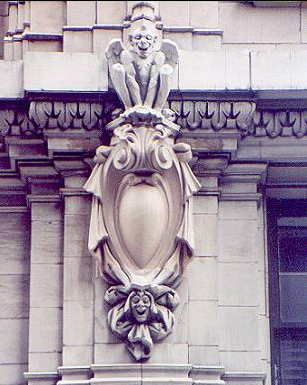
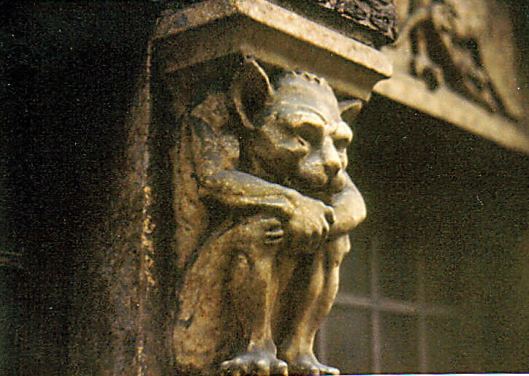
One might also point to the gargoyles of New York as another possible inspiration for the squatting figure of the Cthulhu statuette, especially the wings…

I know almost nothing of the roots of Masonic beliefs, but it may be that some scholar has reliably traced gargoyles back to guilds of masons whose traditions recalled those of Egyptian sculpture at the time of Rome? Whatever the truth of that, Lovecraft would certainly have made the Egyptian connection in his mind when he saw them on the buildings.

“The huge variety of nymphs, grotesques, demons, gargoyles, and other mysterious creatures carved into the facades of New York buildings is pretty astounding.” Ephemeral New York blog, 12th January 2011.

Christian Salomonsen

Christian Salomonsen captures the cosmic, in the form of the Northern Lights (charged particles streaming into the Earth’s atmosphere from space, and which hit the north pole more than the south)…

All pictures © Christian Salomonsen. More at his website.

‘… an unearthly cast which made him feel like an intruder on an alien planet. […] he knew of the northern lights, and had even seen them once or twice.’ — H.P. Lovecraft, “The Mound”.