A new message from beyond…
11 Thursday Aug 2011
Posted in Lovecraftian arts

11 Thursday Aug 2011
Posted in Lovecraftian arts
11 Thursday Aug 2011
Posted in Lovecraftian arts, New books
I’ve found a interesting-looking 64-page comic novelette featuring Lovecraft as a character. Necronauts (2007, Rebellion) is by Gordon Rennie and Frazer Irving…
“In 1926, while practising a new trick, Houdini has a near-death experience, awakening the mysterious Sleepers. Meanwhile, Lovecraft is visited by a talking raven, and a seance that Sir Arthur Conan Doyle is attending is attacked by a strange force that possesses the medium.”
Sounds groovy, although the used print edition has become rather pricey in just a few years. The art looks fabulous, like Berni Wrightson on speed…

11 Thursday Aug 2011
Posted in Historical context, New discoveries
A hat-tip to Christophe Thill, who has pointed out the existence of an interesting octopoid bas-relief from Equador, South America. It seems that this has been written about before as a possible source for the figurine in “The Call of Cthulhu”. Nothing shows up on Google Books or Amazon Look Inside, so possibly there is an essay on this in Lovecraft Studies, Crypt of Cthulhu etc. But those are very expensive now, and I don’t have access to them. So here’s my quick re-tracking down of some of the key facts and images…

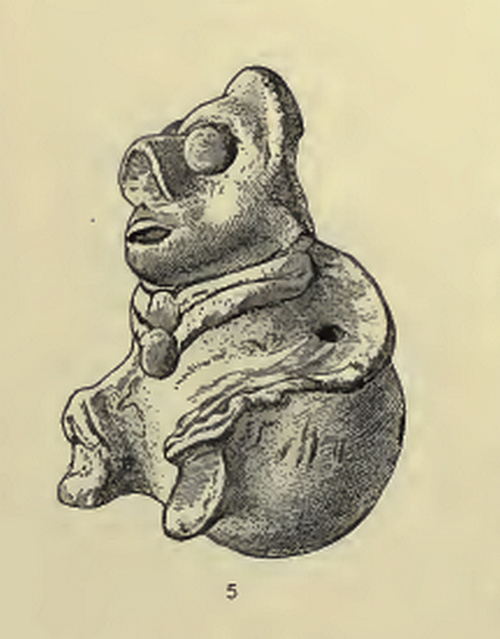
Both from The Antiquities of Manabi, Equador (1907) (Incidentally, an excellent example of why scanned books should not be discarded after mass scanning — the picture quality is rubbish).

The same picture given again in G. Eliot Smith’s book Evolution of the Dragon (1919). It has eight “arms” like an octopus, even though the arms are very straight rather than curvy.
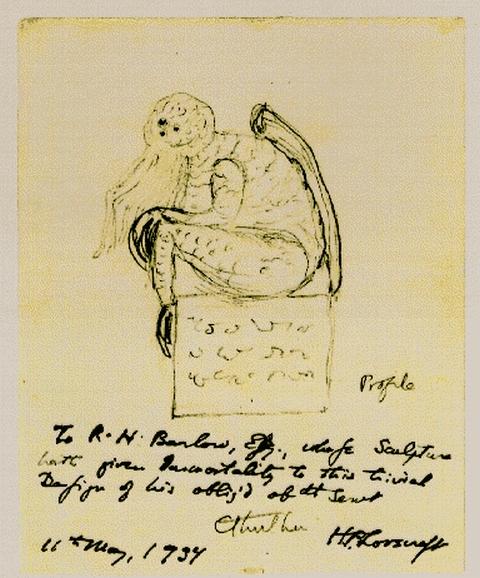
Lovecraft’s own pen-sketch of the Cthulhu figurine in the story.
Frank Belknap Long’s major mythos story “The Horror from the Hills” was written 1929, and first appeared as a two-parter in Weird Tales, Jan & Feb 1931. It is set in a New York museum, and Long mentions ‘The Manabi monoliths’. Although Lovecraft apparently gave written permission for one of his dreams [given in, among others, a letter to B.A. Dwyer of Nov. 1927] to be used in the story, as far as I can tell the story was not one of Lovecraft’s revision works. The late date and the seemingly tangential Lovecraft involvement thus suggests that there’s no actual proof that the Lovecraft circle may have known about the South American Manabi sculptures before 1927/9. Possibly some of Manabi works were on show in museums Long visited to research the story.
Yet… the Evolution of the Dragon was called a “highly acute and sensitive” (The Nation, 1919) work in the reviews of the time, and was even reviewed in Nature (1919), so it would seem strange if Lovecraft had not badgered the Providence library to obtain a copy. Or later tried to obtain a copy when he haunted the used bookshops and libraries of New York. Christophe Thill says that… “A picture of it [the Manabi octopoid] was published in Nature in 1924″, so it was obviously commented on. It is certainly very suggestive in the respect of the 1919 date that the famous entry in the Commonplace Book (entry No. 25, circa 1919, from a dream) describes not a squatting figure but a bas-relief like the one shown in Evolution of the Dragon…
“25. Man visits museum of antiquities — asks that it accept a bas-relief he has just made—old and learned curator laughs and says he cannot accept anything so modern. Man says that ‘dreams are older than brooding Egypt or the contemplative Sphinx or garden-girdled Babylonia’ and that he had fashioned the sculpture in his dreams. Curator bids him shew his product, and when he does so curator shews horror. Asks who the man may be. He tells modern name. “No — before that” says curator. Man does not remember except in dreams. Then curator offers high price, but man fears he means to destroy sculpture. Asks fabulous price — curator will consult directors. Add good development and describe nature of bas-relief.”
He is unlikely to have seen the squatting Manabi figure in the 1907 monograph, and it was not given in the book Evolution of the Dragon. So where might he have had it from? There are of course a great many similarly squatting and pedestal-seated Ancient Egyptian figures, and this seems an obvious source for an Egyptomaniac like Lovecraft. For instance, there are some human figures in that pose, many squatting baboon sculptures from Ancient Egypt from all periods, and the Egyptian sculptures of Bes mostly have the typical pose of squat with hands resting on knees. Lovecraft would have seen these illustrated in books on Egypt, and then by the time of writing “Cthulhu” would have seen plenty of actual examples in the New York museums…

Note the beard of Bes, which almost suggests octopus-like tentacles.


One might also point to the gargoyles of New York as another possible inspiration for the squatting figure of the Cthulhu statuette, especially the wings…

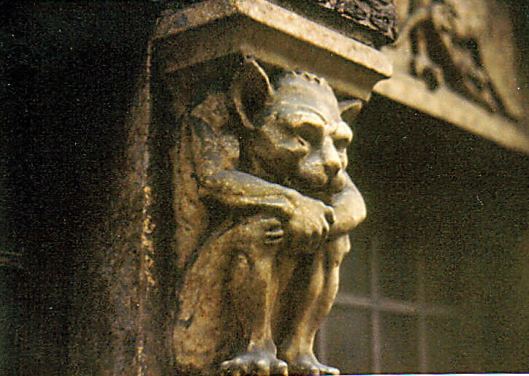
I know almost nothing of the roots of Masonic beliefs, but it may be that some scholar has reliably traced gargoyles back to guilds of masons whose traditions recalled those of Egyptian sculpture at the time of Rome? Whatever the truth of that, Lovecraft would certainly have made the Egyptian connection in his mind when he saw them on the buildings.
“The huge variety of nymphs, grotesques, demons, gargoyles, and other mysterious creatures carved into the facades of New York buildings is pretty astounding.” Ephemeral New York blog, 12th January 2011.
10 Wednesday Aug 2011
Posted in Lovecraftian arts
Christian Salomonsen captures the cosmic, in the form of the Northern Lights (charged particles streaming into the Earth’s atmosphere from space, and which hit the north pole more than the south)…


All pictures © Christian Salomonsen. More at his website.
‘… an unearthly cast which made him feel like an intruder on an alien planet. […] he knew of the northern lights, and had even seen them once or twice.’ — H.P. Lovecraft, “The Mound”.
10 Wednesday Aug 2011
Posted in Lovecraftian arts
A penguin made by Jeremy Mayer from an old antique mechanical typewriter. Those who know At The Mountains of Madness will get the joke…

that nighted, penguin-fringed abyss, whence even now a sinister curling mist had begun to belch pallidly
10 Wednesday Aug 2011
Posted in Historical context
Snagged from an eBay listing of a rare chapbook printing of a poem to Moe. I’ve never seen this photo before, featuring Maurice Moe and Lovecraft in the warm months of 1936…

Moe looks rather short, but I think it’s just an optical illusion? Lovecraft was quite tall, especially for a time when people tended to be shorter than they are now. So, by comparison, Moe looks short?
10 Wednesday Aug 2011
Posted in Historical context, Unnamable
I thought it’d be timely to write a little about public attitudes to “the mob” in Lovecraft’s time, given that we’ve had a taste of it here in the UK over the last few nights.
The ‘mob mind’, riots, and Lovecraft:
The “mob mind” was a popular concept and talking point around 1919-1920, and built on very real public concerns about the dangers of increasingly crowded and ill-educated modern cities that were emerging in the 1910s and 1920s.
In the early 1900s there had been mass panic on the New York subway…
‘Indescribable scenes of crowding and confusion, never paralleled in this city. […] a deadly, suffocating, rib-smashing subway rush which began at 7 o’clock tonight. Men fought, kicked and pummeled one another […] grey haired men pleaded for mercy, boys were knocked down and only escaped by a miracle from being trampled underfoot. The presence of the police alone averted what would undoubtedly have been panic after panic, with wholesale loss of life.’ — New York Tribune, 28th October 1904.
On 1st August 1918, when a then-new subway shuttle system had opened in New York, there had apparently been another riot and stampede to get out of the station. This was before the installation of glowing guide-lines that led people out of the dark.
E.A. Ross’s best-selling book Social Control (1901) had suggested that people were increasingly subject to a primitive “suggestibility” in crowded modern cities. Partly this had to do with the rise of and change in the nature of advertising, partly with the rise of a violent leftist politics, but in America it was able to built on existing French thinking about the nature of the new modern urban crowd and its patterns of behavior. This writing had initially arisen in France after the terror of the French revolution — but it was later heavily developed as intellectuals tried to divine what sort of new politics might come out of the new crowds from the 1900s onwards.
In 1919 Ross’s student Robert Gault had published the book The Psychology of Suggestion, drawing heavily on Ross’s ideas and the concept of the mob mind, and this was no doubt reviewed in the sort of publications Lovecraft would have read. I expect that the race riots and the serious political unrest in 1919 gave Gault’s book a wide readership. On the links between ‘the mob crowd’ and race in 1919 and the years following, see Jan Voogd’s book Race Riots and Resistance: the Red Summer of 1919 (2008) which examines the Chicago race riots of 1919. Even the most violent of the pulps paled beside the vicious horrors described in false rumours that fanned the riots.
On 9th September 1919 the whole of the Boston police force deserted their posts, leaving the city virtually defenceless against the mob, leading to further strong cultural anxieties about Bolshevism (widely believed to have inspired the police strike). This time it was much closer to Lovecraft’s own Providence, and it no doubt conflated politicized unions and crime in the public mind.
These anxieties were, of course, set against the background of the terror of the 1917 Russian Revolution and its organised exporting of the Bolshevist [socialist] creed. And, closer to home and a little later, there was the major terrorist bomb attack on New York on 16th September 1920 using 100lbs of dynamite with metal curtain-weights packed around it. This had followed the discovery of two series of horrific parcel bombs in the mail. This must have further heightened tensions in New York and the cities of New England.
On the specific ‘hypnotic’ nature of crowds, which seems relevant to the columns of semi-hypnotised people in the Lovecraft story “Nyarlathotep” (1920), one might also point to Gustave le Bon’s earlier book The Crowd (published in America in 1896) which had argued that an individual who is too long in a crowd…
finds himself in a special state, which much resembles the state of fascination in which the hypnotized individual finds himself in the hands of the hypnotizer.
By the time Lovecraft arrived in New York in the mid 1920s these wider anxieties appear had quieted down somewhat. Nevertheless they undoubtedly left their mark on the psyches of ordinary people, including Lovecraft.
Further reading:
John Carey. The Intellectuals and the Masses: Pride and Prejudice Among the Literary Intelligentsia 1880-1939. Faber and Faber, 1992.
J.S. McClelland. The Crowd and the Mob: From Plato to Canetti. Taylor & Francis, 2010.
Paul S. Boyer. Urban Masses and Moral Order in America, 1820-1920. Harvard University Press, 1992.
09 Tuesday Aug 2011
Posted in Unnamable
News just in that will interest Lovecraft devotees. From NASA and published in a reputable journal…
scientists [from NASA have found] that ready-made DNA parts could have crashed to earth’s surface on objects like meteorites, and then assembled under earth’s early conditions to create the first DNA. The researchers, from NASA’s Goddard Space Flight Center, made their discovery using samples from 12 carbon-rich meteorites, nine of which came from Antarctica […] The research was published in the Proceedings of the National Academy of Sciences.
[youtube=http://www.youtube.com/watch?v=1g7AKVZ3HC4&w=520&h=317]
08 Monday Aug 2011
Posted in Historical context, Odd scratchings
Some quotes on Lovecraft’s Waterman fountain pen, rescued from the clutter of an old discussion thread on the Fountain Pen Network forum (several kindly supplied to the Network by Chris Perridas). Illustrated here with photos of a 1920 No.56 Ideal Waterman, without gold decoration, currently on sale to collectors in Taiwan, plus a few others of the same time-period. They apparently sell for upwards of $800 in really good condition.
“But avaunt [Go away], dull care! Let me drown my worries in watered ink, or the clatter of Remington [typewriter] keys.” — Lovecraft letter, in Lord of a Visible World: an autobiography in letters.

“You’ll recall that I obtained a pen a piece for SH (Sonia) & myself last October at a price of $1.28 … we found the sale still on [&] the salesman still willing to make exchanges. …to obtain real satisfaction one must invest in a real Waterman … I did not escape from the emporium till a $6.25 Waterman reposed in my pocket — a modern self-filler corresponding to the ancient $6.00 type which I bought in 1906 & lost seventeen years later amidst the sands of Marblehead Neck in the summer of 1923 … the feed is certainly a relief after sundry makeshifts — tho’ I think I’ll change this especial model tomorrow for one with a slightly coarser point — one less likely to scratch on rough paper. It is certainly good to be back among the Watermans again …” — Lovecraft to Lillian Clark on 30th January 1926.
[The “sundry makeshifts” apparently included a self-filling Conklin, loaned from Moe after Lovecraft’s pen was lost “amid the sands of Marblehead”].

From: Howard Phillips Lovecraft: Dreamer on the Nightside, by Frank Belknap Long…
Howard was fascinated by small articles of stationery — writing pads, rubber bands of assorted sizes, phials of India ink, unusual letterheads, erasers, mechanical pencils, and particularly fountain pens.
He used one pen, chosen with the most painstaking care, until it wore out, and several important factors entered into his purchase of a writing instrument. It had to have just the right kind of ink flow, molding itself to his hand in such a way that he was never conscious of the slightest strain as he filled page after page with his often minute calligraphy. It also had to be a black Waterman; a pen of another color or make would have been unthinkable.
When a pen he had used for several years wore out, the purchase of a new one became an event — lamentable in some respects, but presenting a challenge which I am sure he secretly enjoyed. We were walking northward from Battery Park [New York City], where I had met him at noon, stopping occasionally to admire one of the very old houses which still could be found scattered throughout the financial district in the 1920s, when he told me that he intended to purchase a new pen at the first stationery store that had a well-stocked reliable appearance. He removed the old one from his vest pocket and showed me how worn the point had become. I found myself wondering just how many letters and postcards he had written with it, for it did have a ground-down aspect.
We walked on for three or four blocks, found the kind of store he had in mind, and I accompanied him inside. The clerk who waited on him was amiable and greeted him with a smile when he asked to try out a number of pens.
“The point has to be just right,” Howard said. “If it won’t put you to too much inconvenience, I’d like to test out at least twenty pens.”
The clerk’s smile did not vanish when Howard turned to me and said, “I’m afraid this will take some time.”
It was just a guess, but I felt somehow that he had made the kind of understatment that would strain the clerk’s patience almost beyond endurance.
“We just passed a pipe store,” I said. “I’d like to go back and look at the window again. I may just possibly decide to buy a new pipe. I can be back in fifteen or twenty minutes.”
“No need to hurry,” he said. “I’ll probably be here much longer than that.”

I was gone for forty-five minutes. It was inexcusable, I suppose, but it was a clear, bright day, a wind with a the tang of the sea was blowing in from one of the East River wharves where several four-masted sailing ships were tied, and I decided to go for quite a long walk instead of returning to the pipe shop.
When I got back to the stationery store, there were at least fifty pens lying about on the counter and Howard was still having difficulty in finding one with just the right balance and smoothness of ink flow. The clerk looked a little haggard-eyed but he was still smiling, wanly.
The careful choice of a fountain pen may seem a minor matter and hardly one that merits dwelling on at considerable length. But to me it has always seemed a vitally important key to the basic personality of HPL in more than one respect. He liked small objects of great beauty, symmetrical in design and superbly crafted, and by the same token larger objects that exhibited a similar kind of artistic perfection. And the raven-black Waterman he finally selected was both somber and non-ornate, with not even a small gold band encircling it. That appealed to him in another way and was entirely in harmony with his choice of attire.
“I certainly share your despair in regard to ever finding a serviceable fountain-pen — it’s the main reason why I have taken to typing most of my letters. I, too, often employ pencils in making the first draft of a story — though such drafts, with me, are likely to get themselves done any old way. Sometimes I start ’em on the machine — and then finish up or alternate with all the available mediums of scripture. I don’t dare leave the resultant mass lying around too long before making the final typed version — or even I would be powerless to unscramble it!” — letter to Clark Ashton Smith in March 1932.


08 Monday Aug 2011
Posted in New books, Scholarly works
Book Review: I Am Providence (Hippocampus Press, 2010).
I’ve finally finished reading S.T. Joshi’s magnificently expanded two-volume life of H.P. Lovecraft, I Am Providence. I came to it without reading through the earlier versions, although I had consulted Joshi’s books extensively via Google Books.
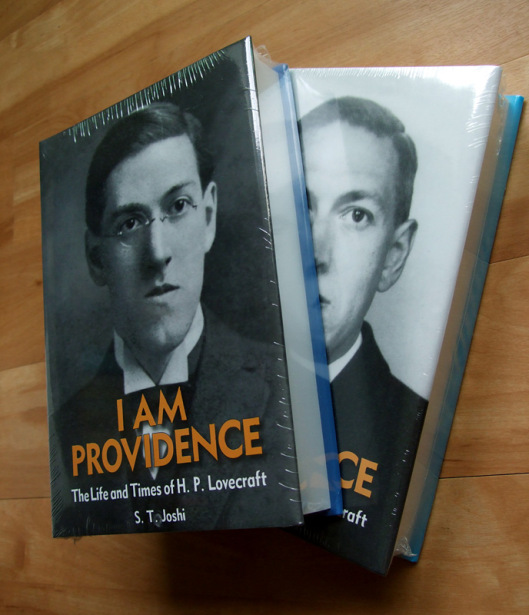
I Am Providence is certainly a hefty treasure, both in terms of the weight and the $100 cost. It is handsomely presented in two volumes between firm black boards, and was printed on good paper. The binding stood up well to my robust first reading, the boards staying flat and the spine only becoming very slightly slippy. Some have suggested (seemingly at a first glance?) that the font choice is a little small, but I had no problem at all with eye-strain while reading through the 1150 pages. I was reading the volumes in a bright summer light, though — so perhaps those reading by a single bulb in the winter, and with older eyes than mine, may have more trouble with the font size. More photographs might have been welcome, and on glossy rather than matte paper, though I expect that the cost of reproduction rights was a factor here. I spotted about ten very minor and trivial typos, but these are obvious and don’t affect the meaning of the passage or the word used. In a work of this size it is no doubt impracticable for a niche small press to get all the typos out, without crowd-sourcing the job or paying a small fortune to professional proof-readers. Both in terms of their tactile nature and their readability / technical precision, the two volumes are very pleasing.
I Am Providence is clearly written in plain English, and it has a straightforward organisation and a substantial index and bibliography. Overall I felt that the book was not a whit too long, although I admit I did skim-read perhaps thirty pages or so, mostly pages that detail petty squabbles within the amateur journalism movement of the 1910s and 20s. Joshi laces the volumes with reams of fascinating facts that must have taken platoons of scholars and fans years of time and trouble to unearth during the last 70 years. Those of us who may be becoming interested in Lovecraft scholarship in the 2010s really do owe an immense debt of gratitude to these grand old fellows for all their painstaking work, some of which has apparently still not been published. In addition, some of the facts in I Am Providence are quite new, arising from quite recent scholarship and discoveries. There is also a useful end chapter giving a distilled summation of the later development of the Lovecraft mythos, its adaptation in other media, and the outlines of Lovecraftian scholarship from 1937 to about 2009.
Are there flaws? There are a few, and it’s probably very churlish of me to mention them but I’m going to anyway. Joshi’s socialism pokes its giant elbow in here and there, but it is always eminently detectable and dissolvable. Homosexuality in Lovecraft’s circle is often left unmentioned or barely treated at certain points, where some very useful elaborations might have been made in the same manner as Joshi elaborates elsewhere on the racial aspects. I was especially curious to see if Barlow’s homosexuality was a factor in Barlow being bullied out of the Lovecraft estate by Derleth. Possibly not, but this occurrence is very vaguely despatched by Joshi in one rather curt and short line, with no reference to where one might find the full facts.
In general the book only allows the various historical contexts to play rather lightly in the background. But to be fair, to have fully treated these would no doubt have required another complete volume of appendices, and the reading of a great many weighty history books from university presses (many of which have appeared only in the last decade, with 1920s New York and the Great Depression being especially well covered with new scholarship). In particular, though, Joshi’s view of the political response to the early years of the Great Depression seems to me to rest too much on out-of-date and partisan leftist histories of the era.
But these are relatively minor and carping points, when set against the grand and impressive sweep of the book. The Lovecraft that emerges from the pages is certainly not ‘the isolated mad freak’ that many have claimed (and some would still like to believe) Lovecraft was. Nor does the book give the slightest encouragement to those who wish to claim Lovecraft as some kind of occult practitioner or prophet. Some have apparently quibbled at the way Joshi inserts his critical opinions on the worth of each of Lovecraft’s stories. I found these short comments and asides to be useful, especially since they do not arise from trendy academic theories and are not obscured by lit-crit jargon. Over the last year I have returned to Lovecraft and have re-read nearly all of the fiction, and I found myself in general agreement with Joshi’s opinions and his plainly-worded rankings of the various works. Likewise the attention Joshi pays to issues of anti-semitism and racialism seems fair-minded and careful, and the broader context of the ubiquity of such ideas in the 1920s and 30s is introduced and considered. In conclusion, I Am Providence is a highly recommended and valuable grounding for those becoming interested in Lovecraft’s life and works, and it is likely to remain so long into the future. Next on my list is the sadly out-of-print Lord Of A Visible World: an autobiography in letters (Ohio University Press, 2000), in which Lovecraft effectively gives us his life in his own words via the letters. It should make a fine bookshelf-companion for Joshi’s two monumental volumes.
08 Monday Aug 2011
Posted in Lovecraftian arts, New books
Alan Moore’s Neonomicon is now on pre-order as a graphic novel from Titan/Avatar Press, set for release in Oct/Nov 2011. Presumably it’ll be fronted by The Courtyard, then will run through the four issues of Neonomicon to make up a 140-page graphic novel. The hardback, currently listed for pre-order on Amazon, states “176 pages”, so presumably there’ll be a couple of new text-only introductions and maybe even a new Moore essay on Lovecraft. The ending of Neonomicon sets up a sequel, so it would great to think that Moore is going to spring a Lovecraftian novelette on us as a concluding part. The story starts in a modern-day Red Hook in New York, and is sexually very graphic. So much so that I wonder if it’ll even be banned or released only in censored form in the UK.
 Cover for Neonomicon #3.
08 Monday Aug 2011
Posted in New books
I came across the new-ish Classics Mutilated: Dread Island by writer Joe R. Lansdale, among 15 others. It was released about six months ago, and was heavy promoted to the comics crowd. The used paperback can now be picked up dirt cheap on Amazon. Although the cover might lead one to think it’s a long graphic novel, it seems the book is actually a story anthology.

Nor is it actually an all-Lovecraftian book, according to the Fangoria review by Jorge Solis who praises the title-tale thus…
The best is saved for last with Lansdale’s “Dread Island.” The weird combination between Mark Twain and H.P. Lovecraft is quite surprising. Huckleberry Finn and his close friend, Jim, are on the search for the missing Tom Sawyer. The clues lead them to Dread Island, where sinister creatures lurk in the shadows. This single story is worth buying the whole anthology [for].
So it’s not like one of those silly quickie “search and replace to make it a zombie version” mash-ups that have been inflicted on Jane Austen and others recently. Joe R. Lansdale wrote elsewhere…
I wrote ‘Dread Island’ based on my love for Mark Twain,” reveals Lansdale, “which collided with my interest in Lovecraft, and the fact that the Uncle Remus tales may have been the first stories I ever read. And then there were comics. I always saw ‘Dread Island’ as a kind of comic book in prose, the old Classics Illustrated look. That’s how it played out in my head.
Those buying for reading, rather than collecting, might note that the Kindle edition includes two extra stories.
