The new Library of America e-Newsletter interviews
S.T. Joshi about Ambrose Bierce (PDF link, full interview).
Library of America e-Newsletter interview: S.T. Joshi
17 Wednesday Aug 2011
Posted in Historical context, New books, Scholarly works

17 Wednesday Aug 2011
Posted in Historical context, New books, Scholarly works
The new Library of America e-Newsletter interviews
S.T. Joshi about Ambrose Bierce (PDF link, full interview).
17 Wednesday Aug 2011
Posted in New books, Odd scratchings
The bull-o-meter nudges the top end of the scale in some of the opening publisher quotes in The Library Journal‘s new cover article on the fantasy/SF renaissance. But otherwise it’s an interesting survey of the ‘big publisher’ trends in the mad scramble from Sept to Xmas. The highlights…
* Gritty ‘dark fantasy’ infiltrates the sort of over-padded fantasy epics that you can stop a door with. But who wants to slog through a 3,000 page trilogy full of ‘grim’, in the current climate?
* A new trend for historical/fantasy desert settings, Arabian Nights style. Interesting. I could imagine a lot of Lovecraftian elements could creep in there, if done well. There’s certainly a lot of public domain material to mine for authentic descriptions and background.
* Growth “in the male urban fantasy market”. That sub-genre must have completely passed me by. Sounds like it’s a 20-something target market, for guys afraid their manhood will shrivel up and fall off if they read about faeries and elves?
* Authors who write about zombies are moving them into political satire and comedy. Best place for them. They’re such dull monsters, the only thing left to do is poke fun at them.
* Steampunk continues to flounder about looking for fresh settings and twists, judging from the article.
* New galactic-spanning space adventures have become very rare, as 50-something SF authors churn in a mire of near-future gloom and angst. Publishers will be republishing their old “upbeat” space epics, to compensate.
* There’s a gap in the market for smart optimistic young-adult hard SF, which will increase as the economic recovery starts.
The biggest news is probably that Neal Stephenson is back with a new novel, Reamde, in September. It’s another 1000-page doorstopper. I don’t mind the size and I really enjoyed Anathem — but it seems that Reamde is more like Cryptonomicon which while gripping was forgettable. No news of any new book from Stephen Baxter, sadly.
16 Tuesday Aug 2011
Posted in Historical context

Lower Clinton Street, Near East River, NYC, 1941. Is this the right Clinton St. for Lovecraft?

The present-day location of Lovecraft’s “dismal” room at 169 Clinton Street. It was then on the fringes of the Red Hook slum area. The Brooklyn Heights blog explains…
“Lovecraft’s description of 169 Clinton, at the corner of State Street, as “at the edge of Red Hook” may seem odd to Heights residents today, but in the 1920s “Red Hook” included all or much of what we know now as Cobble Hill and Carroll Gardens, as well as what we now call Red Hook.”
16 Tuesday Aug 2011
Posted in Historical context
The 2011 H.P. Lovecraft Film Festival will be showing a restored print of Lovecraft’s favourite movie, the time travel feature Berkeley Square (1933).
“This movie was considered by many to be lost […] This will be the first time this print has been screened, and probably the first time the movie has shown anywhere in decades.”

16 Tuesday Aug 2011
Posted in Lovecraftian arts
New theatre production of “The Dunwich Horror”, set to be staged this Autumn in London England…
“This production has been in development for over a year, from a script completed after extensive work-shopping. The premise was to keep extant as much of the text from the original story as possible, while opening up the piece to an engaging theatrical experience. The production will take place as part of the London Horror Festival at the Courtyard Theatre [Hoxton, London UK]”
No dates or box office yet, but the Festival dates are 25th Oct – 27th Nov 2011.
14 Sunday Aug 2011
Posted in New books
This sounds fab. S.T. Joshi’s fave mythos stories collected in one volume (forthcoming)…
Spawn of the Green Abyss
“The House of the Worm” (1933) by Mearle Prout.
“Far Below” (1939) by Robert Barbour Johnson.
“Spawn of the Green Abyss” (1946) by C. Hall Thompson.
“The Deep Ones” (1969) by James Wade.
“The Franklyn Papers” by Ramsey Campbell.
“Where Yidhra Walks” by Walter C, DeBill, Jr.
“Black Man with a Horn” by T.E.D. Klein.
“Nethescurial” by Thomas Ligotti.
“Black Brat of Dunwich” by Stanley C. Sargent.
“The Phantom of Beguilement” by W.H. Pugmire.
“…Hungry…Rats” by Joseph S. Pulver, Sr. (new in this edition).
“Virgin’s Island” by Donald Tyson (new in this edition).
14 Sunday Aug 2011
Posted in New books, Scholarly works
Shipping now, the Lovecraft Annual No.5 (2011).
Locked Dimensions out of Reach: The Lost Stories of H. P. Lovecraft
Cosmic Maenads and the Music of Madness: Lovecraft’s Borrowings from the Greeks
Blacks, Boxers, and Lovecraft
On H. P. Lovecraft’s “The House”
From Bodily Fear to Cosmic Horror (and Back Again): The Tentacle Monster from Primordial Chaos to Hello Cthulhu
Lovecraft and I
Lovecraft and the Sublime: A Reinterpretation
Lovecraft: A Gentleman without Five Senses
Endless Bacchanal: Rome, Livy, and Lovecraft’s Cthulhu Cult
“Cool Air,” the Apartment Above Us, and Other Stories
Lovecraft’s “The City”
14 Sunday Aug 2011
Posted in Historical context, New books
All 18 issues of The Fantasy Fan, as an apparently restored facsimile and bound as a book. Only 100 copies.
13 Saturday Aug 2011
Posted in Historical context
In 1926 the Bronx Zoo exhibited some captured “dragons” (250-pound carnivorous Komodo dragons), which Lovecraft and his circle went along to see…

From Wonders of Animal Life, circa 1930s.
Interestingly, the dragon exhibition also directly inspired King Kong…

From: King Kong: the history of a movie icon from Fay Wray to Peter Jackson, by Ray Morton.
They don’t seem to have directly inspired Lovecraft, unless perhaps you count the description of Cthulhu…
“a scaly, rubbery-looking body, prodigious claws on hind and fore feet” — “The Call of Cthulhu”.
Lovecraft may also have seen evocative photos of their habitat in the magazines…

“Ugly roots and malignant hanging nooses of Spanish moss beset them, and now and then a pile of dank stones or fragment of a rotting wall intensified by its hint of morbid habitation a depression which every malformed tree and every fungous islet combined to create.” — “The Call of Cthulhu”.
13 Saturday Aug 2011
Posted in Lovecraftian arts
Ross. E. Lockhart, over at Night Shade blog, muses on Cthulhupunk, in which a short-lived attempt was seemingly made to fuse SF cyberpunk with Lovecraftian tabletop RPG games in the 1990s.
I can see the many points of connection with Lovecraft’s original fiction: isolated alienated semi-powerless not-really-heroes with a mystery to solve; underground routes in the cultural landscape that lead to forbidden knowledge when hacked; blurring at the boundary of the real/unreal; a ‘reality’ that is outside the code of language; alternate/multiple planes of existence; flying around through weird multi-coloured glowing geometries; a degraded contemporary society stratified by class and race; mind transfer and personality augmentation; unknowable artificial intelligences pulling the strings behind the scenes and projecting their avatars into the real world. Throw in some bio-engineering and gene-splicing ‘gone wrong’ for sea-dwelling humans… could be awesome. Lots of literary potential for crossovers and mash-ups there, I’d say.
Perhaps the failure was more of a market failure on the side of the RPG game marketeers in their rather constricted “durh, Lovcraft iz black magik?” market, than a failure of the imagination on the part of writers? Correct me if I’m wrong (I’ve been away from literary SF for a while) but literary writers have never really had a go at such a melding?
12 Friday Aug 2011
Posted in Historical context, New discoveries
I’ve already written a note on Lovecraft and the Double-R Coffee House. Here are some more notes on the other coffee houses and cafes Lovecraft is known to have frequented…
* Cairo Gardens, Brooklyn.
Owned, probably in the late 1930s and 40s, by Joseph Oppedisano….
“He was a former teacher at Albany High School and Ravena-Coeymans High School. He later owned his own restaurant, Cairo Gardens, in Cairo, N.Y. and was also an area [local] musician in his own band called The Manhattans.” — from his obituary in the Albany Times Union from 8th-10th October 2004.
* Tiffany’s, Brooklyn.
Lovecraft calls this “my regular” in the 1925 letters. Apparently (perhaps later) it was the occasional hangout of young roughs, since a Lovecraft letter of 1927 states that the police had arrested some youngsters for possessing guns at the cafe. Although, one wonders if perhaps they were just attempting to extort ‘protection’ money from the owner?
Tiffany’s obviously also sold food, since Lovecraft states in a letter that he “dined” there with friends. Elsewhere in his letters he calls it the “Tiffany Cafeteria”.
Some might think that the movies Breakfast At Tiffany’s has something to do with the place, but the Tiffany’s in the movie is a jewellery store not a cafe.
* Tontini’s, Brooklyn.
Nothing known. Seems to occur only in Kirk’s letters. Could this actually be Kirk’s mis-spelling of the name of the ‘legendary’ Totonno’s on Coney Island, which was originally… “on Neptune Ave off Coney Island Ave in Brooklyn”?…
“Since 1924, Totonno’s pizzeria has been a beacon on the block, remarkable for its longevity and for the deliciousness of its food.” — New York Times, March 2009.
* Unknown. Spanish restaurant on Fulton Street, sometimes visited on Sundays for lunch.
Lovecraft and the gang would also frequent the ice-cream parlors. These were apparently very sparkly, and a woman in the 1920s was once described as… “glittering like an ice-cream parlor”.
Daniel Fuchs’s Brooklyn story “Low Company” (1937) gives us a vivid portrait of two burglars in a closed ice-cream parlor, a decade after Lovecraft was in New York…

Lovecraft and the gang also paid at least one visit to Coney Island, which had plenty of ice-cream parlors.
Amazingly, the famous anarchist Emma Goldman once opened an ice cream parlor in Brownsville, Brooklyn. It went bust within three months.
12 Friday Aug 2011
Posted in Historical context, New discoveries
The Double-R Coffee House was a fairly regular hangout of Lovecraft and the Kalem Club in New York City. This is what the interior looked like when it opened…
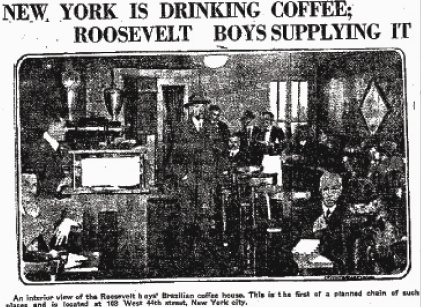
This is a little potted history of it…
“Members of the family of the late Colonel Roosevelt began to promote a Brazil coffee-house enterprise in New York in 1919. It was first called Cafe Paulista, but it is now known as the Double R coffee house, or Club of South America, with a Brazil branch in the 40’s [this is Lovecraft’s 112 West Fortyfourth Street haunt] and an Argentine branch on Lexington Avenue. Coffee is made and served in Brazilian style; that is, full city roast, pulverized grind, filtration made; service, black or with hot milk. Sandwiches, cakes, and crullers are also to be had.” — William Harrison Ukers, All About Coffee (1922).
“Upon entering the long narrow shop, a patron saw portraits’ of Voltaire and Shakespeare on opposite sides of the room. The walls were decorated with green and gold wallpaper containing a Brazilian bamboo plant design. The room contained 30 small oak tables and matching chairs with a large oak counter in the center where freshly ground coffee was made.” — The Rough Writer, Volume 9, Issue 3
It seems to have lasted about ten years under the first owners, and seems to have been set up to take advantage of Prohibition. It sold coffee, postum (a sort of decaf coffee substitute before decaf), pastries and cakes, sandwiches, and offered “a daily Brazilian dish”. It seems the manager was Brazilian.
There were “Expansion plans of Double-R Coffee House” (New York Times, 1923) which presumably meant the new Lexington Av. branch, but the venue was sold in 1928 (Tea and Coffee Trade Journal, 1928) to a Mr. and Mrs. Zivko Magdich — at which time the New York Times described it as a…
“gathering place for aspiring playwrights, actors, artists and musicians.”
The letters of George Kirk are a little more explicit on its artistic nature. It seems that, at least part of the week, the Double-R Coffee House served as a discreet queer meeting place…
“If you had been longer in NYC you’d know that there are many boys and many girls both male and female. My dear Double-R is claimed to be a hangout for these half and halfers.” — George Kirk, Letter of 17th Feb 1925.
Lovecraft wrote a poem to the place…
Here may free souls forget the grind
Of busy hour and bustling crowd
And sparkling brightly mind to mind
Display their inmost dreams aloud
— extract from “On the Double-R Coffee House” (1st February 1925)
It was also rather smoky, since Lovecraft writes in the same poem…
Mids’t them I sit with smoke-try’d eyes
— “On the Double-R Coffee House” (1st February 1925)
He also talks in one of his letters of the… “nicotined atmosphere”.
The full poem is to be found in The Ancient Track: The Complete Poetical Works of H.P. Lovecraft. It somewhat contradicts his very sour view of the artists of Greenwich Village in the short story “He”, although the fact that the coffee shop was a queer meeting place may throw new light on the line in Lovecraft’s New York story “He” (1925)…
“… uncommunicative artists whose practices do not invite publicity or the light of day.”
The Greenwich Village quill of 1921 very briefly mentions the Double R, so it seems that it was ‘on the map’ of the Greenwich Village crowd at that time.

The Double R apparently had a post-closure ‘media ghost’, since it seems to have been recreated as a setting in the TV series Twin Peaks. I’ve never seen the series, so I don’t know how faithful it might have been to the original. Presumably it was a covert Lovecraft reference by the makers.