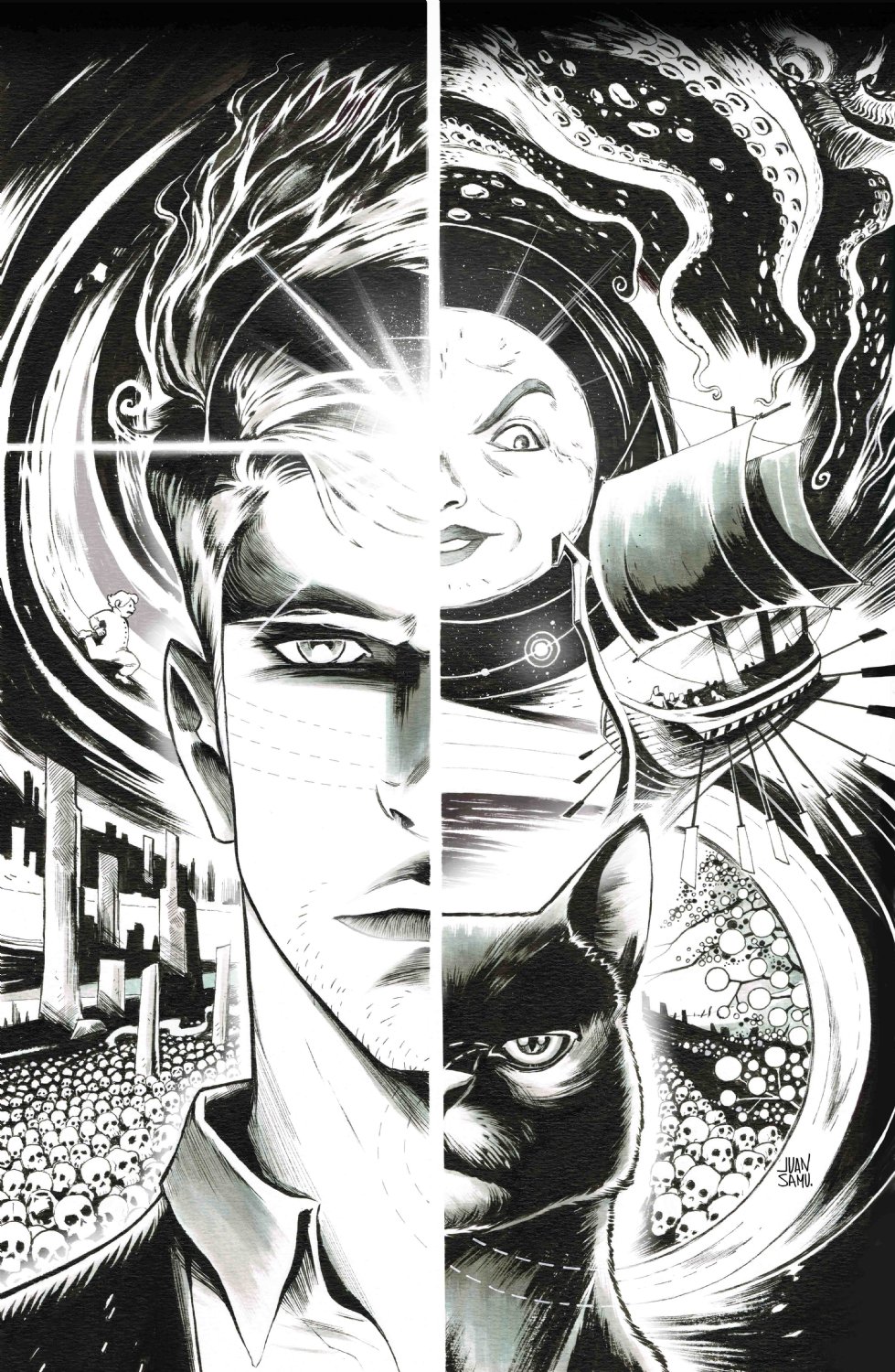
From Kadath, from Joshi

Comic Art For Sale has an original b&w variant splash-page by Juan Samu, from the recent Unknown Kadath series. John Carter, Ulthar cat, Dreamlands ship, tentacles, and side-hints of “Colour Out of Space” and “At the Mountains of Madness”. The ‘Little Nemo’ like figure appears in the comic.


Also relevant to a ‘Kittee Tuesday’ post, S.T. Joshi’s latest blog post has The Weird Cat anthology as publishing tomorrow…

The Weird Cat [is] still not officially published by Wordcrafts Press [but] its publication date is October 18.

He also notes, at the most recent Lovecraft Film Festival…

‘H.P. Loves Cats’, directed by Gary Lobstein — a five-minute film devoted to HPL’s worship of his favourite species.

The Tentaculum

Now in its fourth issue and including non-fiction, The Tentaculum PDF magazine. The latest issue is available to $3 Patreon patrons. Then that issue become free, when the next appears.

Historical non-fiction so far, in the free PDFs:

#1 “The Life and Works of Sonia H. Greene”.

#2 “Edmond Hamilton: Parallel Lovecraftian” [With the convention picture ‘Edmond Hamilton holding pulps’ via the University of California].

#3 “The Hogbens: Atom Age Appalachians” [surveys Henry Kuttner’s ‘Hogben’ tales of a family of weird mutant hillbillies. With an excellent photo ‘Gauer and Bloch with C.L. Moore and Henry Kuttner’ via the Wisconsin Historical Society].


I’ve tickled the b&w Hamilton picture with a few AIs and some Photoshop…

Edmond Hamilton at NyCon 3 (1967) holding British pulp magazines containing his stories. AI enhanced.

Gou Tanabe’s Dreamlands

Acclaimed graphic novelist Gou Tanabe is set to publish the first episodes of his latest Lovecraft graphic novel. He’s tackling the “Short Stories from the Dreamlands”. First as a series which will be published as usual in Kadokawa’s Monthly Comic Beam magazine, which seems to be sort of Japanese version of the old Heavy Metal magazine. His first episode will be in Japanese in the November 2023 edition, and then the series will be ongoing.

Fairly soon after series completion there should be a fat Japanese trade paperback (his graphic novels are long). If past form is anything to go by, it will then appear in French, then Italian, and (after a grindingly long wait, likely of two years) finally in English. Which raises the perennial question… why is English publication of desirable Japanese or French/Belgian graphic novels so slow? And very often, not done at all?

Anyway, Tanabe’s earlier “Shadow Over Innsmouth” completed its serial run in March 2021. It should be officially published in English at the end of November 2023 and is pre-ordering now.

Tanabe’s “The Dunwich Horror” was completed in May 2023, so I guess we can expect that book in English perhaps at Halloween 2025. The new “Dreamlands” will perhaps complete in May 2024, for an English single-volume publication at Halloween 2026?

Letters to Wilfred B. Talman – the fifth set of notes

Letters to Wilfred B. Talman – the fifth set of notes.

Here’s my fifth set of notes on the book of Lovecraft’s Letters to Wilfred B. Talman and Helen V. and Genevieve Sully (2019). These notes cover letters from the end of July 1932 through March 1934. Lovecraft is still writing to Talman, at this point in the book.

p. 211. Lovecraft gives more details about the passenger shipping from Providence to Newport…

the Mount Hope and the all-year-round mail ship Sagamore. The latter has come down to 50 cents for the round trip to Newport and back [and gives the passenger 6.5 hours in Newport, due to a later return-time]. Accordingly I have been three times and intended to repeat…

Thus the 1898 Sagamore was a “mail ship”, which tells us a bit more about her. She began the Providence – Newport Block Island run toward the end of her life in 1928, and is not to be confused with the Lake George ship Sagamore.

The problem with the later return is that the two-hour trip was colder than on the larger Mount Hope. But the fare was the main attraction. The Sagamore fare sometimes went as low as 15-cents for a day’s round-trip, but the passenger had to put up with what Lovecraft called “freight and cattle”. Thus she was sometimes a cattle boat as well as a mail boat. Also, the Sagamore was smaller and thus had more vibration, as Lovecraft said… “the vibration will play the devil with my penmanship” and between this and the cold he could not easily write on board.

p. 211. Confirming what I had thought, Lovecraft states clearly… “Block Island, which I have never seen”. Thus a prime and well-photographed local tourist-trap had never been visited. So far as I’m aware, it never was. Despite the Sagamore being able to take him there.

p. 212. “Went over to see C.M. Eddy Jr. last night — first time in ages”. This tells us that the broken friendship was at least partially renewed by the end of July 1932. And properly so, by a home visit rather than Eddy’s attendance at a Providence gang meeting. Presumably Muriel was also there, and perhaps their children would have also been around the place early in a long summer evening. Lovecraft gives no address for the Eddys, but this was likely at the address I found recently…

the Ghost Stories magazine for April 1929 printed a letter from Muriel Eddy from her address of “317 Plain Street”, Providence. [… this was] in Lower South Providence and about a half-mile from [Lovecraft’s local used bookseller] ‘Uncle’ Eddy and his family at 100 Gallup Street.

The place still stands today as a neat wooden house of the type typical of Providence, and in a neighbourhood that now appears to be gentrifying.

p. 215. Lovecraft’s overview essay “Fairyland” essay was researched and written at speed for the personal benefit of a correspondent (Talman) during a very busy time. It is referred to here on p. 215 (September 1932), and printed as an appendix ‘Some Backgrounds of Fairyland’ on p. 489.

p. 215. Belknap Long was then selling off his library, seemingly all of it. He had become a vocal socialist by this point in the Great Depression, though I don’t recall he was volunteering at Hell’s Kitchen soup-kitchens as a result. Perhaps the fire-sale was to ‘raise money for the cause’, though?

p. 217. Lovecraft reveals he has acquired a new feline friend… “at the house on the corner near the letter-box” used for his posting of letters. He is still living at Barnes Street at this date, so this may help identify the “letter-box” Lovecraft used for mail at that time. It would have been located quite near to a corner. Though I don’t think that posting-boxes show up on old street maps of Providence.

p. 220. In October 1932, the greatest letter-writer of the 20th century estimates he has “50 to 75 correspondents” on the go.

p. 224-25. Talman had written a Dreamlands tale titled “The Heads of Gyrwy”. It’s not printed in the book, so is presumably lost. It depicted “the decayed huts of the Gyrwians still remaining in the time of Dwerga”, Dwerga being a place over which “an atmosphere of menace” hangs. According to Lovecraft he (Lovecraft) pictured this place as on “the upper reaches of the River Skai” and “just out of sight of Hatheg-Kla”, but the story obviously involves Dwerga being erased from the Dreamlands, presumably by the “Heads of Gyrwy”. Lovecraft imagines that when he visits it in his dreams it will be marked only by a marker … “rock [with] the tale writ thereon in a tongue to which no key exists outside certain hints in the dreaded Necronomicon“.

p. 228. “Good old [Arthur] Leeds is back [in New York City] and as a Coney Island barker”. Coney Island was the large and famous site of amusement parks, arcades and sideshows. A “barker “was the “roll up, roll up, see the two-headed man!” front-man who enticed people in to see a substantial attraction. Leeds was known to have worked a great deal with travelling circus and freak-show entertainers, as a straight ‘front-man’, so it was likely a freak show. Lovecraft’s letter was February 1933, so presumably Leeds had been hired to start in the spring and work through the new 1933 summer season. At this time Lovecraft had “not set eyes on him for five solid years”, implying that he and Leeds had last met circa January 1928. But they corresponded.

p. 228-29. His initial description of his new residence at 66 College Street, with drawings.

p. 238. In October 1933 he makes pictures of 66 College Street, having “dragged out my 1907 #2 Brownie” box camera.

p. 241. He discusses punctuation, especially the comma. He finds…

… the minuter details are largely trivial, custom-generated, & subject to diverse usage. No two people punctuate alike. […] the exact context aught to determine the insertion or absence of commas. Hard and fast blanket rules are never applicable to matters like [the one you cite]. […] All one need do is to try to be uniform […] I believe that punctuation aught to mark vocal and rhetorical pauses as well as purely logical divisions […] It is a mistake to regard punctuation as anything but a surface adjunct to language. […] It has nothing to do with grammar, but is merely a convenient device for clarifying the meaning of written language.

p. 242. In a discussion on the use of “Esq.” for names, Lovecraft notes his Providence tailor is a “Harry Steiner”.

p. 245. In early March 1934 and Lovecraft stated that the temperature outside No. 66 College Street was “17 degrees below [zero]”. His old place at Barnes Street had some heating fitted, late in Lovecraft’s tenure there. But the abundant steam-heat being pumped into No. 66 (from the adjacent John Hay Library) may well have helped prolong his life, given such deep sub-zero winter temperatures. I haven’t studied the matter in detail but I get the impression that the weather of the later 1920s/30s was far more turbulent than today, and involved more extremes of winter cold and summer heat.

p. 246. Lovecraft had however ventured through the “beastly weather”, going along the hill to visit the R.I. School of Design. There he had seen exhibitions of Egyptian and Etruscan tomb paintings, North Staffordshire pottery from England, and a “rather notable” show of Hispanic paintings.

p. 246. He states he is reading “Count de Prorok’s account of his Carthaginian excavations”. Born in 1896 and thus a near contemporary of Lovecraft, the Count Byron De Prorok excavated Carthage from 1920 to 1925. He became more and more one of the several ‘Indiana Jones like’ figures of the 1930s. Lovecraft was reading his book Digging for lost African gods; the record of five years archaeological excavation in North Africa (1926).

p. 247. He states he has just read Machen’s new book, The Green Round (1933). This was Machen’s final novel. A man visits the western parts of Wales and there enters a mysterious and apparently natural grassy hollow. He comes away with more than he expected, and brings it back to the metropolis. Lovecraft found the work “extremely interesting — with some very potent reflections on that persistent sense of unreal worlds impinging”. While it had the fault of “rambling diffuseness” and is “hardly one of Machen’s greatest”, he says “I’m vastly glad to have read it”. I note that the novel’s initial set-up sounds like it may have a similarity to the initial set-up of the Barrow Downs sequence, which happens early in The Lord of the Rings.

p. 248. Lovecraft has been to a local Providence cinema with Brobst. They saw the movie The Ghoul (1933) with Boris Karloff. Lovecraft passes no extended judgement, but only states tepidly that… “Some of the atmospheric effects weren’t bad”.


New book: To Worlds Unknown

Hippocampus has two new books listed as forthcoming for October 2023. One is To Worlds Unknown: The Letters of Clark Ashton Smith, Donald Wandrei, Howard Wandrei, and R.H. Barlow, being…

The joint correspondence of four titans of the Lovecraft Circle [which] sheds fascinating light on the complex interplay of the personal and professional lives of these writers, artists, editors, and collectors. […] H.P. Lovecraft is a focal point of discussion in all the correspondence.

The other book is Interplanetaries: The Complete Interplanetary Tales of Clark Ashton Smith. In just over 300 pages, for $20.

‘Mapping Randolph Carter’

A new dissertation for CEFET-MG in Brazil, Cartografando Randolph Carter: entre monstruosidades e a busca onirica pela desconhecida Kadath (2023) (‘Mapping Randolph Carter: moving between monstrosities in a dreamlike search for unknown Kadath’). Open access, with an English abstract. The author sees the Dream-Quest through the lens of Deleuze & Guattari and…

aims to map the work The Dream-Quest [via Carter in relation to] its monstrosities, as aesthetic figures, [and these are found to illuminate an aspect] of Deleuze and Guattari’s philosophy

“the purring friendliness was unabated”

It’s 2023 and how and why cats purr is still a scientific mystery. They’re channelling cosmic star-winds from the Dreamlands, is my guess.

Meanwhile, a new article in the Catalan newspaper Vila on “Lovecraft pentinant gats”, partly spurred by the fact that…

the text of H.P. Lovecraft’s “Cats and Dogs” is now published by Males Herbes in Catalan, with a translation and short introduction by Javier Calvo.

I assume this is new, and the translation doesn’t seem to have been linked before on Tentaclii.

Rare Books School

Sounding like something from Harry Potter, the U.S. state of Virginia has a Rare Book School. Their Scholarship and Fellowship applications are now open. Deadline: 1st November 2023.

I’m not sure they’d be interested in a Necronomicon hunter. But they might be curious about someone interested in the genuine rarities in the field of modern SF / fantasy / horror books, a topic which might also touch on rare books in relation to bibliophiles and collectors, fandom and fannish lore/memory.

Some tips for using AIMP for audiobooks

A few tips for audiobook playlists and bookmarking with newer version of the free AIMP audio player. A great player, but the UI is somewhat convoluted for most people — and post-2021 changes made it even more convoluted in key places.

1. Add the playlist files by drag-and-drop, and save the playlist, as you would in any audio player. Saving a playlist is done in AIMP by right-clicking in the sidebar and then “Send to other playlist” | “To New playlist”. Clunky and roundabout, but it works.

2. Many audiobooks then need a pause added between .MP3 tracks, if the tracks are chapterised. Otherwise the end of one chapter gabbles straight into the start of another without any pause. This pause can be manually set in the AIMP settings. Here’s how it’s done…

3000ms = a 3 second pause, added between each .MP3 track.

3. Bookmarking. Since the 2021 changes this is impossible for a newbie to find in the UI, and it’s almost impossible to discover how to do it from the official site/forum. Few users would think to right-click in the waveform itself as it’s playing, but that’s how it’s now done in newer versions of AIMP…

Easy, but only if you know how. The added bookmark will then show up in the list on the Bookmarks tab. Double-clicking the bookmark only starts the track at the beginning. Right-clicking and “Play selected files” starts it at the actual bookmark timestamp.

4. Finally, a security tip. If you already installed libwebp.dll in the AIMP program folder (C:\Program Files\AIMP), so as to get WebP image format support for cover artwork, then Google’s recent massive WebP security car-crash means you’ll need to replace the old .dll with the new safe libwebp.dll 1.3.2.

Into Battle!

Regular readers will know I enjoy the occasional copy of Commando, and comic art in general. So I was pleased to hear about the exhibition Into Battle! The Art of British War Comics. Open now and running until 30th April 2024, at the Soldiers Museum near Oxford in the UK. The location is about seven miles north of Oxford, a town which is well served by train services.

The history of British war comics through the archives of classic comic titles such as War Picture Library and Battle Action. These men’s comics have been publishing continuously in Britain for over 130 years.

They remain a viable popular ‘pocket-money priced’ genre, even in the face of piracy and a multitude of other entertainment time-sinks such as videogames and sprawling TV series. As evidenced by the ongoing Commando series.

The exhibition has original art and appears to be free entry. It could be combined with another free museum in Oxford itself. Though 30 minutes of searching reveals an unappealing bunch of possible combinatory options in the town for autumn / fall 2023. Unless perhaps an exhibition on ‘colour in the Victorian period’ interests. However, note that right next door to the museum is Blenheim Palace which has a “blockbuster” Icons of British Fashion exhibition opening on 23rd March 2024. There’s a month’s overlap there with Into Battle!. If you also had an overnight stay, then the Into Battle! / Icons of British Fashion combo could be combined with ‘doing the Ashmolean’ the next day and perhaps also an evening peep at some of the Tolkien sites. However, that would be springtime, so you’d need to book things well in advance and also anticipate the likely pre-election ramping up of the train strikes.


Meanwhile, in New York City, a “small” exhibition titled ‘The Museum and Laboratory of the Jewish Comics Experience’ opens 9th October 2023 and runs until the end of 2023. The Center for Jewish History in Manhattan survey the history of Jewish comics and the Jewish creators of many of the most iconic American comic-book characters like Spider-Man, The Fantastic Four and more. Along with comics-creation workshops and a cosplay booth, which sound like they’re aimed at under-16s.

Unpublished cover for the famous Amazing Fantasy #15 (first Spider-Man)…