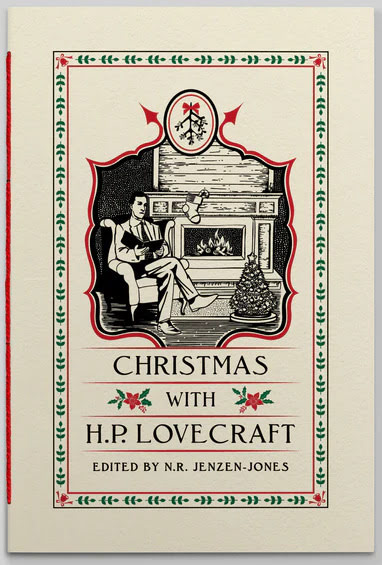
New at the HPLHS Store, the gift book Christmas with H.P. Lovecraft. Sadly not a themed selection from the letters. Rather it… “primarily comprises Lovecraft’s published and unpublished poems which deal with Christmas, winter, the solstice, and related themes.” Plus “The Festival”. A 48-page limited edition of 500 copies.
Here, however, is one of the ‘Christmas’ letters…
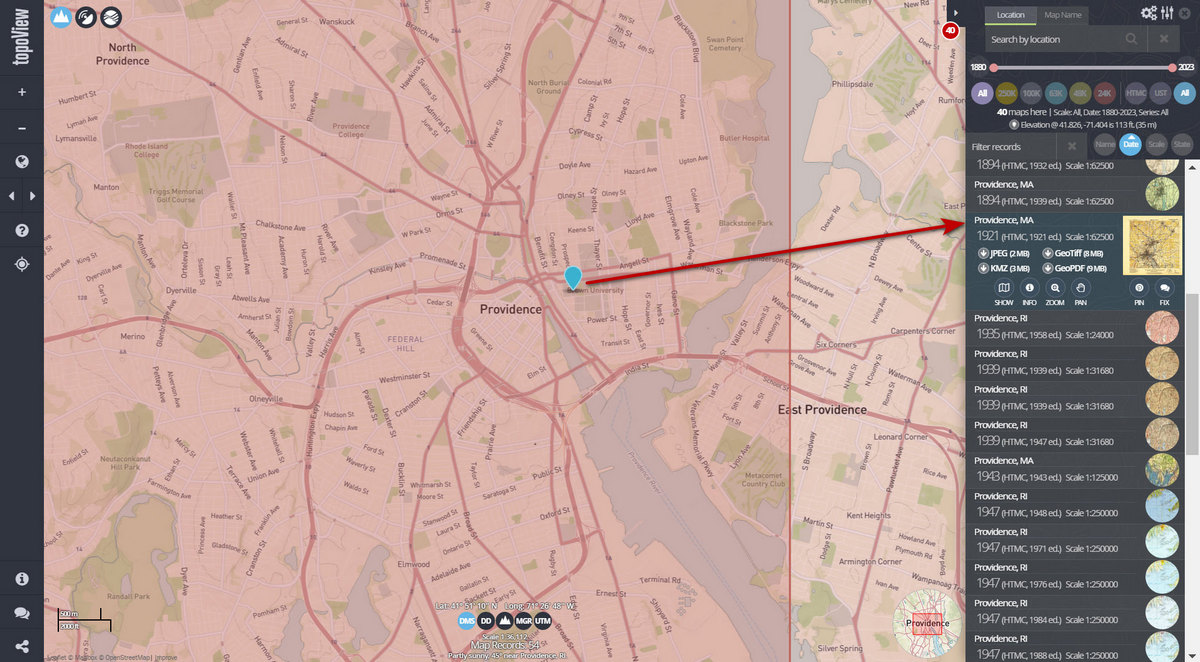
[December 1934] “My aunt & I had an exceptionally pleasant Christmas, & I hope the same is true of yourself. We had a tree for the first time in over a quarter of a century. All our old-time tree ornaments were long ago dispersed; but I laid in a new & inexpensive stock at Woolworth’s & Kresge’s [1] — tinsel star & rope, globular baubles, set of lights, stand, & abundant shreds of tinsel to hang from the branches like the Spanish moss of the far south. The result was really delightful & impressive, & I’ve spent considerable time admiring & gloating. We had numerous though inexpensive presents — my best one from my aunt being a picture of the oldest house in Providence (the Stephen Hopkins house — 1742 only a block & a half from our door), drawn by a local artist & simply framed. We began the day most auspiciously by listening to the great British Empire broadcast — which I hope you did not miss. Etheric conversations between London & the uttermost reaches of our [Empire’s] Dominions — Australia, Tasmania, Canada, India, South Africa, & so on — with other area sages from Scotland, Ireland, Liverpool, & a country place in the Cotswolds … & finally an address by the King. I don’t know when I’ve ever had a greater imaginative stimulus. [2] After it was over I turned face down the dollar bill that was tied on top of one of my gifts …… I couldn’t bear to see the features of one who was instrumental in the cruel tearing of these colonies from the Empire in whose fabrick they rightly belong!
Later in the day came a turkey feast at the boarding-house across the back garden (home of the late [cat] Sam Perkins), a general unveiling of gifts, & a session of conversation & contemplation by candlelight & tree-light. At the boarding-house Mrs. Spotty (little Sam Perkins’s mother) received a catnip mouse as a Christmas gift, & seemed very well pleased with that traditional feline delicacy. I couldn’t locate any of the members of the Kappa Alpha Tau [his local shed-top cat ‘club’] — the weather being inauspicious for sessions atop fence & clubhouse — but trust they all partook of ample Yuletide cheer. Well — unless something goes wrong, the New York convention season will open Monday morning — the last day of 1934. Barlow hit the metropolis Christmas Day, & is staying at a rather luxurious hotel in 102nd St. which Long found for him. His tastes in lodging are so sumptuous & sybaritical that he couldn’t get about the country as cheaply as I do!”
[1] “Kresge’s”:

“S.S. KRESGE’s 10c STORE”, Westminster Street, Providence. Note what might be an “American Cheese” sign.
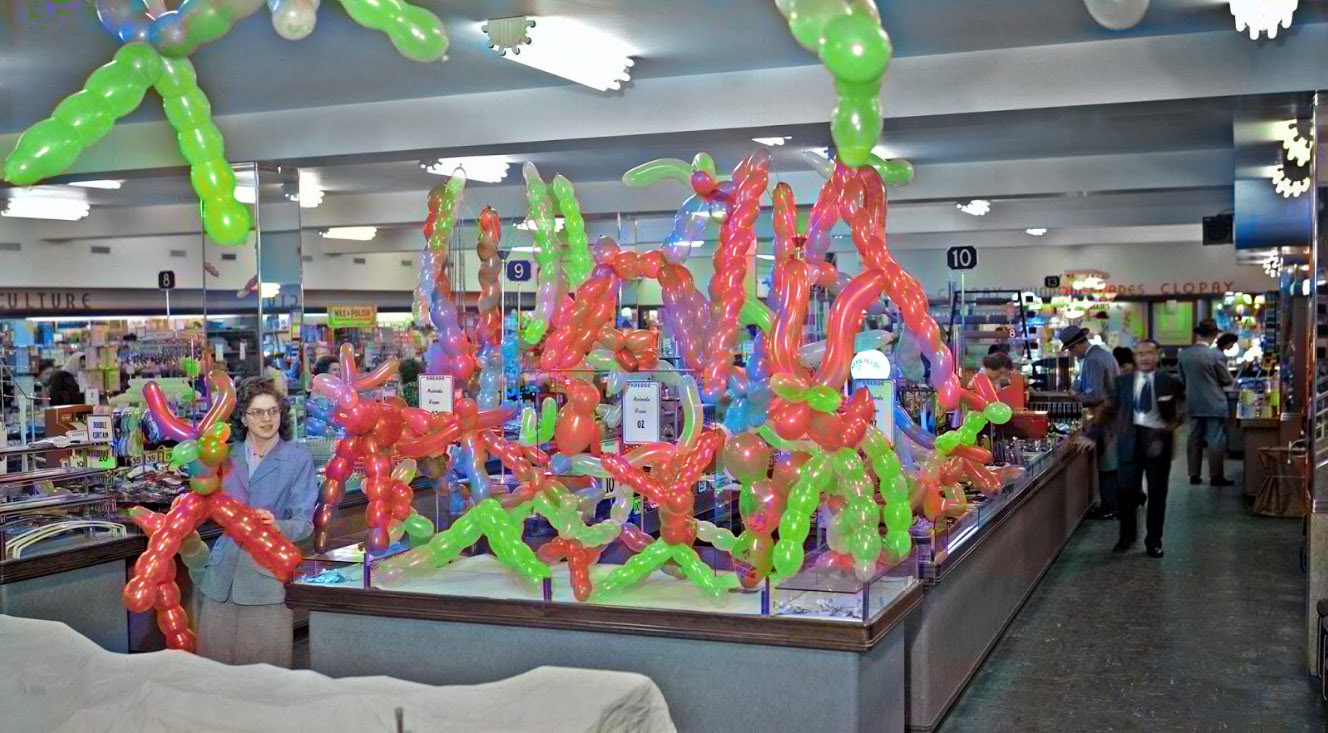
Typical Kresge’s interior, with tentacular balloons, 1948. Later became KMart.
[2] The Empire broadcast:
Live, the hour was an intricately coordinated triumph of radio engineering and clear evidence of the new medium’s global reach. The British Empire then still ruled a quarter of the world’s people, thus Lovecraft’s fond cry of “God Save the King!” was no vapid archaism.