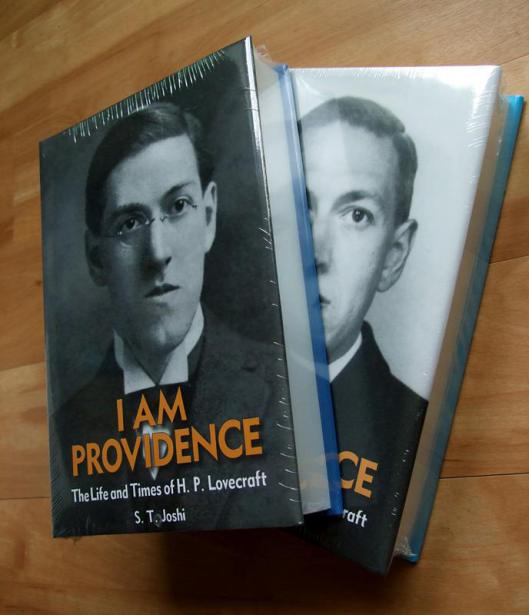
Wilum Pugmire reports that the paperback edition of S.T. Joshi’s magnificent I Am Providence: The Life and Times of H.P. Lovecraft should be available soon.

04 Tuesday Sep 2012
Posted in New books
Wilum Pugmire reports that the paperback edition of S.T. Joshi’s magnificent I Am Providence: The Life and Times of H.P. Lovecraft should be available soon.
03 Monday Sep 2012
Posted in Historical context, Podcasts etc.
A fascinating BBC Radio 4 history programme, The Discovery of the English Land (listen online) has much to interest those looking into the antiquarian/topographical tradition of the curiously perambulating English literary gentleman, a tradition in which Lovecraft was steeped.
03 Monday Sep 2012
Posted in Scholarly works
Some final extra-dimensional summonings for the Open Lovecraft page…
* Luciana Martinez (2009), “En busca del lenguaje del horror: H.P. Lovecraft segun Alberto Breccia”, Extravio: revista electronica de literatura comparada, 4, 2009. (In Spanish, English abstract: “analyzes Alberto Breccia’s transpositions of the H.P. Lovecraft’s Cthulhu mythos in the 1970s”).
* Keira McKenzie (2009), “Triggering Time’s Trapdoor”, online at inter-disciplinary.net. (On the nature of Lovecraft’s monsters).
* Ben Woodard (2011), “A Nature to Pulp the Stoutest Philosopher: towards a Lovecraftian philosophy of nature”, Incognitum Hactenus: art, philosophy, horror, Vol.1, No.1, 2011.
02 Sunday Sep 2012
Posted in Lovecraftian arts
Jeff VanderMeer has a lengthy new post arguing against the shadow that Lovecraft’s towering presence casts across contemporary weird fiction. There are a few good points made, especially on how interest in Lovecraft can help rekindle interest in neglected weird writers.
But it seems to me that VanderMeer’s article is a little stuck in the ‘scarcity mindset’ of the old print culture, and also the 20th century vanguardist idea of ‘forward progress’ in taste and techniques. In the age of the abundant Web, the Kindle/POD ecosystem, and our new hybridizing remix cultures, I’d say there’s ample space to develop audiences and vehicles for all sorts of varieties of ‘the weird’ in fiction — and beyond. If one’s favorite magazine no longer appears to cater for one’s precise political or aesthetic tastes, then start another that does.
Personally I’m looking forward to the liberation of short stories from their old prisons in magazines and forest-devouring mega-anthologies, via an Instapaper or Spotify -like re-bundling and delivery service. Perhaps that will come via a service that offers a free quality ‘audio book reading’ to authors and rights holders, on condition that the resulting audio story is distributed via the new service.
02 Sunday Sep 2012
Posted in Scholarly works
Three more for the Open Lovecraft listings page…
* Jose Carlos Gil (2010), “Poe and Lovecraft: interior and cosmic terror”, Revista Anglo-Saxonica, Vol.3, No.1, 2010. (Portugese journal, but article is in English. This is a special Poe issue of Revista Anglo-Saxonica.)
* Roberto Garcia Alvarez (2010), “La masoneria en la obra de H.P. Lovecraft”, Masoneria y Literatura, Vol.1, No.4, July 2010. (On freemasonry in the work of H.P. Lovecraft. In Spanish).
* Jose Carlos Gil (2009), “H.P. Lovecraft: im icone da cultura ocidental contemporanea”, BANG! revista de literatura e fantasyico, No.6. February 2009. (In Portugese, explores the importance of Lovecraft for western culture, and specifically for Portugese culture. Continues in BANG! 7 and BANG! 9).
01 Saturday Sep 2012
Posted in Scholarly works
Additions to the Open Lovecraft page…
* Thomas B. Whitbread (2005), “Samuel Loveman: poet of Eros and Thanatos”, The Fossil, Vol.101, No.4, July 2005.
* Kwzia L’Engle de Figueiredo Heye (2003), “Weird fiction and the unholy glee of H.P. Lovecraft”. (Masters disseration for the Universidade Federal de Santa Catarina, Brazil, online from July 2012. In English. Asks if the concept of weird fiction can be classified simply as a sub-genre of horror, or if it constitutes a genre of its own).
* Bobbi Sinha-Morey (2007), “Fungi: the Poetry of H.P. Lovecraft”, Calenture, Vol.2, No.2, January 2007. (The H.P. Lovecraft special issue).
* Phillip A. Ellis (2007), “The Construction of Race in the Early Poetry of H.P. Lovecraft”, Calenture, Vol.2, No.2, January 2007. (The H.P. Lovecraft special issue).
* Anon. (2008), “The Fungi from Yuggoth: a Concordance”, Calenture, Vol.3, No.3, May 2008.
* Frank Coffmann (2006), “H.P. Lovecraft and the Fungi from Yuggoth Sonnets (part one)”, Calenture, Vol.2, No.1, September 2006.
* Pino Lasone (2007), “Asenath and Leucothea: female figures from the sea of literary fiction”, Calenture, Vol.2, No.3, May 2007.
* Af Simon Hesselager Johansen (2011), “Tilstedevaeren ved Vanviddets Bjerge: Martin Heidegger, H.P. Lovecraft og mellemkrigstidens elitære konservatisme”, Tanken: studieblad for filosfi, No.4, 2011 (Short article in Danish, title translates as something like “On the Folly of Climbing Mountains: Martin Heidegger, H.P. Lovecraft and interwar elitist conservatism).
* James L. Aevermann (2009), “The Destruction of the Hero: an examination of the hero’s purpose in Lovecraft’s works”, IN: Huppert (Ed.), Where Fear Lurks: Perspectives on Fear, Horror and Terror, Inter-Disciplinary Press, 2009.
31 Friday Aug 2012
Posted in Scholarly works
Added to the Open Lovecraft page…
* Ben Woodard (2010), “Thinking Against Nature: nature, ideation, and realism between Lovecraft and Schelling”, Speculations journal, No.1, pp.47-65.
* The journal Antartes: prospettive antimoderne, No.00, 2011. (Special Lovecraft issue, in Italian only).
* Cecile Cristofari (2012), “Le temps du reve lovecraftien, ou l’elaboration d’un temps du mythe”, e-lla, May 2012. (In French. In the online journal of the University of Provence, France. Title translates as: “The dreamtime Lovecraft, or a development from the times of myth”. Essay tests the application of the Australian Aboriginal idea of ‘the dreamtime’ to key Lovecraft stories).
* Tomi Vatanen (2010), “Tuntemattomiem Kaahujen Tutkijat: maailmankuva H.P. Lovecraftin novelleissa” (Title translates as “The Unknown Terrors of Researchers: the worldview of H.P. Lovecraft’s stories”. In Finnish. Appears to be a Masters dissertation from Finland).
31 Friday Aug 2012
Posted in Lovecraftian arts, Podcasts etc.
The Atlanta Radio Theater Company has announced three live performances of Lovecraft…

31 Friday Aug 2012
Posted in Lovecraftian arts
Puffed Shoggoths, Lovecraftian artzine/book due for premiere at the Toronto Comics Arts Festival 2013.

30 Thursday Aug 2012
Posted in Scholarly works
A thesis, newly deposited online:
Rodolfo Munoz Casado (2000), Los mitos de Cthulhu como movimiento literario, Ph.D. thesis. Madrid, deposited online 2012. In Spanish.
“analyses the so-called Cthulhu Mythos as a true literary movement […] the Cthulhu Mythos fiction has a fundamental unity and a prominence within a literary genre, and it is not commercial work to be considered as lower in quality or importance.”
30 Thursday Aug 2012
Posted in Scholarly works
New addition to the Open Lovecraft page…
* Hannah Spencer (2011), “Semantic Prosody in Literary Analysis: a corpus based stylistic study of H.P. Lovecraft’s stories”, Masters dissertation, University of Huddersfield, UK.
“uncovers linguistic aspects of Lovecraft’s stories that could not be detected intuitively, and provides a firm basis for some subjective literary assumptions.”
28 Tuesday Aug 2012
Posted in Historical context, New discoveries
An amusing little bit of additional evidence, re: my recent essay that uncovers a key source for “The Rats in the Walls”. ‘Viscount Ratcliff’ was one of the titles belonging to Dilston, and Ratcliffe was the family name of James Ratcliffe, Earl of Derwentwater…

— from William Berr’s Encyclopaedia heraldica or complete dictionary of heraldry, Volume 2 (1828)

— from Stephen Whatley’s England’s Gazetteer (1751)

— from Thomas Rose’s Westmorland, Cumberland, Durham, and Northumberland (1832)
There is also a tantalising note from Notes and Queries of 1914, perhaps relevant to the idea of some long-absent descendant coming to claim Exham Priory, but I am unable to get more…
“the following extracts from The Times and contemporary journals:— ” Great excitement was caused at Hexham and the western parts of Northumberland on Tuesday by a lady who claims to be a descendant of Ratcliffe … The lady first appeared upon the scene … in 1865, and a year or so later took possession of Dilston more or … to be a descendant of Ratcliffe, the last Earl of Derwentwater, taking possession of Dilston Castle, about three miles from Hexham, and claiming all the estates once belonging to that unfortunate [Earl]”