
$30 vinyl wall decals, to Lovecraftify your living space.

02 Saturday Feb 2013
Posted in Lovecraftian arts
$30 vinyl wall decals, to Lovecraftify your living space.
02 Saturday Feb 2013
Posted in Odd scratchings
I’ve never seen any evidence that Lovecraft saw or read this work, but the 1922 book Mazes and Labyrinths: A General Account of their History and Developments might have tickled his imagination, if he had picked it up in the Providence library or encountered it later in the libraries of New York. It has two opening chapters on the Egyptian forms, and a closing one on mazes in literature. It’s available to read online…

26 Saturday Jan 2013
Posted in Scholarly works
Added to the Open Lovecraft page…
* G. Warlock Vance (2010), “Dread and portent : reading H.P. Lovecraft’s Necronomicon as social commentary”, PhD thesis, University of North Carolina at Greensboro, 2010.
* Oluwatoyin Vincent Adepoju (2012), “”Aquatic Ancestry” by Kingsley Nnabuagha and the fiction of Howard Phillips Lovecraft : a study in imaginative convergence”. Part of the Compcros library run by Oluwatoyin Vincent Adepoju.
* Henrik Boe Ueland (2010), “Frykten som litteraer erfaring : Grenseerfaring og transgresjon i H.P. Lovecraft’s forfatterskap”. Masters dissertation, University of Bergen, 2010. In Nowegian, with English summary. (“Fear as a Literary Experience : borders and transgression in the fiction of H.P. Lovecraft”).
23 Wednesday Jan 2013
Posted in Lovecraftian arts
del Toro is to have another go at getting a major studio to put up the money for the filming of At the Mountains of Madness…
“I’m going to try it one more time. Once more into the dark abyss,” he laughed. “We’re gonna do a big presentation of the project again at the start of the year and see if any [studio’s] interested.” And yes, Tom Cruise is still game to be on board if they can find a home for it. “Yeah, Tom is still attached. I think it would be so fantastic to make it with him. He’s been such a great ally of the project.”
21 Monday Jan 2013
Posted in Podcasts etc.
A BBC Radio 3 mini-documentary, on how John Dee has been portrayed in culture (MP3 link).
12 Saturday Jan 2013
Posted in Scholarly works
New additions to my Open Lovecraft page…
* Cecile Colin (2012), “La maison hantee dans l’oeuvre de H.P. Lovecraft: l’homme, la mort, l’univers”, Transatlantica, 1, 2012. (In French. Part of the crime pulps special issue of Transatlantica. Title in English: “The Haunted House in the work of H.P. Lovecraft: man, death, and the universe”. Freely available mid Dec – mid Jan 2013, but since redacted? A link to the corrupted PDF is included here, in the hope the error is simply technical in nature).
* Rachel Mizsei Ward (2010), “Plushies, My Little Cthulhu and Chibithulu : The Transformation of H.P. Lovecraft’s Cthulhu from Horrific Body to Cute Body”. Presented at Cine Excess IV: International Conference on Cult Film Traditions, Brunel University (UK), April 2010.
* Didier Kahn (2005), “La question de la palingenesie, de Paracelse a H.P. Lovecraft en passant par Joseph Du Chesne, Agrippa d’Aubigne et quelques autres, Journee Francois Secret : Les Muses Secretes : Kabbale, alchimie et litterature a la Renaissance, Verona Italy, 2005. (In French. English title: “The question of palingenesis [i.e., reincarnation, and] Paracelsus in H.P. Lovecraft…” Summary at HAL: “In this short history of early modern palingenesis [western beliefs in reincarnation] experiences, we discuss in depth the conceptions of Paracelsus and Joseph Du Chesne before turning to the literary fortune of palingenesis, notably in Agrippa d’Aubigne’s Les Tragiques, but also in a work by H.P. Lovecraft inspired by the seventeenth-century alchemist Pierre Borel.”).
12 Saturday Jan 2013
Posted in New books
Interesting new essay on Lovecraft, sadly imprisoned in an $80 academic book…
Brantley L. Bryant, “H.P. Lovecraft’s “Unnamable” Middle Ages”, in: Daniel T. Kline (ed.), Medieval Afterlives in Popular Culture (New Middle Ages)
“examines the hidden influence of the medieval world on H.P. Lovecraft. […] While researching for the essay, Bryant read extensively through Lovecraft’s published criticism and correspondence to find medieval “afterlives” in the work of an author not usually connected with the Middle Ages.”
10 Thursday Jan 2013
Posted in Scholarly works
Independent scholars might like to know about the new expanded free public access to JSTOR. Now offering free access to 1,200 humanities titles (nothing much directly relevant to Lovecraft, I looked), as well as to all pre-1923 journals (more likely to be of interest to Lovecraftians).
10 Thursday Jan 2013
A new interview with Lovecraft, transcribed from a single postcard!
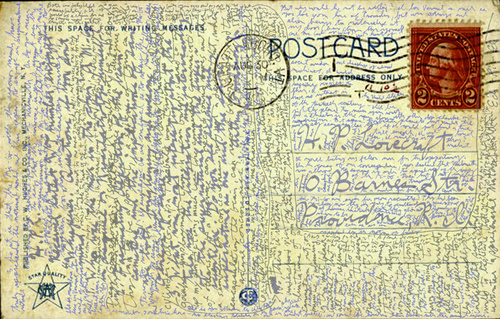
Part of the new Lovecraft edition of The Revelator.
So now we know, H.P. Lovecraft invented Mail Art as well as everything else 😉
09 Wednesday Jan 2013
Posted in New books, Scholarly works
New issue of the reviews journal Dead Reckonings ($7.50, paper only), with what seems(?) to be a non-review essay: “The Weird Scholar” by S.T. Joshi. Or perhaps it’s his listing of noted (but not reviewed) items?
03 Thursday Jan 2013
Posted in New books, Scholarly works
Excellent news for Lovecraft scholars. S.T. Joshi writes that he is assembling his…
“collected essays on Lovecraft, to be published by Hippocampus Press no earlier than 2014. [ … many rarities and] The book will be distressingly large, but will probably not extend to two volumes.”
Keyword-searchable digital version, too, please!
02 Wednesday Jan 2013
Posted in Historical context, New discoveries
While browsing the Economist‘s Xmas issue I came across an unlikely-but-excellent article on Hell. Thanks to this article I also found a nugget that sounds very similar to the ending of At The Mountains of Madness…
“The Trojan hero Aeneas in Virgil’s Aeneid toured Hades [Hell], with difficulty enough, and [while there] he merely glanced towards Tartarus [the prison of the defeated gods], glimpsing a high cliff with a castle below it surrounded by a torrent of flame. That single sighting fixed him to the spot in terror.”
Very similar to Danforth’s final backward glance (in which he presumably glimpses Kadath), I thought. As far as I can tell, no-one’s spotted this possible source before. It suggests there may be further links between the Aeneid and Mountains.