Hippocampus has dated and priced the collected essays of Steven J. Mariconda, H.P. Lovecraft: Art, Artifact, and Reality. $20, July 2013.


11 Tuesday Jun 2013
Posted in New books
Hippocampus has dated and priced the collected essays of Steven J. Mariconda, H.P. Lovecraft: Art, Artifact, and Reality. $20, July 2013.
10 Monday Jun 2013
Posted in Historical context, Maps
Map of parks and green spaces in Providence that Lovecraft could have known in his boyhood. Providence magazine. v.28, 1916. Map showing situation on City ownership of parks in 1903. Omits the unofficial spaces such as the remains of Cat Swamp.

10 Monday Jun 2013
Posted in Historical context
Pleasant places in Rhode Island, and how to reach them, a book from the Providence journal, 1893.

10 Monday Jun 2013
Posted in Historical context
I’m looking for an old press article, “Blackstone Park – An Unspoiled Beauty Spot”, Providence Journal, August 4, 1912, sec.5, p.3. Does anyone have a copy I could see?
09 Sunday Jun 2013
Posted in Historical context
A full composite of Adams’ Synchronological Chart of Universal History (1881), which Lovecraft used as a child and which he kept in later life.

Lovecraft called it, in a letter about how he learned as a child, … “a marvellously graphic historic device called “Adams’ Synchronological Chart” — which I still have” (Lord of a Visible World, p.20). Elsewhere it is termed…
A huge and impressive twenty-three foot long chart showing 5,885 years of history, from 4004 B.C. to 1881 A.D. First issued in 1871, Adams put out several editions in many formats.
09 Sunday Jun 2013
Posted in Odd scratchings
The early Hegel specialist James Hutchinson Sterling, in 1865, famously describing Hegel’s thought in Lovecraftian terms…
“Shall I be able to conduct you through this vast Cyclopean edifice this huge structure this enormous pile this vast mass that resembles nothing which has yet appeared in France or England or the world? One of those vast palaces, it is, of Oriental dream, gigantic, endless court upon court, chamber on chamber, terrace on terrace, built of materials from the east and the west and the north and the south marble and gold and jasper and amethyst and ruby, old prophets asleep with signet rings guarded by monsters winged and unwinged, footed and footless, there out in the void desert, separated from the world of man by endless days and nights, and eternally recurrent and repeating solitudes, lonely, mysterious, inexplicable, a giant dreamland, but still barbaric, incoherent, barren!”
08 Saturday Jun 2013
Posted in Scholarly works
New June 2013 issue of the radical philosophy journal Speculations: a journal of speculative realism. Free as a PDF.

07 Friday Jun 2013
Posted in Historical context, Maps
Here’s a hi-res composited version of the map sheets from Plat Book of the City of Providence Rhode Island, 1918, which I’ve centered on 66 College Street, Lovecraft’s last address. 66 is set back from College St., and actually sits halfway between College St and Waterman St. S.T. Joshi says in I Am Providence that the tiny alley leading back to 66 from College St. was once called Ely’s Lane. The “Paxton” just north on Waterman was the boarding house where Lovecraft sometimes had his meals.
Update: The Paxton was the ‘Arsdale’ by Lovecraft’s time. Later the “old Arsdale” at 53-55 Waterman Street became the “Hopkins House” dormitory for boys in 1946, when there was a sudden and pressing need to accommodate vast numbers of students returning from the Second World War. My thanks to Schultz and Faig for the additional information.
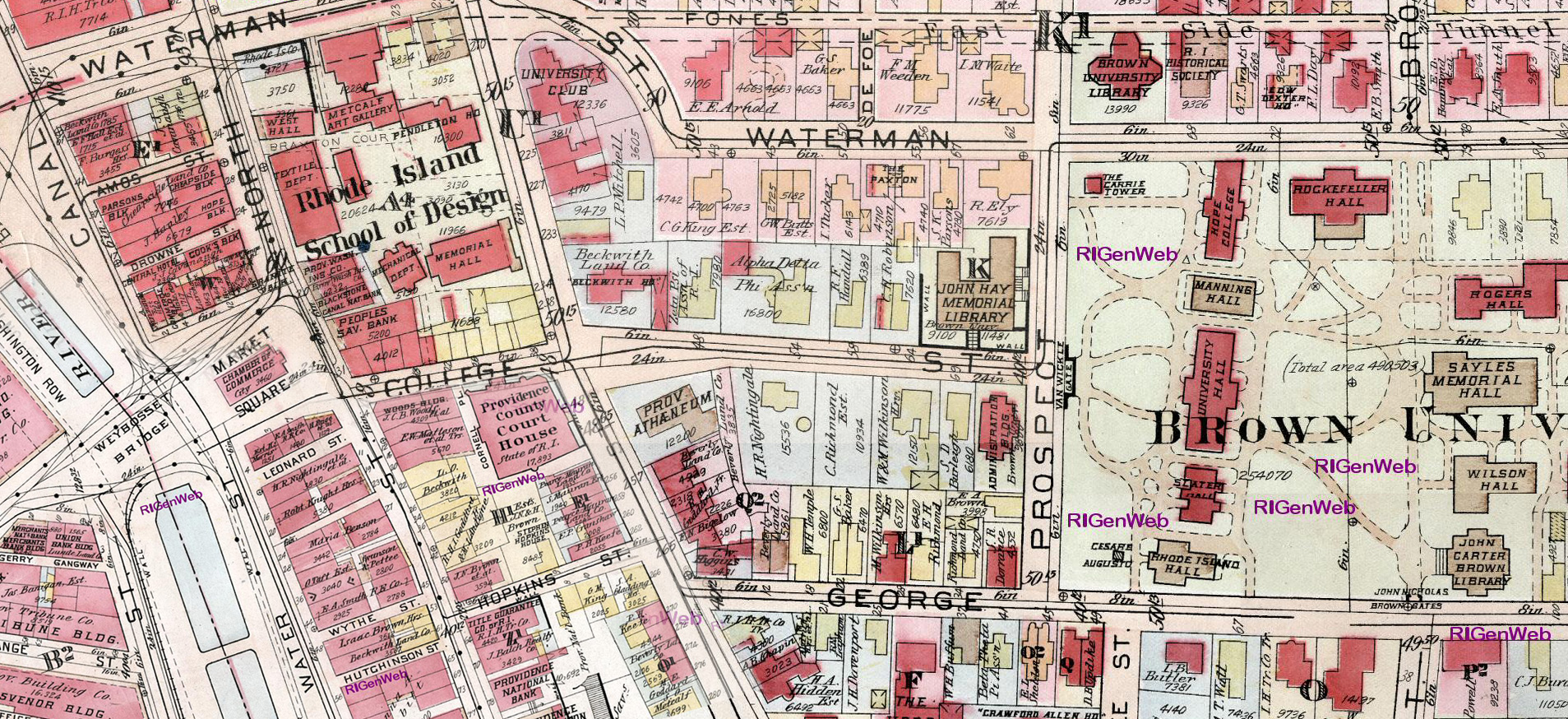
Above: (No.66 detail from Plat Book of the City of Providence Rhode Island, 1918)
Lovecraft’s desk window looked west from the upper floor, and in the other corner he had a seat looking through two paired windows (one facing west and another south). So his desk would have been looking at the back parts of the Alpha Delta Phi (Brunonian chapter) fraternity house at Brown. This appears in “The Haunter of the Dark” as: “Students in the Psi Delta house, whose upper rear windows looked into Blake’s study, noticed the blurred white face…”
Missing picture
Above: Alpha Delta Phi fraternity house. You can see how the curved frontage section corresponds with the map. Lovecraft’s home out of sight directly behind the fraternity house. In the left of his view from his two west windows he would have seen the NE upper windows of the short wing at the back of the fraternity house.
The house has now been moved. Thanks to Andrew Kuchling for the photo (below) of the site of 66 College Street, as it is now. The western view from about 15 ft. above the roof of that little extension of the List Art Building (seen here) would give an approximate indication of the main view from Lovecraft’s study desk. One would need to point the camera so that the Psi Delta house windows are on the far left of the picture being taken and the roof of their little low square building is in the left quarter of the picture.
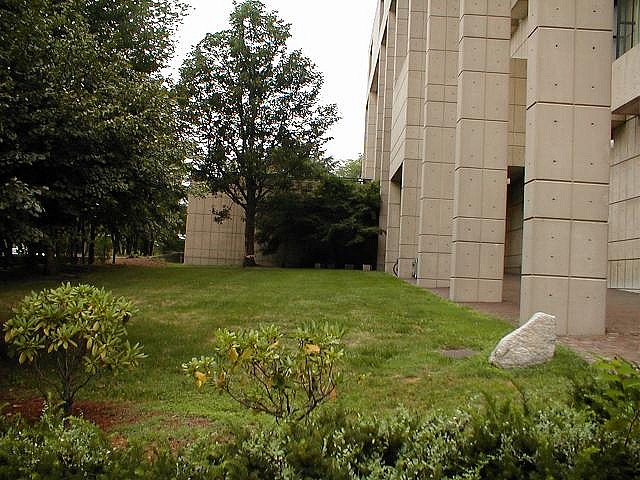
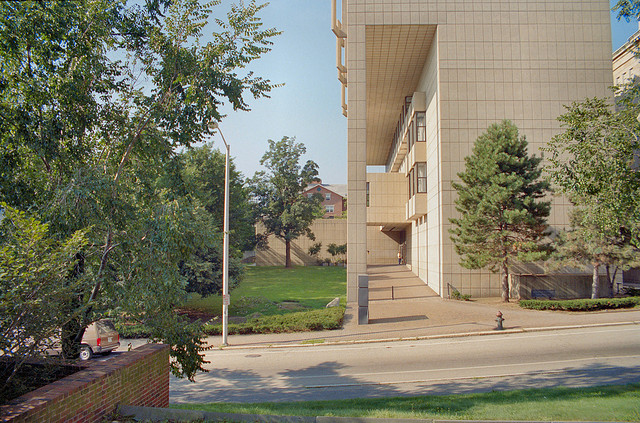
You can see the location in relation to the road in this picture by Will Hart…
Sadly it now appears there are trees in the way of Lovecraft’s old view, as you can see in this picture by Will Hart …
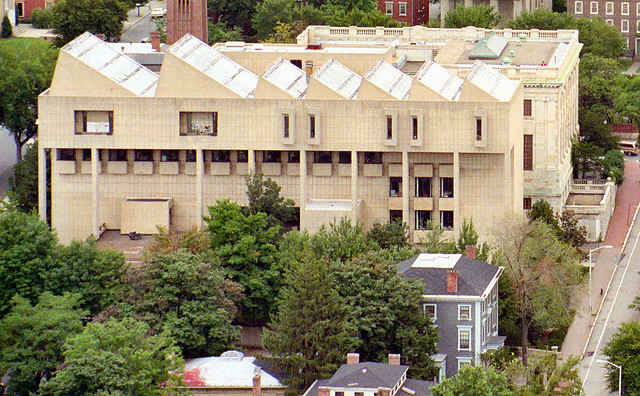
Remote-controlled hover-drone with HD camera needed, I’d say, to hover just to the left of the top of the central bright green tree in the above photo Alternatively one of the building windows might do it. Keep in mind you’re facing west, so avoid late afternoons and sunsets or you might have difficulties with photographing straight into the sun. A clear bright winter morning might be best, when the leaves are off the trees.
07 Friday Jun 2013
Posted in Historical context, Maps
Very large scale public-domain boundary maps of Providence, scanned from the Plat Book of the City of Providence Rhode Island, 1918. There’s an Overview of sections…

…and hi-res scans of the plates of each section. 160ft to the inch, giving incredible amounts of detail (and also the names of the owner of each house plot) of the streets of Providence.
Presumably surveyed during the First World War, Lovecraft then about age 26 or 27. Compare with the 1891 Survey map to see how the area north of Lovecraft’s home was built up from the 1890s to 1918.
07 Friday Jun 2013
Posted in Historical context
Update: this essay has been hugely expanded and footnoted, and is now available in my new book Lovecraft in Historical Context: fourth collection.
05 Wednesday Jun 2013
Posted in Historical context, New discoveries
The building next to the Fleur de Lys Studios in Providence? Lovecraft’s uncle Franklin C. Clark appears to have owned it between 1873-1884. It’s the Deacon Edward Taylor house at 9 Thomas Street.

05 Wednesday Jun 2013
Posted in Historical context
Franklin Chase Clark, “A Contribution to the Study of Medicine“, Detroit Medical Journal, October 1877, Vol. 2. No.10. A long learned article from Lovecraft’s uncle (the nice one), on the emergence of medicine from the well of superstition…
“In an old medical work, published in London as long ago as 1711, and used as a vade mecum by students and practitioners generally, is the following prescription for the cure of stone. I give in its original spelling and crudeness :
“Take Blood of a Goat, four or five Pound ; the urine of a healthy young Lad and of a Goat, of each five or six Pints ; Wood-Lice, bruised, three pints ; Seeds of Parsley, Commin, Juniper Berries and black Radish Roots, of each four ounces ; Winter Cherries, number sixty or seventy; Herb arsemart. Parsley, Leaves of Birch, Rue and Burdock, of each two Handfulls ; Juice of Birch, Arsemart, Fenil and Wild Tansey, of each one Pint ; digest these together in a warm Place for four or five days. Then distil and draw off a Gallon or five Quarts, which keep close topped for use. Of this Liquor give two ounces with the like Quantity of good White Wine, every Morning, Noon and Night.”
This remarkable prescription without doubt, produced some, if not the desired, effect.”
He also touches for a page on alchemy, in an article on the history of antiseptics in early medicine.
In The Narragansett Historical Register (1888) he had an article “The Dubertus Caught” that went to quite some lengths to track down the mysterious Dubertus, a giant fish mentioned in whaling records.
In the Biliotheca Sacra journal (1908), he has a historical article “The Rise of the Toleration Movement”, tracing the rise of religious toleration.

