Added to Open Lovecraft

* Jason Carney (2014), The Shadow Modernism of Weird Tales: Experimental Pulp Fiction in the Age of Modernist Reflection (Ph.D thesis for Case Western. Explores the extent to which the best writing in Weird Tales aligns with the canonical accounts of modernism, as given by the early theorists of the movement. The most ambitious of the Weird Tales authors wove new modernist approaches into conventional realism, and thus discovered ways to make ordinary phenomena seem weird)

* Jeffrey Michael Renye (2013), Panic on the British Borderlands: The Great God Pan, Victorian Sexuality, and Sacred Space in the Works of Arthur Machen (Ph.D thesis for Temple University, Philadelphia. Identifies Lovecraft as the first critical writer on Machen)

* Eleanor Toland (2014), “And Did Those Hooves: Pan and the Edwardians” (Masters dissertation for the University of Wellington, NZ. Surveys the curiously British mythos that various authors together evolved around Pan in Edwardian Britain. Sees the Pan mythos as ending with the advent of the First World War, and does not consider the later reception of the Pan stories or the example they gave of the rapid development of a new mythos from many hands)

169 Clinton Street sold for $3m

New interior photos of 169 Clinton Street, at the edge of the former slum of Red Hook, New York City. Sold recently for an amazingly cheap $3m (cheap by London standards, and given the size of the place). The interior is now changed, although Lovecraft might have actually found the ersatz-historical rooms (shown in the sale photos) to his 18th century taste. More interesting to Lovecraftians might be the complete floor-plan.

225x300169 Clinton St., 2014. Judging by the elevation this could even be Lovecraft’s first-floor room. If so, it looks like the owners tried to ‘exorcise’ Lovecraft by reaching back to the earlier history of the house.

169floorplanPlan: 169 Clinton St.

From 31st Dec 1924 H.P. Lovecraft had a $40-a-month (later $10 a week) first-floor apartment there in the north-west corner, with “two alcoves—one for dressing and the other for washing” (S.T. Joshi, A Dreamer and a Visionary, p.211). This room is the 15′ x 16′ front room on what is marked as the “Third Floor” on the above plan (it seems the lowest ‘Garden’ floor on the plan is what was formerly the sculleries/basement area?). He did not have the modern left-hand cupboard-bedroom (added later?), but had access to the small alcove and its walk-in-closet at the rear of the room. His own sketch plan of his room’s layout can be found near the front of I Am Providence.

He made the “shabby-genteel” place as homely as he could, following the lead of Everett McNeil who was his mentor in living-with-poverty in New York. The room hosted some of the meetings of the Kalem Club. But it appears that the whole place was basically fraying into being a slum, and what he thought was “shabby-genteel” was really a “dismal hovel”. It was under-heated and under-repaired, infested with bedbugs and mice, and (according to L. Sprague de Camp) “he found to his horror that he had Orientals as housemates”. Presumably he also had the daytime noise from the street as he tried to sleep (he was often out much of the night with the boys), since his room was directly over the street: there would have been less traffic in the mid 1920s, but probably noisier when it appeared, and there was also much more street life and children playing-out. Lovecraft was one night burgled by youths who had rented the adjacent room, and they stole his best suits and overcoat and Loveman’s $100 radio.

In that room he wrote “The Horror at Red Hook” and “Cool Air”, the complete plot of “The Call of Cthulhu”, the 1925 Diary, typed “He”, and wrote many letters…

“Something unwholesome—something furtive—something vast lying subterrenely in obnoxious slumber—that was the soul of 169 Clinton St. at the edge of Red Hook, and in my great northwest corner room.” (Lovecraft, Lord of a Visible World, p.167)

1925-169Picture: Lovecraft in front of 169 Clinton Street.

Lovecraft on the Web, linkrot purge

I’ve given the ‘Lovecraft on the Web’ directory its annual link check.

Fixed most moved links, unless it’s simply the case that someone has paid a vanity fee to remove the www. — http://www.site.com

Removed URLs (taken to Yuggoth by ye buzzing ones): Pulpfest/Pulpcon; Old Time Radio Horror; Miskatonic Archive; Mythos Books; Nemonymous; Lovecraft Scholars (Yahoo Group); Creeping List (Yahoo Group); Necropsy: The Review of Horror Fiction; Representations of Antarctica.

Atlanta Radio Theatre Company: Call of Cthulhu

Atlanta Radio Theatre Company report they have a new studio, and post an .mp3 sample to prove that “The Call of Cthulhu” radio adaptation is really on its way…

“It’s hard to believe that we started this production all the way back in 2010. Another casualty of our notoriously long production schedule – BUT! There is starlight at the end of the tunnel! The production is nearly finished and will certainly be released this year and we are excited about ARTC Studio, which should put an end to these interminably long wait times for new material from us.”

Loveman and Crane, and Lovecraft

From The letters of Hart Crane, 1916-1932 (1952)…

* Hart Crane [c. June 1922, still in Cleveland], on Lovecraft’s good friend Samuel Loveman…

     “You will like my classic, puritan, inhibited friend Sam Loveman who translates Baudelaire charmingly! It is hard to get him to do anything outside the imagination,—but he is charming and has just given me a most charming work on Greek Vases (made in Deutschland) in which satyrs with great erections prance to the ceremonies of Dionysios with all the fervour of de Gourmont’s descriptions of sexual sacrifice in Physique de L’Amour, which I am lately reading in trans. [translation]”

* Hart Crane [14th Sept 1924, from Brooklyn, NYC], on Samuel Loveman…

     “I have just come back from a breakfast with Sam [Loveman] […] I have been greeted so far mostly by his coat tails, so occupied has Sambo [Crane’s nickname for Loveman] been with numerous friends of his here ever since arriving; Miss Sonia Green and her piping-voiced husband, Howard Lovecraft (the man who visited Sam in Cleveland one summer when Galpin was also there) kept Sam traipsing around the slums and wharf streets until four this morning looking for Colonial specimens of architecture, and until Sam tells me he groaned with fatigue and begged for the subway! Well, Sam may have been improved before he left Cleveland, but skating around here has made him as hectic again as I ever remember him …”

* Hart Crane [23rd Sept 1924, from Brooklyn, NYC], Crane feeling hard-done-by and rather catty because Samuel Loveman now spends his time with Lovecraft…

     “Sam is still here, and sleeping in the back room. […] What his present plans are—I don’t know, as I have scarcely had a word with him since last Friday night. He doesn’t evidently think about spending much time with me. […] It is all right with me, because I realize that Sam touches life at very few points where I do, and this even comes into our abstract discussions of literature, quite naturally, of course, because I see literature as very closely related to life,—its essence, in fact. But for Sam, all art is a refuge away from life,—and as long as he scorns or fears life (as he does) he is witheld from just so much of the deeper content and value of books, pictures and music. He sometimes talks about them in terms as naive as an auctioneer would use. Yet he is instinctively so fine and generous that I will always love and pity him, however much my admiration is curtailed. I don’t think he will remain in New York much longer. He is really bound to his family more than we’ve ever realized, although I have thought of that a good deal. He must have the assurance of his mother’s attendance and he fancies that the “quiet” of Cleveland is a more normal environment for him. Well, if he feels that way, it’s so. Feeling, his own feeling, is the only scale there is to use in such a matter, and I shall not urge him to stay here against his will—which couldn’t be done anyway.”


Many years later…

     “Charles Hamilton, in his Great Forgers and Famous Fakes (1980, pp.198—99), wrote that Loveman “dabbled in forgery.” For instance, he had obtained a supply of bookplates from the late Hart Crane (whom Loveman claimed had been his homosexual lover) and pasted them in books Crane would have been likely to own. Hamilton added. “Nearly every catalogue that Loveman issued was tilled with fabulous ‘bargains’ — books signed by Melville, Mark Twain or Hawthorne — a whole galaxy of great authors. All priced at ten to twenty-five dollars each. The signatures were in pencil and were not, of course, genuine; but it was exciting to study his catalogue and pretend that such bargains really existed.” (Joe Nickell, Real or Fake: Studies in Authentication, University Press of Kentucky, 2009).

     “He [Loveman] had acquired, on the death of Hart Crane’s mother, her entire archive of her son’s letters, books, and papers, a lot that included a large supply of Crane’s unused bookplates. Well into the late 1960s Loveman was pasting these into otherwise valueless books, offering them as books from Hart Crane’s library. At least once, to my knowledge, he slipped up and put a bookplate into a book not published until after Crane’s death. As senility set in, Loveman got more and more careless about signing books, using ball-point pens for signatures of authors who had died before the ball-point pen was invented. His catalogs were an endless source of amusement to those familiar with his wares. To my mind, he reached the peak of his forging career when he offered, for a mere $50, a book on whaling “annotated in pencil by Herman Melville.” I’ve often wondered who bought this treasure.” (Robert A. Wilson, Modern Book Collecting: A Basic Guide to All Aspects of Book Collecting, 1980).

So far as I’m aware, he never produced Lovecraft fakes as well. Such a pity that he didn’t sell his Lovecraft letters, rather than burn them all, if he needed money that badly.

Gorham Silversmiths, 1906

Gorham Silversmiths, Providence, 1906 (Hat-tip: Shorpy). Gorham was one of the biggest local employers, and possible employer of H.P. Lovecraft’s father as a salesman. Although according to S.T. Joshi, the only evidence we have for that is Sonia’s hazy 1948 memories. One wonders if she might have been recalling a tale once told her by Lovecraft about his father’s cousin Frederick (1850-1893) a businessman in jewellery manufacturing in 1890s New York City, and her memory had conflated and confused the father/jewellery references with Gorham? On the other hand, it is possible that Lovecraft’s father had somehow got into the jewellery trade via Frederick.

gorham-providence-ri-q1906-shorpy

Open Letter on Studies in Weird Fiction

Bobby Dee has a new “An Open Letter on Studies in Weird Fiction” essay, at Wikithulhu. Including a useful discussion of what he calls “zombie ideas”, also known as received wisdom or outright myths, for example that ‘Lovecraft had syphilis’ or that he was ‘involved in the occult’.

He also suggests the need for a better framing and subtle contextualising of research questions, something which is all the more useful for those hefting a big axe they intend to grind on Lovecraft’s gravestone (‘Lovecraft was a racist, woman-hater, bad writer, disliked puppy dogs, etc’)…

“[on the ‘he hated women’ accusation]…how did Lovecraft’s depiction of women compare to those of his peers? Certainly Lovecraft handled women differently than Dashiell Hammet or Ernest Hemingway, but how does Lovecraft’s use of female characters stack up compared to Seabury Quinn [the star name of Weird Tales, at the time], or his fellow masters of the weird Robert E. Howard and Clark Ashton Smith? … [then it would] perhaps [be] worth retreading some [of that] old ground

I might have added an extra paragraph about the need to discover the wider historical context of one’s research question, and also to take into account a previous researcher’s apparent biases, most often inculcated by the historical era in which they were raised and trained. But sometimes also by their personal idiosyncrasies, such as L. Sprauge de Camp’s blockheaded inability to detect when Lovecraft was joking and joshing or running into self-parodic hyperbole in his letters, which was frequently.

As for “weird fiction” as a term, I can add that — contrary to opinion in the blathersphere and academia — Lovecraft did not purloin the term from Le Fanu.

Added to Open Lovecraft

* Alyssa Arbuckle (2014), “Considering “The Waste Land” for iPad and Weird Fiction as models for the public digital edition”, Digital Studies, 2014. (Compares “The Waste Land” for iPad with “the author’s own attempt at developing a digital literary application (Weird Fiction)”).

* Jose Eduardo Serrato Cordova (2013), “El imaginario gotico en dos autores Mexicanos: Emiliano Gonzalez y Ernesto de la Pena”, Revista Isla Flotante, Vol.V, No.5, 2013, pp.27-44. (In Spanish. Discusses… “the reception of the gothic in Mexico, via Emiliano Gonzalez and Ernesto de la Pena … The first of whom adapted for the Mexican reader the fantasy literature style of H.P. Lovecraft”).

* Fernando Dario Gonzalez Grueso (2007), “Buddai: el gigante dormido Australiano de Lovecraft”, Culturas Populares, No.4, 2007. (In Spanish. Compares the motifs and themes of certain folklore, with those employed by Lovecraft. Specific reference to “The Shadow Out of Time”, re: aboriginal oral legend and myths of the sleeping giant, frightening winds, the sinister moon, fields of stones, and ancient footprints once left by giants of the Dreamtime).

H.P. Lovecraft and the Providence Public Library

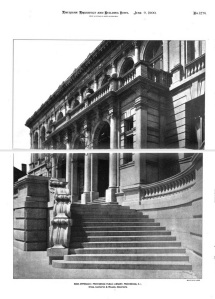
Providence Public Library, as Lovecraft would have known it…

From The American Architect and Building News, 9th June 1900:

Providence Public Library, complete interior floor plans, 1900 (PDF link). May not display properly in Firefox, but is fine in a normal PDF viewer. Best resolution yet found: at 400% one can just about read the lettered titles for each room).

2014-06-30_134427

2014-06-30_134409

CENTRAL-ORIGINAL BUILDING-Exterior-FRONT ENTRANCE (postcard) Postcard via the Providence Public Library website, indicating the colour of the entrance stonework.

* From The American Architect and Building News, 15th September 1900 (pictures were included in International Edition only, not in U.S. edition):
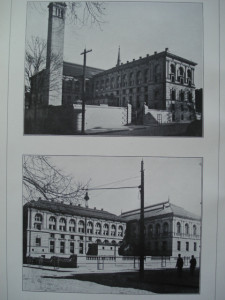
provlib-rear Rear views of the Providence Public Library, 1900.

For more historical pictures, see the Collection of Providence Public Library.


H. P. Lovecraft and the Providence Public Library

The Providence Public Library membership card records do not appear to have survived from the pre-1914 period, nor the postal mailing list for the monthly bulletin of new books. Yet it seems highly likely that the 9½ year-old H.P. Lovecraft would have joined the new Library as a child member before the grand opening in March 1900. He was probably already a member of the old library, but not to have had him join the new one might have been deemed a very snobbish social misstep on the part of his grandfather and family.

Based on this March 1900 photo and my research on it, my hunch is that Lovecraft (who seems to be third from the left) could have been a founder member of the Library League at the Children’s Library, helping to set the standards of behaviour — as would befit a bookish lad who was the grandson of one of the city’s most successful entrepreneurs and investors.
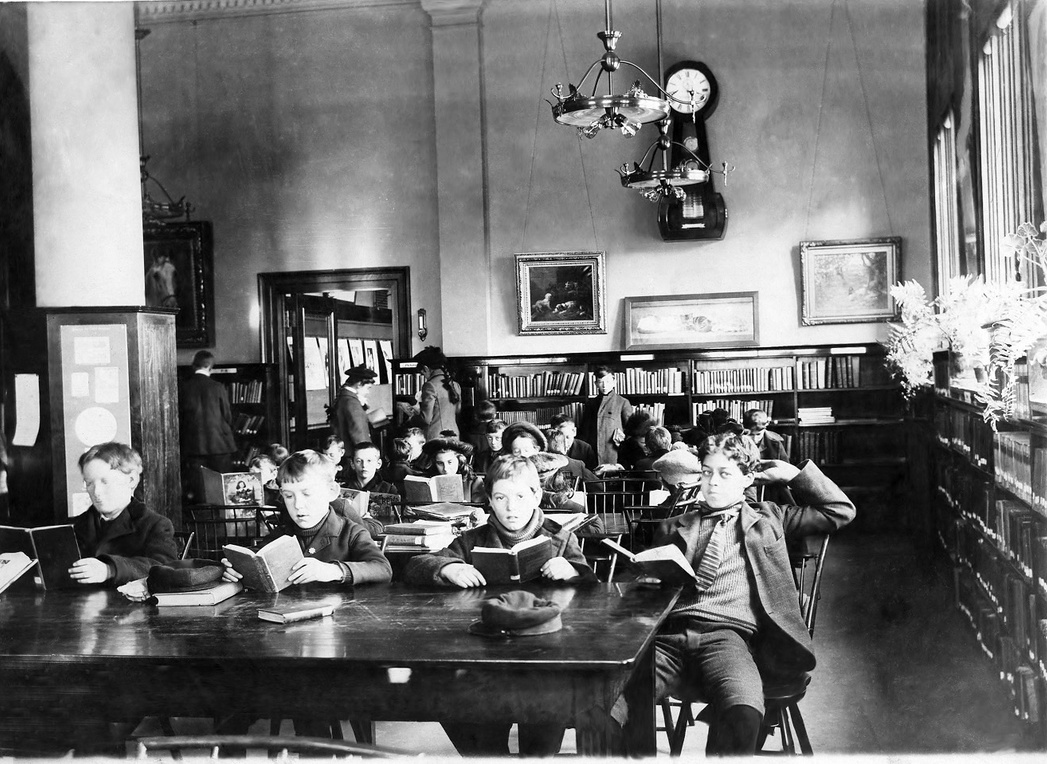
providence_public_library_1900Picture: Providence Public Library, March 1900. Photo by A. L. Bodwell, the picture taken to document the newly opened new Children’s Library and one of a series to be sent to the Paris World’s Fair. Picture is from the Collection of Providence Public Library.

Lovecraft did not attend school between 1899 and September 1902, and he seems to recall that he had sparse contact at that time with other children. At home he had several substantial and fine home libraries at his disposal. But the new Public Library would have had its enticements, as it evidently also provided exhibitions, summer trips and and lectures for its child Library League members, and so he might have visited when his variable health allowed. A particular enticement might have been the Library’s very large number of current periodicals, unavailable at home. Even from a young age, Lovecraft was always avid for magazines and newspapers. The library took, among many others: Inland Printer; National Geographic; Photo Era; Popular Science; Printing Art; New England Magazine; Punch; Saint Nicholas (popular quality children’s magazine); American Boy (popular boy’s magazine); Typographical Journal; and a handful of railroad magazines. Lovecraft was at this time also an avid fan of various popular adventure and detective fiction books that he probably could not find in his home libraries.

Lovecraft may have started using the adult sections from about age 12, August 1902, if not before. The Children’s Library section had evidently become extremely over-used by 1902, with the Annual Report suggesting some schools had informally offloaded their library responsibilities onto it. This overcrowding may have pushed Lovecraft into the adult sections, something seemingly permitted and even encouraged by the library, even if he had not already made the move. Possibly he was sometimes taken to the Library by his unmemorable private tutors, whom he seems to have suffered occasionally during 1903 and to March 1904.

But I would hazard an educated guess that it was probably from the early summer of 1904 that Lovecraft really began to properly use the adult sections of the Public Library. He was then aged nearly 14, and family calamity had recently and traumatically forced him to move to what he called a “skimpy flat” with his mother. I imagine it was quite pleasant to him to escape to the calm environs of the adult sections of the public library, rather than be shut up with his stifling mother, especially during the winter of 1904/05.

We then skip two years to find the earliest written documentation linking Lovecraft with the Providence Public Library: we have a letter from Lovecraft describing how he became very fond of a Cataloguing Room Messenger boy of his own age, Arthur J. Fredlund. Fredlund is listed as such in the Library’s 1905 Annual Report. Lovecraft later recalled the details for his friend Galpin…

I came across a superficially bright Swedish boy in the Public Library. He worked in the “stack” [Library storeroom for books] where the books were kept and invited him to the house to broaden his mentality (I was fifteen and he was about the same, though he was smaller and seemed younger.) I thought I had uncovered a mute inglorious Milton (he professed a great interest in my work), and despite maternal protest entertained him frequently in my library. I believed in equality then, and reproved him when he called my mother “Ma’am”. I said that a future scientist should not talk like a servant! But ere long he uncovered qualities which did not appeal to me, and I was forced to abandon him to his plebeian fate. I think the experience educated me more than it educated him — I have been more of a cynick since that time! He left the library (by request) and I never saw him more….” (21st August 1918, Letter to Alfred Galpin, Selected Letters I, p.70)

“I was fifteen” dates the start of this friendship to between August 1905 and July 1906, and strongly suggests Lovecraft was a card-carrying member of the Library at that time, and possibly even one who also had a card allowing him access to the “stacks”. The phrase “mute inglorious Milton” is from Gray’s famous poem “Elegy written in a Country Churchyard”, and the meaning is ‘an unregarded peasant genius’. So, by “mute” Lovecraft does not imply that Fredlund rarely spoke.

Lovecraft recalled in a letter that he had suffered a “nervous breakdown (winter ’05-’06)” (Lord of a Visible World, p.32), which must narrow the dates for the Fredlund friendship to Spring 1906 — Autumn 1906, since…

In the September 1906 issue of the Rhode Island Journal HPL [Lovecraft] states that his boyhood friend Arthur Fredlund had taken over as editor of the [his own] Scientific Gazette” (An H.P. Lovecraft Encyclopedia, p.232)

Fredlund produced no issues under Lovecraft’s guidance, and his name does not appear in the staff lists of the Library’s 1906 Annual Report. The nature of his damning “uncovered qualities” are unknown.

It appears that Lovecraft was still using the Public Library during the early 1910s, and was delving deep into the periodical archives. Citing a Lovecraft letter to Robert Bloch, S.T. Joshi places at circa 1911-13 the date at which Lovecraft…

…read the entire run of the Providence Gazette and Country-Journal (1762-1825) at the Providence Public Library” (S.T. Joshi, I Am Providence, p.135)

Within those dates Lovecraft also evidenced — to a R.I Senator, no less — a startlingly comprehensive knowledge of current political and legislative manoeuvrings, suggesting he was then a frequent visitor to the Library’s periodicals room.

In the absence of Library borrower membership records, the earliest surviving actual official text linking Lovecraft to the Public Library is a record in the 1915 Annual Report, in which the 24 or 25 year-old Lovecraft is noted as having that year donated three “numbers” to the library stock. Presumably these “numbers” were magazines or journal issues.

At some point he presumably discovered and comprehended the Library’s Alfred M. Williams Collection of Folk Lore, standing at a massive 1,909 volumes when catalogued in 1902, and very strong in Irish folklore. The name strikes me as being somewhat similar to Lovecraft’s fictional “Albert N. Wilmarth”, professor of literature and folk lore at Miskatonic University.

In a letter of August 1916 to Kleiner, Lovecraft states…

I intend to spend considerable time at the library searching out the various expressions and conventional proper names used by the classicists, both ancient and English.

Writing to Fritz Leiber about Shakespeare, Lovecraft remarks that he once read one of the bard’s plays…

in an early collection of the sort belonging to the public library.

When Lovecraft first discovered Lord Dunsany he wrote, in a December 1919 letter to Kleiner (Lord of a Visible World, p.71), that…

I have filed recommendations for all his works at the local publick library, and have met with favourable responses.

In a letter to Galpin of April 1920, Lovecraft notes… “I now have from the library both “What is Man?” and “The Mysterious Stranger” [both Mark Twain]”. Also in 1920, to Kleiner in September, he writes…

Saturday I went out for the first time since my journey, visiting the library & picking up an addition to mine own library at a bookstall on the way home. My new possession is entitled “Men & Manners of the Eighteenth Century,” & is by one Susan Hale — who seems to me to have more of industry than of genius.

Doubtless there are more examples of his mentioning the local library in the early letters, but I only have limited access to the letters.

In a letter of the mid 1920s Lovecraft revealed that he carried not only a regular Public Library card, but also a further card that would allow him to access the “stack”, meaning the books storeroom. He was then also well known to the head librarian… “good old William E. Foster”, who had steered the new Library through from its inception in 1900 and who was then still five years from retirement.

Haffner Press

New to me is Haffner Press. They’ve developed a substantial line of expensive limited-edition print reprints of vintage pulpsters, for collectors. Sadly they haven’t then followed through later with cheaper paper or ebook editions, with some of the volumes most interesting to Lovecraft fans now being out-of-print. Such as Terror in the House: The Early Kuttner, Volume One. And Manly Wade Wellman’s Complete John Thunstone, a sort of 1940s proto Doctor Strange. Wellman occasionally made passing homage references to the Lovecraft mythos in his work.

Thunstone2aComplete John Thunstone art, by Raymond Swanland.

Lovecraft and the Order of Bookfellows

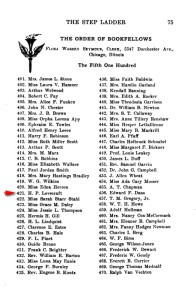
My thanks to Carsten Flaake for pointing out The Step ladder journal online, which lists H.P. Lovecraft as a member of the Order of Bookfellows. Flaake notes Lovecraft is in the membership lists for 1920 (p.75), as well as for 1921 (p.48). I note that Lovecraft is joined in his Bookfellows membership by his friends and correspondents Renshaw and Daas. Later editions of The Step ladder are unavailable online due to copyright, so Lovecraft’s continuing membership can’t be determined. As far as I can tell he doesn’t mention the Bookfellows in his letters. I can find no accessible scholarly source that has noted Lovecraft’s membership of the Bookfellows. Perhaps the recent collection of letters between Lovecraft and Renshaw might throw some light on how Lovecraft came to be a member of the Bookfellows?

bookfellows

bookfellows1921

The Bookfellows was a Chicago based literary society, seemingly devoted to poetry, book collecting, and the publishing of its members. It was established by the auditing accountant and poet George S. Seymour (1878-1945). It appears to have started to publish in 1919, with an address of 4917 Blackstone Avenue, Chicago. Seymour and his lawyer wife were avid collectors of materials and letters from “various political and royal figures in France” as well as “items from authors, scientists, American Presidents, politicians and other historical figures”, and they amassed a large collection of historic autographs and letters. They possibly also dabbled in Eastern mysticism…

“A reception at the twilight hour followed at Bookfellow Lodge, the center for the Order of Bookfellows, Mr. and Mrs. George S. Seymour being the hosts. Here the Swami [Paramananda] read from “The Vigil” and “Soul’s Secret Door,” and answered carefully…” (Message of the East, Vol.13, 1924. p.144)

The Bookfellows also published two or three books per year, and the May 1927 issue of The Step ladder was devoted to the poetry of Clark Ashton Smith (thanks to Scott Connors for this information).

The Order of Bookfellows reach seems to have been national, since it was elsewhere refered to as the “Nat’l Order of the bookfellows” and the 1920 and 1921 membership lists show a wide reach. Pearl K. Merritt — later to marry Lovecraft’s friend Morton — and her sister Ella were relatively early members.

Poetry from the journal was collected in the books The Poet’s Pack (1921, 500 copies — no Lovecraft included) and Songs From The Step Ladder (1927, 285 copies) and they issued A Bookfellow anthology from 1925 through 1936 (Lovecraft’s friend Frank Belknap Long was in the 1925 collection), and The Bookfellow poetry annual from c.1938 onwards. But presumably Lovecraft didn’t publish there, or else such titles would be in Joshi’s monumental Lovecraft Bibliography. My vague guess would then be that Lovecraft found his poetry was too antiquarian for The Step Ladder, and thus his hopes of finding an outlet for his cherished poetry were dashed — so he allowed his membership to lapse circa 1922? On the other hand, perhaps he hung on with his membership until penury came knocking, in the slim hope that he might one day get a small book published with them?

Lovecraft’s new library, 1900

Full details in the 1900 Annual Report of the Children’s Library in the Providence Public Library, at its opening in mid March 1900. It was on the second floor, had well over 4,000 volumes, open 10am-9pm and 2pm-9pm on Sundays. At the opening H. P. Lovecraft was aged nine and a half years, and no doubt revelling in his amazing new library…

“No portion of all the building has apparently given more pleasure to adult visitors, as well as to the young people themselves, than this attractive room with its growing plants in the windows, its open book-cases extending around the room, its choice photographs on the walls, its picture bulletins, its low tables, its flood of sunshine, and the smiling faces of the children themselves. On the shelves are 2,602 volumes of juvenile fiction, 1,941 volumes of non-fiction, and 175 volumes of juvenile periodicals, bound, making a total of 4,718 volumes. […] Two of the gratifying achievements of the year have been the reclassifying of the juvenile fiction, so as to give it an alphabetical arrangement, on the shelves, and the completion of a card-catalogue for the use of this room, with a low table, near by, on which to use the drawers. This catalogue, and the books of reference in the room, are by no means the only instructive and civilizing influences by which the children are affected. Habits of order inculcated in returning the books to the shelves; of neatness, in keeping hands and books spotlessly clean, and of taste, in making the acquaintance of the literary and art treasures which the library has to offer [the third floor offered a dedicated art library, and the main Lecture Room exhibitions on the second floor had opened with the inaugural “Photographs of Rome” exhibition, repeated there in October 1901] are of no little moment.”

“Personal contact of the child with the Children’s Librarian [Mrs. Mary E. Root, with Miss Lilla R. Burge in the evenings] has been the aim kept in view throughout, and it has been abundantly realized. The study of pictures, an hour of story-telling; an evening of lantern-slide pictures; a consultation in regard to summer trips; confidences in regard to the child’s own natural bent, as for instance, mechanical ingenuity, or amateur photography, are some of the phases of this admiral intimacy between the child and his library friend. […] The equipment and resources of the Children’s Library have repeatedly been put to practical use in connection with the teaching of nature, of literature, of history, of art, and of geography. The two-book system, already mentioned above, has been of constant service, in supplying an additional book for use in connection with school work. The Class Room, adjoining the Children’s Reading Room, has been utilised by teachers, with classes, for the study of such subjects as King Arthur, and has also been used for posting picture exhibits. The interest in this room, on the part of the public, has shown itself in repeated and most cordial gifts from those who have witnessed the plan of work in this room. […] One prime object of work in a [Class R]oom like this is to introduce the children to books which are not “children’s books.”

A footnote to this 1900 Annual Report is interesting, since Lovecraft was about to break into the adventurous phase of middle-childhood, and he became in his own words “a veritable bicycle centaur”, exploring for miles around on the bicycle…

“At the beginning of the summer [1900], a map of the vicinity of Providence, showing the routes favourable for cycling, trolley, or walking trip, together with about twenty views of attractive places in the vicinity, were posted in the Class Room.”

A few weeks later Lovecraft was given his first bicycle, on his tenth birthday. He cycled relatively short distances until 1908. Due to ill health he thereafter probably only cycled sporadically thereafter until 1913 when he gave it up entirely.

Additional details from Proceedings of the Montreal conference of the American Library Association, 1900, pp.63-64…

“Into this children’s library, with its 4000 books on open shelves, were turned loose on the opening day some two or three hundred children, who had never before had access to open shelves in this way. Their interest was intense…” [after an initial struggle to get the children to understand the need for accurate re-shelving…] “Often our boys are seen going to shelves and straightening out rows of books which some less careful child had displaced.” […] “We desire that these few pictures [shown] on the walls shall be old friends; and so we allow every League child to select his favourite from among them, in the shape of a “Perry picture,” [mass reproductions of art works as very cheap paper prints] which he may take home and mount, and thus have for his own. […] Not only have there been no disturbances or disorder, even on days when the rooms were crowded with almost twice as many children as there were accommodations for, but there has been only the very slightest tendency to disorder on any occasion.”

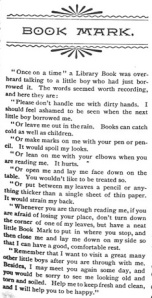
The Children’s Library issued the Maxton Bookmark with each book, which contained guidance on care for the book…

maxbook

Elsewhere in the 1900 Report (p.23) the account of the new 1900 library notes a “Library League”, on which the Montreal conference conference paper adds that this was for those children who were not yet grown to be “large boys or girls”. The League’s inaugural helper members were treated to an evening lantern slide show on Sept 12th 1900, although the subject of the slides shown is not given. Having established itself, the League later expanded to a membership of hundreds.

There was also The Short Story Club which had a lecture on “The Islands of the Pacific” on 27th December 1900, by a Mrs E.S. Colcleugh, who had evidently visited Tahiti and photographed there. One wonders if the young Lovecraft might have been a member of one or both of these clubs, since he was at that time both an avid book-hound and a budding short story writer.

Also noted (p.58) in the 1900 Report are details of the series of 1900 interior photographs, and who made them…

“A set of 20 photographs of the building, and its exterior and interior details, by Mr. A. L. Bodwell, was suitably mounted, and exhibited in the American Library Exhibit [presumably at the Montreal conference of the ALA, June 1900], at the Paris Exposition of 1900 [World’s Fair, April-November 1900], and afterwards at the Pan-American Exposition of 1901. Other views have been published and are for sale by the Providence Albertype Company and Abraham Mendenhall, Providence. Any of the above may be ordered through the library.”

So if I am correct in identifying the 9½ year old H.P. Lovecraft in an 1900 interior photograph, then the picture would have been made by a Mr. A. L. Bodwell and Lovecraft’s young face might once have been seen in Paris. The picture would then most likely have been taken mid to late March 1900, in the week or so after the new library opened, so as to be ready for shipping to the opening of the Paris Exposition in April.

The following 1901 Report noted of the Children’s Library…

“The larger of the two rooms, the Children’s Reading Room, has repeatedly been full, to overflowing. In such instances the overflow is, very naturally, into the next room,—the Class Room,— or into the Lecture Room, on the same floor. […] The habits of order and cleanliness which are so firmly and successfully inculcated in this department (and yet without in the least impairing the perfect spirit of freedom, everywhere manifest), are most impressive; and are undoubtedly closely connected with the fact that the “Library League” formed among the children themselves now numbers nearly 1,000. Some progress has been made towards facilitating the “graduation” of young readers from this department into the other departments of the library.”

By 1901 a Sarah E. Albro was the evening librarian at the Children’s Library, replaced by Harriet A. Tourtellot in 1903. The amount of users had necessitated the appointment of a day assistant to the Children’s Librarian, and by 1902 a further assistant was needed but not yet appointed. The 1901 Report also mentions a Library Art Club. 2,820 volumes were in the third-floor Art Library by 1902, one floor above the Children’s Library.

In 1902 Mrs. Mary E. Root, Children’s Librarian, gave a large number of lectures to its users on the methods of accessing and using any library. One presumes that the young Lovecraft attended one or more of these.

The 1902 Report mentions an Alfred M. Williams Collection of Folk Lore, then standing at a massive 1,909 volumes, and recently catalogued. The name strikes me as being somewhat similar to Lovecraft’s fictional “Albert N. Wilmarth”, professor of literature and folk lore at Miskatonic University. The Annual Report of 1922 confirms its ongoing presence there. Rhode Island Heritage has a biography online for Williams. It appears his collection was and is especially strong on Irish folklore. Williams’s books are scanned and on Hathi Trust, including The Poets and poetry of Ireland and Studies in folk-song and popular poetry.

The Library issued a public reading list on “Arctic exploration” in 4th October 1902, perhaps co-inciding with strong interest on the topic among the boys? Lovecraft was obsessed with polar exploration, but this interest pre-dated the 1902 list. And by 1902 he was newly entranced by the Antarctic, in preference to the Arctic.

So, all in all, it appears that from the vital years from 9½ to 12 Lovecraft had access to a really superb new local library, perhaps one of the finest the USA has ever seen. Not only that, but the Library was also uniquely one that gave its child users ‘free reign’, in exchange for their good conduct.