New York City Radio Theatre’s Lovecraft Festival, October 2014…


18 Friday Jul 2014
Posted in Lovecraftian arts
New York City Radio Theatre’s Lovecraft Festival, October 2014…
17 Thursday Jul 2014
Posted in Scholarly works
* Brian Leno (2006), “Lovecraft’s Southern Vacation“, The Cimmerian Vol. 3, No. 2, 2006. (Recounts the story of how the Howard-Lovecraft correspondence came about, claims that Howard later felt slighted by the humorous names Lovecraft used for him in letters, such as “Sagebrush Bob” etc, then goes on from this to claim that Howard’s… “1934 tale ‘Pigeons From Hell,’ [is] a story full of anti-Lovecraftian subtext”)
* Chris Jarocha-Ernst (2013), “Commonplace and Trivial” at rutgers.edu. (A partial annotation of Lovecraft’s Commonplace Book, the notebook containing his story germs and basic plot ideas)
* Jesse Norford (2010), “Pagan Death: Lovecraftian Horror and the Dream of Decadence”. (Lovecraft is rooted in late-nineteenth-century cultural fears and desires that arose in response to a renewed interest in paganism and the occult)
16 Wednesday Jul 2014
Posted in Historical context, Scholarly works
I’m again very pleased that the legendary Lovecraft researcher Randy Everts has chosen Tentaclii to help publish another essay on Lovecraft’s unknown or little known friendships. With his permission I have slightly tweaked the text, formatted it with my usual book style, and added my footnotes. My thanks to Randy for this great opportunity.
Download: Randy Everts, “Unknown Friends of H. P. Lovecraft: No.4, James Tobey Pyke”. (PDF, formatted for 6″ x 9″ booklet printing).
15 Tuesday Jul 2014
The new book Legends and Lore of the North Shore


15 Tuesday Jul 2014
Posted in Odd scratchings
Booking now. Monday, 21st July 2014: Obscura Society NYC: Lovecraft in Brooklyn — A Moonlit Mausoleum Reading…
We’ll be navigating our way through historic Green-Wood’s winding pathways and elaborate memorials by lantern light, featuring several of the cemetery’s most atmospheric locations along the way. … an intimate reading of H.P. Lovecraft’s “The Horror at Red Hook” … Our evening exploration will culminate with a private cocktail reception by the Suydam mausoleum, typically locked and off-limits to the public.

15 Tuesday Jul 2014
Posted in Historical context
The marriage of Lovecraft’s friend James F. Morton, reported in the amateur press…

His wife giving a glimpse of their life in Paterson…

Pearl K. Merritt was the sister of Dench’s wife, and thus not — as some university academics have claimed and as late as 2008 — “an African-American woman”. Morton’s death by a car accident, reported in the amateur press…


The report of his death implies that, as one of the leaders of the Puzzlers’ Club, he may have played a part in wartime code-breaking efforts.
15 Tuesday Jul 2014
Posted in Historical context
 Forrest J. Ackerman during wartime, from an amateur journal in PDF.
Ackerman had been a sometimes correspondent of Lovecraft since 1931. Also an early dealer in Lovecraft, as Fritz Leiber remembered…
“The Whisperer in Darkness,” which I bought in tearsheets from a Los Angeles schoolboy, Forrest J. Ackerman.
 Ackerman in caped costume at the 1939 Worldcon convention.
15 Tuesday Jul 2014
Posted in Historical context, New discoveries
A poetic tribute to Lovecraft, in Inklings No.7, May 1938, from one who obviously knew him…
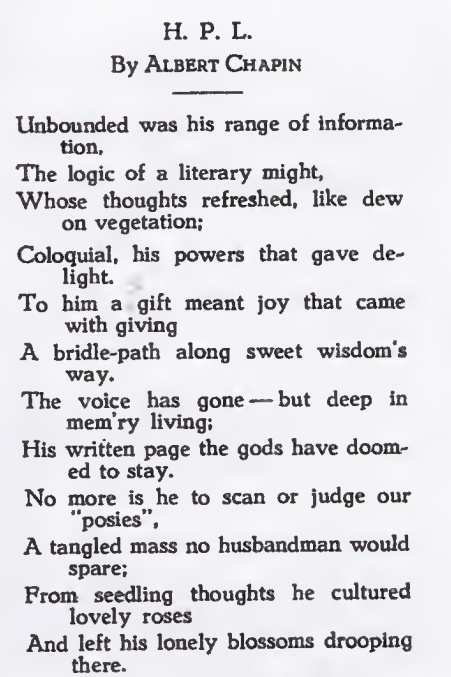
Albert Chapin (1869-1946) was described as one of the “New England [amateur] journalists” in an article on a convention in 1941. The “History of Early Amateur Journalism in Massachusetts” implies that he published a journal called “the Minstrel, Albert Chapin, West Roxbury” toward the end of the 1890s and/or early 1900s.
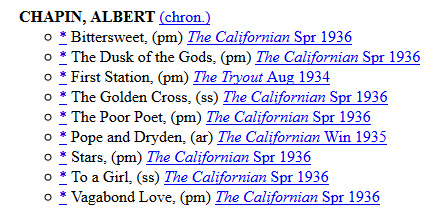
Chapin had a variety of work published in The Californian in the mid 1930s…
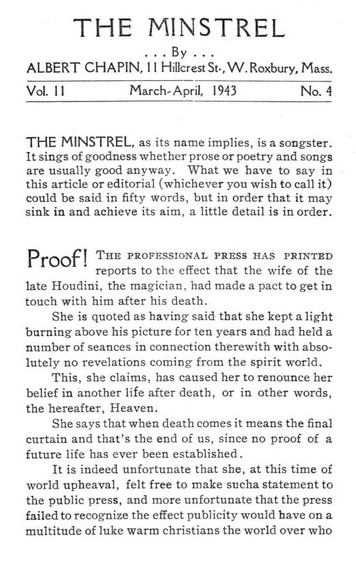
It appears he began the Minstrel title again in the late 1930s and continued it into the 1940s, also from “11 Hillcrest Street, West Roxbury, Mass.”, which is six miles SW of Boston …
It seems there are several mid 1930s letters from Chapin to Lovecraft in the John Hay Library collection at Brown University, and even a photograph of Chapin, so it seems he and Lovecraft corresponded although probably only briefly. Lovecraft quoted four lines from a Chapin poem in his own late essay “What Belongs in Verse” (1935), which further suggests that their correspondence was around 1935. My guess that Chapin was at that time an old amateur ‘coming back to the fold’ in the mid 1930s after decades of quiescence.
15 Tuesday Jul 2014
Posted in Historical context
Chris Jarocha-Ernst’s HPL’s Charleston, a photo-tour that tries to follow part of Lovecraft’s own tour.
… that apex of colonial antiquity—Charleston, South-Carolina. […] Never have I beheld a place which appeals more thoroughly to me. The climate is marvellous and summer-like—palmettos, live-oaks, creeping vines, wisteria, jasmine, azaleas, etc., etc. everywhere, and the thermometer up around 75° and 80° in April and May. Nearly everyone was wearing a straw hat, and […] The atmosphere made me feel 20 years younger and 100% better—indeed, I seemed to have a genuine surplus of energy for the first time since the preceding August. The sea-breeze was always blowing, and I became as tanned as an Indian in two days.” —H.P. Lovecraft, from “Account of a Visit to Charleston, S.C.” (28th April 1930)
14 Monday Jul 2014
Posted in Scholarly works
Geek Anthropologist is looking for contributors for texts ranging from “comprehensive pieces to book reviews”…
The Geek Anthropologist is a blog where geek culture and all things geek are analysed through the perspective of socio-cultural anthropology. We write about the intersections between social science, cultural analysis and practice of anthropology with geek culture, whether they be embodied, literary, cinematic or cybernetic. In short, we’re interested in any culturally informed analysis of geek culture or things that geeks love.
13 Sunday Jul 2014
Posted in Lovecraftian arts, Odd scratchings
London artist Johanna Schmeer, of The Royal College of Art, has made a short film called Bioplastic Fantastic. It depicts a future world in which bioplastic food generators are common, and Lovecraftian gloop and strange mists are what’s on the menu…
“…the Great Race’s mechanised culture had long since done away with domestic beasts, while food was wholly vegetable or synthetic.” — H.P. Lovecraft, “The Shadow Out of Time”.


13 Sunday Jul 2014
Posted in Historical context, Lovecraftian arts
“The Moon Pool” (1918) by A. Merritt, in its original 17,000 word novelette version. The H.P. Lovecraft Encyclopedia states that Lovecraft…
considered the novelette “The Moon Pool” (Argosy [Argosy All-Story], 22nd June 1918) one of the ten best weird tales in literature; he disliked the later novel version
Basic .mobi (Kindle) and .epub conversions are here.
Sadly there appears to be no free audio-book reading, although Librivox has one for the later novel. The novel is apparently a rather poorly-structured combination of the original story with a six-part sequel, all of which was then abridged for book form. Merritt seems to have had the Elizabethan / folk tale approach to the ‘sanctity’ of his texts, freely hacking them about and adding to them in order to fit each subsequent appearance. Science-fiction: The Gernsback Years points out that few early SF fans ever got to read the original 1918 Argosy All-Story version, reading either the novel (1919) in book form or the Amazing Stories magazine reprint of the novel in May-July 1927. Science-fiction: The Gernsback Years claims the original story was not reprinted from 1918 through 1970, but I have found a record of what appears to be a reprint of it in Famous Fantastic Mysteries, Sept-Oct 1939.
 Illustration: Virgil Finlay.