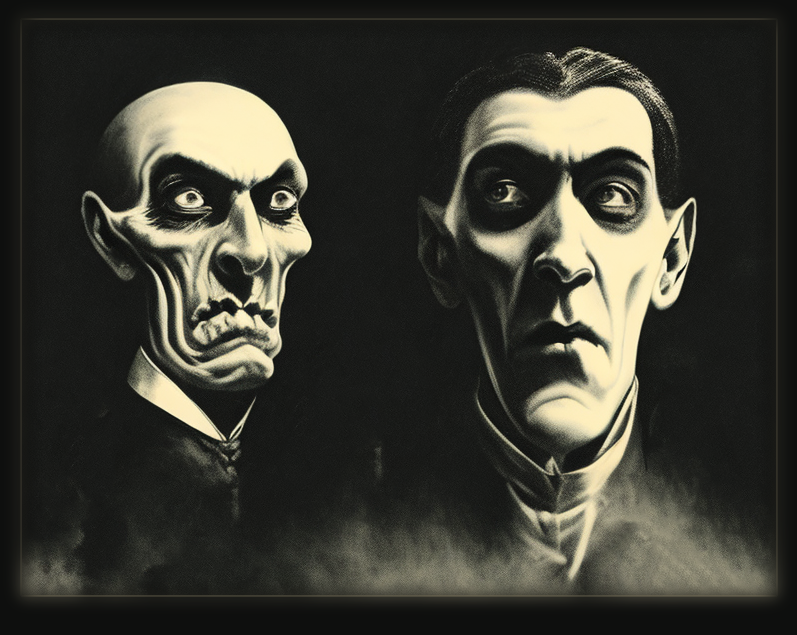
Heavy dark LORAs

More new free LORAs of possible interest, for use with your local AI image generation software (ComfyUI, InvokeAI, etc, running Stable Diffusion 1.5).

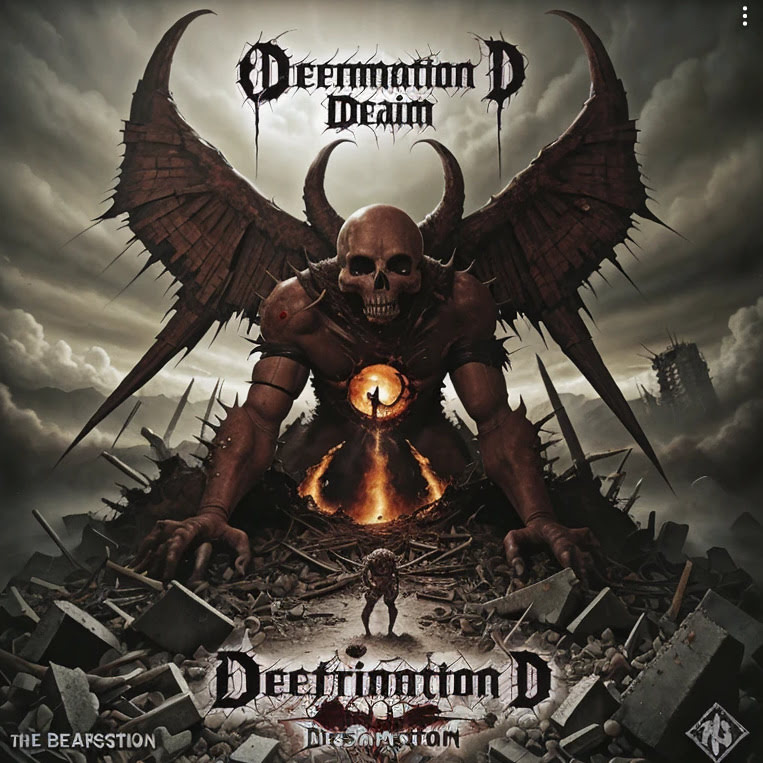
Death Metal artwork, in an album-cover style though one can remove the lettering (SD 1.5 doesn’t do readable lettering). Seems well-liked by those who’ve tried to work with it.

Possibly also useful for fantasy-horror needs, the new environment LORAs Fantasy Swamps (generic) and Ice Age (old and future Ice Ages, sci-fi ice worlds).

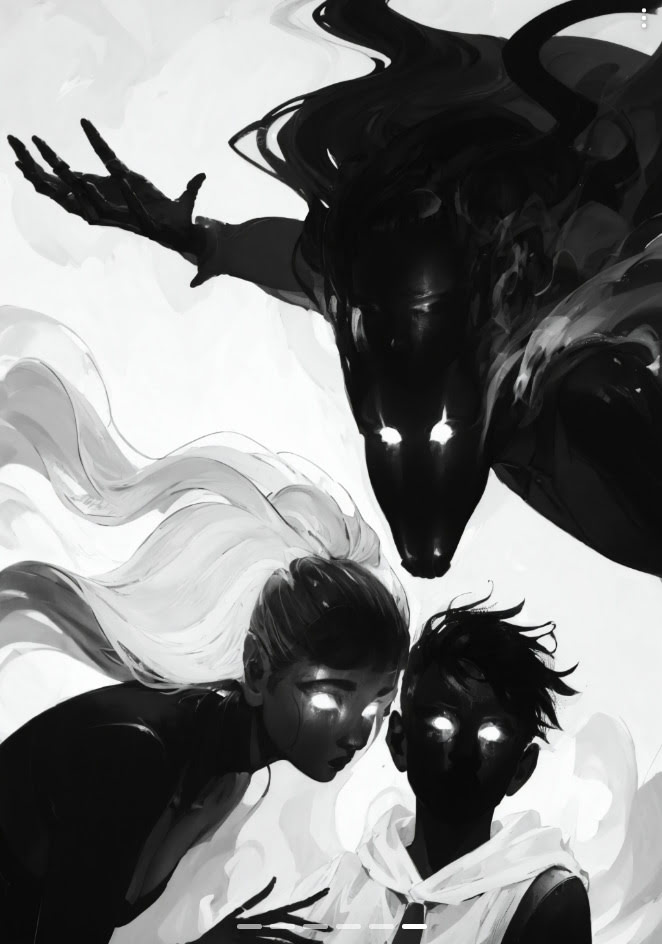
Perhaps interesting to combine in Lovecraft-y ways, the new silhouette-y Shadow Concept and the dusk-with-glows Shadow Concept.

And finally, a new Solomon Kane character LORA, based on stills from the movie.

Lovecraft’s eyes

There’s a new and interesting scientific wrinkle on Lovecraft and ‘fear of the dark’. You’ll recall that Lovecraft had darkish hazel-brown eyes. A new pre-print research paper from Liverpool in the UK tested the “Effect of iris pigmentation of blue and brown eyed individuals” of European descent, in terms of their low-light vision. They found that…

Blue eyed individuals were identified to have significantly better ability to see in lower lighting

… after a short adaptation period. In other words, after a short time of ‘letting your eyes get used to the lowering light’. The authors suggest that the already-known susceptibility of blue eyes to ‘straylight'(*) is the likely cause, providing just…

enough luminance to provide blue-eyed individuals with a visual advantage to make out shapes

… with relative speed in lowering-light environments. Such as hunting at dusk. This seems plausible, though note that the study has a small sample size.

But the implications for Lovecraft is that as an adult he saw darkness as more of a ‘void’ than he might have done if he really had been a blue-eyed Nordic type. Although in 1923 he joshed with the Mediterranean-favouring Belknap Long in a letter that he was really a Nordic, and thus entitled to imagine himself…

a comrade of the wolves, and rider of nightmares — aye — I speak truly — for was I not born with yellow hair and blue eyes — the latter not turning dark till I was nearly two, and the former lasting till I was over five? Ho, for the hunting and fishing in Valhalla!

Thus, there may have been a ‘double impact’ here for Lovecraft in early childhood. An imaginative tot’s intense fear of the dark exacerbated by his blue eyes, until the age of two, due to good perception of subtle shapes in the dark. Then a strong and perhaps sudden lessening of this ability, leading to the increasingly imaginative child’s fear that the terribly phantasmal shapes were still there in the dusk, but were now dangerously unseen…

Their hand is at your throats, yet ye see Them not; and Their habitation is even one with your guarded threshold.” (Necronomicon).

You’ll recall also Lovecraft’s early fear of the dark. Evidenced by the lengths his grandfather went to, to try to cure the boy of it. Also his love of cats, friendly creatures able to see relatively easily in the very low light.


* straylight — “light that enters the eye but does not reach the retina in a focused manner”
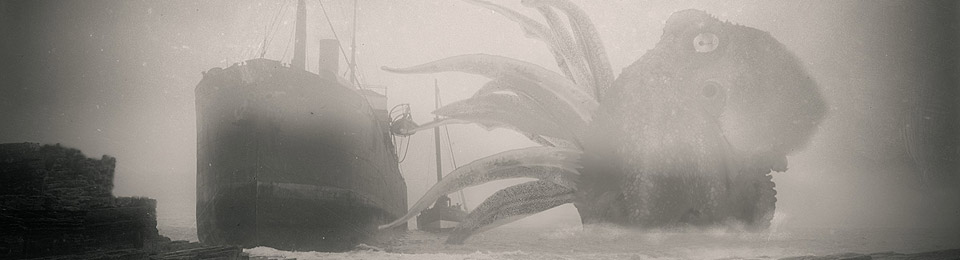
Le Dernier Jour d’Howard Philip Lovecraft

A new quick official video peep at the art for the new graphic novel Le Dernier Jour d’Howard Philip Lovecraft, or more accurately a ‘BD’ (being the French/Belgian format of a large-format and relatively short but high-quality graphic-novel in hardback).

This led me to another video which reveals the 5,000(!)-copy printing sold out over Christmas and it’s reprinting (“a new printing has taken place”). This video also has a flip-through giving a quick preview of the interior art and layout. Possible spoilers.

Hopefully the success will encourage an English translation and ebook version.

Medieval cats and braces

For ‘Kitty Tuesday’, a new Medieval cats LORA for your PC’s local AI image-generator. Cats as seen on medieval manuscripts. That was when they had rocket-cats. Really…

Also a new Retro Men’s Suspenders Outfit LORA, which could be useful for those making an ‘H.P. Lovecraft as character’ comic or 1920s-50s Call of Cthulhu RPG artwork with AI image generation. In British English, suspenders = braces.

So far as I’m aware, he used a firm belt rather than braces, but the LORA is certainly depicting a key aspect of his era.

Multi-voice Dexter Ward

Actor William E. Hart’s multi-voice unabridged The Case of Charles Dexter Ward, from the corrected text. This is actually from way back in 2012, but it seems to have passed me by. It’s free, just over five hours, and the .MP3 links are still live.

How my AI sees the tale.

Just the thing to liven up a slow Monday, perhaps. Or, you might choose the new LibriVox public domain recording of Belknap Long’s “The Space Eaters”.

Sac Prarie

In the first news post of 2024, S.T. Joshi reports that August Derleth’s main regionalist fiction is back in print in Joshi-scrutinised editions. These being Place of Hawks (1935), Evening Spring (1941), Shield of the Valiant (1945), part of the set known as the Sac Prairie saga. Joshi also reports that…

I have now completed work on a volume of previously uncollected Sac Prairie stories, Gently in the Autumn Night

A half dozen or so Sac Prarie volumes can also be found on Archive.org in scans of varying quality, “to borrow”. In a 1963 book, Derleth lists the titles of his Sac Prarie saga…

Talking of Derleth, I took another look for a Solar Pons collection, Derleth’s Sherlock Holmes -alike detective. Back in 2020 I determined in a Derleth survey that The Original Text Solar Pons Omnibus would be the best collection, being the one from 2000 with uncorrupted text, but it was then ridiculously expensive. Now also unavailable, I find.

To my 2020 survey I can now add that he wrote the less heavy “Gus Elker Stories”, these being rather more amusing stories of Wisconsin country life than those of Sac Prarie. But these had to wait a long time to be collected, as Country Matters (1996). For which the blurb read…

Here are 35 rolicking misadventures of Sac Prairie’s most engaging characters, Gus Elker, Great-aunt Lou and Great-uncle Joe Stoll. Nineteen of these stories have never appeared in any book or anthology. Since this collection was released, 17 additional unpublished stories have been found and will be published in the near future.

I can’t immediately find news of the second Gus Elker volume, so there may be an opportunity there for a publisher to pick it up? Or perhaps produce an audiobook with all the stories?

The Armchair Detective

New on Archive.org, a scan of The Armchair Detective for June 1976. Has a few items of interest…

* “Wicked Dreams: The World of Sheridan Le Fanu”

* “Edmund Wilson and the detective story”. The arch critic’s judgement on the best of the genre was just as dismal as on Lovecraft and Tolkien, it appears.

* “An Informal Survey of Cover Art of the Seventies”.

Also a mention of Lovecraft in an article on Chesterton’s Father Brown detective character, noting a circa early-1930s story…

he [Brown] remains untouched by “The Blast of the Book” (an amusing take-off on Necronomicon-like things, although whether Chesterton ever read H.P. Lovecraft is unknown to me) because he is not superstitious

Lovecraft’s letter-box

This week for ‘Picture Postals from Lovecraft’, letters, or rather letter-boxes. We know all about Lovecraft’s letters and postcards, but what exactly did his posting them look like? Or indeed, what did a U.S. public mailbox look like at that time?

He certainly had one nearby, and a mighty capacious box it must have been to cater to the champion letter-writer of the 20th century. But only once does Lovecraft refer in passing to his “outgoing mail-box” in a 1927 letter to Belknap Long, in the letters I have searchable access to. He does not use the British form “post-box” or “postbox”.

Lovecraft would have first encountered the collection mail-boxes of Providence in his middle childhood circa 1900, and begun using them to write to his family and cousin soon after. From 1897 until 1905 they might have looked rather space-age to our eyes, done in silver aluminium paint with red lettering. This national re-painting of the boxes was in fact a corrupt make-work scheme with cash kick-backs for officials, but Lovecraft and his young pals weren’t to know that. Most likely the boxes were at that time on short posts and sited on street corners. Very garish and out-of-place the silver boxes might have looked to the frowning matrons of College Hill. But in a certain light the combination of a cosmic star-glitter and blood-red might have been quite alluring, to boys inclined to imagine far places.

So far as I can tell he would have encountered three types of box-shape during his life. Here we see two key ones together…

Perhaps more likely for College Hill, circa 1905 as his correspondence grew, would be the smaller ‘Doremus’ type seen above. These were re-done in dark green enamel paint and white lettering, probably much to the relief of the aesthetic guardians of College Hill, from 1905 until his death.

As he grew older and became involved in amateur journalism, many of his items would be larger packets. Thus he would either have to find one of the larger box types, called “package boxes” (also seen above), or visit a Post Office — where he could also have purchased stamps but would also have to endure a queue.

It would be amusing to imagine the Providence postmaster puffing and blowing about having to install a special larger box, just to accommodate Lovecraft’s daily flow of correspondence and packages. Possibly also with a late evening collection time (10:30pm seems to have been possible in Providence, judging by Lovecraft’s postmarks). But so far as I know we have no evidence of that happening.

Later, I’m not sure how much later, photographs suggest that the larger style of box could also be used for bag-storage by mailmen on their delivery rounds. But that conversion may have occurred after his death.

The larger collection boxes were so ugly, further marred by cheap ‘Army style’ stencil lettering, that some places asked that they be concealed from sight as much as possible. The move to dark green paint no doubt helped in their concealment in residential streets, with greenery grown either side.

The smaller “style B” box (seen below) was issued in 1912 and was in use into the 1960s. Cast iron was used for these from 1924, for added security. It wasn’t until 1955 that the Postmaster General had these by-then ageing boxes freshly re-painted in a patriotic red, white, and blue scheme — which we see in this vintage auction item…

Give the above dates it’s not impossible that Lovecraft returned from New York City to find that the older type had been replaced by the new 1924 cast-iron “style B” in the city, in dark green. Though older smaller ‘Doremus’ boxes, again green but with older faded paint, might have been retained in sedate places like College Hill. Or was it sedate, in terms of mail? Recall that Brown University is at the centre of the Hill. Its traffic in erudite letters and bulging packets must have been constant during term-time.

Thus it appears that when Lovecraft went out to mail letters he slipped them into mailboxes like the ones above.

Today it seems that the U.S. still uses much the same larger-type design, but since 1970 these have been a dark blue with some white logos plus red warning labels and flashes.

Further reading: USPS, “Mail Collection Boxes: A Brief History”.