John Russell, a Lovecraft correspondent during the years 1913-1925.
The young Lovecraft once jousted, in the pages of Argosy magazine, with one John Russell of Florida. Russell later became a correspondent at a critical time in Lovecraft’s career, but he remains something of a mystery to Lovecraftians. We don’t even know his birth and death dates, it seems. Note that he is not to be confused with John Russell Fearn (1908-1960) who was also British, an early science fiction fan, a contributor to The Futurian and later a prolific SF author.
The story of the jousting in the Argosy is well documented over several pages in S.T. Joshi’s monumental Lovecraft biography I Am Providence. The public exchange was fateful, since it brought Lovecraft to the attention of a recruiter for the amateur journalism movement. Lovecraft later recalled this consequence in a letter…
“John Russell, the Florida Scotchman who in 1913 conducted the Argosy controversy with me which led to my discovering amateur journalism!” (Selected Letters I).
One of the Lovecraft poems from this inky jousting, “Frustra Praemuntius”, a satire on Russell, was apparently not published at the time. It can now be found in the collections of Lovecraft’s poetry titled The Ancient Track, along with the other poems from the controversy.
Russell also joined the amateur journalism movement, although a year or so after Lovecraft. Russell was born at Penicuik, near Edinburgh, and his skill was said to have been Scots dialect poems in the Robbie Burns tradition. Lovecraft wrote of him in the short “Introducing Mr. John Russell” (1915)…
“During the winter of 1913–14 The Conservative [Lovecraft] was engaged in an extremely heated controversy concerning the merits of a certain author whose work appeared in one of the popular magazines of the day. The letters of the disputants, both in prose and in verse, were printed in the magazine, and among them appeared both the formal heroics of The Conservative, and the neat octosyllabics of one John Russell, Esq., of Tampa, Florida. Mr. Russell and The Conservative, who were arrayed against each other in the metric fray, were each separately invited by Mr. Edward Daas to join the United, but while The Conservative responded eagerly and almost immediately, his opponent deferred action. Meanwhile a peace had been sealed betwixt the contending bards, and a correspondence established, in which The Conservative continued to urge what Don Eduardo had first mentioned; the result now appearing in Mr. Russell’s advent to the association.
John Russell, whose present address is General Delivery, West Tampa, is a true-born Scotsman, being a native of Penicuik, near Edinburgh. The patriotism of his family is attested by the presence of his two nephews at the front in Belgium, one with the Gordon Highlanders and the other with a Canadian regiment. Mr. Russell’s poetry has appeared in the public press of Scotland, Canada, and the United States, and possesses a tersely epigrammatical and at times brilliant satirical style all its own. Though proficient in classic English, it is in the quaint speech of Caledonia that Mr. Russell chiefly excels. Of this delightful dialect he is a perfect master, and his well-constructed lines are redolent of the atmosphere of North Britain. Upon joining the United, one of Mr. Russell’s first acts was to dedicate a poem to the Blue-Stocking Club of Rocky Mount, whose study of Robert Burns at once aroused his interest.”
In the United Amateur Lovecraft later gave a shorter description of the new recruit…
“John Russell, formerly of Scotland but now of Florida, is a satirist and dialect writer of enviable talent. His favorite measure is the octosyllabic couplet, and in his skilled hands this simple metre assumes a new and sparkling lustre.” (“Department of Public Criticism”, United Amateur, August 1916).
A little later Russell secured employment on a local newspaper, as Lovecraft’s own journal The Conservative noted in October 1916 that…
“John Russell of Florida, whose satirical and other verses have formed such a piquant feature of amateur letters, has recently accepted a position with the “Tampa Breeze” [a weekly, under the editorship of former General W.W. Averill]. He will be in complete charge of the advertising department, besides having duties of an editorial nature…” (p.114 of the book reprint of The Conservative issues).
S.T. Joshi has also noted (I Am Providence, p.276) that the 1918 Lovecraft poem “The Volunteer” was published circa 1918 in the St. Petersburg Evening Independent, a Florida newspaper. Joshi speculated that Russell might have secured this publication for Lovecraft.
Russell had nephews fighting in the First World War, so I would hazard a guess that his age might have been about age 45 in 1916. This gives a likely birth date range of circa 1868-75.
Lovecraft almost met Russell in 1922 in New York…
“…fancy who has just written, asking me to meet him if convenient in NY at the Victor Hotel, 37th St. & 5th Ave., on Saturday, Sept. 23, (one week from today) 1922? None other than that John Russell, the Florida Scotchman who in 1913 conducted the Argosy controversy with me which led to my discovering amateur journalism! I had never thought to see him in the flesh, although I have corresponded to some extent with him; & the present chance is wholly accidental — he has been home to Scotland & is returning by way of New York. The odd thing is, that he has no idea I am in NY — his suggestion is that I make the trip from Prov. especially to see him — which would be a bit expensive & unlikely. I should like to meet the man whose verses elicited the satires from which Daas recruited me, & I have half a mind to do it — I’ll let you know. It’s so darned congenial here that I hate to break away — but I am a philosopher, & accept with stoical imperturbability every circumstance & dispensation of fate. However — what I’d advise is your coming along here & mixing in the festivities!!! You’d find Belknap a little angel — he’s second only to the immortal Alfredus.” (Lovecraft in Letters from New York)
Sadly, when the appointed hour came around, it appears that Russell missed the appointment amid the hubbub of New York.
Letters from Russell to Lovecraft are listed in the Brown University collection. The dates of these suggest that Lovecraft struck up a more regular correspondence with Russell through the late summer of 1923…
1920 Jun 30
1923 Aug 4
1923 Aug 19
1923 Sep 22
1923 Oct 13
1923 Oct 27
I could be wrong, but I suspect these have not yet been published, since the corresponding letters by Lovecraft have been lost. S.T. Joshi remarks that Lovecraft’s… “letters to Russell have not come to light” (I Am Providence, p.228). There is almost no trace of Russell in the online record, although his name is one that is very difficult to trace.
Lovecraft’s relocation to New York in 1924 probably curtailed much of his contact with his outer circle of wider correspondents, including Russell. But then Russell finally met Lovecraft face-to-face in New York in early 1925. Russell might then have been about age 55, and this a markedly ‘older’ man according to the mindset and demographics of the time. S.T. Joshi remarks in I Am Providence that Lovecraft and Russell “spent several days in April” (p.602) together in New York. There seems to be no record of the meeting or their trips, but presumably Joshi had the basic details from an aside in one of the letters. One imagines that Russell, being a ‘oldster’ and a Scot, must surely have been taken to visit the similar Everett McNeil at one point during the visit. Possibly he met the fellow staunch British patriot Ernest La Touche Hancock, who was also in New York at that time.
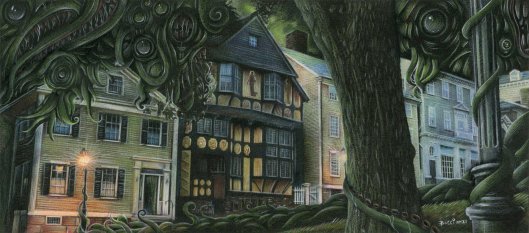
Russell may have been passing through New York on his way to take ship for a summer tour of the British Isles, since in August or September he sent Lovecraft three postcards of ancient Tudor houses in Ipswich, England. Lovecraft noted these in a September 1925 letter, and he went on to say that he had completed a long letter to Russell in return. If Russell had sent the cards from England, then he obviously had the funds for a lengthy trip abroad. One wonders if there was perhaps a touch of jealousy on Lovecraft’s part, since it was a trip he had long desired for himself, and his own position in New York was quite pitiful in comparison. Evidently the 1925 New York visit had been an amicable one, but there is no further evidence of correspondence after September 1925.
The amateur journalism paper The Little Gem, Jan-Feb 1938, No.2, had an article titled “AMATEUR JOURNALISM CHATS: John Russell Foos”. The Little Gem is in one of the big amateur journalism collections due to be scanned and online relatively soon. But this seems unlikely to be an interview with ‘Lovecraft’s John Russell’, and is perhaps instead with the 18 year old John Russell Foos of Ohio.








.png)