Crackpots and Eggheads: Eccentricity in Natural History

A fine lecture at the Museum of the History of Science, University of Oxford, by Brian Regal. The title is “Crackpots and Eggheads: Eccentricity in Natural History”. Specifically, the talk is on monsterphilia among the early natural historians and taxonomists, which then fed into the field of early scientific cryptozoology among mainstream scientists, and which then spiralled out into amateur cryptozoology and various fringe belief systems. Regal tells the story vividly, though the various personalities and places involved.

54 minutes, 2011. There’s an .MP3 as well as embedded media.

Comprehensive cats

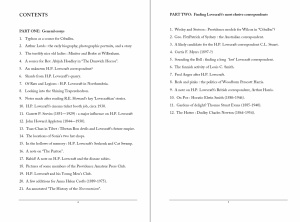
A new blog post from S. T. Joshi reveals the contents of his new book on recent weird fiction, 21st-Century Horror: Weird Fiction at the Turn of the Millennium. And thus his rankings of authors therein, as The Elite, The Worthies, and The Pretenders, which are to be seen on the Contents page. Also, by silent implication of being omitted entirely, ‘The Unmentionables’.

Joshi also mentions that the French magazine Nez is to run an hour-long interview with him… “about Lovecraft’s fascination with odours, stenches, and related topics.” However, I guess it’s possible they may translate it and run it in French.

Also, it’s good to hear that Joshi’s forthcoming “H. P. Lovecraft Cat Book” is to be “comprehensive”. So presumably an assemblage of all the mentions of cats, felines and felis etc in the letters, as well as in other materials.

Revista Abusoes: special Lovecaft issue

The Brazilian journal Revista Abusoes had a bumper crop of H.P. Lovecraft scholarship in Portuguese, in a 2017 special issue. 15 essays and two interviews with translators of Lovecraft, all open access and public. I can’t read Portuguese but the Contents page looks good to me, via Google Translate.

Too many articles to list individually on Open Lovecraft, but I’ve added the whole issue.

Friday “picture postals” from Lovecraft: Lighthouse

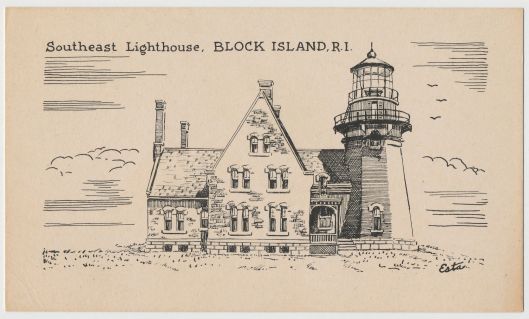
The curious light-house at Bullock Point, Providence. It’s across the river and about four miles south, so is not something Lovecraft would have encountered or glimpsed every day. And so far as I know he never took a steamer to New York (though he did see people off at the docks, such as Morton, who were going back to New York that way). But it’s the sort of place he might have glimpsed on his youthful bicycle and play expeditions over to that side of Providence, and would have later encountered pictorially on postcards such as this.

In a letter of 1921 Lovecraft recalls “our boyhood play-scenes — East Providence, Seekonk, and Rehoboth”. This was in the context of returning there in an unexpected car trip around his old haunts, on which he states that “I had not been there for eight or nine years”. This statement would place the last visit there circa 1912, perhaps about the time this postcard was made.

I should note that he also had his rooftop observatory until at least 1919, from which he could see far and in detail along the shoreline with the aid of his telescope. Letters sent to Galpin record him training his telescope not only on the stars, but also down and across the river during the day.

Lovecraftian role-players may also like this crisp scan of another local lighthouse postcard from circa the 1940s, to print up as a gaming prompt…
Lovecraft: The Myth of Cthulhu

A new comics anthology of Lovecraft adaptations, Lovecraft: The Myth of Cthulhu, and it’s wholly new in English.

“Illustrated in haunting black and white by Esteban Maroto over 30 years ago, these comics are re-presented in a new edition, adapting three of H.P. Lovecraft’s most famous stories involving the Cthulhu Mythos: “The Nameless City”, “The Festival”, and “The Call of Cthulhu”.”

Very pleasing artwork and lettering…

It if reminds you a bit of the best 1970s Eerie or the oversize b&w Marvel Comics, that may be because the same artist did Red Sonja with Roy Thomas and appeared as an artist in Eerie. Thought it seems that these strips didn’t appear there, and are new translations from the Spanish. They are said to have appeared in the back of the Spanish children’s comic Capitan Trueno, of all places, and then vanished. The artist never had his art back from the publisher, but he recently found good photostats and has now republished the strips in English.

I’m not keen on the cover, but I guess ‘Show The Monster On The Cover’ is what gets a few extra sales in today’s crowded comic-store marketplace. Currently the book is only available in paper, and runs to 80 pages. If this gets onto Kindle at £3.99, once the print-run sells out, it should sell very well there.

The Emergence of the Fourth Dimension

Released back in April 2018, The Emergence of the Fourth Dimension: Higher Spatial Thinking in the Fin de Siecle. Not just a book of the history of mathematics, but a survey of the cultural influence of the new discoveries at the time when Lovecraft was a youth and young man…

“the volume describes an active interplay between self-fashioning disciplines and a key moment in the popularisation of science. It offers new research into spiritualism and the Theosophical Society and studies a series of curious hybrid texts. Examining works by Joseph Conrad, Ford Madox Ford, H.G. Wells, Henry James, H. P. Lovecraft, and others, the volume explores how new theories of the possibilities of time and space influenced fiction writers of the period, and how literature shaped, and was in turn shaped by, the reconfiguration of imaginative space occasioned by the n-dimensional turn.”

Automata

In Our Time : Automata. BBC Radio 4’s flagship programme… “discusses the history of real and imagined machines that appear to be living, and the questions they raised about life and creation”, with the usual intimate round-table of scholars and scientists. Unlike many BBC programmes, the In Our Time recordings are available to those outside the British Isles — and even have .MP3 files.

Picture: impsandthings: Steampunk Automata (2010). He also has video of it working.