Ben Tucker’s new Librivox public-domain reading of “The Shadow Over Innsmouth”.

First appearance of Innsmouth in 1936, first illustration by Frank Utpatel.

Utpatel’s illustration board, showing significant differences from the printed version.

13 Wednesday Mar 2024
Posted in Lovecraftian arts, Podcasts etc.
Ben Tucker’s new Librivox public-domain reading of “The Shadow Over Innsmouth”.
First appearance of Innsmouth in 1936, first illustration by Frank Utpatel.
Utpatel’s illustration board, showing significant differences from the printed version.
12 Tuesday Mar 2024
Posted in New books
The booklet Christmas with H.P. Lovecraft now has a page on hplovecraft.com, with detailed description and table-of-contents. This usefully shows that none of the letters were excerpted, which seems a pity. The publication is poems, “The Festival” and the ‘Christmas Greetings’ ditties sent to friends (and friends’ cats) at Christmas. One might have hoped that the compiler could have slipped in just two or three bits from the letters. Which Brown consider to be in the public domain. I mean, how could one leave out something like this…
[Yule (Christmas)] here was commendably cheerful — including a turkey dinner at the boarding-house across the garden, with a congenial cat meandering among the tables and finally jumping up on the windowseat for a nap. We had a tree by the living-room fireplace — its verdant boughs thickly festooned with a tinsel imitation of Florida’s best Spanish moss, and its outlines emphasised by a not ungraceful lighting system. Around its base were ranged the modest Saturnalian gifts — which included (on my side) a hassock [a cushioned wooden foot-stool] tall enough to let me reach the top shelves of my bookcases […]. Of outside gifts the most distinctive was perhaps that which came quite unexpectedly from one of the kid fantasy fan group […] when I had removed numberless layers of corrugated paper and excelsior, what should I find before me but the yellowed and crumbling fragments of a long-interred human skull!
11 Monday Mar 2024
Posted in Odd scratchings
New on Archive.org, a scan of the 1937 Not At Night Omnibus. This had Lovecraft between hard covers, if only in the British Isles. In the form of his “Pickman’s Model”, and the revision tale “The Horror in the Museum”.

Weird Tales offered their most suitable grue-some stories, these being selected by the magazine’s London agent Charles Lovell. The Selwyn & Blount anthologist Christine Campbell Thomson then made the final selection and ordering for the chunky mass-market hardback. One might have thought it would appear for Halloween in the autumn lists, but it appears to have been published in April or May 1937.
10 Sunday Mar 2024
Posted in AI
A few more free LORAs, newly released and of possible interest to Tentaclii readers. For use with the free AI image-generator Stable Diffusion 1.5 on a PC.
Chriss Foss style LORA, for generating Chris Foss ‘wasp’ spaceships.

The Mist LORA, for deep mist with huge monsters looming out of it. Might work well with Lovecraftian shorelines?

Xenozoic Tales – v1.0 LORA, with a nice retro-comics inking style which may be suitable for 1950s pulp illustrations.

Also a rare (the only one?) Anaglyph Image Generator LORA. If you’re lucky, it will generate viable old-school 3D images of the type you view with red-blue glasses. Which may interest some. Perhaps combine with the new Psychedelic Landscape LORA for way-out-there 1970s posters / album-covers with depth?

09 Saturday Mar 2024
Posted in Scholarly works
NecronomiCon Providence has issued the call for the Dr. Henry Armitage Memorial Scholarship Symposium, to be held at the impressive Omni Hotel, Providence – 15th-18th August 2024. Among the most interesting suggestions for possible topics are…
* Lovecraft’s correspondence as pre-blogging/travelog
* [Publisher] “Arkham House” and its heritage: further discoveries in its archival history
“Pre-blogging” is a new one to me. Never heard of it before. Seems that it may mean ‘a blog post you write before you actually do something, which you then also blog about afterwards’. Or they may just mean historically, that Lovecraft was ‘using letters as a form of blogging, before blogging was invented’? If the latter, it raises the question of his often phenomenal memory. Did he, like a modern blogger today, have substantial ‘search access’ in his mind to much of importance that he had written in his correspondence? “Lovecraft’s memory” might make an interesting topic for a short talk, showing just how good it was, how it worked, pointing to where and why it might have failed over time, and all the while drawing examples from the correspondence.
Anyway, submission deadline for the 2024 Symposium is 24th May 2024 and “early submissions are encouraged”.
2024 Call Flyer and contact details.

Omni Hotel
08 Friday Mar 2024
Posted in Picture postals
For this week’s ‘Picture Postals’, a few more images to accompany my earlier and more in-depth look at St. Paul’s Chapel, Broadway and Vesey. This was the church where H.P. Lovecraft married Sonia H. Greene, 100 years ago this week on 3rd March 1924.


By Rachael Robinson Elmar.
Most pictures of the place were and still are made in verdant summer. But, as I’ve established with reference to the weather records, the leaves would have been off the trees for the Lovecraft marriage. At the most the newly married couple might have emerged to…
a few hints of the very earliest new leaves on the trees, a sparse first flush of new grass after winter, and perhaps a few early un-opened daffodils.
Inside these two pictures give the best overview I can find. In Lovecraft’s time it appears that a British and an American flag hung down like banners on either side. By the looks of it later these were removed and there was just an American flag, discreetly draped to one side. Today it appears all the flags are gone, and there are only festoons of greenery.


The walk to the altar…

07 Thursday Mar 2024
Posted in New books
A new attempt to strap Lovecraft onto the large stones which dot Providence and other parts of New England, in a new booklet of 96 pages titled H.P. Lovecraft’s Megaliths: The Unknown In Plain Sight (Jan 2024)…
So careful a worker was Lovecraft that even though he substituted fictional names for those of the New England anomalous artifacts that he visited, researchers have been able to use Lovecraft’s fiction as a guide to the sites and have been able to locate a number of the stone circles and stone crypts that were so fundamental to his terrifying world-building.
06 Wednesday Mar 2024
Posted in Scholarly works
Another quick scamper around the tunnels of academia…
* “Science and Madness: Echoes of Freudian Psychoanalysis in the Works of H.P. Lovecraft”, an M.A. dissertation. “Available for download on Thursday, April 25, 2024”.
* H.P. Lovecraft’s monsters of modernity read through J. J. Cohen’s ‘Seven Monster Theses’. Another Masters dissertation, from 2022 and also embargoed, but with a substantial abstract. As well as the oft-cited racial fears…
“The study finds that Lovecraft’s monsters are in part influenced by religious uncertainty following the First World War, the scientific advancements of Einstein’s theories of relativity, and the economic uncertainty of the American Great Depression” and at a deeper level “laissez-faire capitalism and Judeo-Christian thought”.
* In Indiana, the 2023-2024 IDAH HASTAC Scholars include a reseacher looking at… “the role of magic in weird fiction, particularly that influenced by H.P. Lovecraft. As part of this work, Sam utilizes computational text analysis methods such as topic modelling and document classification.”
05 Tuesday Mar 2024
Posted in Films & trailers
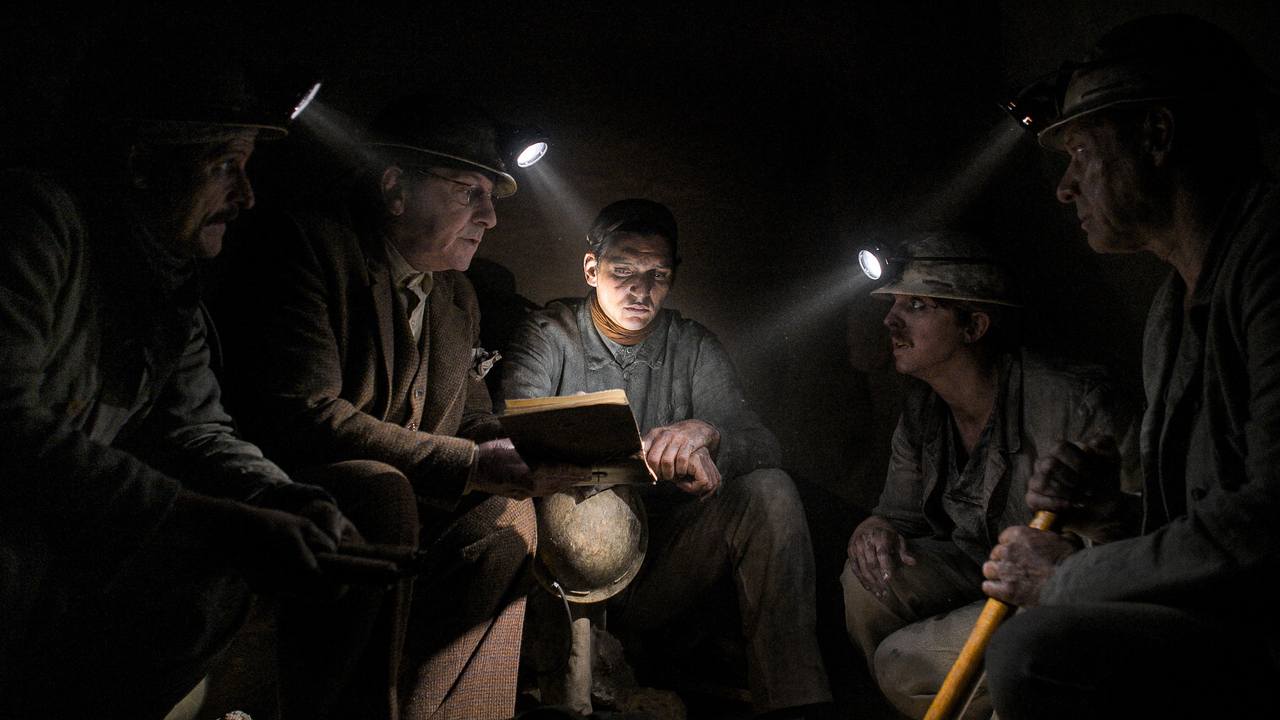
A possible new French movie of interest, released in November 2023…
If horror cinema occupies a special place in the American cinematic landscape, in France, it’s another story. The proposals for such a thing have been regular since a “gore” revival in the 2000s, but in recent years the flame has rarely been lit in France. However, in the heart of a mine in the north of France, the young director Mathieu Turi has dug up a very flammable new nugget [in the form of his new movie]. Turi first introduces his spectator to the atmosphere of the coal mines over a splendid thirty minutes build-up [in which French miners in 1956 must take a professor down to take samples], in order to build a controlled atmosphere [around which] Turi gradually builds a cryptic Lovecraftian aura.
This appears to be the young director’s third movie.
04 Monday Mar 2024
Posted in Odd scratchings
A short month, and a chilly one. My new employment requires venturing out of the Tentaclii Towers grounds, and — lacking the requisite brazier-heated coach and fast horses — I have been re-acquainted with the delights of the English weather. Despite what hysterical cultists would have you believe, the English spring weather is definitely not “boiling” so far as I can tell. It’s set to be sub-zero with a heavy mist tomorrow, as I write.
In this month’s ‘Picture Postals’ posts I clambered up the mysterious Newport Tower in search of Vikings; I glimpsed the lower depths of Brooklyn Heights, which finally led me to a good artistic vision of what Lovecraft would have seen from atop those same heights; I gazed down Fulton Street in earlier times (which seemed to me to link with Lovecraft’s “The Street”); and peeped at the new excavations alongside the List building at Brown University (the site of Lovecraft’s house at 66 College Street). In another picture based post I wondered at the similarity of Lovecraft’s bibliophile ‘Great Race’, in “The Shadow Out Of Time”, to the Surrealist “Exquisite Corpse” of 1927.
For Valentine’s Day I examined Lovecraft’s one-time epistolary pseudonym ‘Valentine Boiling Fitz-Randolph Byrd’.
In scholarly work I found four new items. I also noted the use of Lovecraft for a new “Psychoanalysis of Wet Dreams”, which led me to dig up Lovecraft’s suitably soppy parody poem on the topic. I noticed that Fungi from Yuggoth: An Annotated Edition is back in print. In forthcoming books, S.T. Joshi announced a forthcoming volume of letters sent to R.H. Barlow, and also remarked on a new French screen documentary on Lovecraft.
In new books I noted: The Weird Tales Boys (2023) and Long Memories and Other Writings (2022) on Frank Belknap Long. Also the forthcoming artbooks Lovecraft’s Commonplace Book: Weirdly Illustrated by Michael Bukowski; and H.P. Lovecraft: Zoomorphic Manual. In old books I was pleased to learn of the existence of The Annotated Tales of Edgar Allan Poe (1981), now on Archive.org.
My occasional highlighting of free AI ‘LORA’ image-generation plugins continued, and I linked to an AI generated video adaptation (Lovecraft’s cosmic “The Poe-et’s Nightmare” from 1916).
Also in freeware, I was pleased to recommend AnyTxt Searcher for scholars. Also free, though requiring a hefty and expensive graphics card for your PC, Nvidia released “Chat with RTX”. Which appears to be an easy way to locally build an in-depth ‘H.P. Lovebot’ AI chatbot from his letters and essays. Now all we need is the humanoid robot HPL to put it in. Ready when you are, Mr. Musk!
Definitely not freeware, a complete set of Weird Tales was put up for sale on eBay at around $150,000. Which if you have a mere three bitcoins lying around, would actually be quite affordable. Sadly I only have a tiny fraction of one bitcoin, worth about $80 at the last count.
I updated my PDF of letters from E.H. Price to Lovecraft, which triggered a small but pleasing round of new downloads. Also for the Lovecraft Circle, I was pleased to find a good map for the Conan tales. I’m a little surprised there aren’t more such maps, and that I had to dig it up from 1975. In audio I noted R.E. Howard’s Weird Tales horror stories had arrived on Librivox.
I also posted on “Brian Stableford as editor and scholar”, and sorted out which of Asimov’s many ‘robot tales’ are said to be the best to start with. In Tolkien, I made more progress with issue #8 PDF ‘zine version of my Tolkien Gleanings, which should be out in a few weeks and weigh in at 100 pages.
And… the blog passed 5,000 posts.
03 Sunday Mar 2024
Posted in Odd scratchings
New to me, the term “loci numinosi”. Wonderful.
Found in a descriptive blurb for the new open access conference-proceedings Cult Practices and Cult Spaces in Hittite Anatolia. Half the volume is on… “the significance of various [sacred] places, such as rivers, loci numinosi, roofs, [etc]”
The term seems to have been invented relatively recently by Hittite historians, to describe places where a ‘numinous’ deity might have been found, ranging from a typical temple altar or throne to ‘the catch-bag’ of a day’s hunting. Possibly in a sacred grove. The term is thus somewhat more humdrum than it first appears. Borrowing lustre from the more widely-known idea of the genius loci, which means the more ineffable (but also protective or “tutelary” as Lovecraft calls it) spirit of a natural place.
Still, the delightful new term loci numinosi is definitely one for imaginative authors to consider borrowing. One might even make a slight tweak to loci luminosi to indicate the repository of glowing Lovecraftian crystal, a high niche illuminated by giant burnished mirrors, a sacred grove of bio-luminescent fungi, or a dark place into which light can only enter at certain key moments of the astronomical cycle.
03 Sunday Mar 2024
Posted in AI, Lovecraftian arts
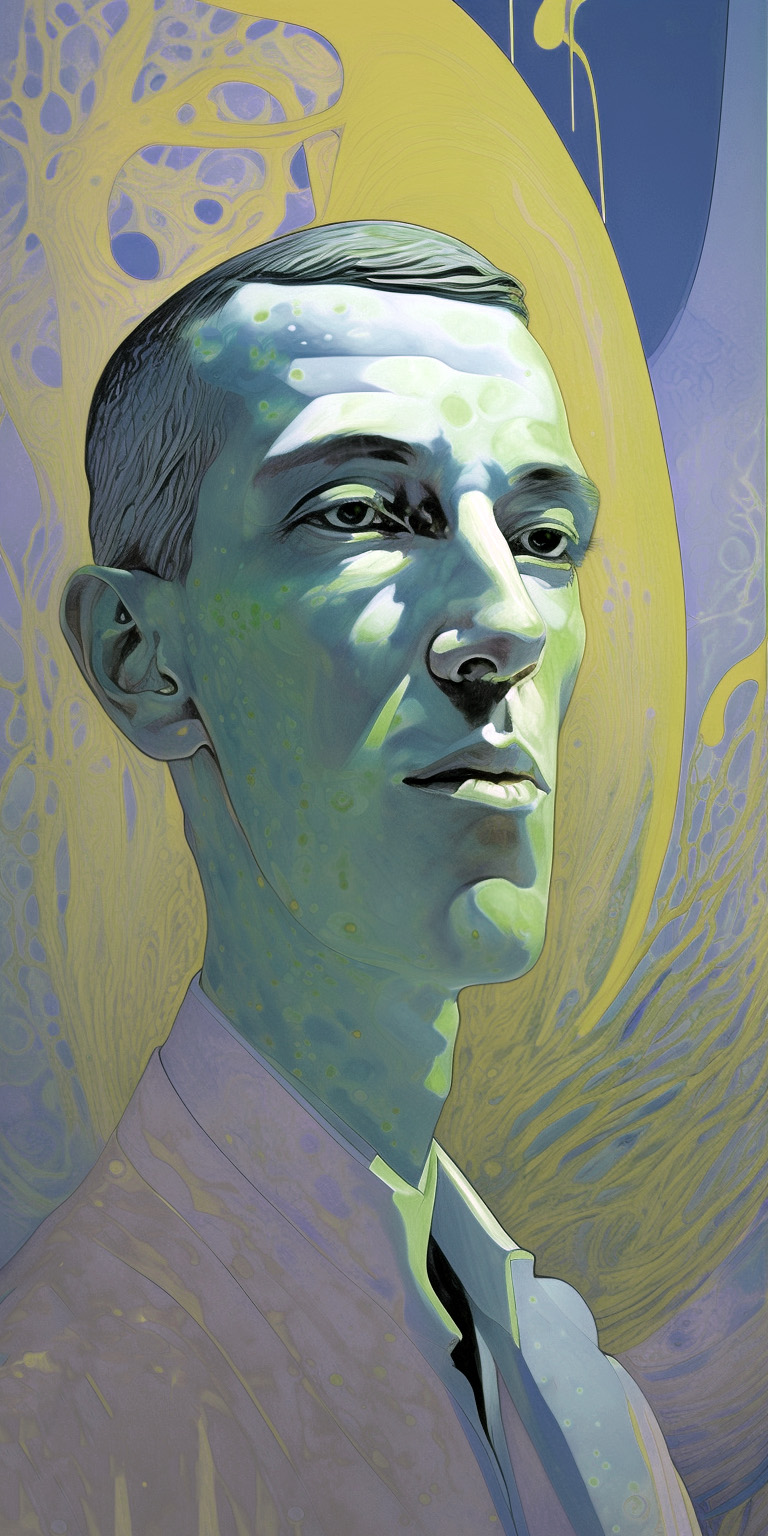
Does Stable Diffusion 2.1 768 know what Lovecraft looks like, with a simple name prompt of ((H.P. Lovecraft)) ? After all the hoo-ha about celebrity pictures and name-tagging being removed from the training of SD 2.x? Well… yes, sort of. The results are not bad, considering how few good pictures there are of him. But not great.