Friend Of Ol’ Marvel

The U.S. radio stations are reporting the passing of the great Stan Lee, of Marvel Comics fame, whose comics gave such enjoyment and edification to… millions? Probably billions, actually. His comics certainly very strongly and positively shaped the imagination of millions of the more imaginative kids in the generation who grew up between 1960 and 1980. I was one of them. His ‘Marvel Method’ and lack of condescension to readers changed the industry. Not many leave a legacy, in popular storytelling, as huge as the one that he has left us.

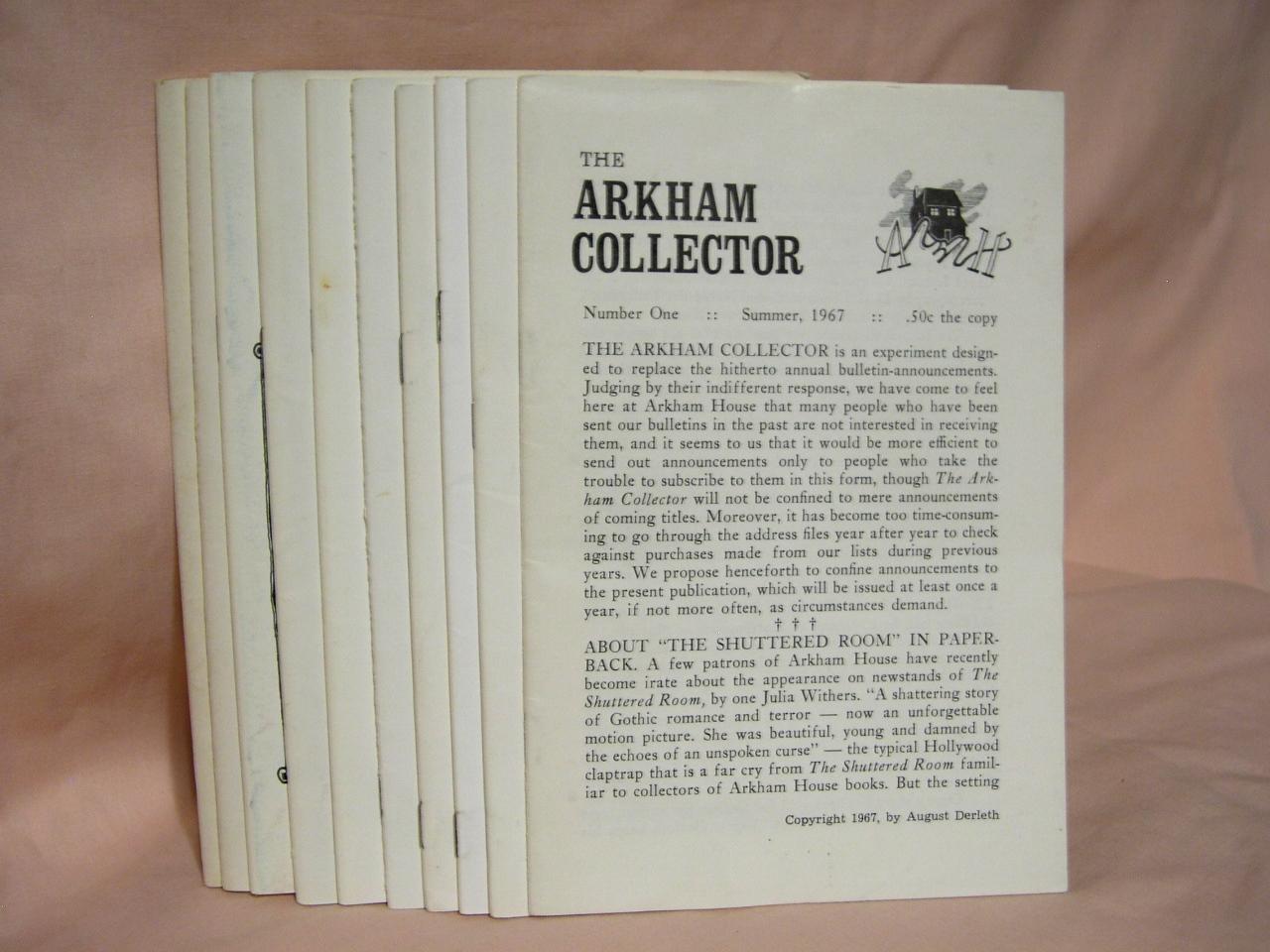
Arkham Collector

Arkham Collector #5, free on Archive.org. It’s nice to get a look at one, and see that it was a very neatly presented little zine. Issued by August Derleth in the summer of 1969, as a hub for interest in Arkham House. Complete with poetry, and some Mythos shorts, and even the occasional b&w photo.

I was disappointed that this was the only issue on Archive.org. Wikipedia informs me that “A hardbound volume in an edition of 676 copies (issued without dustjacket), collecting the entire run of ten issues, was published by Arkham House in 1971.” Judging by pictures of that, the hardback binding may have been rather tight into the gutter, though. As such, if I were a collector I think I’d prefer to have a set of the loose pamphlet editions in a slipcase…

George Julian Houtain in the movies

I’ve found another interesting little nugget about the connections of the Lovecraft Circle with the movie business in New York City. Arthur Leeds had been in the movies there, and Everett McNeil (who Leeds employed at one time) had been an experienced screenwriter. Now I find that George Houtain was also once in the movie business. He was an amateur journalism colleague who later published Lovecraft ‘shocker’ stories in Home Brew. But only a few years earlier he was head of Gray Seal Productions, before the industry moved west. This appears to be a new discovery.

Not only that, but Houtain employed another Lovecraft colleague in 1919…

“Dench Joins Gray Seal, Inc. President George Julian Houtain announces the appointment of Ernest A. Dench” “Mr. Dench will handle the special publicity of the Gray Seal stars, who include Myrtle Stedman, Wheeler Dryden, Grace Harte and Richard Turner.” — Moving Picture World (March 1919).

Wheeler Dryden, you’ll recall, attended a number of meetings of the Kalems with Lovecraft. Motion Picture News (April 1919) reported that Dench resigned this “special publicity” role after a few weeks, due to taking an extended trip back to England…

Dench must have either primed the files with some stories before he went, or returned soon, as an article by him in favour of Gray Seal appeared in Photo-Play Journal (July 1919). It reveals the address of Gray Seal…

Gray Seal Productions made a number of movies with the comedy star Wheeler Dryden, Chaplin’s half-brother. Dryden reportedly made 26 comedy shorts for Gray Seal in 1919. Myrtle Stedman was an “old time” star, having “been associated with the industry since its earliest days”, and presumably played older women. Grace Harte was a young society girl who was a “find” of Houtain’s. Richard Turner was the leading man and also a production supervisor.

It appears the company may have been named for a memorable gangster/crime movie character, “The Gray Seal” (1916). The brand doesn’t appear to have survived the industry’s move to the west of America. Houtain, along with Leeds, Dench and McNeil stayed in New York City. As mentioned above, Wheeler was Charlie Chaplin’s brother and is known to have attended many meetings of Lovecraft’s circle, the Kalem Club in the mid 1920s. So it appears that he also stayed and was in New York at least in 1925/26, but Chaplin historians may know more about his movements at that time.


The above adds to my “How did H.P. Lovecraft come to know McNeil?” section in my book Good Old Mac, on the life and work of Everett McNeil.

Man-Gods from Beyond the Stars (1975)

In the 1970s Lovecraft’s burgeoning reputation must surely have both benefited from and fed into the ‘ancient astronauts’ fad. Jason Covalito had a book-length survey of that nexus of influence, which arose mostly from the Morning of the Magicians (1960) and then fed forward, in his The Cult of Alien Gods: H.P. Lovecraft And Extraterrestial Pop Culture (2006, and I see that this is now available as an ebook).

An exemplar of this 1970s sub-genre, which reached even those not likely to read text-heavy and expensive UFO-ology paperbacks, was the fine $1 comic-magazine Marvel Preview #1, “Man-Gods from Beyond the Stars” (1975). I remember having a copy of this as a youth, a copy now long gone.
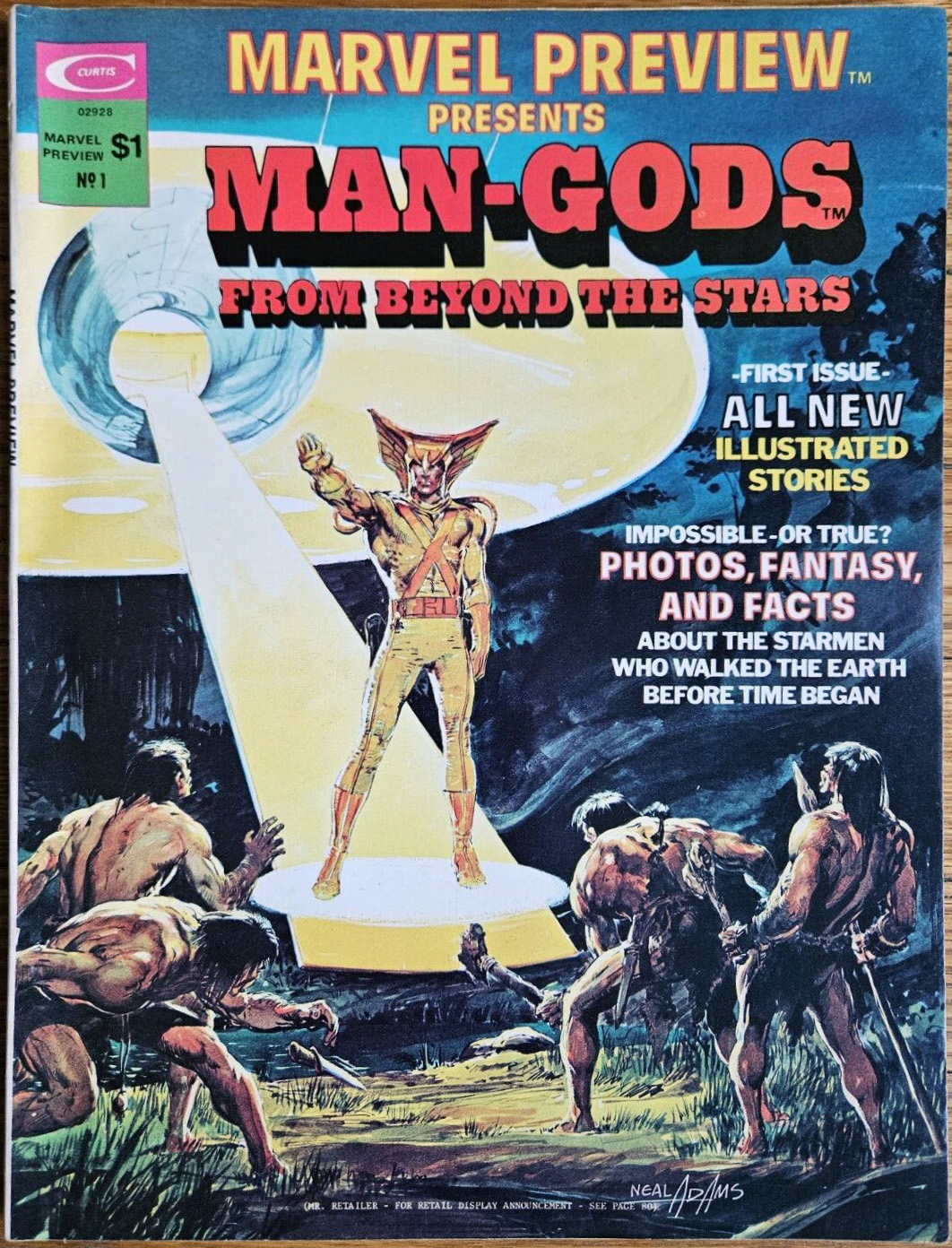
Marvel Preview was an oversize magazine-style b&w comics title, intended to test ideas for titles that would reach more mature audiences outside the censorship of the loosening Comics Code. Notable later in the run were two Sherlock Holmes (#5-6, 1976) and a fine John Buscema take on Merlin the wizard (#22, 1980).

Preview is now mostly known for launching the Star-Lord character (#4), but this first standalone “Man-Gods” issue riffed on the ancient astronauts theme with a long Doug Moench tale from a basic Roy Thomas concept/plot, beautifully illustrated by Alex Nino. The excellent letterer doesn’t appear to be credited, and so may have been Nino himself.

Page 2 had a full-page Lovecraft poster-quote from “The Call of Cthulhu”, against Easter Island statues. As well as the lead comic there was also a profile and timeline for the best-selling ‘ancient astronauts’ author von Daniken, and capsule reviews of all the key books for and against the ‘ancient astronauts’ theory (which in the 1960s and early 70s could still be deemed ‘undecided’ by many, including Carl Sagan, rather than ‘crackpot’). At the back there was a nicely-done modern monster-heavy tribute to the old EC-style ‘planet explorer’ tales.

Apparently the same issue was re-printed for Australia in 1981. There are evidently a lot of copies about on eBay in paper, but they appear to be priced at silly ‘ooh gosh, Neal Adams cover art’ prices. Anyway, if you squint the following set of page scans are just about readable, and have the whole of the issue’s central story…

Part 1.

Part 2.

Part 3. Conclusion.

Not much Lovecrafting here, other than the general theme and some archaeological interludes, and it’s more of an exemplary short science-fiction mash-up of space-gods and ‘sabre-tooth-tiger’ prehistory. Jack Kirby, also at Marvel, would explore similar ideas in his The Eternals (first issue July 1976).


One of the Amazon reviews for The Cult of Alien Gods: H.P. Lovecraft And Extraterrestial Pop Culture (2006) is a cursory one but points out that Garrett P. Serviss’s Edison’s Conquest of Mars (1898) proto-pulp Edisonade got there first with such ideas…

“Edison’s “Conquest of Mars” has the Martians coming to Earth in the distant past, abducting humans, and then hanging around to build the pyramids of Egypt”.

That Lovecraft read Serviss’s book as a boy is highly likely (see my chapter on Lovecraft and Serviss, a favourite author in his youth and ‘the Carl Sagan of his day’, in my book Lovecraft in Historical Context #4). And there was a book reprint of Edison’s Conquest of Mars in a 1,500-copy limited edition in 1947, which was advertised for several years in the likes of Weird Tales. Its reprint edition would have been about the right time to hit France in the mid 1950s, if only as book reviews (Morning of the Magicians was written c. 1955-59 and published 1960 in French). But Covalito’s book convincingly shows that the Morning of the Magicians authors were strongly influenced by Lovecraft.

In theory then the route(s) of influence to von Daniken could be many:

Serviss [1947] -> Morning of the Magicians [mid 1950s] -> von Daniken’s ‘ancient astronauts’ [1960s].

Serviss [1898] -> Lovecraft [1920s] -> Morning of the Magicians [mid 1950s] -> von Daniken’s ‘ancient astronauts’ [1960s].

The most likely is, cumulatively:

Serviss [1898] -> Theosophy [1920s] -> Lovecraft [1920s] -> + more Theosophy and other 1930s historico-mystic currents [1930s and 40s] -> Morning of the Magicians in English [1963] -> other French copycats of Magicians [mid 1960s] -> von Daniken’s ‘ancient astronauts’ [later 1960s].

But quite whether the bulk of the 1970s UFO-logists bothered to look any further back than von Daniken after his 1971 American paperback and cinema movie, who knows? There was also an American documentary of the increasingly popular book, the TV programme In Search of Ancient Astronauts (NBC, 1973).

Though we do know that Terrence McKenna was influenced early by Lovecraft (see the memoir The Brotherhood of the Screaming Abyss), and many of the more literate hippies must have at least tried to read Lovecraft once he was in affordable paperback form. Some key Lovecraft ideas had also filtered through into Arthur C. Clarke’s trans-cosmicism — which had its own ‘ancient contact’ symbolism such as 2001‘s monolith among the primitive man-apes — so there may be more wormholes of influence to be considered there. Carl Sagan’s famously lyrical Cosmos TV series probably also had an influence (see Cosmos: Podcast Edition – Carl Sagan for a good audio-only version), with Sagan highly sceptical of post-1940s UFO contacts but not of alien civilisations per se.

Nor should we underestimate the power of oral transmission, in terms of the influences swirling through the tight but far-travelling counter-culture of the UFO-logists. I guess there must be good histories of ‘serious’ UFO-ology by now, which might tell us more about that swirl. But I expect that research on the now-unfashionable ‘ancient astronauts’ wing and the influence of Lovecraft is likely greatly hampered by big gaps in memory, caused by: i) the inevitable natural memory loss and distortion caused by age; ii) the natural ephemerality of the counter-culture’s diaries and suchlike; iii) the psychedelic drugs of the time (summed up in the saying “if you can remember the 1960s, you weren’t there”); and iv) the later 1970s heroin epidemic which burned through so many urban hippies.

Apparently this half-baked stuff is still popular, mainly through a rather shallow American TV ‘documentary’ series called Ancient Aliens. I’ve never seen that series, and didn’t even know it existed until today. It’s said that even ‘serious’ UFO-ologists shun the ‘ancient astronauts’ believers as a ‘fringe of a fringe’, but I guess it has some passing entertainment value as “what if?” TV pseudo-archaeology for the masses. Although, as Lovecraft suggested several times in his letters, such wild real-world historical-conspiracy theory is really best confined to speculative fiction which is its proper home.

It’s possible that such ideas won’t just be confined to junk TV and swivel-eyed YouTube channels in the near future. On the 50th anniversary of von Daniken’s book, Hollywood is obviously currently sniffing around the sub-genre, with Prometheus already leading the way and a proposed movie-trilogy based on Kirby’s Eternals comics being mooted.

Europe

The long-running Europe literary journal had a Lovecraft and Tolkien special in April 2016 (No. 1044), with essays in French.

J.R.R. Tolkien et Georges Dumezil.
J.R.R. Tolkien et (l’)Europe.
Peut-on (re)traduire J.R.R. Tolkien?
Tolkien et la fantasy, encore et toujours.

H.P. Lovecraft et l’imaginaire Americain.
Lovecraft a l’ecran.
Le jour ou Cthulhu a traverse les Pyrenees.

Une reinvention du fantastique.
Entre la magie et la terreur.

Plus many reviews and lecture reports.


J.R.R. Tolkien and Georges Dumezil.
J.R.R. Tolkien and Europe.
Can we (re)translate J.R.R. Tolkien?
Tolkien and fantasy, again and again.

H.P. Lovecraft and the American imagination.
Lovecraft and the screen.
The day Cthulhu crossed the Pyrenees.

A reinvention of the fantastic.
Between magic and terror.

HPL in colour: the rural gardener

My first try at colourising the scan of the Vrest Orton ‘milkmaid’ picture. It is September 1928, and HPL is again visiting Vrest Orton in the woods of Vermont, and is wearing a wooden yoke of the type traditionally used to carry milk-pails.

   “The change of plan began when a friend of mine — now resident in New York but spending the summer in his ancestral Vermont — fairly kidnapped me into a two weeks’ visit at a lonely farm he had hired in the exquisite countryside near Brattleboro. In this half-fabulous paradise of endless green hills and wild, brook-haunted glens, it is needless to say that my nerves recovered very substantially from the strain of New York. […] I now drank in to its fullest extent the miraculously preserved early-American life of the region.” — letter of 28th July 1928.

   “No more likeable, breezy, & magnetic person ever existed than he [Vrest Orton]. In person of smallish size; dark, slender, handsome, & dashing, he is clean-shaven of face & jauntily fastidious of dress … He confessed to 30 years, but does not look more than 22 or 23. His voice is mellow & pleasant … & his manner of delivery sprightly & masculine — the careless heartiness of a well-bred young man of the world. … A thorough Yankee to the bone, he hails from central Vermont, adores his native state and means to return thither in a year, & detests N.Y. as heartily as I do. His ancestry is uniformly aristocratic — old New England on his father’s side, & on his mother’s side New England, Knickerbocker Dutch, & French Huguenot.” — letter quoted in I Am Providence.

One can see, if one looks closely, that the “smallish” Vrest is standing on a slightly raised lawn, about four inches higher than HPL, in the picture. Thus they appear to be about the same height. Some tactful visual height compensation has obviously been neatly arranged by the photographer. He also likely has boot-heels that add another inch, whereas HPL appears to have flatter old walking shoes.

This picture was made at a time when he was helping Orton to dam a hillside stream and divert it to make a new pool, so it also reflects that labour.


Postcard sent by Lovecraft during his 1928 stay with Vrest…

The Doom of London (1903-04)

New on LibriVox, a free audiobook for The Doom of London, with a fine American reader…

“Here are six stories, each one describing a disaster afflicting London, that were popularly serialized during 1903-1904 in Pearson’s Magazine. The tales depict (1) a deep freeze and unprecedented snowfall; (2) a heavy, blinding, paralyzing blanket of fog; (3) a widespread killer virus; (4) a fraudulent scheme causing financial panic; (5) a minor electrical accident in a tunnel that spirals into catastrophe; and (6) most of the city’s water supply, reportedly contaminated with deadly bubonic bacillus, puts the population in great fear of plague.”

Archive.org also has the same as a torrent. I see that they also have the book The London Fog: A Biography (2015), which has a few pages of details of ‘fog doom’ London tales of previous decades, such as Barr’s earlier 1890s “The Doom of London”.

Likely to appeal to those who were interested in my London Reimagined, the fog-shrouded London of Sherlock Holmes and H.G. Wells, and possibly even fans of more recent movies such as the enjoyable action-thriller London has Fallen (2016).

Friday “picture postals” from Lovecraft: Keith’s Theatre

“I am not much of a vaudeville follower, but it happens that I saw him [Houdini] at the old Keith’s Theatre here nearly a quarter of a century ago [c. 1905] it must have been at the very outset of his career, for he was not then especially well known.” — H.P. Lovecraft, letter to Henneberger, 2nd February 1924.

Poster (apparently genuine?) advertising Houdini’s 1905 tour, in this case the Newport stop in New England. The word “Metamorphosis” would surely have caught the 15 or 16 year-old Lovecraft’s eye.

Vintage Portuguese Lovecraft, 1941?

The cover for The Case of Charles Dexter Ward in Portuguese translation, published from Lisbon in (apparently) 1941.

The Lovecraft bibliography has this as “1958?”, but the eBay seller who provided this scan and who had the book to hand stated 1941. Colour covers during wartime seems a little unlikely, though. But possibly they were expected on paperbacks in Brazil and wouldn’t sell well without colour?

An article on Lovecraft in Portuguese suggests “1956”, and — although that claim is unreferenced — the date does seem to match the illustration style and the use of colour.

Some 2019 anniversaries

50 Years (1969):

* Foundation of Panther in the UK and Ballantine in the USA, both publishers who did sterling work to bring H.P. Lovecraft, R.E. Howard, and the writers of the Lovecraft Circle, to the masses.

* Arkham publishes its two-volume Tales of the Cthulhu Mythos, the first multi-author Mythos anthology book.

* French literary journal Le Cahier de l’Herne famously devotes its entire issue to Lovecraft.

80 Years (1939):

* Arkham House founded in 1939, and the first title published — The Outsider and Others.

100 years (1919):

* Lovecraft publishes the story “Dagon”.


(My thanks for Martin A. for correcting my ‘slip of the memory’ on “Dagon”. When first published the above post said the story was written in 1919. The story was, of course, published in 1919).