Europe

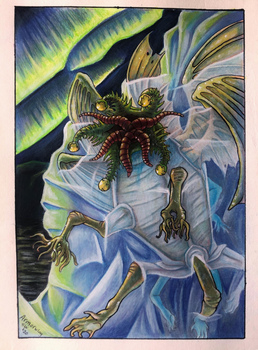
The long-running Europe literary journal had a Lovecraft and Tolkien special in April 2016 (No. 1044), with essays in French.

J.R.R. Tolkien et Georges Dumezil.
J.R.R. Tolkien et (l’)Europe.
Peut-on (re)traduire J.R.R. Tolkien?
Tolkien et la fantasy, encore et toujours.

H.P. Lovecraft et l’imaginaire Americain.
Lovecraft a l’ecran.
Le jour ou Cthulhu a traverse les Pyrenees.

Une reinvention du fantastique.
Entre la magie et la terreur.

Plus many reviews and lecture reports.


J.R.R. Tolkien and Georges Dumezil.
J.R.R. Tolkien and Europe.
Can we (re)translate J.R.R. Tolkien?
Tolkien and fantasy, again and again.

H.P. Lovecraft and the American imagination.
Lovecraft and the screen.
The day Cthulhu crossed the Pyrenees.

A reinvention of the fantastic.
Between magic and terror.

HPL in colour: the rural gardener

My first try at colourising the scan of the Vrest Orton ‘milkmaid’ picture. It is September 1928, and HPL is again visiting Vrest Orton in the woods of Vermont, and is wearing a wooden yoke of the type traditionally used to carry milk-pails.

   “The change of plan began when a friend of mine — now resident in New York but spending the summer in his ancestral Vermont — fairly kidnapped me into a two weeks’ visit at a lonely farm he had hired in the exquisite countryside near Brattleboro. In this half-fabulous paradise of endless green hills and wild, brook-haunted glens, it is needless to say that my nerves recovered very substantially from the strain of New York. […] I now drank in to its fullest extent the miraculously preserved early-American life of the region.” — letter of 28th July 1928.

   “No more likeable, breezy, & magnetic person ever existed than he [Vrest Orton]. In person of smallish size; dark, slender, handsome, & dashing, he is clean-shaven of face & jauntily fastidious of dress … He confessed to 30 years, but does not look more than 22 or 23. His voice is mellow & pleasant … & his manner of delivery sprightly & masculine — the careless heartiness of a well-bred young man of the world. … A thorough Yankee to the bone, he hails from central Vermont, adores his native state and means to return thither in a year, & detests N.Y. as heartily as I do. His ancestry is uniformly aristocratic — old New England on his father’s side, & on his mother’s side New England, Knickerbocker Dutch, & French Huguenot.” — letter quoted in I Am Providence.

One can see, if one looks closely, that the “smallish” Vrest is standing on a slightly raised lawn, about four inches higher than HPL, in the picture. Thus they appear to be about the same height. Some tactful visual height compensation has obviously been neatly arranged by the photographer. He also likely has boot-heels that add another inch, whereas HPL appears to have flatter old walking shoes.

This picture was made at a time when he was helping Orton to dam a hillside stream and divert it to make a new pool, so it also reflects that labour.


Postcard sent by Lovecraft during his 1928 stay with Vrest…

The Doom of London (1903-04)

New on LibriVox, a free audiobook for The Doom of London, with a fine American reader…

“Here are six stories, each one describing a disaster afflicting London, that were popularly serialized during 1903-1904 in Pearson’s Magazine. The tales depict (1) a deep freeze and unprecedented snowfall; (2) a heavy, blinding, paralyzing blanket of fog; (3) a widespread killer virus; (4) a fraudulent scheme causing financial panic; (5) a minor electrical accident in a tunnel that spirals into catastrophe; and (6) most of the city’s water supply, reportedly contaminated with deadly bubonic bacillus, puts the population in great fear of plague.”

Archive.org also has the same as a torrent. I see that they also have the book The London Fog: A Biography (2015), which has a few pages of details of ‘fog doom’ London tales of previous decades, such as Barr’s earlier 1890s “The Doom of London”.

Likely to appeal to those who were interested in my London Reimagined, the fog-shrouded London of Sherlock Holmes and H.G. Wells, and possibly even fans of more recent movies such as the enjoyable action-thriller London has Fallen (2016).

Friday “picture postals” from Lovecraft: Keith’s Theatre

“I am not much of a vaudeville follower, but it happens that I saw him [Houdini] at the old Keith’s Theatre here nearly a quarter of a century ago [c. 1905] it must have been at the very outset of his career, for he was not then especially well known.” — H.P. Lovecraft, letter to Henneberger, 2nd February 1924.

Poster (apparently genuine?) advertising Houdini’s 1905 tour, in this case the Newport stop in New England. The word “Metamorphosis” would surely have caught the 15 or 16 year-old Lovecraft’s eye.

Vintage Portuguese Lovecraft, 1941?

The cover for The Case of Charles Dexter Ward in Portuguese translation, published from Lisbon in (apparently) 1941.

The Lovecraft bibliography has this as “1958?”, but the eBay seller who provided this scan and who had the book to hand stated 1941. Colour covers during wartime seems a little unlikely, though. But possibly they were expected on paperbacks in Brazil and wouldn’t sell well without colour?

An article on Lovecraft in Portuguese suggests “1956”, and — although that claim is unreferenced — the date does seem to match the illustration style and the use of colour.

Some 2019 anniversaries

50 Years (1969):

* Foundation of Panther in the UK and Ballantine in the USA, both publishers who did sterling work to bring H.P. Lovecraft, R.E. Howard, and the writers of the Lovecraft Circle, to the masses.

* Arkham publishes its two-volume Tales of the Cthulhu Mythos, the first multi-author Mythos anthology book.

* French literary journal Le Cahier de l’Herne famously devotes its entire issue to Lovecraft.

80 Years (1939):

* Arkham House founded in 1939, and the first title published — The Outsider and Others.

100 years (1919):

* Lovecraft publishes the story “Dagon”.


(My thanks for Martin A. for correcting my ‘slip of the memory’ on “Dagon”. When first published the above post said the story was written in 1919. The story was, of course, published in 1919).

Frank E. Schoonover: American Visions

“Frank E. Schoonover: American Visions” is a survey exhibition of over 80 original works, from a life’s work of over 2,000 pictures. The show runs 10th November 2018 until 27th May 2019 at the Norman Rockwell Museum (about 75 miles north of New York City). Mostly westerns, medieval, pirates, in the Howard Pyle manner, but he also did some science fiction. The Schenectady Daily Gazette has a well-written profile of the artist — which I’m pleased to see is also available to those in the UK and Europe, at a time when many small U.S. newspaper websites are blocking overseas visitors.

A John Carter of Mars illustration, with a faintly Lovecraft-like character visiting the hero.

10th Algeciras Fantastika – a Lovecraft special

Two reports of a Spanish Lovecraft event, translated and condensed…


The Guillermo Perez Villalta Building, host of the 10th International Fantastic Arts and Terror event Algeciras Fantastika, yesterday [Nov 2018] hosted the literary tribute to the American writer Howard Phillips Lovecraft. The director of the festival, Angel Gomez, together with other collaborating writers such as Juan Emilio Rios, Carmen Sanchez, Jorge Sanchez, Miguel Angel Planas and Juan Luis Helguera, honored the classic author through the reading of poems, sketches and short stories. Gomez recalled that this literary tribute of Algeciras Fantastika is one of its most traditional moments, and has previously celebrated and honoured famous artists such as Edgar Allan Poe, Gustavo Adolfo Becquer, Ray Bradbury and H.G. Wells.

The Algeciras Fantastika 2018 festival is a multidisciplinary cultural event specializing in fantasy, suspense, terror and science fiction, organized by the City Council of Algeciras and the University of Cadiz (UCA). Angel Gomez Rivero, director of the event, highlighted the extensive program of Algeciras Fantastic, “in which we can enjoy screenings of short films and feature films, the Little Mystics children’s literary contest, exhibitions of illustrations by Jesus Merino, the literary tributes of H.P. Lovecraft, and the tributes to the film director Miguel Angel Vivas and the actor Manuel Galiana.”

[Algeciras Fantastic also offers a] retrospective session on The Cinema of H.P. Lovecraft, in which a palace containing the spirits and the monster of terror will be screened. [Then on] The last day of Algeciras Fantastika 2018 a retrospective Lovecraft double-bill screening, with projections of The Resurrected and The Whisperer in Darkness, both in original version with Spanish subtitles.

Theology and horror – call for abstracts

A call for abstracts, for the academic book Theology and Horror.


Explorations of the relationship between religion and horror are fairly well established. However, this is not the case for theology and horror. Many times explorations of theology and horror involve simplistic readings in which theological concepts or doctrines are spotted within horror narratives and noted as points of connection. While this approach has its place, great possibilities exist for going deeper and wider in the exploration of horror and theology.

[The book will explore] how theology is present in horror [and suggest] how theology can be changed and shaped by an interaction with horror. [It will be] co-edited by John Morehead and Brandon R. Grafius. Morehead is the proprietor of TheoFantastique.com, and is a contributor, editor and co-editor to a number of books including The Undead and Theology, Joss Whedon and Religion, The Supernatural Cinema of Guillermo del Toro, and Fantastic Fan Cultures and the Sacred (forthcoming). Grafius is assistant professor of Biblical Studies at Ecumenical Theological Seminary.

Abstracts of 300-500 words with CVs should be sent to johnwmorehead@msn.com and bgrafius@etseminary.edu by 15th January 2019. The submission deadline for drafts of manuscripts of 6,000-8,000 words is scheduled for 1st September 2019.

More on McNeil

Found, a new biographical peice from Everett McNeil of the Lovecraft Circle. It was published in The Trestle Board, 1887. We might imagine that this anecdote of childhood tobacco poisoning was one that the Lovecraft Circle heard at least once, during their long coffee and tobacco-fuelled meetings in McNeil’s rooms in the mid 1920s. From it we can glean just a few more biographical details. We already knew his father was an accomplished prize-winning farmer, but here McNeil confirms that his father David McNeil grew significant amounts of tobacco, and that there was a hired farm-hand ‘living in’ with the family.

And another new article by McNeil is found in Moving Picture News in 1912. At this point he is still part of the movie industry (then still largely in New York City) where he works as a highly experienced scenarist (in modern terms, a screenwriter). 1912 was a couple of years before his move to the Edison studio to work under Arthur Leeds. Here he complains about cinemas that run the film ‘fast’, in order to put on extra showings, and hints at industry prosecutions of the exhibitors.

Again, one imagines that in the mid 1920s the Lovecraft Circle heard McNeil’s memories of encountering his own movies being shown at high-speed, back during his movie-making years. Possibly (with the bitterness erased by the years in between) such memories were recounted by him in a rather more comic manner than previously, focussing on the laughably speeded-up antics?

The above are in addition to my book on McNeil and his career, Good Old Mac.