Tecnicus Street Studios has recently been hand-sculpting Lovecraft and a tentacular Azathoth, and has well-lit speeding-up timelapse videos of the process.



06 Thursday Dec 2018
Posted in Lovecraftian arts, Podcasts etc.
Tecnicus Street Studios has recently been hand-sculpting Lovecraft and a tentacular Azathoth, and has well-lit speeding-up timelapse videos of the process.
05 Wednesday Dec 2018
Posted in Scholarly works
* T. W. Melvaer, “Imagining the Unimaginable: Lovecraft in Popular Culture”, Masters dissertation for the Norway Technical and Natural Sciences University, 2018. (Surveys the use of Lovecraft and Cthulhu in recent popular culture: Rick and Morty; South Park; Batman: The Doom That Came to Gotham; and the videogame Darkest Dungeon).
* J. R. C. Pacheco, “Apropiaciones Lovecraftianas de temas teosoficos”, Melancolia, Vol. 3, 2018. (In Spanish. A student of the Center for the Study of Western Esotericism discusses theosophical references in Lovecraft, especially… “Blavatskian anthropogenesis and the myth of the Book of Dzyan”).
04 Tuesday Dec 2018
Posted in New books, Scholarly works
The new book Holy Monsters, Sacred Grotesques: Monstrosity and Religion in Europe and the United States is one of those elite $115 essay collections seemingly aimed at collecting dust in University and (in this case) ecclesiastical libraries.
I’ve only just noticed it, and see that it appeared in the summer of 2018. It’s only of interest here for the one chapter: “Lovecraft’s Things: Sinister Souvenirs from Other Worlds” by Jeffrey Andrew Weinstock. Curiously an essay of the same title, and by the same author, also appeared in the similar (though now rather less costly) book collection The Age of Lovecraft (2016), so the 2018 essay seems to be a reprint — though I suppose it could also be revised and/or expanded version.
For those wondering what’s in that essay, since the new book has no previews as yet… after introductory and theoretical ‘thing theory’ sections, the final third of Weinstock’s Age of Lovecraft essay surveyed Lovecraft’s re-use of the stock Gothic props of the Castle (“Rats”), the Portrait (“Pickman”), and the Forbidden Book (guess), especially in terms of their uncanny quasi-personification in Lovecraft’s texts. It is suggested that such a form of personification might raise in Lovecraft’s readers a dimly resonant recall of a superstitious world, a world in which liminal objects and object-places (such as castles) had once been psychologically ‘enchanted’ with both dread and wonder. Such personification of earthly ‘things’ might also be understood as foreshadowing Lovecraft’s later deployment of monstrous cosmic forces in his fiction, outer entities that indifferently understand humans only as ‘things’. (The essay somewhat feeds into academic theory’s current notions of trans-species psychology, a future eco-animism, and a post-human planet).
03 Monday Dec 2018
Posted in Lovecraftian arts, Odd scratchings
New on Archive.org, the Amateur Correspondent for May-June 1937 (Vol. 2, No. 1), with H.P. Lovecraft on the cover in the now well-known Virgil Finlay cover art. Inside this issue of “the magazine for the amateur fantasy writer” is a lively short tribute to Lovecraft from E. Hoffmann Price. Lovecraft had died a few months earlier in March 1937, so this issue was a tribute issue. But not wholly so when one looks inside — the reader senses that the news of the death was then still slowly percolating through fandom.

Archive.org also has the Amateur Correspondent for November-December 1937 (Vol. 2, No. 3) with Clark Ashton Smith giving lengthy advice to writers on “Atmosphere in Weird Fiction”.
03 Monday Dec 2018
Posted in Historical context, Scholarly works
A newly-republished essay on “The Political Thought of Edgar Allan Poe” which has until now been locked up in an obscure paper journal published in the 1990s. It seems like a useful addition for those reading Joshi’s Decline of the West, the key book on Lovecraft’s politics and philosophy, and who might be left wanting an overview of what Lovecraft could have taken from his idol Poe — beyond the obvious inheritance of the fictional style/settings and the aesthetic repertoire.
 Poe’s room at the University of Virginia. A Creative Commons Attribution image which is set to be removed in the Flickr-purge in January 2019.
02 Sunday Dec 2018
Posted in Unnamable
Oh dear. In the latest Scientific American the lead editorial article seriously suggests that we ditch the un-spellable and un-pronounceable “anthropocene” blahword… and replace it with something even more un-pronounceable…
the Chthulucene … an age in which we teach ourselves to live in full and rich harmony
Not to be confused with the Cthulhucene, in which Plush Cthulhu will gather around the campfires with happy rainbow-tailed LOLcats, to intersection-ally knit muesli together and sing ‘Kumbaya my Lord…’ while cuddling their therapy-shoggoths.
Judging by the piece, the editors of Scientific American are being serious and obviously have no clue at all about Cthulhu, and why he might make their dippy “Chthulucene” proposal just a little bit untenable for a mass audience.
02 Sunday Dec 2018
Posted in Lovecraftian arts
Jonathan Thomas’s Tempting Providence and Other Stories is a 2010 story collection which I don’t think I was aware until now. But on reading the blurbs, the title story certainly appeals.
Apparently the story “Tempting Providence” is the best of what the Publishers Weekly called an “uneven” bunch. Amazon reviewers appear to concur about the unevenness. Although I see many glowing nuggets of praise plucked from magazine reviews, and that Thomas is in the “Elite” of recent writers according to Joshi’s new book 21st-Century Horror: Weird Fiction at the Turn of the Millennium. So he seems worth a look.
In the well-regarded title story, it is said, the wistful ghost of H. P. Lovecraft returns to modern Providence. He finds that a herd of real-life horrors have been allowed to run rampant across his beloved city. He lyrically compares the dehumanised modern city to the old Providence he knew so well. What a fine idea for a story. Thomas is a native of Providence, and thus the topographic and architectural details must be presumed to be accurate to a level that only a local could attain.

I’d definitely like to read this story at some point, and there’s a £5 ebook. Though no audiobook, or a 99 cent audio reading of just that story. I see that it’s the third story in the book, so I can’t get it free just by weaselling the free 10% ebook sample from Amazon.
But my finances dictate that the book is one for my WishList at present, since I recently had to spend £130 to replace an old computer monitor than died. Nice to see a big version of the book’s cover, though, simply in terms of a tasty bit of Providencial Lovecraftian art presented within an adequate design framework (though I would have improved the use of type, such as by reducing the huge gap between the words ‘Tempting’ and ‘Providence’). Self-publishing is drifting into a dangerous disregard for the needs of book cover design and typography, in my view, though this fine cover from Hippocampus shows how appealing a cover can be to potential readers. I doubt I’d have stumbled on the book, in image search, if it hadn’t been for seeing a thumbnail image of the cover. The cover is your primary initial marketing hook, and it should not be neglected just because Amazon often chooses to annoyingly whisk the reader to the start of the body text when they first open a purchased ebook.
The cover art is by Thomas S. Brown, who I’m pleased to discover is both British and on DeviantArt with a fine big Gallery that I had never seen before (despite much regular burrowing into DA for Digital Art Live magazine). Brown’s Gallery has a delightfully Lovecrafty version of the famous ‘death of Chatterton’ paintings…

There’s also a darker ‘age stained’ version of the picture, something that perhaps reflects the fact the the original also exists in several versions. I saw the original of the Birmingham version of the ‘death of Chatterton’ many years ago, up close and at leisure. I hazily recall that it was unexpectedly small, but also magnificently detailed.
01 Saturday Dec 2018
Posted in Lovecraftian arts, Odd scratchings

That rather nice comics panel I showed here a while back can be translated to English.
01 Saturday Dec 2018
Posted in Maps, Odd scratchings
The eastern part of America, visualised as a map of the Greyhound long-distance bus routes for 1935.
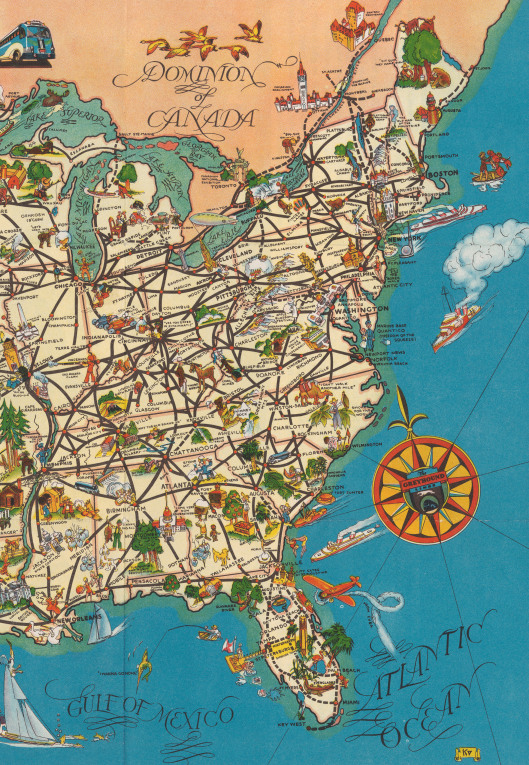
Lovecraft was, of course, an experienced bus-hopper in the summer months. Though in his later years his poverty could usually only countenance the cheaper options for such transport, and the Greyhound lines were not the cheapest….
“We’ll have to investigate Chauncey. Westerly coaches pass through Hope Valley (so do the New York Greyhounds), but the fare is probably rather formidable.” — letter to Morton, January 1933.
He may also have juggled a cheaper fare by not going all the way…
“I generally proceed by coach out some main highway, then striking across country afoot till I reach another coach-bearing highway along which I can return. In this way I have explored many regions which I never saw before — some delectably-unspoiled” — 1933 letter.
Still, the map is indicative of the key destinations that could be reached by the long-distance coach-bus routes, and may be something to print out and slide in alongside the volumes of his letters. In order to keep track of him, as he reels off the more major placenames to his correspondents. The more fine-grained map of his home ground, which I posted here earlier, would be needed for the smaller little towns and settlements in Mass. and Rhode Island.
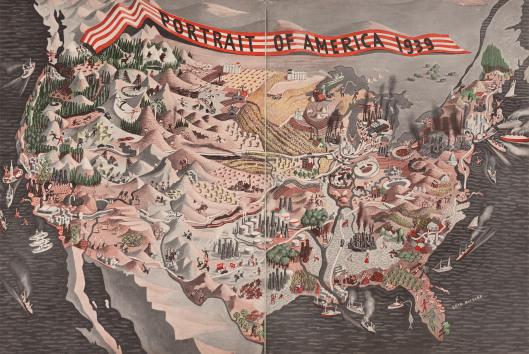
More generally useful, especially for those outside the USA, is an Erik Nitsche map of the ‘mental picture’ that Americans had of the nation’s patchwork of regions in 1939, without all the state lines confusing matters…
I also found a good map of the British Empire, as the Anglophile Lovecraft would have known and understood it, in a map of 1929…
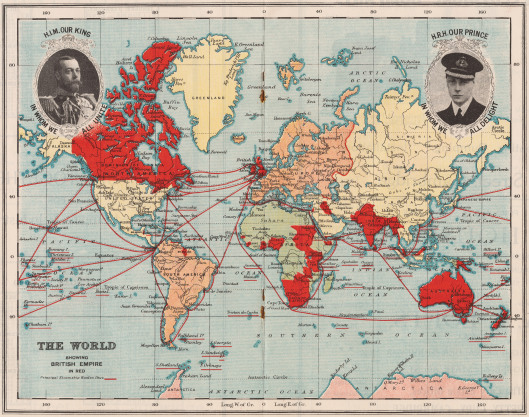
The dozy-looking “Prince in whom we all delight” turned out to be a duffer, but was replaced by someone better (see the excellent movie The King’s Speech for the story).
30 Friday Nov 2018
Posted in Lovecraftian arts, Podcasts etc., REH
Another audio experiment. This time it’s an experiment with the voice of a human reader, rather than a generated TTS robo-voice.
Text: Robert E. Howard’s “The Hyborian Age” (c. 1930s), in which Howard recounts the historical background for Conan.
Source: A full reading of “The Hyborian Age” in the form of the April 2018 public-domain Librivox recording. The Librivox reading was done by a young reader named ‘Klaatu’ whose voice I felt was not quite suited to the weight of the material. I added some pauses to this audio, for pacing, and I also had to remove one section in which a few lines of text had been repeated twice but not excised.
Task: To use the free audio software Audacity to try to change this higher Librivox voice down to a more suitably deep “Wayne June” style, if possible. Listeners to H.P. Lovecraft audiobooks will be familiar with Wayne June’s deep gravelly voice. More bass could of course be approximated on-the-fly in real-time with the likes of AIMP and its pitch-shift and bass-boost options, but here I wanted to see if a better result could be had by using the power of Audacity and its specialised plugins.
Workflow:
1) I added a “Wayne June” effect in Audacity with the free RoVee VoiceChanger plugin. Settings used are seen on the screenshot…

2) The result was certainly rather “Wayne June”, but was slightly ess-y in my high-response headphones. I then de-essed in Audacity, with the free Spitfish De-esser plugin.
3) There was some “bass bubble” on the pitch shifted reading. I tried the addition of suitable background music, as a subtle form of masking.
Conclusion: Successful, but not entirely so… mostly due to a little ‘more bubble than gravel’. A slightly lighter touch on the RoVee VoiceChanger settings might be tried next time. However, the level of the success suggested that longer audiobooks on Librivox could be “Wayne June-ised” with relatively little effort, and with more aesthetic success than pitch-shifting and bass-boosting in AIMP.
The result: A reading of R. E. Howard’s “The Hyborian Age” on Archive.org. 55 minutes.
30 Friday Nov 2018
Posted in Picture postals

Entrance to Wilbraham Academy, Mass. Note the curiously Eastern looking sculpture on the frontage, with the light-globe resembling a turban.
“I tarried eight days in Wilbraham, picking up many strange legends of great interest to me, since both Mrs. Miniter and Miss Beebe are expert in the curious folklore of that archaick region. I am at this very moment introducing one, as subsidiary colour, into a weird novelette I am writing. [This would become the famous “The Dunwich Horror”, set just east of Wilbraham and heavily inspired by the district.] I visited all the churchyards and burying places, and inspected the pleasing village of Wilbraham proper, where still flourishes the old academy founded in 1825.” — H.P. Lovecraft, “Observations on Several Parts of America”, in Lovecraft’s Collected Essays, Volume 4: Travel.
30 Friday Nov 2018
Posted in Odd scratchings
I hope you’ve enjoyed, and perhaps even profited, from reading Tentaclii this month.
I count 76 blog posts sent into the luminiferous aether during November 2018. With a total of 20,000 words, not counting the PDFs (such as my free chapter on Lovecraft and Zimbabwe). Some posts were quite substantial, and had new discoveries about the lives of those in the Lovecraft Circle. There was also a short (but very popular) post which surveyed the Black Friday sales.
If you can help me out with a $ or two per month via Patreon, please, then it would help greatly with the ginger-beer supply needed to fuel Tentaclii through another month of blogging.
Recommending Tentaclii in social media, and linking here, is also very useful.
Thanks again for reading!