Masterplots in PDF on Archive.org

Frank N. Magill’s 1964 15-volume Masterplots is now partially at Archive.org, in open public PDF download. It offers short and precise point-by-point plot summaries of great works, for use by writers needing ideas, for scholars needing a reliable recap, and for the general reader in search of worthy reading.

The series seems likely to be of interest to writers who read my blog, especially as many of the works summarised are now in the public domain. Their plots are thus available to be directly re-worked in new genre-shifted forms and formats. The summaries are far superior to those to be found on the likes of Wikipedia, which often have strong political biases and omissions or are simply inadequate.


15 volume Masterplots:

Masterplots Vol. 5 — Essa-Grea.

Masterplots Vol. 7 — Huon-Last.

Masterplots Vol. 13 — Scho-Sunk.

Masterplots Vol. 14 — Supp-Unfo.

Masterplots Vol. 15 — U.S.A.-Zule.

Archive.org also appears to have the missing volumes available for Archive.org members to ‘digitally borrow’. Although the books usually have poor metadata, often extending even to the titles, which can make it difficult to work out which volumes they are without actually going through and laboriously borrowing each one.


Digest edition (?):

* Masterpieces Of World Literature In Digest Form. This appears to be a one-volume A-Z digest of Masterplots?


Series Two:

Added 500 more plots, of works which had been “crowded off” the original list of 1,000 or so, with older and antique works being here much more noticeable…

* Masterpieces Of World Literature In Digest Form: Second Series — A-Lay. (This is also at Hathi in public flipbook form and Hathi also has the second ‘Laz-Z’ volume in the same format).


Series Three:

Added an additional wealth of world literature including notable essays, biography and autobiography, some poetry, and key works of Chinese and Japanese literature. Here the format necessarily often becomes the concise essay-review…

* Masterpieces Of World Literature In Digest Form, Third Series.

Lovecraft’s 2018: a year in brief review

Lovecraft’s 2018: a year in brief review:

* In 2018 many translations were either seriously underway or newly published in Europe. These including S.T. Joshi’s monumental biography I Am Providence as Je Suis Providence in France (due in 2019, with early advance PDFs out now for subscribers), and Lovecraft: Leben und Werk in Germany (the second and final part of which is due in early 2019). Cthulhu kalder: Fortaellinger 1926-1928 gave Danes the Lovecraft stories in their native Danish. Teoria dell’orrore [The Theory of Horror] gave Italians writings by Lovecraft on the theory of horror and the weird. A fine edition of Lovecraft’s selected poems appeared in Polish, and the best of his essays was published in Spanish as Confesiones de un incredulo: y otros ensayos escogidos. Joshi’s book collection Against Religion: The Atheist Writings of H.P. Lovecraft appeared in Italian as Contro la religione. The Hungarian Lovecraft Society is currently well into translating Lord of a Visible World, Lovecraft’s ‘autobiography in letters’.

* Leading Lovecraft scholar S.T. Joshi published his usual small mountain of new books, including: his critical survey 21st-Century Horror: Weird Fiction at the Turn of the Millennium as an affordable Kindle ebook (in the face of leftist threats of a boycott of any publisher who dared publish it); his very entertaining and pithy What Is Anything? Memoirs of a Life in Lovecraft; and the fourth edition of Lovecraft’s Library: A Catalogue (end Dec 2017). Joshi’s older H.P. Lovecraft: The Decline of the West, a clear exposition and study of Lovecraft’s philosophical and political thinking and development, also became usefully available on Amazon in 2018 as a budget ebook. The chunky collection of Lovecraft’s letters, Letters to Maurice W. Moe and Others, was published in print and includes the Dwyer letters and Samuel Loveman material. The journal Lovecraft Annual launched a strong new issue, with Joshi at the helm as usual. The S. T. Joshi Endowed Research Fellowship in H. P. Lovecraft opened for 2019 applicants.

* The usual scholarly work proceeded at all levels, from student dissertations to the Lovecraft Annual #12, through to expensive $110 essay collections destined for academic libraries and elite paywalled research databases. Strong works on Lovecraft’s historical context appeared, such as the excellent business-history book Secret Origins of Weird Tales which looked at the early years of the title, and the academic survey collection Weird Fiction in Britain 1880–1939. A book seemingly well-suited to the undergraduate classroom appeared from McFarland, H.P. Lovecraft: Selected Works, Critical Perspectives and Interviews on His Influence. The Journal of Geek Studies was an especially notable appearance among open journals, and the open Brumal: Research Journal on the Fantastic called for contributions to a future “monographic issue on The Fantastic in Lovecraft’s Universe”.

* Several ebooks vanished from Amazon in the summer, such as Lovecraft’s Letters to James F. Morton, and H.P. Lovecraft: New England Decadent. So did the Arthur C. Clarke biography, which is of interest re: the early Lovecraft influence. The Morton letters later returned to Amazon at the end of the year, but such vanishings suggest it is perilous for scholars to assume that once an ebook is published it will always remain available.

* A two-day symposium on Lovecraft was held in January 2018 at Jean Monnet University, Saint-Etienne, France. A major Spanish cultural and literary event, the 10th Algeciras Fantastika, was a Lovecraft themed special. A low-key Stockholm H.P. Lovecraft Festival appears to have been held in Sweden. Planning appears to have proceeded for NecronomiCon 2019, and some initial publicity and art was released.

* The venerable Robert M. Price robustly re-booted his role as Crypt of Cthulhu editor, producing three substantial new issues in 2018. The new Crypt stuck to the tried and tested formula by mixing fiction with a wealth of highly informed new scholarship from independent scholars. Price also supervised a raft of republications as PDF downloads, and most of the Crypt back-issues are now available as ebooks at the Necronomicon Press website. However, Price’s popular The Lovecraft Geek podcast went silent in early summer 2018.

* The large Hevelin Collection of fanzines opened up for public online transcription. Lots of nice scanned material turned up on Archive.org, for free, including good 1920s Weird Tales and some Lovecraft Studies scans. Brown University continued to scan and place online its wealth of Lovecraft archival material.

* Providence’s new life-sized Lovecraft statue was completed in and looks great, and is presumably now wending its weary way through the bureaucratic elements of the site permits and installation procedures in the city. Thanks to the work of Dave Goudsward, ‘Tryout’ Smith — an Amateur Journalism friend and publisher of Lovecraft — finally had a grave marker/headstone along with a dedication event in his native Haverhill.

* Lovecraft himself did well in comics this year with two very high-quality graphic-novel biographies in paper and ebook, He Who Wrote in the Darkness and Une nuit avec Lovecraft, which joined 2017’s similar Some Notes on a Nonentity: The Life of H.P. Lovecraft. There were also more general adaptations of the fiction to comics, perhaps the most notable being Maroto’s Lovecraft: The Myth of Cthulhu.

* The usual wealth of 2D visual art and sculpture continued to be produced, and might in future usefully be collected in a curated “Best Lovecraft Art of 2019” POD/ebook. Despite the availability of such art the standards of book cover design continued to decline, often to dismal levels, with notable exceptions among the stylish Italians.

* A major orchestral work by Guillaume Connesson premiered in Germany as “The Cities of Lovecraft” (aka “Les Cites de Lovecraft”, aka “Les Trois Cites de Lovecraft”) and was broadcast by the National German Radio service (NDR). A strong series of blog articles explored “The Music of Harold Farnese”, an early classical composer for Lovecraft. In rock music 2018 was judged an outstanding year for the Lovecraft-infused ‘death metal’ genre of heavy metal, with the leading album being “The Scythe Of Cosmic Chaos” by Sulphur Aeon. This album was ranked many reviewers as one of the best ever produced by the sub-genre, and it forms an extended evocation of Lovecraft’s “The Haunter of the Dark”.

* Theatre and radio-theatre continued to be a small but productive niche for Lovecraft adaptations, and the London Lovecraft Festival was again staged. In 2018 some biographical material emerged, with stage or radio dramas of Lovecraft-and-Sonia being either published (Howard, Mon Amour) or broadcast, and S.T. Joshi also announced he is working on a Sonia screenplay titled The Lovecrafts.

* Quality audiobooks of Lovecraft’s work continued to become available, including previously unavailable items such as good readings of the collaborations and revisions. It now seems to be quite fashionable for a new crop of young Generation Z fans to do an impromptu ‘reading aloud of a Lovecraft story’ for posting on YouTube.

* Two members of Lovecraft’s circle did well in terms of high-end cinema. The long-awaited feature documentary Clark Ashton Smith: The Emperor of Dreams was released on DVD and streaming services, and has been well reviewed. The acclaimed Robert E. Howard biopic The Whole Wide World was released on a basic DVD, albeit in cut form with a couple of scenes missing including one in which Lovecraft is discussed. In the big-budget productions, Lovecraft’s ideas continued to feed in to many movies and some TV, in either acknowledged or unacknowledged ways. The popular Aquaman was probably the Hollywood movie that put ‘Lovecraftian horror’ on the screen most expensively in visual terms in 2018, albeit within the framework of a great deal of fun absurdity and stock pulp heroics. There was also a strong rumour, late in the year, of a major future production in 2019 of “The Colour Out of Space” and it was said that the major actor Nicolas Cage had signed on for the project. Independent producers continued to make enough new indie films to feed the annual H.P. Lovecraft Film Festival.

* There was a lot of activity in games, as usual, in their various forms: digital, tabletop RPGs and card games. The most notable release was the big-budget Call of Cthulhu videogame which offers players a fairly faithful interactive 3D mystery-horror visit to what is effectively Innsmouth. The game was produced under a Chaosium licence, and appears to have landed fairly well and its retail reception was not ‘thrown off’ too much by the usual haters.

* And of course, the return of the Tentaclii blog, after highly productive sojourns with H.G. Wells, Tolkien, and the Gawain-poet. On a daily posting schedule, new discoveries have so far included an early un-noticed Lovecraft appearance in fiction in Long’s “The Black Druid”, and the probable reason for Wright’s crucial rejection of “Cool Air”, plus more new biographical details about Lovecraft’s circle and correspondents.

Onward to 2019!

Foxx’s London Overgrown

Here’s a calming electronic-orchestral neo-romantic album which some readers may care to explore in the hectic run-up to Christmas and the New Year, London Overgrown by John Foxx (2015, 52 mins). It’s one of his best ambients, and is free in full and ad-free via an ordered YouTube playlist.

Foxx is solo and purely instrumental here and he revisits the mood — though not the rapid electro-pulses and singing — of his early classic post-Ultravox album The Garden. Those who know Eno’s best ambient and the instrumentals on early albums — such as Before and After Science and Another Green World — may hear small homages and nods to the master on several tracks in the first half of the album. In the second half it becomes even more eerily becalmed and frankly almost dull in places, but in a rather British ‘sublimely beautifully decay’ way. The album has a rather downbeat trailing-off ending, and some listeners may like to segway the final track into something similar but a bit more upbeat from Foxx, perhaps suggesting a return or awakening from dreamland wanderings.

* Foxx’s sleevenotes for London Overgrown.

* Some booklet pictures for London Overgrown.

* My anthology London Reimagined: an anthology of visions of the future city, which you may care to dip into while listening.

* Amazon download for London Overgrown, with better quality audio than on YouTube.

The album’s cover suggest the post-apocalyptic, something I’m not a great fan of. Though this isn’t part of the tiresomely relentless wave of post-apocalyptic science-fiction. In which an old-school genre wild west story gets retooled with a thin sci-fi veneer, punky haircuts and some sub-Riddley Walker slang, and an uber-violent gang of Bad Men who menace a peaceful enclave of tofu-knitting eco-hippies. Similarly I have little time for the escapist neo-primitivist future-fantasies of ‘total re-wilding’, to be found among both the anarchist eco-left and in certain theoretical grouplets of the continental far-right, and which sometimes also feed into science-fiction.

But in the case of Foxx’s London Overgrown album we have something different, I think, and with different intellectual roots. His is a poetic idea of wandering, walking in an abandoned and partially overgrown empty city, taking in the sublime sunset vistas and pondering the garden-clad architecture of a lost civilisation. Psychogeography, if you like, but without the tired old leftist politics it’s often been freighted with by the London school.

Such exploration was of course a theme that Lovecraft explored in both his night-walks and his fiction, and he did so on the back of the many very real archaeological discoveries of ruined cities in the 1870s-1930s — think, for instance, of his Nameless City, Mountains of Madness, Kadath, and other works. Lovecraft would have made a fine pith-helmeted archaeological explorer, I think, had his constitution been more robust. He would have revelled in the heat involved in somewhere like Mexico, then the ‘hot ticket’ to career success for Americans such as his friend Barlow. Still, at least he paced the ancient cities in his imagination and dreams, to our great benefit.

Thus, though Foxx’s album cover montage of St. Paul’s dome implies that the album is a projection into ‘a future ruined’, it seems to me more of a nostalgic recovery in music of a Richard Jefferies (Wild England) / H.G. Wells (Time Machine) vision of an overgrown London. Foxx’s album arises from the poetic response to the real ruined cities that were encountered in the days of Empire. In which explorers entered the silent empty ruins of great cities unseen for great ages, and there pondered and wove poetry on the inevitable fading away of all Empires. As such the album seems an echo of a real lived moment in cultural time, rather than a future-fantasy.

As Foxx states in his sleeve-notes, his music also evokes another more recent reality — the way he’s lived through something comparable, namely the 1974-2014 de-industrialisation and restoration of those parts of our English landscapes that had been made primarily by the industries of steel, coal, and heavy manufacturing. Restoration sometimes by heroic but unsung human reclamation works, sometimes by natural over-growing aided by the carbon-fertilisation effect, often a bit of both. Again, this has been a lived reality, as cities such as Stoke-on-Trent — once the most polluted in Europe — really have changed over 40 years from industrial wasteland to relative verdancy. And done so at such a slow pace that the mental preconceptions of their car-driving residents (who usually only see the place from a few routinely-travelled grotty main roads) have yet to catch up with the changed realities and newly verdant terrains which lie behind the houses and the tawdry store-fronts. To coin a psychogeographic phrase: “Behind the storefront, the forest!”

Ancient Egypt – walking with kitties

Lovecraft would have liked strolling about Ancient Egypt, petting the sacred kitties. The Assassin’s Creed: Origins Discovery Tour enables one to do that. The best-selling Assassin’s Creed Origins videogame is set in the Ancient Egypt of Ptolemy, and since spring 2018 has a special official “Tour mode” — without the user needing to wrestle with acquiring and installing third-party no-combat mods…

The Assassin’s Creed: Origins Discovery Tour is a mode that will allow you to explore ancient Egypt without being interrupted by combat or quests. Purely educational, this mode is a “virtual museum” in which you can simply walk around or take guided tours.

Excellent idea, and seemingly unique as an official option for a big AAA game that’s top-of-the-range in terms of ancient environment recreation in real-time 3D. I’ve used no-combat mods before for the likes of Morrowind etc, and some games such as Rime have unofficial trainer/savegame combos which effectively serve as no-combat/no-enemies mods. But it’s good to see big developers supporting ‘virtual tourism’. Actually we should probably call it ‘virtual time-travel’ in this case, and presumably it extends the game’s sales period into decades (rather than the usual six years or so).

The Tour comes in two identical variants, with different access points. If you own the latest Assassin’s Creed: Origins already, you can download and start the Discovery Tour from the game’s main menu. If you own the standalone Discovery Tour, then you can start it like any other Windows application.

There’s nothing on Amazon for “Assassin’s Creed: Origins Discovery Tour”, but it’s on Steam at £12.50 and also Ubisoft’s own UPlay service. Although if you’re not signed up to either it’s probably a lot less hassle to get an unlock code for the standard game via Amazon at £16.50, then download it from the main servers. The page for the Amazon purchase states that… “The Discovery Tour is available now as a free update!”.

However, be warned! The Tour alone needs 42Gb(!!) of space hard-drive. That’s going to be a long download it’s you’re on slow broadband. I guess there may be a disk version for those with slow rural broadband, but you’d need to check if the Discovery Tour on the disks or not.

Apparently the Discovery Tour version for the new follow-on game, Assassin’s Creed: Odyssey (set in Ancient Greece), is coming soon. Other games have unofficial mods, as discussed in a PC Gamer article in the October 2018 issue, “How modders are removing enemies from games to create stress-free experiences”. The world of The Witcher is probably the most interesting to readers of this blog, though it would be interesting to find one for the new Call of Cthulhu game and take a stroll around an access-all-areas Innsmouth. Such mods usually go by the name of ‘no-enemies’ / ‘no-threat’ / ‘no-combat’ mods. So far as I know there’s not yet any one website that collates and links to them all. Also of note, at the highly-polished end of games, is one of my favourites which is TheHunter. This is effectively a no-combat walking game, if you choose to carry a camera rather than a rifle.

And yes, there are kitties in the Ancient Egypt of Assassin’s Creed: Origins….

Cats can be found just about anywhere in the world of Assassin’s Creed: Origins. We’ve had the most luck finding them on the outskirts of larger towns, though. Try fishing villages and smaller farming communities. Take a stroll along the water or through the fields and keep an eye open for the furry four-legged creatures. Simply crouch near a cat and, if you’re lucky, the cat will come seek you out and let you pet them. Though some will remain aloof, as cats will.

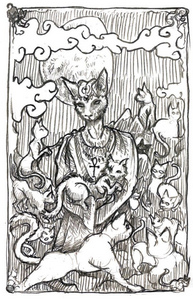
Which makes one think… would a “Cats of Ulthar” game mod be possible? With the story? Or perhaps in The Witcher, using the kitties and their animations extracted from Assassin’s Creed: Origins?

Friday “picture postals” from Lovecraft: the 1807 Portland Observatory

Lovecraft on a mysterious tower…

“Portland is not nearly as colonial as Providence, & looks just as citified, although it’s only 1/3 as large. Very fascinating from its marine colour — I went up that ancient tower (1807) shown on one of these cards, and had the maritime vista of my life! Have done the whole town and visited the colonial suburb of Stroudwater. Shall do the two Longfellow houses tomorrow — also a visit to Yarmouth, a quaint & ancient fishing village which will form my farthest north.” — H. P. Lovecraft letter of 26th August 1927, published in Mysteries of Time and Spirit: The Letters of H. P. Lovecraft and Donald Wandrei.

Not that mysterious, actually. As his mention of “1807” identifies the tower as the Portland Observatory…

And here’s the tower in high-res, with my quick new colorisation. Although unlikely to be Lovecraft, note the Lovecraft-alike man standing on the raised entrance platform outside the tower’s doors…

Use it or lose it

I’m pleased to see that the UK Society of Authors is pushing for a ‘use it or lose it’ clause, as is the case in France. This aims to combat the way that many publishers currently keep old works out-of-print, and cease to market an author — while refusing to give the rights back to the authors so the books can be self-published or issued in new editions.

A ‘reversion clause’ would apparently be inserted in contracts. So I guess there’s the option for publishers to offer that to their authors now, without waiting for legislation on the matter. Thus to differentiate themselves in the market, and make themselves more attractive to authors.

Another hand-drawn map of Providence, 1907

I previously posted a hand-drawn map made for a 1907 series of ‘Open Days’ in Providence, from The Official Program of the Old Home Week.

Now I’ve found a scan of the pocket walking booklet for the same event, A Little Guide to Providence, 1907. The neat little Guide focusses largely on the artistic and cultural life of Providence, as Lovecraft would have become aware of it circa age 16-17.

I’m pleased to see that the booklet has a version of the same map without the gutter problem of the earlier scan. At the back it has another map made in the same charming hand-made style as the first. I’ve rectified the slight lens distortion, perspective skew and colour-cast, as well as dropping them to 3,800 pixels so they’re manageable.

Looking at the map, it strikes me that if one were to combine Kingston and Plymouth placenames via a “Kin–mouth” amalgamation then one would come very close to the name Innsmouth, and with the “kin” perhaps pointing to that story’s underlying plot element of ‘kinship’.

The “lightning-scarred” Lovecraft

I don’t bother with the likes of Twitter, but I occasionally use Social Searcher to take a fleeting keyword-based glance across the cesspool. Very rarely does anything newsworthy turn up among the parroting and blather. But today I noticed that a Twitter-diot is complaining about Lovecraft making up items such as “lightning-scarred” in “The Lurking Fear”. Yet a simple search of Google Books, Google Scholar and Hathi swiftly reveals many such uses…

* The U.S. Congress…

These lightning-scarred trees are readily found in any large body of timber. During the dry season of 1910 there were many electrical storms, and innumerable small fires were found immediately afterwards.” (1910)

* The U.S Bureau of Mines…

Lightning, however, sometimes strikes an airship without destroying it. The Friedrichshafen Museum has lightning-scarred parts of airships that have withstood thunderstorms successfully (1933)

* It appears to have been ‘house standard’ usage in American Forestry journal, and elsewhere in forestry publications and articles. One can find it, for instance in the pre-war publications of the ranger stations at Yosemite and the Grand Canyon.

Thus, while one can find it getting past the picky copy-editors of The New England Magazine in 1909 (“the lightning-scarred beech tree by the mill in the hollow”) and The Saturday Evening Post in 1919 (“He had seen living trees struck and had examined the lightning-scarred tops of fallen dead ones”), and it does occurs in the poetry of Aubrey De Vere and the 1910 translation of The Aeneid of Virgil (“[his] body lightning-scarred, Lies prisoned under all, so runs the tale”), Lovecraft does not seem to have been reflecting very much of a literary usage. For instance, there’s nothing in the obvious suspects such as Poe or Melville’s “The Lightning-Rod Man”.

It seems more probable that Lovecraft had noticed the then-current forestry usage, and I assume that was because he had perused a few journals for research before he wrote “The Lurking Fear” and made a working list of the correct terminology. He would also have been looking for books on mountain lightning and thunder-storms. See my annotated “Lurking Fear” for details on the extent of Lovecraft’s accurate knowledge of the Catskill Mountains.

Ulthar Post for Christmas

My Patreon patrons will find there are now two new blog posts from me with a printable-size ‘Ulthar Post’ stamp. I realised that one can treat Patreon like a private patrons-only blog, so now that I know how to do it there will be more such posts.

It might look good on Christmas parcels, as well as hand-delivered Christmas cards.

The edge-deckling is in the cutout .PNG, but you might find it’s a bit tricky to add that by hand. Especially if you print it on paper at less than about four inches. Serrated shears of the sort used for fabrics are going to be too large, but careful use of a sharp X-Acto (USA) or Stanley (UK) knife to form deckling might do it. As it’s a PNG with a transparent edge it might also be used as a template for a very thin bit of 3D-printing — you might get an amusing beer-mat or fridge-magnet out of it.

Putting a simple drop-shadow on it before you print, and then printing on paper the same white colour as the envelope should also reveal the deckling.

You could of course get some real but large stamps of low value, and carefully stick the Lovecraft square over the top.