The Assemblage of Dr. Arnold Astrall
Following my reading of the 2018 Cthulhu/Lovecraft RPGs survey I thought I would have ‘a first-time try’ at making an outline RPG scenario, or something that I imagine is like one, through picture-researching and making a new creative assemblage of vintage pictures.
The result takes the form of a ‘curated scrapbook’. This can be filled with your own words, to accompany your own detailed RPG game scenario story. This scrapbook is imagined as having been made by a U.S. museum curator. It contains all that is known about a strange and evidently dangerous upland area in the Near East, and this book serves as his briefing document for your own intended expedition to the location.
The 130Mb printable bundle for this is available for all my $5+ Patreon patrons in a .ZIP download, with 24 book pages at full size. They should print adequately at 10″ x 8″, if you require print, and then trimmed and hole-punched. Pages are laid out with photos but not with explanatory caption-cards, for which blanks are provided and you add them to match your developed game scenario. Matching paste-in cards, the telegrams, and paper scraps are thus provided for you in the bundle, together with additional blank book pages and a suitable typewriter font in .TTF format. There is also a PDF with the following suggested story/scenario details…
THE BOOK:
To assist you before you leave on your expedition the museum curator has assembled this 24-page book, drawing on the museum archives and correspondence folders. It tells of three previous expeditions to the region. The curator stresses that the book must be kept secret, since he does not wish to entice other western expeditions into the dangerous area.


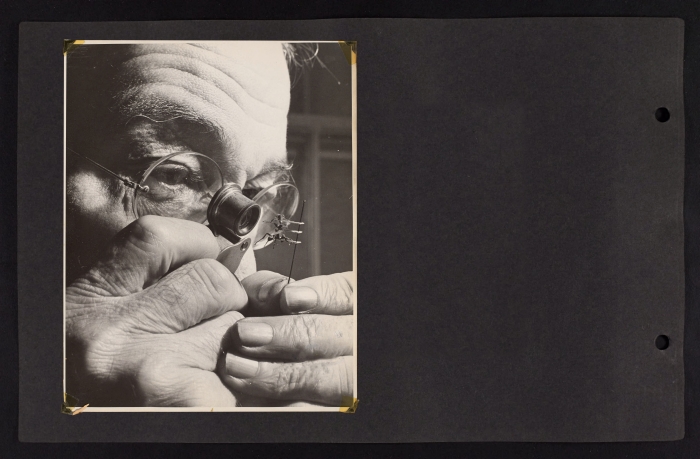
The curator (pictured) first provides you with a paste-in of the telegram. This recently alerted him to the need to send you and your team to the area. (What it says is up to you to add. The same is true of explanatory typed cards for each page, for which space has been left in the layout).

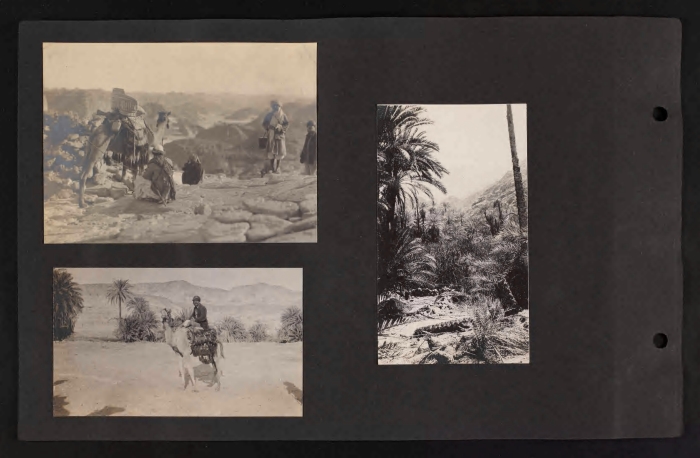
First expedition: The book tells briefly of the first expedition. A Victorian explorer — the museum curator’s father — was visiting the antiquities as an antiquarian tourist when he had cause to venture out to a remote Trading Post. Possibly he went there in search of curious carved items. At the Post he heard tell of a mysteriously shunned fertile belt in the desert uplands. In search of adventure he hired three guides, at some cost, and penetrated toward it for some days. He found an extended oasis of jungle-like ravines that ‘should not have been there’, according to any Army map that he had seen of the area.


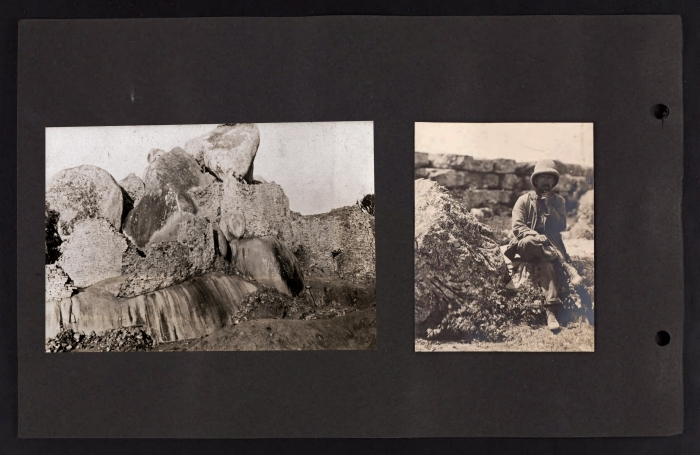
Beyond these fertile ravines, the uplands returned to rocky dry land where he encountered a high ruined cliff city. An ancient and eerie track led him up behind this city, to what from the manner of their stone-work seemed impossibly ancient ruins sited on the clifftop above. Both the city and its fore-runner were unknown to the guides, who had known only of the fringes of the fertile area. The explorer never returned from this trip into the interior, but one haggard guide later traded the explorer’s saddle bag — with its notebook fragments and camera plates — at the trading post. These were thus recovered by the authorities and sent back to the museum. His notebook has a scribbled note about what can be glimpsed in the uplands beyond the clifftop.


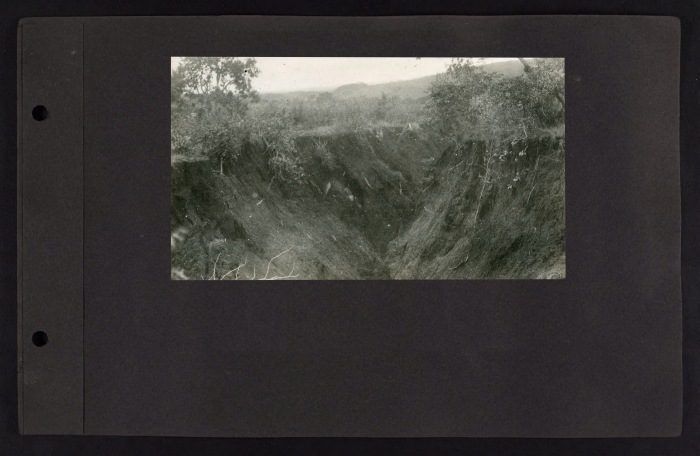
Some years later there was some missionary exploration which penetrated as far as the fringes of the fertile ravines, seeking hypothetical converts. But at its edge it was found to have been recently subject to immense earthquakes and earth-rifts, causing the sparse local population to fear it intensely and making further exploration as far as the supposed city impossible.

Second expedition: This was formed of two botanists from the curator’s own Museum. Having become interested in the area due to his father’s disappearance there, Dr. Astall had discovered that bizarre fossil plants could be had from the region. He set this father and son team to work on these at the Museum, and quite a collection was formed. The two men later went to the district itself in search of more such fossils. They were also tasked with finding any further details of Dr. Astrall’s lost father.


In the lobby of their port hotel there suddenly appeared a recently harvested living specimen of the supposedly ‘fossil’ plants. The two botanists met with an eccentric snake-charming plant collector, their local correspondent, who suggested it may have come from the mysterious and shunned fertile belt.


The pair travel out and get just past the first really deep rift of the mysteriously fertile belt. There they discover the flies that feed on the living plants to be deadly (and in a rather curious and alarming manner). Of the pair, only the father returned to America. The father continues at the Museum, and he studies the dead flies intensely, as well as the fossil plant collection. He is curiously reticent about what he has discovered, if anything.
Third expedition: A rich young man had come, only a few years ago, to Dr. Arnold Astrall at the Museum. He enquired of the fragmentary notebook made by the Victorian explorer, Astral’s father. These pages were shown to the young man. Dr. Astral noticed the young man became somewhat agitated when he saw the faded map in the notebook. He then abruptly left the Museum.

A short while after this visit Dr. Astrall received an excited telegram from the young man — he had a route to the lost city, firepower on his hip, fly-repellent grenades at the ready, and a fully mechanised base-camp at his disposal! No damn death-bugs would get him! There was surely gold in that city, and he meant to get it! The Museum would generously get 10% of the treasure found, as thanks for its help.

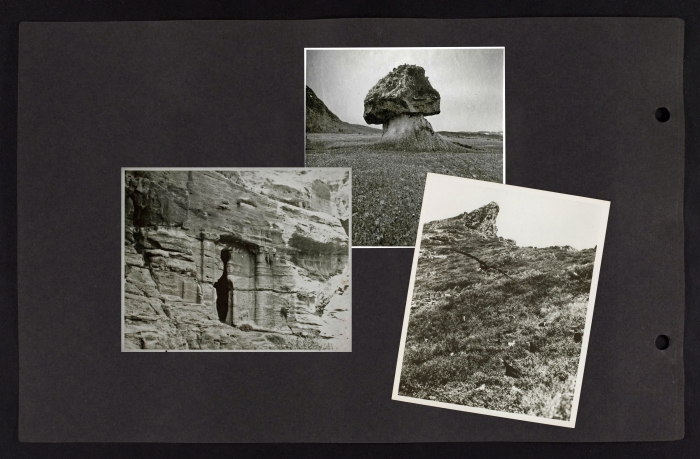
Yet… that was the last the world heard of the young man. Three photographs were to be the only relics of his lost expedition, the film reel being recovered from a drunken guide known to have visited the Trading Post. These pictures are presumed to be of the uplands somewhat beyond the mysterious cliff-city.

By pasting in picture-corners, the curator has indicated to you a mysterious missing photo from the third expedition. It is said to have been seen at the Trading Post by a missionary…

Possibly it was a closer picture of the Mysterious Winged Thing seen swooping toward the camera in the last photo.
The curator has added some final pages of notes and advice…


You are to form the fourth expedition. Good luck and bon voyage!
Settings, in order:
1. THE MUSEUM and its archives. What can be learned here about the fossil plants and their two researchers? About Dr. Arnold Astrall’s father? About Dr. Arnold Astrall himself?
2. THE PORT HOTEL. What can be learned about the district from afar? Can the eccentric local-plant collector be recruited to the expedition?
3. THE TRADING POST. Rumour and local lore. Obtaining the missing photo(s). Persuading local guides to go.
4. THE FERTILE BELT. Its dangerous plant-flies and earth-rifts. Other dangerous plants may lurk. Or walk…
5. THE ANCIENT CITY. Are there relics to be found here of the rich young man’s mechanised expedition? Of Dr. Arnold Astrall’s father? What was the lure of the uplands, that apparently drew the young man away from the city?
6. THE WEIRD UPLANDS BEYOND THE CITY.
Suggested H.P. Lovecraft works for use as inspirational touchstones:
* The opening part of “Under the Pyramids”.
* “The Outpost” (poem).
* “Winged Death”.
* “The Evil Clergyman” (fragment).
* “The Nameless City” and “The Transition of Juan Romero”.
* Lovecraft’s plot details for “The House of the Worm”, re : flies.
* Lovecraft’s letter to his aunt Lillian, 1st July 1928…
“absolutely marvellous firefly display […] All agree that it was unprecedented, even for Wilbraham. Level fields & woodland aisles were alive with dancing lights, till all the night seemed one restless constellation of nervous witch-fire. They leaped in the meadows, & under the spectral old oaks at the bend of the road. They danced tumultuously in the swampy hollow, & held witches’ sabbaths beneath the gnarled, ancient trees of the orchard”. [Lovecraft went to bed afterwards, intending to dream the fireflies into…] “spectral torches, & about the lean brown marsh-things (invisible to mortal eyes) who wave & brandish them in the gloaming when the unseen nether world awakes”.
Lovecraft had already prefigured these “lean brown marsh-things” as “fauns” in a summer 1915 poem…
So wink the fireflies in the humid brake;
While Fancy traces in the fitful light
The torches of the fauns that dance by night.
That’s it. My $5+ Patreon patrons get the 130Mb printable bundle for this! .ZIP file links have been sent via the Patreon message service to all my $5 or more Patrons. Links will also be sent to anyone signing up at or above that level, and making their first monthly payment.