New on Itch.io, The Temple by Esquadron, a $3 interactive fiction version of Lovecraft’s “The Temple”. Though unfortunately not in a more readable two-column layout that would match the widescreen pictures.
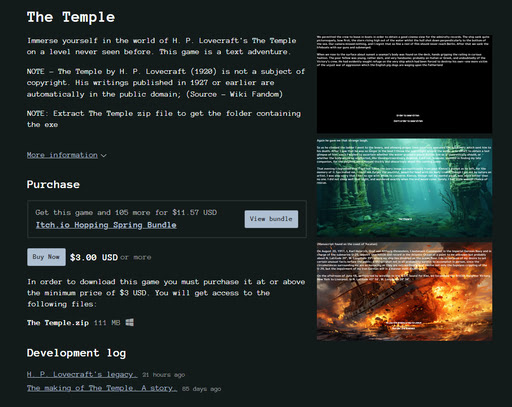
Note also the link to the “Making of…”.

22 Monday Apr 2024
Posted in Lovecraftian arts
New on Itch.io, The Temple by Esquadron, a $3 interactive fiction version of Lovecraft’s “The Temple”. Though unfortunately not in a more readable two-column layout that would match the widescreen pictures.
Note also the link to the “Making of…”.
21 Sunday Apr 2024
Posted in Scholarly works
I’m pleased to say that S.T. Joshi has accepted my long article for the next Lovecraft Annual, and that I’ll be in the 2024 issue. No news of the rest of the 2024 contents as yet.
By the way, if you’re having trouble accessing the Hippocampus Press site, publisher of the Lovecraft Annual, I find the problem is the Web browser’s “DNS-over-HTTPS provider”. The default Cloudflare DNS “knows a’ nurthing” about Hippocampus, while switching it to use Google Public DNS gets you there.
20 Saturday Apr 2024
Posted in Scholarly works
A new issue of Mythlore, with a lead article on “Tolkien Augustinian Theodicy, and ‘Lovecraftian’ Evil”. Freely available online.
19 Friday Apr 2024
Posted in Picture postals
This week on ‘Picture Postals’, I stay with Lovecraft’s city of Providence, anticipating the city’s coming NecronomiCon / Armitage Symposium later this year. Here I’ve found a rare wide ground-level view of the Marketplace at the centre of the city. Most such views are elevated.
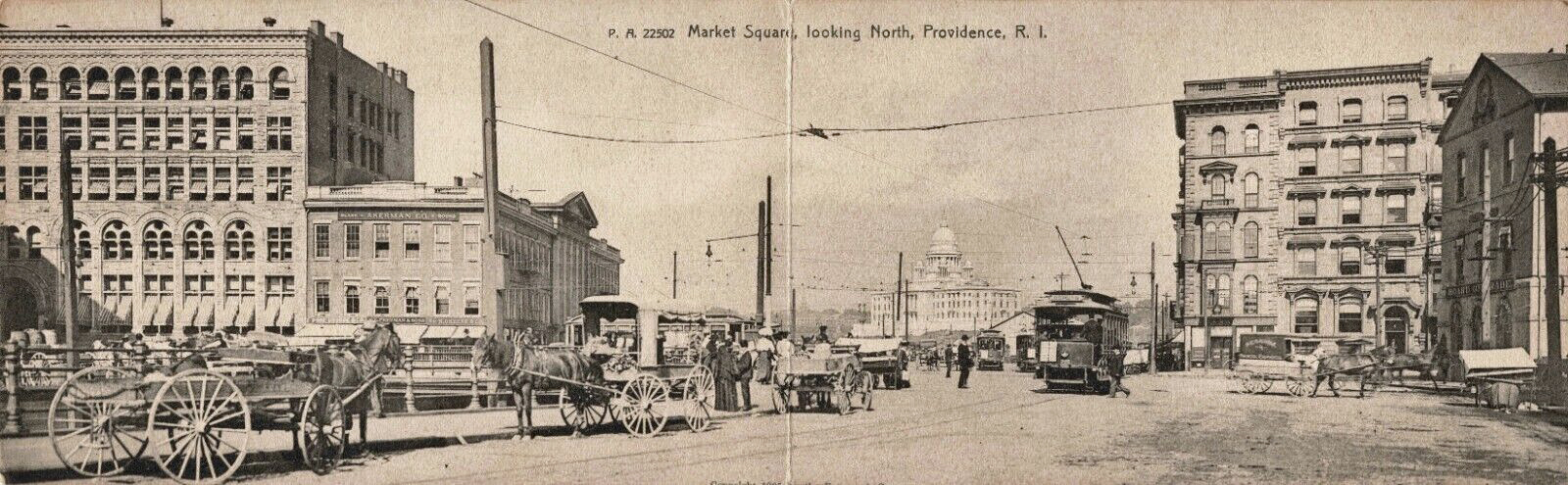
Marketplace looking toward State Capitol
The date is perhaps 1900, Lovecraft then aged 10 and forming an ever-widening picture of his city based around central hubs such as this. The river is below and on the left, and we can see a bit of the bridge across it. In the distance is the State Capitol building. On the far right, the Board of Trade building, seen below ‘head on’ and with College Hill behind it.

Board of Trade looking toward College Hill
The area where the panorama cameraman is standing was the weekly marketplace. Off-camera to the right would have been the ‘Old Brick Row’ (which Lovecraft later tried to save from being swept away) and behind that College Hill.
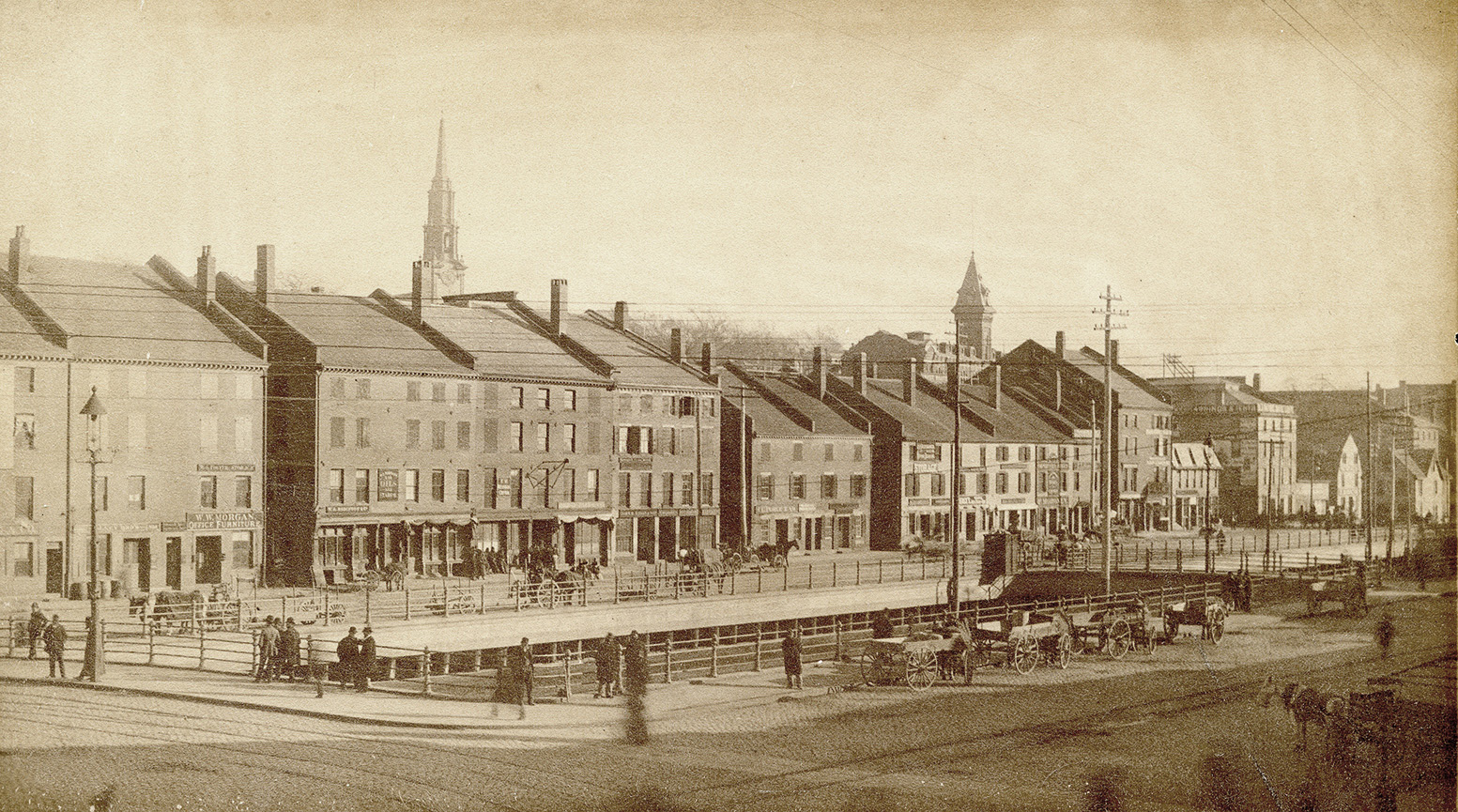
The Old Brick Row
See my earlier marketplace post for pictures which contextualise the new one seen above.
This 1906 view is also a panorama which looks in the same direction, and it shows the above panorama location in the distance (just left of the chimney top). The docks area (below and out-of-sight of the spot from which this balloon-photo was made) was a place that Lovecraft would later explore with Eddy in the 1920s.

1906 view over the industrial side of the Providence docks
18 Thursday Apr 2024
Posted in Podcasts etc.
Grey Matter has a new full-cast adaptation of “The Dunwich Horror” in 45 minutes, with an open .MP3 download.
“Whatever he left inside… it’s loose”.

17 Wednesday Apr 2024
Posted in AI
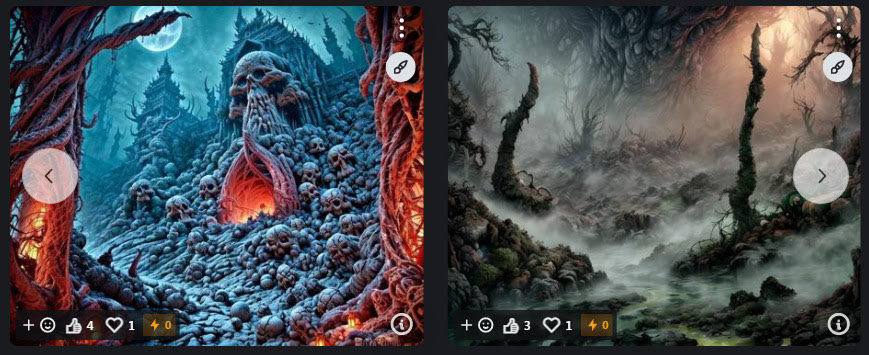
A few more recent Lovecraft-adjacent new free LORA add-ons, for use with a local install of Stable Diffusion 1.5.
Meteor Shower v1.0. Artistic meteor showers. It can also do just one or two. The same maker also has the earlier similar Fireflies from last Halloween.
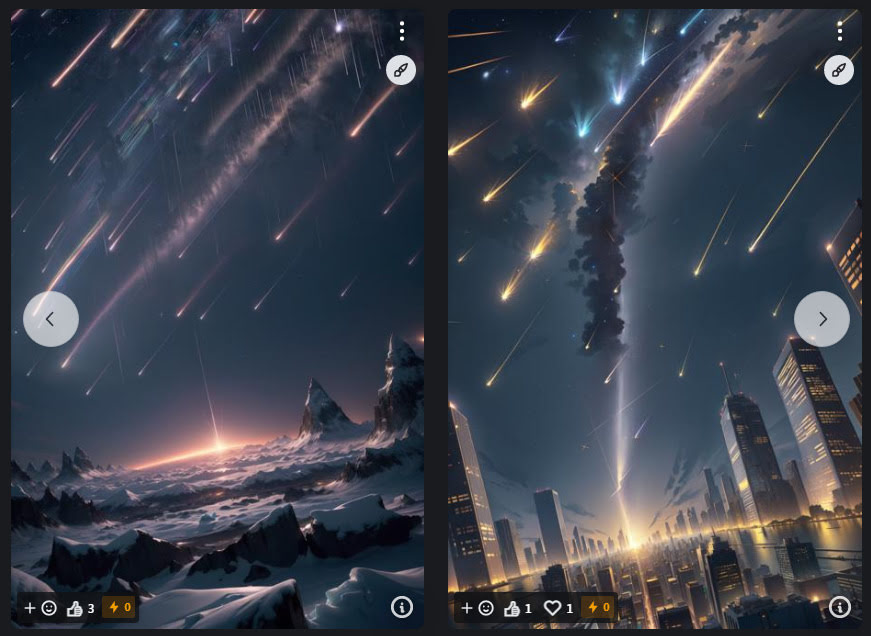
Meteor Shower

Fireflies
Dark Core Style. It “creates comic-book-like inked illustrations, dark, gloomy and simplistic with lots of sharp angles”.

And Death and Decay, looking very suitable for generating the basis of a heavy metal album cover. The same maker also has a new Celtic / Gaul Warrior today.
17 Wednesday Apr 2024
Posted in Lovecraftian arts
You wouldn’t know it from the description, but Compound Fracture, a mod for the original DOOM II videogame is claimed to be…
my 10-map episode based on Nyarlathotep and Yog-Sothoth. The final boss is supposed to be Yog-Sothoth.
I learned this from finding a new forum thread, which jogged my memory about the game. Greatly enjoyed by me at the time, along with the fantasy variant Hexen. The forum thread also suggested the mod Rylayeh for DOOM II.
Via search, I found five more mods (aka wads) that are substantial and have good reviews…
Shrine 1.2 for DOOM II. A “Lovecraftian Total Conversion mod!”
Void for DOOM II. “Lovecraft meets Lewis Carroll”. Uses ZDoom.
Strange Aeons v5.7 for DOOM II. Huge Lovecraftian total conversion. Uses ZDoom.
Beyond Kadath for DOOM II. “A story-driven WAD roughly in the vein of H.P. Lovecraft’s Cthulhu Mythos.”
Maskim Xul for DOOM II. “One of the winners of the 2018 Cacowards.”
The game itself can be had on CD via eBay for around £15. It’s obviously become collectable, despite the vast quantities it sold, and the days of getting a jewel-case for £1.99 inc. shipping seem over. More affordable is the download at GOG.com for £4 including “the enhanced re-release” of 2019. Then you download ZDoom / GZDoom and run it through that, giving the old game enhanced powers. You may also need a Flashlight++ mod.
16 Tuesday Apr 2024
Posted in Lovecraftian arts
The maker of the hit videogame Dredge is in the very early stages of a live-action movie adaptation. Basically Dredge is a Lovecraftian ‘small trawler’ fishing game, with its possible-movie officially described my the developers as… “a grounded atmospheric cosmic-horror blend of H.P. Lovecraft and Ernest Hemingway.” Sounds good. The Sonic the Hedgehog producer is apparently on board, so I guess there is actually a chance of co-funding for at least a modest indie movie. Casting suggestions for a fisherman pulled into the net of cosmic horror are now invited.

If you can’t wait for this dose of damp cosmic horror, this week the ‘Fairies of New England’ blog appears to have visited H.P. Lovecraft’s “Dark Swamp” and has pictures.
15 Monday Apr 2024
Posted in AI

Testing out an AI that claims to do reasonably good text generation. But… kinda. Heavy Photoshopping was needed.
14 Sunday Apr 2024
Posted in Scholarly works
S.T. Joshi’s blog has updated, and he notes the title of the forthcoming Long letters, A Sense of Proportion: The Letters of H.P. Lovecraft and Frank Belknap Long, in one volume due later in 2024. He and Schultz are also considering a Letters to H.P. Lovecraft volume, which I would assume would be ‘selected’ rather than everything known? Since the Price letters would take up a volume on their own, and the whole lot might have to be two volumes?
Joshi also notes “I continue to work (with David E. Schultz) on Letters to R. H. Barlow“. Which I guess will then replace O Fortunate Floridian? (Update: No it won’t: it’s letters to Barlow from people other than Lovecraft).
Joshi anticipates that the Lovecraft Annual and a number of books of Lovecraft scholarship will appear toward the time of the NecronomiCon / Armitage Symposium in Providence, later in 2024. See his full 12th April 2024 blog post for the details.
13 Saturday Apr 2024
Posted in Odd scratchings
The Lovecraft Letters Vol 1: Mysteries of Time and Spirit from a UK seller at a quite reasonable £27 in hardback. Sadly it can’t be shipped to an Amazon locker, and the seller isn’t also listing it on eBay. So I can’t get it. But some lucky Lovecraftian will. Get it while it’s hot…
13 Saturday Apr 2024
Posted in Odd scratchings, Scholarly works
Useful for writers as well as RPG gamers, and new on Archive.org as a scan in PDF, Monograph #319, Miskatonic University – The Gaslight Equipment Catalogue (2005). ‘Gaslight’ = the game-setting of the British Empire in the 1890s.
