James Barton has a new investigation into Swamp Men and French Werewolves, in the Louisiana swamps that now form part of Lovecraft country.

Picture: Scary Louisiana swamp, from an old U.S. government publication on the trees of the swamps there.

05 Wednesday Jun 2019
Posted in Historical context, Scholarly works
James Barton has a new investigation into Swamp Men and French Werewolves, in the Louisiana swamps that now form part of Lovecraft country.
Picture: Scary Louisiana swamp, from an old U.S. government publication on the trees of the swamps there.
04 Tuesday Jun 2019
Posted in Doyle, Historical context, REH
DMR has a developing series of short blog posts which introduce a set of “Forefathers of Sword and Sorcery”. The latest up for consideration, Arthur Conan Doyle. I must say I’d never even considered him as an influence on R.E. Howard, except in the vaguest way.
In addition to enjoying his Holmes stories, Doyle is also interesting to me for being another of the great names who have Birmingham and Staffordshire connections, alongside Wells, Tolkien, Borges and the Gawain-poet. For instance, I’ve reviewed Sherlock Holmes in the Midlands, which is the book you want if you’re interested in that topic or decide the take a literary touring holiday in Birmingham, Staffordshire and out into the neighbouring Welsh Marches.
Until reading DRM’s post I’d always thought of Doyle in terms of the always-re-readable Sherlock Holmes + some Edwardian horror stories. Even the fairy-world spiritualism of his dotage is of interest, because it tells one something about the pits of fraudulent charlatanry that opened up as religion faded, and how these could swallow up even highly intelligent people. This then reflects on the paths available to the early Wells, the young Tolkien, Kipling, Lovecraft and others, re: the cultural terrain they were navigating.
I must admit that I’ve never once encountered Doyle’s Professor Challenger adventure books, which DMR mentions, nor the various adventure and historical novels which the Doyle bibliography reveals. Professor Challenger is three novels, and two stories, apparently. Ho hum, yet another set of books to get around to… eventually! Ideally when a full-cast unabridged audiobook of such appears, and perhaps with Phil Dragash-like levels of avoidance of modern cynicism and hipster overtones in its vocal delivery.
04 Tuesday Jun 2019
Posted in Kittee Tuesday, Lovecraftian arts
Celebrating H.P. Lovecraft’s love of our mysterious felines.
An illustration from the Dr Nikola proto-pulp, by Louis Wain. Wain is one of the most famous cat artists, now entirely associated with ‘cute cats’. It’s thus very unusual to encounter one of his that’s a little more Ulthar-like.

04 Tuesday Jun 2019
Posted in Lovecraftian arts
Librivox’s latest Short Ghost and Horror Collection 033 has appeared, and has a wealth of amateur Lovecraft readings. Including “Memory” which is a very short prose poem written in 1919.
This led me to discover that the excellent reader Ian Gordon has also done a new free 10 minute reading of “Memory” by H. P. Lovecraft. This was posted by him on YouTube, a couple of months ago. The story itself is quite brief and followed by music.
04 Tuesday Jun 2019
Posted in Housekeeping
Tentaclii is back at No.1 on Google…
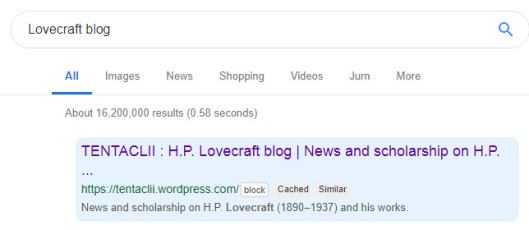
Though is still not indexed on Bing or DuckDuckGo, apart from (bizarrely) just two random PDFs. It’s been that way for years. As it’s no longer possible to submit a blog to Bing, I don’t see any way of changing it.
Tentaclii is present on the first page of results at Yandex. Yandex is a pretty reasonable search-engine and supplies DuckDuckGo. The Duck being a blend of Bing and Yandex, as you can see here…
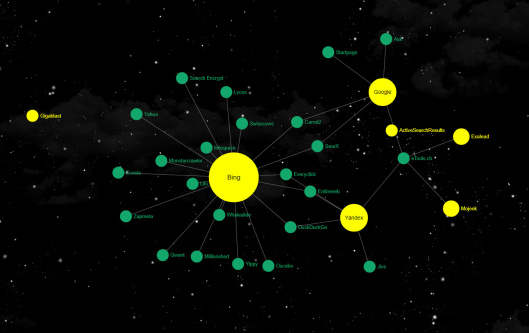
… but a lot gets censored from Yandex before it gets fed to the Duck. Tentaclii is presumably one of the elements being filtered out, which suggests it’s flagged as ‘undesirable’ in some way. It may be being bounced partly because Bing doesn’t index it?
Tentaclii is the top result on the worthy but eclectic Gigablast, which is the only other one that vaguely matters. Mojeek being worthy as a standalone indie that keeps soldiering on, but now very old and with very poor relevance ranking. Common Crawl still has no third-party keyword search interface, except for an incredibly old crawl. Yippy is a filtered Bing, and while excellent (if rather slow) for techie forum searches like researching a regex formula, it doesn’t seem to be much use for anything else I want.
I don’t know of any engine that dogpiles together the full main Google, with Bing and Yandex, and also has good relevance ranking and de-duplication. According to the above chart (2019) it doesn’t exist. But if anyone knows of one, or a browser addon or dashboard that does the same without captchas, I’d welcome hearing about it.
03 Monday Jun 2019
Posted in Lovecraftian arts
The 298-page Vol. 1 of the English translation of At The Mountains of Madness graphic novel, by cult manga artist Gou Tanabe, has a release date of 25th June 2019 from Dark Horse.
The 365-page Vol. 2. of Mountains of Madness now also has a release date, of 29th October 2019. At which point the work will apparently be complete in English translation. Even if there’s some padding from the publisher, it looks to be more than 600 pages in total.
This is what his style looks like…

03 Monday Jun 2019
Posted in Historical context, New books, Scholarly works
I’ve found an open access PhD thesis titled Prophets of Decline (2003), which has two chapters relevant to understanding the historical context for Lovecraft’s reception of Spengler in the America of the later 1920s…

Once returned to Providence…
Lovecraft began in the late 1920s to develop his notions of the decline of the West — notions that his reading of Oswald Spengler’s great work on the subject only helped to clarify and develop. (S.T. Joshi, I Am Providence).
From a Lovecraft letter of 1926…
Recently I saw a review of Spengler’s ‘Decline of the West’ — which will make splendid discussion-matter with Mortonius [James Morton]. Did you see it — in the New York Post?
This must be the front-page review by the anti-communist John Cournos, “Is Our Civilization Doomed? No Chance Of Survival — Says Spengler” The New York Post Literary Review supplement, 29th May 1926. (Now un-findable online, and it seems there’s no microfilm of this title at libraries before 1934?).
The Prophets of Decline thesis thus offers what are effectively two ‘free bonus’ appendices, in a digestible thirty pages, for readers of S.T. Joshi’s book on Lovecraft’s intellectual life The Decline of the West (now a very affordable and cleanly formatted ebook on Amazon). The chapters are quite dense and have some typos, but are admirably concise and focused. They outline Spengler’s initial reception in America, and then the changed perceptions there of Spengler in the 1930s — as the civil war within socialism raged and both communism and fascism twisted the ways he was portrayed and understood. Part of the problem on the right was that Spengler did not endorse Hitler. He had also supported those purged in 1934, and because of this was subject to a campaign of vilification by the Nazi Party.
As for the rest of the thesis it tells the larger story of the reception by journalists and intellectuals of the alarmist doom-mongers of 1896-1961, and as such provides useful background for better understanding the doom-mongers of the 1970s and 80s.
02 Sunday Jun 2019
Posted in Historical context
In the latest University Bookman, Stephen Schmalhofer takes a trip “From New York to Chartres with La Farge” and examines this macabre Providence artist’s later stained-glass work and his influence on other creatives of his time.
Adams came to understand that gothic architecture was not gloomy. “The necessity for light was the motive of the gothic architects,” he writes of Chartres. “They needed light and always more light, until they sacrificed safety and common-sense in trying to get it.” Cortissoz observes that La Farge’s art contained “little knots of form, meant to hold color in solution; cunningly wrought webs in which to imprison light” and his windows were “curtains of jewels hung between us and the light, pieces of some new kind of luminous poetry.”
I’d previously noted the early print illustration work of this Providence artist, in my post on “A macabre Providence artist”. There I observed that Lovecraft’s discovery of him had coincided with the writing of “The Rats in the Walls”.

02 Sunday Jun 2019
Posted in Scholarly works
Congratulations of Dylan Henderson of Arkansas, who has been awarded the R.D. Mullen Fellowship. According to the local press, he will…
“conduct archival research this July [2019] at the John Hay Library on the Brown University campus. The $1,000 fellowship is sponsored by the journal Science Fiction Studies. Henderson’s current research project explores how, in the 1920s, the distinct genres now known as fantasy, horror, and science fiction gradually coalesced and then separated from one another. He seeks to investigate the role of the early pulp magazines in this process, specifically Weird Tales, the first pulp magazine to specialize in speculative fiction. During its early years, when the genres it published were still comparatively fluid, the Weird Tales magazine contained works that defied categorization, including short stories by H.P. Lovecraft, Clark Ashton Smith, and Robert E. Howard. […] Henderson hopes to reveal how certain plot structures became associated, in the minds of both readers and writers, with more clearly distinct genres of science fiction, horror, and fantasy.”
01 Saturday Jun 2019
Posted in Astronomy, Historical context
A new photograph of the interior of the Ladd Observatory, a place which Lovecraft knew very well. The camera looks between rooms and across a corridor, and thus into the tiny Clock Vault room. The need for a sealed room, constant temperature, and thick insulation for this room might remind one of Lovecraft’s story “Cool Air”.

From the same blog, even more Lovecraftian is a 1930s picture of the chemical battery cells that powered the Observatory’s telegraph system…

01 Saturday Jun 2019
Posted in Historical context
Newly up for sale, a short letter / postcard from Lovecraft in his Dream-Quest of Unknown Kadath period. The description is from bookseller James Cummins, and states…
The first paragraph of this note was published in the Arkham House collected correspondence and in Joshi & Schultz [i.e. the Letters books]; the second paragraph has remained unpublished until now.

From this second “unpublished” paragraph we learn that writing a work of Kadath‘s length proved to be slow-going, and was not (as some might have assumed) the rapid and enjoyable dashing-off of a free-wheeling draft. We also see how Lovecraft preferred to work on one tale at a time, and felt he had to get Kadath out of the way in order to do something else. Lovecraft finishes by mentioning that he’s discovered a new artist of the weird, but doesn’t name him. Though there appears to be some miniscule writing inserted above, which might be the name?
I also like Lovecraft’s description of a story as a “hair-raiser deluxe!”
Perhaps just as interesting is what appears to be Lovecraft’s fingerprint in blood, which raises the possibility of chemical analysis of Lovecraft’s blood. I assume that advanced 21st century forensics could achieve something with it, even at this great distance in time. Though perhaps not as much as some would like — such as resurrection via a cloned baby Lovecraft, etc.
31 Friday May 2019
Posted in Astronomy, Guest posts, Historical context, Scholarly works
Horace Smith had kindly posted the following as a comment on this blog. But I think I’d rather present it as a Guest post, which does his work justice. So, here is his investigation…
John Edwards of the Ladd Observatory at Brown — Cockney or Cornishman?
By Horace Smith.
I’ve been researching H.P. Lovecraft’s early astronomical interests. Tentaclii had at one point briefly puzzled over Lovecraft’s calling the Ladd Observatory assistant, John Edwards, a Cockney in one letter and a Cornishman in another. If what I have found is right, he was neither by birth.
 Picture: the Ladd Observatory as it appeared in the mid to late 1930s. Newly shadow-lifted and colourised.
Of the three staff members of the Ladd Observatory, whom Lovecraft “pestered half-to-death” in his youth, the observatory assistant John Edwards provided the greatest practical aid to Lovecraft’s astronomical endeavours. Whether it was offering a diagonal eyepiece for his telescope, lantern slides for a lecture, or a lens for a camera, Edwards was there to help. But, aside from being an assistant at the Ladd Observatory, who was John Edwards? In different letters, Lovecraft alternatively referred to him as a cockney, a term traditionally applied to someone from East London, and a Cornishman from Cornwall. Could I pin down which, if either, was correct?
Tracing genealogical connections can be tricky, and not everything you read online can be trusted. I knew when I began only that Edwards had worked at the Ladd Observatory in the late 1890s and early 1900s, but I didn’t know his middle name, nor when he was born, nor where, except that England was a good bet for his birthplace. I turned to Ancestry.com and FamilySearch.org to progress further.
The federal census for 1910 gave me a middle initial, W, and a spouse, Mary A. It also provided a birth date of around 1858 and an immigration date of 1887. In 1915, Edwards accepted his former colleague Frederick Slocum’s offer of a position at Wesleyan University’s new Van Vleck Observatory in Middletown, Connecticut. When Edwards took up that position, the Wesleyan University Bulletin printed his full name: John William Edwards. Alas, his stay at Wesleyan was not long, for he died of heart disease three years later, on 24th April 1918.
 Picture: Wesleyan University Bulletin for May 1918.
The Hartford Courant newspaper for 28th April 1918, informed me that, after Edwards’s death, his body was taken to Attleboro, Massachusetts, for burial. Why Attleboro?
‘Find a Grave’ led me to a photograph of the tombstone of John and Mary in Attleboro. It carried their birth and death years (1858-1918 for John and 1856-1917 for Mary) and those of two of their children, Joseph (1882-1901) and May (1891-1891). The 1910 census had already told me that, by 1910, two of their three children had died, and the gravestone and census were thus consistent. The son still living in 1910 was Alban Edwards, born in Lonsdale, Rhode Island, in 1888. His First World War draft card showed that it was he who resided in Attleboro. Massachusetts death records confirmed that Mary Ann Edwards had died in North Attleboro in 1917, the year before her husband’s passing. Now the burial of John and his wife in Attleboro made sense. The gravestone also gave me Robinson as Mary’s maiden name.
With that information, could I trace the family back to England? I checked immigration records, finding one likely match: the arrival from Liverpool of a John Edwards with Mary A. Edwards and Joseph Edwards, all of the right ages, at the port of Boston aboard the Catalonia on the 1st of October 1887. They were lower steerage passengers, and John was labelled a labourer. I next came up with a marriage record for a John Edwards and a Mary Ann Robinson on 12th April 1879, at Christ Church in Preston, Lancashire, with the birth years of 1858 for John and 1857 for Mary. That seemed quite close and, if correct, gave me Peter Edwards as John’s father and an association with Lancashire. Was there additional evidence for a Lancashire connection? A John William Edwards was christened on 4th April 1858, at Saint John Church in Preston, Lancashire. John William Edwards was also listed as having been born in Preston sometime in the first quarter of 1858. If not a certainty, there is at least some likelihood that he was the future assistant at the Ladd Observatory.
Everything was hanging together, so far. But John Edwards is a common name. Could I find any evidence that contradicted the above? I did find one document that didn’t fit. The 1900 U.S. Census showed a John Edwards who was an astronomer’s assistant, who lived on Doyle Avenue, near the Ladd Observatory, who was the right age, and who arrived in the United States 12 years earlier in 1888 — not far off the late 1887 date found above. The census’s March, 1858, birth date is consistent with an early April christening. However, the 1900 census stated that John was single! Where were Mary and Alban? Was that just a mistake? Or did it indicate some sort of otherwise hidden family problem?
I checked the 1900 census for a Mary A. Edwards. Mary Edwards is a common name, but I couldn’t find a Mary Edwards that seemed to fit the bill in terms of age, birthplace, spouse, etc. Nor was there any mention of an Alban Edwards. To try to straighten things out, I turned to the Providence city directories. The 1901 and 1903 directories showed John living at two different Doyle Avenue addresses. They also showed that a Mrs. Mary A Edwards worked as a nurse and lived at 67 Manton Avenue in Providence, but later directories show that she was not the Mary Edwards for whom I was looking. Many women who were not heads of a household or employees do not appear to be listed within the directories, so the absence of Mary is not necessarily telling. For example, John W. Edward’s address in the 1910 city directory is consistent with his 1910 census address, However, the 1910 directory makes no mention of Mary, while the 1910 census indicates she was living with John at that address.
Fortunately, Rhode Island carried out state censuses in between the federal ones. I discovered a 1905 Rhode Island state census for a John W. Edwards, living on Doyle Avenue, of the right age — his birth date is given as 4th March 1858 — and working at the Ladd Observatory, with a mother and father born in England. Those last items are incorrectly indexed on the transcribed version of the census, but are clear in the original. However, in that census, Edwards is listed as married not single, with four in the household. There is also a census entry for Mary A. Edwards at the same address — her birth date is indexed as 18th April, 1856, but the original pencilled entry is hard to read. Mary was then a mother of three, only one of whom was still living, and with a household again containing four people.
My conclusion is that the weight of the evidence indicates that it is the 1900 census entry which is in error. Perhaps the circumstance of their son Joseph having died the following year somehow temporarily disrupted living arrangements? Or perhaps “the census-taker’s knock” awakened John after a night of observing and he just wanted to get back to bed as quickly as possible! If all this is indeed correct, we conclude that John Edwards was English, but neither a cockney nor a Cornishman.