Index To The Verse In Weird Tales

Thomas G.L. Cockcroft’s Index To The Verse In Weird Tales (1960), free on Archive.org. Also related magazine titles edited by Farnsworth Wright, such as Oriental Stories and The Magic Carpet.

Many good scans of Weird Tales can now be had free on Archive.org, but this Index should help speed up the finding of ‘on the original page’ verse by your favourite authors. Since it’s also effectively a keyword index to likely header illustrations, it might also be used as an index for finding illustrations by theme.

Also, I wonder if it might be possible for an ambitious student typographer, seeking a project, to get in touch with the heirs of Thomas G.L. Cockcroft (1926-2013) and request permission to do a new properly typogrified, designed and printed version of this old stencil-duplicated Index To The Verse In Weird Tales. Perhaps the new edition might integrate the best of the poem illustrations in the public domain, and for each poem add a line of colour-coded keywords indicating theme and symbolism/setting?

Three surveys

Black Gate has a new survey of “The Weird Tales Anthologies”. With covers and some tables of contents. It’s not comprehensive but lays out what you might find cheaply and has useful brief assessments. Note that some of the book covers may not be “safe for work”, in these prudish days.

Another new survey is a detailed evaluation by The Pulp Hermit of the run of Bronze Shadows, the ground-breaking early Doc Savage / Shadow fanzine which ran for 15 issues in the 1960s. Altus Press also has an evaluation of its place in history, in “Bronze Shadows & The Moon Man”.

Also in the category of retrospectiva posts, Murray Ewing has a new long post in which he revisits Erich von Daniken’s influential Chariots of the Gods? book and its claims…

Von Daniken’s own method mostly consists of rhetoric rather than proof. [His] technique is to find oddities, puzzles, and things that the average reader might be surprised to find in the ancient world, then point at them and say, “Well, who can say it’s not aliens?”

New book: Windy City Pulp Stories #19

The Pulp Super-Fan reviews Windy City Pulp Stories #19, the substantial 2019 program book for the convention and trading fair.

This year the focus is on the pulp writers, editors, and publishers from the Chicago area.

Th Farnsworth Wright section has the 1933 profile of him I posted here in April (I had no idea they were going to include it in the programme book). But there’s also much more on the other editors and publishers from the Windy City.

The making of Call of Cthulhu: Dark Corners of the Earth

PC Gamer this weeks reprints on the Web an article from “issue 172 of Retro Gamer” (not on Archive.org). It’s a long and detailed insider account of “The making of Call of Cthulhu: Dark Corners of the Earth. The game was made in the early 2000s and it’s widely hailed as one of the most authentic and lovingly-made Lovecraftian videogames. It was largely developed in the West Midlands of England, if I recall correctly, somewhere just north of Birmingham.

The best free HD texture-makeover I could find in a few minutes of searching is the HDR ReShade together with step-by-step install instructions…

Dark Phoenix burns out

Oh no, my paper copies of the original Claremont ‘Dark Phoenix’ X-Men comics just plummeted in value! I was hoping them might go up in value, and I could sell them, durn it.

Because, while the original comics are still a pinnacle of comics-making, the new X-Men: Dark Phoenix movie is very dire indeed according to nearly all the reviews.

“Xcruciating, eXecrable and ineXcusable with its juddering mess of a storyline” — The Sun newspaper, the biggest UK tabloid.

“A Disastrous End To The X-Men Franchise” — ScreenGeek, and many other similar sentiments can be found in the U.S. reviews. “Burned out”. “Mediocre”. “A Phoned-In Conclusion to a Mutant Saga”. “X-Men Franchise Goes Down In Flames”. “Dark Phoenix is a cinematic shoulder shrug with no reason to exist.” And “biggest dud of X-Men franchise”.

What a pity. One of the greatest stories in superhero comics, trashed.

Friday Picture Postals from Lovecraft: on the corner of Joralemon St and Clinton St., NYC

Here we see the corner of Joralemon St and Clinton St., Brooklyn, then on the edge of Red Hook. H.P. Lovecraft lived just a short walk from this spot, in a “dismal hovel” at 169 Clinton St., also right on the edge of Red Hook. During his time here he…

often” ate at “Peter’s in Joralemon St.” (Selected Letters II)
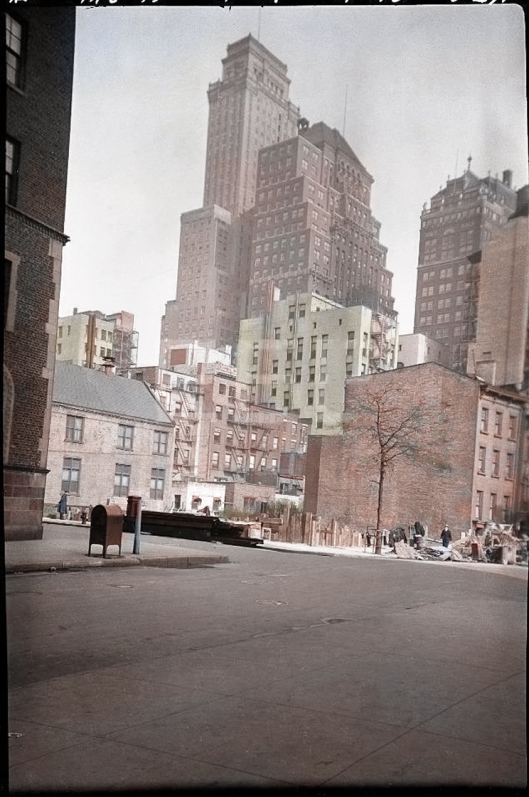
Thus he may have known the corner well, as he often walked down from his apartment and around the corner to eat in a Joralemon St. cafe. Joralemon St. goes both ways from the intersection, as you can see from the map below. Since the precise cafe location is currently unknown, then the direction in which he would have turned off Clinton St. is also unknown.

The photographer was Percy Loomis Sperr, and the date is 22nd February 1930. Which is only a few years after Lovecraft had left.

As for Lovecraft, the man seen walking into the right of the picture, or the man seen on the left contemplating the wasteground, both seem like close stand-ins for him (perhaps they’re Sperr’s bodyguards, which a cameraman with a valuable camera and tripod might need in Red Hook). Although by this date the master was safely back in Providence, and musing on the opening lines of “The Whisperer in Darkness”.


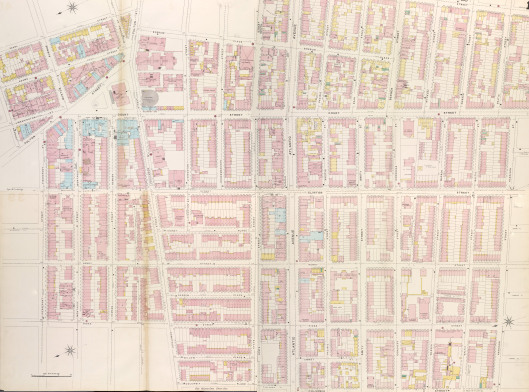
Here’s my useful map for future researchers in this part of Brooklyn. I used Photoshop to combine four such maps, which show building-level numbering and street layout. It’s centred on Lovecraft’s 169 Clinton St. Bear in mind that it’s from 1884, so is only to be used for initial orientation. Specific details for your chosen time period will need to be confirmed by consulting later maps.

It seems that Clinton and Atlantic broadly formed the boundaries of what was then thought of as Red Hook. Which means Lovecraft was living right on its edge. Evidently it was not a salubrious edge. Lovecraft’s decrepit mouse-infested lodgings were noisy, smelly, and the apparently genteel Irish landlady quickly proved to be none too particular about who she took in as lodgers — an adjacent room harboured shifty youths who stole Lovecraft’s clothes and left him only what he was wearing.

Below Columbia St., seen along the very bottom of the map, the long waterfront of sailor-bars and wharfs and warehouses began and ran down for a few blocks before thrusting out into a series of ship-piers. Experts on the waterfront’s history say little online about the 1920s and 30s, but can say that until the public works of the mid to late 1930s there were still shantytowns, open scrubby land and undrained marshland along the waterfront. Eastern parts of Red Hook were also heavily dotted with “weedy undeveloped terrain” on 1924 aerial photography, and a Thomas Wolfe short story of 1936 (which concurs with Lovecraft’s description of Red Hook) would put this area at “Erie Basin”.

Searches of Google Books reveal that, back of this waterfront area, the built-up residential part of Red Hook seen on the above map mostly had a population of poor Italians from the south of Italy, split into dialect groups that had great difficulty comprehending each other. Red Hook also had some large, though possibly dwindling, Irish groups until the later 1930s. Further there were significant numbers of Syrians who were almost all Christians escaping persecution, according to the book An Ethnic and Racial History of New York City — although Lovecraft wasn’t to know that from listening to their “eldritch” music through the walls of his apartment. There were even a few old Norwegians and Finns (classed as “Swedish” in reports), left behind after earlier waves of immigration had left the area c. 1900-1910. Presumably many of these remainers were old sailors and this may especially interest some, in terms of Lovecraft having a Norwegian sailor be central to the plot of The Call of Cthulhu. Mixed in with Red Hook’s two majority populations of Italians and Irish were floating populations of active sailors on shore-leave from all over the world. There was a small permanent Caribbean population in Red Hook at 1920, perhaps families of sailors, and these may be the same as those noted in a 1927 report as being tiny colonies of Porto Ricans and black Brazilians. Mingling among the transient sailors were the many illegal arrivals, spurring occasional raids into Red Hook by the immigration authorities. In “Red Hook” Lovecraft thus appears to have got the demographics right, except that he substituted the Spanish (not yet in Red Hook, at that time) for the Irish. Presumably he made this change because his detective protagonist is Irish.

One academic has claimed in the New England Review that Lovecraft was right about there being Kurds in Brooklyn, the claim being based on the rather idle assumption that the modern Kurdish community has always been there. That is not the case. The current Kurdish community only arrived there in 1975 when the U.S. resettled 700 people. Brooklyn’s Kurdish Library was opened in 1989 and by the early 1990s there was a community of 2,000 (Encyclopaedia of New York City). Thus the modern community, centred on North Gowanus which is now Boerum Hill, cannot plausibly be ‘mapped back’ onto any Kurds Lovecraft might have encountered in Brooklyn in 1925. Indeed, Lovecraft correctly states in “Red Hook” that Gowanus was then home to a relic population of Norwegians. I can add that there had been a failed Sheikh Said rebellion of the Kurds in February-March 1925, and this might just have caused some richer Kurds to try to get to New York City. “The Horror at Red Hook” was written 1st-2nd-August 1925, and thus Lovecraft might had seen and felt a small but noticeable influx of exiled Kurds entering clandestinely into Brooklyn in May-June-July. But that is speculation, and I can find no confirmation of any newly-arrived Kurds in Brooklyn in 1925.

On the area S.T. Joshi remarks, in I Am Providence

It [Red Hook] was then and still remains one of the most dismal slums in the entire metropolitan area. In the story Lovecraft describes it not inaccurately, although with a certain jaundiced tartness:

‘Red Hook is a maze of hybrid squalor near the ancient waterfront opposite Governor’s Island, with dirty highways climbing the hill from the wharves to that higher ground where the decayed lengths of Clinton and Court Streets lead off toward the Borough Hall. Its houses are mostly of brick, dating from the first quarter of the middle of the nineteenth century, and some of the obscurer alleys and byways have that alluring antique flavour which conventional reading leads us to call “Dickensian”.’

Lovecraft is, indeed, being a little charitable (at least as far as present-day conditions are concerned), for I do not know of any quaint alleys there now.

Photographs show large parts of Red Hook being erased by massive ‘housing projects’ (UK: ‘tower blocks’) in the late 1930s, so the alleys Lovecraft evoked may once have actually existed.


I’ve given the opening picture of Joralemon St. and Clinton St. a new light colorisation. Architectural record photographers such as Sperr tend to prefer very quiet times to make pictures, and we can thus assume that at other times this scene would have been alive with children, food-carts, vehicles, pedestrians, and other obstructions to making a record-picture. Here is a 1923 picture indicative of the sort of Italian/Irish New York street-corner life Lovecraft would have had to weave his way through to reach his cafe. Though one imagines that the affluent lady in the open chauffeur-driven car would have been a rare sight, in that part of New York…
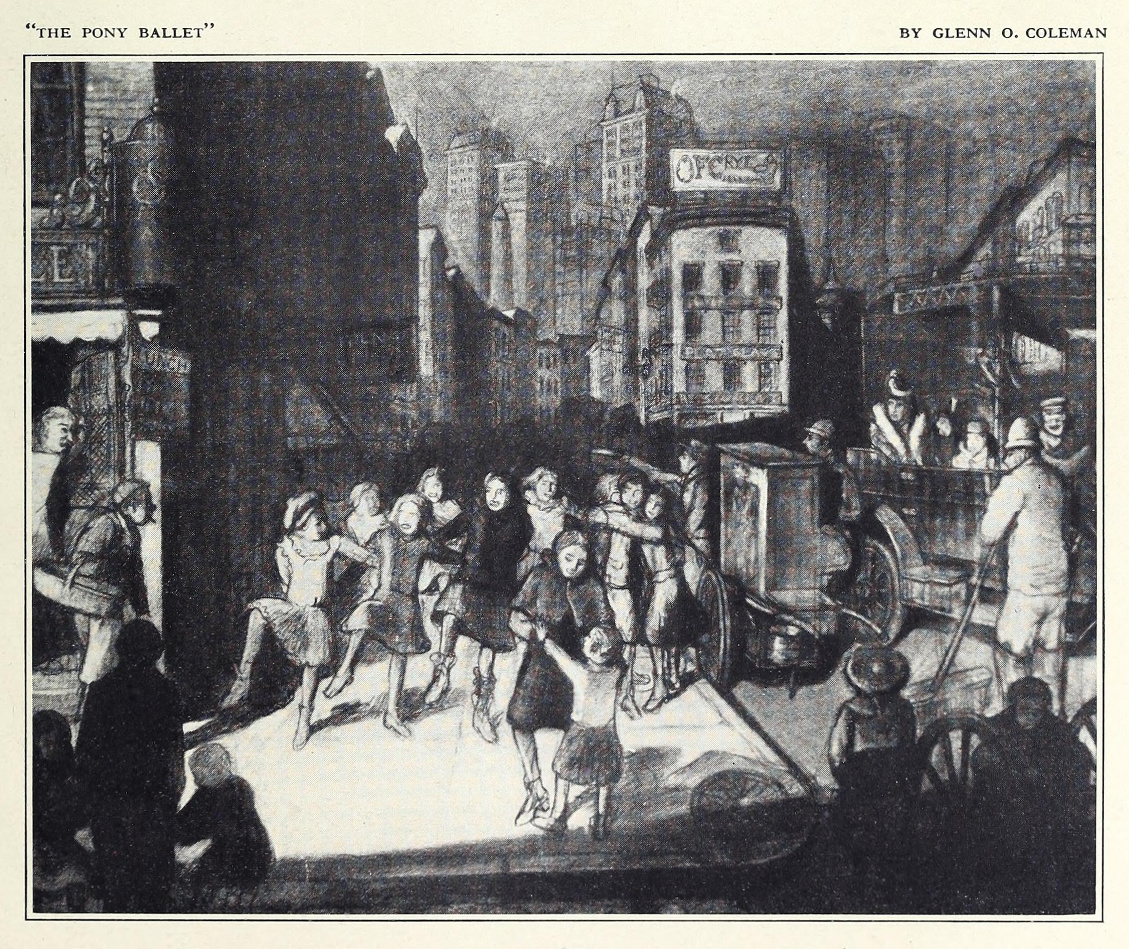

Picture: Glenn O. Coleman, “The Pony Ballet”. A pony ballet was a very high-kicking chorus-girl dance-line, presented on the stage by the younger dancers in a theatre troupe. It usually formed an interlude between acts at a variety theatre.

In terms of the appearance of the streets we should also take into account the extreme weather in New York City during Lovecraft’s time there, which would seasonally have radically changed the nature of the streets. Such as the worst snowstorm in living memory from 1st-3rd January 1925. Lovecraft had barely moved in to his “dismal hovel” at 169 Clinton Street, on 31st December according to the date I have, before the storm hit the city. Then a searing killer heatwave settled on the city in June of 1925. There was a similar but slightly less searing heatwave in July 1926, though by that time Lovecraft had left New York. Worse was to come, as can be seen from this EPA chart, but Lovecraft was able to enjoy these in far more comfort. Indeed, it might be said that without the 1929-37 heatwaves, he would not have lived as long as he did…


The Wandering Earth

I’m liking the sound of the new $700m Chinese science-fiction epic movie, The Wandering Earth. A three-star review (three of five) in the latest Sci-fi Now magazine made me realise that this way-too-long-awaited movie had actually been released at long last. That’s the problem with too much hype too early, something also seen happening with the H.P. Lovecraft game The Sinking City for the last year. That game will probably be very good when released (it’s from the guys who made the superb Sherlock Holmes games, but this time they’re doing Lovecraft). But once the actual release happens many have long since switched off their attention for it, due to the years of vapid hype for something not yet available. I’m thinking that there’s a market for a magazine or website that only covers new stuff that’s actually released and fully complete, as a huge time-saver for busy people.

Anyway, Sci-fi Now talks of “the irony-free bombast of the whole thing”, and describes The Wandering Earth as “a gigantic, ludicrous over the-top disaster movie” — making it sound like a Chinese Independence Day. Great. That, and “irony-free”, is a very good thing in my book. Some other reviews (skimmed, to avoid plot spoilers) grudgingly admit it’s good romping save-the-world heroic entertainment. But one often gets the impression the reviewer feels that it’s not politically-correct or career-advancing to be seen to like such ‘gung-ho / can-do’ stories of sentimental heroism.

Despite the movie being slammed by IndieWire as “unwatchable” and unceremoniously dumped on Netflix with no publicity at all, one intelligent review confirms another reason for my interest it it. Its sheer difference from Hollwood pap such as the dire new Godzilla

The Wandering Earth is a breath of fresh air. Its basic assumptions are sufficiently different from those of a Hollywood film that this increases our enjoyment of all the surprising turns, while making us think about the way in which certain civilisational differences can lead to new forms of artistic expression.

The characters in The Wandering Earth are engineers, workers of physical reality. Pleasure for them will come after their work is done. The Western viewer may be surprised that the movie contains no hint whatsoever of romantic or erotic interests.

Sounds even better, then. Proper sci-fi adventure, and not contorted by adding ‘love interest’. Johnny Depp’s awful nanotech sci-fi movie Transcendence (2014) was a prime example of that destroying a movie. There’s also that tedious new mode of… “We need to repeatedly bring the action to a grinding halt for eight minutes, to Talk Deeply About Our Feelings”, as seen in the second Guardians of the Galaxy movie, and the early series of Game of Thrones (until they got a bit more action-oriented).

It’s said that the American-English dub for The Wandering Earth significantly shifts the characterisation toward camp cheesiness, and also is rather American. Thus presumably the subtitled version is the one to try to watch the first time around, even though the vocal shadings will be lost (social class, emotional overtones etc) on a Westerner. Then see the English dub as one’s later ‘second viewing’ of the movie.

Joshi in France – the report

S.T. Joshi’s blog has updated with an illustrated report on “A Trip to France”, made to promote the French translation of his monumental Lovecraft biography. Among much else, he ventured down into the Catacombs of old Paris…

Traversing this site was a suitably grisly experience for a devotee of the weird and macabre.

Suitably primed, he later discovered the young artist Laurent Gapaillard, who does epic architectural prints in the Piranesi and Prout style, and from my cursory searches seems to be known in France for his book illustration and concept art for videogames.

The French ‘Lovecraft & Sonia’ play Howard, Mon Amour is being translated to English, and Joshi hopes to find a publisher for it.

Also, Joshi has had a copy of his The H. P. Lovecraft Cat Book in print. The hardcover first edition has sold out already.

NecronomiCon 2001

Snagged from a sale listing, a pretty good scan of a NecronomiCon convention cover. Done in very pleasing pen and ink by an unknown artist, for the 2001 convention. Search doesn’t immediately land me on the artist’s name.

Update: the artist has been suggested, by the style, as the British artist Dave Carson. Following that I’ve found a credited Dave Carson piece which has the same maker’s mark on it, so this cover is indeed by him.