Whose work is entering the public domain in 2020?

As we wing toward the middle of 2019, it’s time for a survey of interesting texts set to enter the public domain in early 2020. Here I first look at nations, such as the UK, which follow “the 70 year rule”, the author having died in 1949. Then I look at the 50-year rule nations. Then I note some material in the forthcoming “published 1924 in the U.S.” release.

70-year rule:

* H. Bedford-Jones. Prolific pulp writer for the ‘slicks’, mainly historical adventure stories, but he also wrote for Farnsworth Wright’s Oriental Stories. I see that at least one anthology of his work has been published in recent years, The House of Skulls and other Tales from the Pulps (2006), so I assume he’s still a good read.

* Hervey Allen. Author of the filmed novel Anthony Adverse, and several colonial-era novels, all probably no longer to modern tastes. However he also wrote Israfel, a 1926 biography of Poe.

* Dame Una Constance Pope-Hennessy, British author of Edgar Allan Poe, 1809–1849: A Critical Biography (1934). Spliced with Hervey Allen’s Poe biography (above) and with the two heavily abridged, one might have for the text for a new graphic novel on Poe’s life?

* Tod Robbins. A writer of accomplished and ghoulish horror stories, including the story said to have inspired the movie Freaks (1932).

* Arthur Leo Zagat. He seems to have been a prolific crank-’em-out pulp writer, including some stories that appeared in science-fiction pulps such as Thrilling Wonder Stories and Astounding.

* Jessie Douglas Kerruish. British Manx author of a ‘psychic/occult detective’ meets werewolf book, The Undying Monster (1922). Set in Sussex (the south of England) in modern times, but laced with northern lore and antiquarian touches. Later filmed as a 1942 war-time quota movie with John Howard, in what the veteran movie critic Halliwell calls a… “Silly but well-photographed and directed minor horror on wolf-man lines”. S.T. Joshi considered the novel worthy and said it… “is one of the more elaborate werewolf tales of the early twentieth century and shows the inventive extremes to which writers were resorting in their effort to revitalize a classic horror theme.” Kerruish had three stories in the Not At Night horror anthologies of the 1930s (“Gold Of Hermodike”, “Wonderful Tune”, “The Seven-Locked Room”), and my digging into the copyright registrations reveals a story “‘Twelve miles above the earth’, in John o’ London’s weekly, Nov. 1, 1930″ which could be science fiction or one of the wave of ‘future air-power’ stories that emerged at this time. Also “The Making of a Martyr”, seemingly a story about a very slow poisoning over many years. The last work was Babylonian Nights’ Entertainments (1932), in which a dozen of the best stories from all over the most Ancient world are collected for the entertainment of an insomniac Babylonian king, and re-told for him (via Kerruish) — a Theosophist review considered that most of these re-tellings had “spirit and life” and that Kerruish had done well to “capture the spirit of the ancient Near East”.

* Norbert Davis. American detective fiction author of the 1930s and 40s. Said to be a fun and non-realist writer of detective fiction, and sometimes he ventured into outright detective-comedy. Overshadowed today by the cynical ‘hardboiled’ detective writers preferred by post-1960s critics of the genre.

* Sir Malcolm Fraser. His 1911 story collection The Trail of the Dead was said to be “ingeniously constructed” and The Bookman hailed it as “full of thrilling incident and exciting adventure”. Seems to be vaguely in the Sherlock Holmes mould? Sounds like something that the RPG gamer crowd might consider using, today? The book can possibly be had as a $20 reprint here.

* Rex. E. Beach. Several conventional but stirring adventure novels set in Alaska, later filmed as American movies with big stars.

* Richard Connell. Known for the castaway man-hunter story “The Most Dangerous Game”, aka “The Hounds of Zaroff”, which was filmed several times.

* William Price Drury. A substantial British historical novelist who seems to have stuck to military and naval themes.

* Will Cuppy, satirical humourist and prolific reviewer. Author of humour books such as How to Tell Your Friends from the Apes, and How to Be a Hermit, done in the ‘snappy patter’ style which appealed to the New Yorkers of the 1920s — but which is difficult to appreciate today.

* Hugh Kingsmill. Compiled two anthologies of invective and verbal abuse. Wrote some early and rather creaky-sounding British science-fiction novels of the ‘lost race’ type. His collection The English Genius: a survey of the English achievement and character (1938) was only as editor, so won’t be out of copyright.

* Joseph Charles Mardrus, French translator of the Arabian Nights. The modern book The Arabian Nights: A Companion called it… “a portrait of a fantasy Orient, compounded of opium reveries, jewelled dissipation, lost paradises, melancholy opulence”. “Hailed as a triumph” by literary men such as Gide, but quickly quibbled over by scholars. Sounds great, but it’s in French only.

* Robert Ripley, of “Ripley’s Believe it or Not” fame. I’d assume that he wrote his books with a team, so they may not be coming out of copyright. The estate may also try to tie up the valuable name in legal knots.


50-year rule:

Places with a 50 year copyright term get; Richmal Crompton (the Just William books about a rascally English schoolboy); Jack Kerouac (the near-unreadable Beat Generation stream-of-consciousness novel On the Road); John Wyndham (Day of the Triffids and other classic British science-fiction); and… the pulp-ageddon that is the release of the works of the most popular Weird Tales writer, one Seabury Quinn. If you can be content with a nation-limited release, Quinn’s story Roads is probably the most likely to make a satisfactory graphic novel or animation.


The “1924” release:

In the USA, everything published in the U.S. in 1924 will enter the public domain. Frank Belknap Long’s first story “The Desert Lich” appeared November 1924, so that should become available for desert-themed anthologies and dramatised audio readings. Perhaps paired with Lovecraft’s “Nameless City”, which has a somewhat similar desert setting. S.T. Joshi summarises “Lich” as… “a non-supernatural conte cruel in which a man who had sold an unfaithful wife is forced to lie in a sarcophagus with her corpse.”

Lowell Thomas’s With Lawrence in Arabia (1924) sounds like it might make the basis of a new graphic novel of Lawrence of Arabia.

Yevgeny Zamyatin’s science-fiction dystopia We, in its first English translation.

Also Herman Melville’s Billy Budd, and Edgar Rice Burroughs’s Tarzan and the Ant Men.

As for Lovecraft, 1924 brought publication of: “The Shunned House”; “The Rats in the Walls”, the notorious Eddy necrophilia collaboration “The Loved Dead”; and the ghost-written Houdini tale “Imprisoned with the Pharaohs”. The 1924 date may spring the lock on re-publication via automated copyright-checking systems such as Amazon, for the latter two collaborations.


New: George Laswell, a pen and ink artist with the fine picture book titled Corners and Characters of Rhode Island (1924).

Fall, or Dodge in Hell

Great news, another 900-page slab from Neal Stephenson (Snow Crash, Anathem) has landed on the bookstore shelves. Any new book by Stephenson is always an event. And with Stephenson, unlike other authors, you know that the book’s not that’s big because it’s been padded with blah.

At the meta level Fall, or Dodge in Hell is reported to be a sci-fi / fantasy mash-up, which I have no problem with, but even today such books do have a tendency to raise the hackles of defensive reviewers on ‘both sides’ of fandom. More mainstream readers may hanker for an abridged version, in these busy days. But, skimming the reviews, it seems that those who like it find it an enjoyable romp and not a slog despite the length.

From what I can gather from the initial reviews, by lightly skimming the plot mentions… a Seattle-based multi-billionare dies and is cryogenically frozen. He later ‘wakes’ to find the freezing paid off and he’s been uploaded to a digi-world of eternal digi-life. But, rather than a glittering post-human techno-topia that’s ‘The Present Re-made, Shinier and Sexier’… he apparently finds that the new world inevitably falls out along ingrained mythic high-fantasy lines, akin to Tolkien and Milton.

There are several covers for the book. The main one makes it look like one of those generic serial-killer horror books, and has a clipart crow and humdrum typography to boot. What were the publishers thinking of, there, as a cover for such a major author? But the ebook has an absolutely superb cover, one of the best I’ve seen in the last few years…

I very rarely “read in ebook and also skim”, and I certainly wouldn’t for a fine book like Stephenson’s earlier Anathem. But given the length here, and ‘virtual world’ themes that I don’t personally find all that alluring, I’m thinking that skimming may be a preferable alternative to what is going to be a very long audiobook.

A Youth in Wayland Square

This weekend, the 39th Festival of Historic Houses of Providence, Rhode Island…

Sunday will appeal to horror fiction fans. The new guided walking tours will visit the birthplace and childhood neighborhood of writer H.P. Lovecraft. “We’ll also be doing a tour of Gladys Potter Park and tours of the Blackstone Conservation District to highlight the cultural landscape of the neighborhood: the origins, the history, how it’s evolved, what’s being done today to protect some of the great open spaces there,” adds Brent.

Booking.

Friday picture postals from Lovecraft: Fulton St. near Clinton St., Brooklyn.

Last week I looked at the corner of Joralemon St. and Clinton St., New York, which led me to look at the geography and demographics of Red Hook in the 1920s. Lovecraft got the demographics and mix of Red Hook right in his description of the place, except in one respect. Having an Irish protagonist in the story, he substituted “Spanish” for “Irish” in his opening description of the place and its people. According to my reading on Red Hook, there was to be a large Spanish-speaking population there, but that came later in time.

Following my look at Joralemon and Clinton St., here’s a ‘picture postal’ of another nearby scene which I’ve also newly colorised…
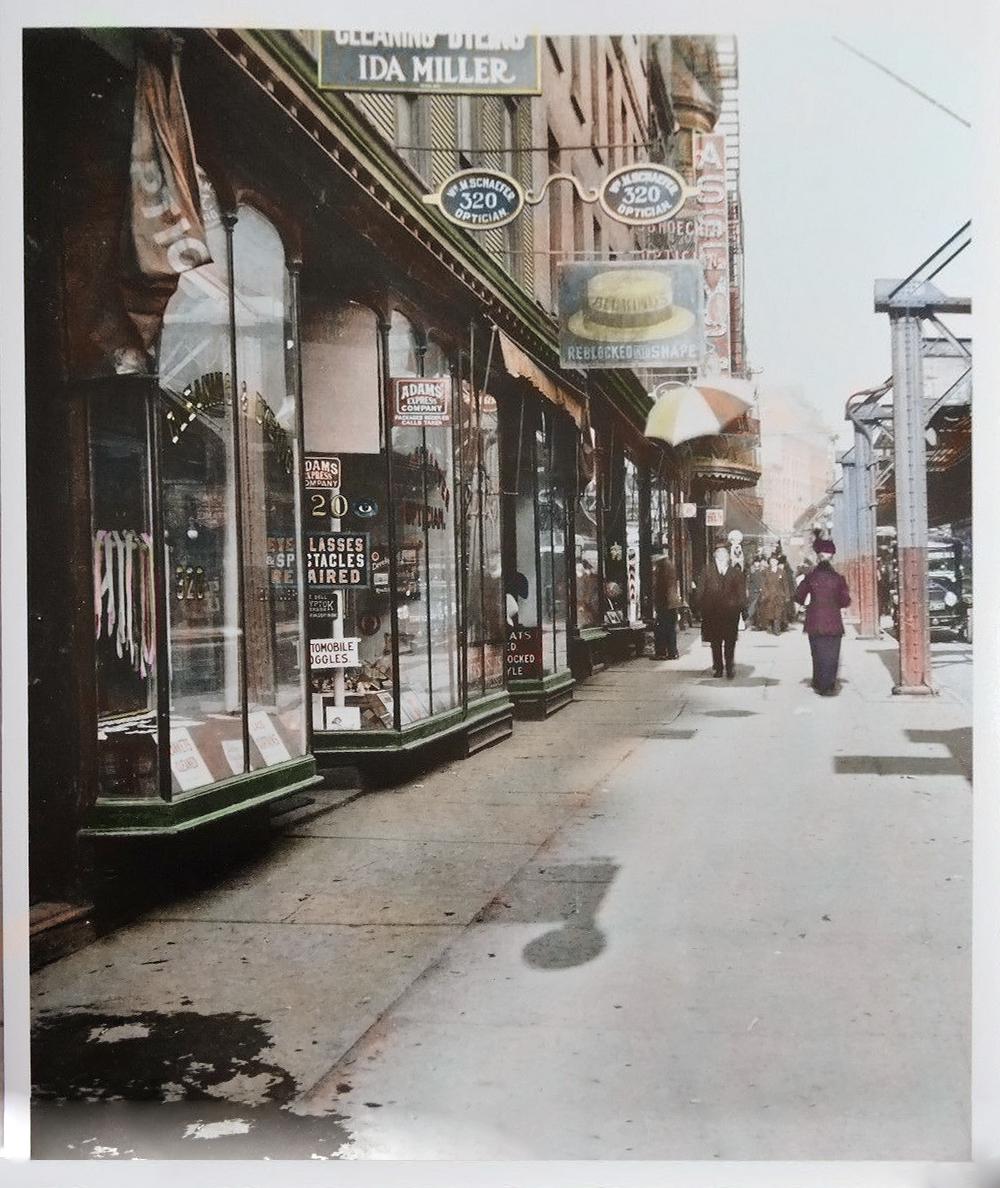
Again, we also see an evocative ‘H.P. Lovecraft stand-in’, this time as if walking toward the viewer. The man is not Lovecraft, but one could imagine he might be. We also see 320 and 322 Fulton Street on the left. This spot is thus close to Lovecraft’s dingy apartment on Clinton St., and the two points are marked on this extract from last week’s map…

The lady’s hat might date the picture some years earlier than the mid 1920s. One source says 1907, the other 1915. The scene here is one street over from the Montague Street technical and mercantile branch (1903) of the main Brooklyn Public Library, and I assume the Music Academy was still opposite this library (update, no it had burned down but there was an Art Club). This part of Fulton St. is obviously more salubrious than the adjacent Red Hook, despite the relative proximity to it. There’s a cleaners, an opticians, a hat-blocker, what seems to be an umbrella shop, a novelty shoe shop (according to Directories), the latter being next to “Asseys” (sp?). The “Asseys” sign and canopy might lead one to think it was a theatre or similar. But I can find no trace of such. Possibly it was a private club with large restaurant with dance-floor. Because there was a “Gentlemen’s Cafe and Grill Room” at 308 Fulton St. in 1910, with… “Accommodations for Balls, Banquets, Private Dining Parties and Lodges” and promising to provide the Royal Hungarian Orchestra. One has to wonder though, if this stretch of the street was quite so salubrious a place by 1925/26, given the way that the social status of New York neighbourhoods can rapidly shift over time. But one has to assume that the nearby Library continued to give the place a certain level and type of clientele, in the mid 1920s, which helped to maintain its standing.

The curious steel structure on the right of the picture is part of the famous and once much-loved elevated railway, “the El”. Lovecraft’s friend Rheinhart Kleiner celebrated Fulton Street and the El in this section of his Betjeman-esque poetic ditty “Brooklyn, My Brooklyn”…

   To hear the passing roar above
   Of elevated trains,
   That thrill me as they soar above
   Unnumbered marts and fanes.

   I’d miss the book so pleasingly
   Displayed on Fulton Street;
   The other wares that teasingly
   Remind of things to eat.

By book Kleiner presumably means a large bookshop shop-sign, hanging above the street and done in the shape of a book? In the photo above we see something similar in the shape of eye-glasses…

By fanes Kleiner indicates ‘temple or shrines’, and presumably the word is here used whimsically of the lunch eateries and soda palaces.

In one letter of 15th April 1929 Lovecraft talks of travelling into New York by rail on the… “elevated which I generally employ”, for a return visit. Here is a postcard and archive picture which shows the sort of elevated view he would have enjoyed along Fulton St. The second picture is a record-picture of the Elevated in the heart of Fulton St., Brooklyn, albeit from perhaps 20 years before Lovecraft’s time there.

Travelling in this manner is hugely enjoyable to the observant and keen-eyed type of person, provided one has a good window seat on the correct side of the carriage. One can thus become far more endeared to a place than otherwise, if one were only riding along in heavy traffic or trudging and dodging along at ground level on foot. Cities with elevated and double-decker transport are inherently more ‘likeable’ places.

Lovecraft’s good friend Frank Belknap Long also liked to browse an antiquarian shop on Fulton Street for curios, although (amazingly) it was Lovecraft who in 1922 had introduced Long to the second-hand bookshops of New York, not the other way around. Long went there at least once with Lovecraft…

[Roman coins and] baked-clay Roman lamps, and he [Lovecraft] once helped me pick out magnificent examples of both ‘coinage and lampage’ at an old-coin shop on Fulton Street.” (Dreamer on the Nightside)

Presumably this was the Brooklyn Fulton St., though it could have been its namesake over the river. That said, Long’s memory (of more than forty years prior) is not to be wholly relied on, and the store might even have been in some other street entirely. Scans of old coin-collector journals reveal the name of a well-respected curio and coin dealer dealer on Fulton St., but this name can lead me to no address or picture.

But the opening picture of this post is certainly of the Brooklyn Fulton St., the street in which Lovecraft successfully culminated his epic pursuit of a new suit at a cheap price after his clothes were stolen. That suit store was at 463 Fulton Street, Brooklyn, further up the street-numbering and around the bend from the spot pictured above. Lovecraft also patronised a restaurant off Fulton Street, this being sometimes visited by Lovecraft on Sundays for lunch. There were likely also some bookshops nearby, given the proximity of the technical and business Library, and more were coming — the bookshop of Isei Binkin at 252 Fulton Street may have been at that nearby address from 1932. This was the same Mr. Binkin of the amazing Grill/Binkin collection of Lovecraftania, which emerged in the early 1970s alongside Lovecraft’s reviving reputation.

Probably there are more mentions of ‘Fulton’ in print, but the two key books on Lovecraft in New York are not indexed to street-names. Once again I’m reminded that if one wanted to turbo-charge Lovecraft scholarship, a searchable database of all the letters would surely do that — even if it only supplied Google Books-like snippets in its search results. Surely such a thing would be fully crowd-funded within a day, if championed by Joshi and others?

But even without such a scholarly tool, I generally have the impression that the lower half of Fulton St. was ‘about’ something. It was about making the more aspiring people of this first great city of the modernity feel comfortable and easy, for a relatively-modest but fair price. Whether that was in affordable men’s accessories, cleaning and hat services, Sunday meals and soda/ice-cream palaces, or small items items such as spectacles, umbrellas, unusual shoes, cut-flowers, smoking pipes, and perhaps (later) books. In the upper half, as the streets rose into the 450s and 60s, the stores seemed to have become grander and there were several large and tall department stores.


I should note that there is another Fulton St. to be found just across the Brooklyn Bridge, passing through what is now the Financial District of New York. It was once connected to the Brooklyn Fulton St. by river ferries which had terminals at the foot of the famous Brooklyn Bridge. The ferry service seems to have been discontinued by the mid 1920s, thus severing the two streets. This means that when Lovecraft talks of visiting the Fulton St. Fish Market in a letter, he’s actually across the river and walking around the dockside at the foot of that other Fulton Street…

Some years ago Long and I attempted to explore the Fulton Fish Market section of New York — which is full of quaint scenes and buildings. I don’t know where I left the
lunch I had eaten an hour previously — for I was too dizzy to read the street signs! In the end I managed to stagger out of the stench without actually losing consciousness …” (letter of 1933, Selected Letters IV)

This brief mention implies that this daytime visit was hasty, yet according to Vrest Orton’s memoir of Lovecraft the area was a fairly frequent night-walk haunt of Lovecraft’s (see Lovecraft Remembered) in search of 18th century remains. Possibly the fish-smell was less so in the dead of night, when the boats were away and trawling and the disinfected warehouses awaiting their dawn-landed catch?

That Fulton St. appears to have subways rather than an “El” railway, and a subway entrance can be seen here in this 1933 picture…
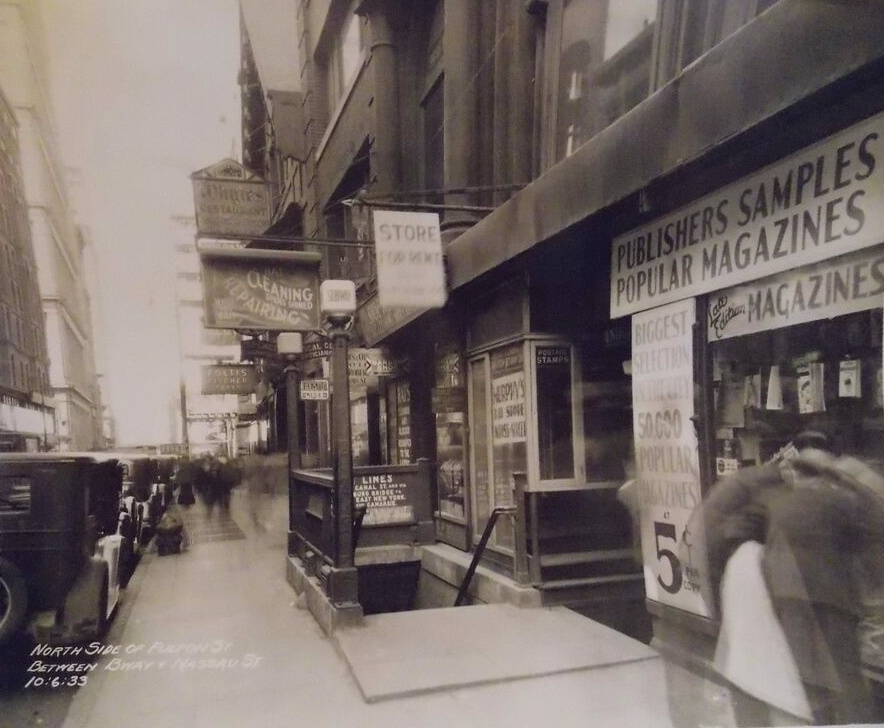
Since we know Lovecraft was also in this other street too, we might again imagine the picture’s scene shifted a few years in time. And that the men looking excitedly in the display-window resemble Lovecraft and Belknap Long — perhaps just hopped up from the subway to visit the “50,000 magazines store” — and seeing familiar names on the cover of a brand-new edition of Weird Tales.

New book: Lovecraftian Proceedings #3 (2019)

Newly listed at Hippocampus, Lovecraftian Proceedings No. 3 (June 2019). This is the book of some of the many papers given at the Armitage Symposium at NecromiCon 2017.

Looking interesting to me, after filtering the table-of-contents past the 2017 abstracts book, are…

* Ian Fetters, “Lovecraft’s Dark Continent: At the Mountains of Madness and Antarctic Literature”.

* Heather Poirier, “H. P. Lovecraft and the Dynamics of Detective Fiction”.

* Nathaniel R. Wallace, “The Cosmic Drone of Azathoth: Adapting Literature into Sound”.

The Borough Clothiers on Fulton St.

Two new discoveries.

1) A photograph exists of the interior of the shop where Lovecraft culminated his epic hunt through New York, seeking a new affordable suit after his clothes were stolen. The date of the photograph is likely perfect, too.

A trade journal named The Clothier and Furnisher, seemingly in its 1925 volume, which has a long profile article on The Borough Clothiers store in Fulton Street, which was Lovecraft finally bagged his $25 suit. Hathi has a scan of three 1925/26 volumes, but these are on copyright lockdown for another few years and can’t be had even with a VPN.

Finally he seemed to come across just what he wanted—except that the coat only had two buttons. This was at the Borough Clothiers in Fulton Street in Brooklyn. Lovecraft was shrewd in dealing with the salesman: he said that he really wanted only a provisional suit until he could get a better one, therefore implying that he might buy another suit from the place later (not mentioning that it might be more than a year before he did so); the salesman, accordingly, consulted with a superior and showed him a more expensive suit but priced it at only $25. Lovecraft, putting the thing on, found that it “vastly delighted me,” but the absence of the third button gave him pause. He told the salesman to hold the suit while he checked more shops. The salesman told Lovecraft that it was unlikely he could get a better deal anywhere else, and after examinations of several more stores Lovecraft found that this was the case; he went back to Borough Clothiers and bought the suit for $25. (S.T. Joshi, I am Providence).

Perhaps someone with access to the archives of the New York libraries might be able to get a copy of the picture from the paper archives?

2) With some keyboard twiddling I managed to get the actual address from the Google Books copy, in a snippet:

the store operated under the name of The Borough Clothiers, at 463 Fulton Street, Brooklyn, is …

So far as I’m aware, this is the first time that scholars of Lovecraft’s life have known the actual address. A small point, yet it may lead to the emergence of a 1920s photo of the exterior as well as the interior.

Call for papers: Monsters and the Monstrous

Call for Papers for the Inaugural Session of the Monsters and the Monstrous Area at the 2019 Conference of the Northeast Popular & American Culture Association (November 2019). Proposals due by: 15th June 2019.

“the Monsters and the Monstrous Area is also especially interested in celebrating both the New England Gothic tradition and the life, works, and legacy of H. P. Lovecraft, a leading proponent of Weird Fiction and an immense influence on contemporary popular culture.”

Joshi’s Liberation newspaper interview

S.T. Joshi’s Liberation newspaper interview, in French: “Lovecraft admettait lui-meme que les relations humaines ne l’interessaient pas”. Now online and public, and with no paywall that I can see, but it may be one of those “the first view is free” newspapers.

Via Google Translate:

Q: Could you have written more with more [source] material, and are you planning a new version?

A: The biography is largely based on Lovecraft’s letters, an incredible source that often represents an almost daily chronicle of his life. This raw material does not interest everyone, and it needs to be interpreted to make it fit a coherent narrative frame. I could add more details to my biography, but it would not serve much purpose. Although in the last ten years we have learned new facts, and facts about Lovecraft. But I think I have already said a lot.

Cat Book contents

The H. P. Lovecraft Cat Book now has a page on hplovecraft.com with a full contents list, including precise details re: the number of letters…

The Cats of New York (excerpts from 21 letters)
Old Man (longer excerpt from one letter)
The Kappa Alpha Tau (excerpts from 34 letters including “[Anthem of the Kappa Alpha Tau]”)
Musings of an Ailurophile (excerpts from four letters to Marian F. Bonner)
Extracts from Letters (excerpts from 50 letters)

So that’s 110 letters, a good haul. No Amazon listings for it, yet. Let’s hope there will be an ebook at some point, too.