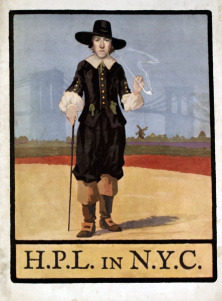
Last week I looked at the corner of Joralemon St. and Clinton St., New York, which led me to look at the geography and demographics of Red Hook in the 1920s. Lovecraft got the demographics and mix of Red Hook right in his description of the place, except in one respect. Having an Irish protagonist in the story, he substituted “Spanish” for “Irish” in his opening description of the place and its people. According to my reading on Red Hook, there was to be a large Spanish-speaking population there, but that came later in time.
Following my look at Joralemon and Clinton St., here’s a ‘picture postal’ of another nearby scene which I’ve also newly colorised…
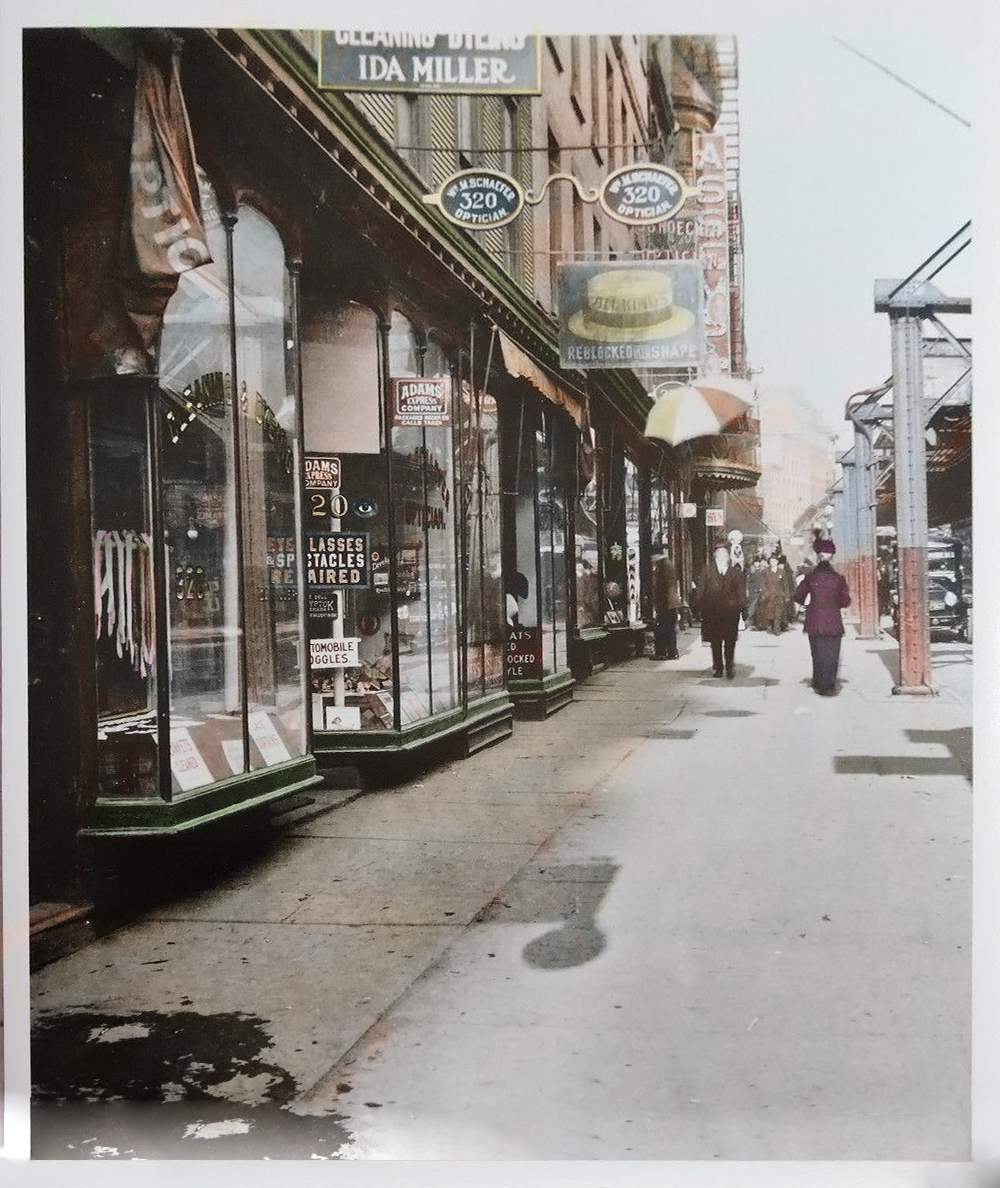
Again, we also see an evocative ‘H.P. Lovecraft stand-in’, this time as if walking toward the viewer. The man is not Lovecraft, but one could imagine he might be. We also see 320 and 322 Fulton Street on the left. This spot is thus close to Lovecraft’s dingy apartment on Clinton St., and the two points are marked on this extract from last week’s map…

The lady’s hat might date the picture some years earlier than the mid 1920s. One source says 1907, the other 1915. The scene here is one street over from the Montague Street technical and mercantile branch (1903) of the main Brooklyn Public Library, and I assume the Music Academy was still opposite this library (update, no it had burned down but there was an Art Club). This part of Fulton St. is obviously more salubrious than the adjacent Red Hook, despite the relative proximity to it. There’s a cleaners, an opticians, a hat-blocker, what seems to be an umbrella shop, a novelty shoe shop (according to Directories), the latter being next to “Asseys” (sp?). The “Asseys” sign and canopy might lead one to think it was a theatre or similar. But I can find no trace of such. Possibly it was a private club with large restaurant with dance-floor. Because there was a “Gentlemen’s Cafe and Grill Room” at 308 Fulton St. in 1910, with… “Accommodations for Balls, Banquets, Private Dining Parties and Lodges” and promising to provide the Royal Hungarian Orchestra. One has to wonder though, if this stretch of the street was quite so salubrious a place by 1925/26, given the way that the social status of New York neighbourhoods can rapidly shift over time. But one has to assume that the nearby Library continued to give the place a certain level and type of clientele, in the mid 1920s, which helped to maintain its standing.
The curious steel structure on the right of the picture is part of the famous and once much-loved elevated railway, “the El”. Lovecraft’s friend Rheinhart Kleiner celebrated Fulton Street and the El in this section of his Betjeman-esque poetic ditty “Brooklyn, My Brooklyn”…
To hear the passing roar above
Of elevated trains,
That thrill me as they soar above
Unnumbered marts and fanes.
I’d miss the book so pleasingly
Displayed on Fulton Street;
The other wares that teasingly
Remind of things to eat.
By book Kleiner presumably means a large bookshop shop-sign, hanging above the street and done in the shape of a book? In the photo above we see something similar in the shape of eye-glasses…

By fanes Kleiner indicates ‘temple or shrines’, and presumably the word is here used whimsically of the lunch eateries and soda palaces.
In one letter of 15th April 1929 Lovecraft talks of travelling into New York by rail on the… “elevated which I generally employ”, for a return visit. Here is a postcard and archive picture which shows the sort of elevated view he would have enjoyed along Fulton St. The second picture is a record-picture of the Elevated in the heart of Fulton St., Brooklyn, albeit from perhaps 20 years before Lovecraft’s time there.


Travelling in this manner is hugely enjoyable to the observant and keen-eyed type of person, provided one has a good window seat on the correct side of the carriage. One can thus become far more endeared to a place than otherwise, if one were only riding along in heavy traffic or trudging and dodging along at ground level on foot. Cities with elevated and double-decker transport are inherently more ‘likeable’ places.
Lovecraft’s good friend Frank Belknap Long also liked to browse an antiquarian shop on Fulton Street for curios, although (amazingly) it was Lovecraft who in 1922 had introduced Long to the second-hand bookshops of New York, not the other way around. Long went there at least once with Lovecraft…
[Roman coins and] baked-clay Roman lamps, and he [Lovecraft] once helped me pick out magnificent examples of both ‘coinage and lampage’ at an old-coin shop on Fulton Street.” (Dreamer on the Nightside)
Presumably this was the Brooklyn Fulton St., though it could have been its namesake over the river. That said, Long’s memory (of more than forty years prior) is not to be wholly relied on, and the store might even have been in some other street entirely. Scans of old coin-collector journals reveal the name of a well-respected curio and coin dealer dealer on Fulton St., but this name can lead me to no address or picture.
But the opening picture of this post is certainly of the Brooklyn Fulton St., the street in which Lovecraft successfully culminated his epic pursuit of a new suit at a cheap price after his clothes were stolen. That suit store was at 463 Fulton Street, Brooklyn, further up the street-numbering and around the bend from the spot pictured above. Lovecraft also patronised a restaurant off Fulton Street, this being sometimes visited by Lovecraft on Sundays for lunch. There were likely also some bookshops nearby, given the proximity of the technical and business Library, and more were coming — the bookshop of Isei Binkin at 252 Fulton Street may have been at that nearby address from 1932. This was the same Mr. Binkin of the amazing Grill/Binkin collection of Lovecraftania, which emerged in the early 1970s alongside Lovecraft’s reviving reputation.
Probably there are more mentions of ‘Fulton’ in print, but the two key books on Lovecraft in New York are not indexed to street-names. Once again I’m reminded that if one wanted to turbo-charge Lovecraft scholarship, a searchable database of all the letters would surely do that — even if it only supplied Google Books-like snippets in its search results. Surely such a thing would be fully crowd-funded within a day, if championed by Joshi and others?
But even without such a scholarly tool, I generally have the impression that the lower half of Fulton St. was ‘about’ something. It was about making the more aspiring people of this first great city of the modernity feel comfortable and easy, for a relatively-modest but fair price. Whether that was in affordable men’s accessories, cleaning and hat services, Sunday meals and soda/ice-cream palaces, or small items items such as spectacles, umbrellas, unusual shoes, cut-flowers, smoking pipes, and perhaps (later) books. In the upper half, as the streets rose into the 450s and 60s, the stores seemed to have become grander and there were several large and tall department stores.
I should note that there is another Fulton St. to be found just across the Brooklyn Bridge, passing through what is now the Financial District of New York. It was once connected to the Brooklyn Fulton St. by river ferries which had terminals at the foot of the famous Brooklyn Bridge. The ferry service seems to have been discontinued by the mid 1920s, thus severing the two streets. This means that when Lovecraft talks of visiting the Fulton St. Fish Market in a letter, he’s actually across the river and walking around the dockside at the foot of that other Fulton Street…
Some years ago Long and I attempted to explore the Fulton Fish Market section of New York — which is full of quaint scenes and buildings. I don’t know where I left the
lunch I had eaten an hour previously — for I was too dizzy to read the street signs! In the end I managed to stagger out of the stench without actually losing consciousness …” (letter of 1933, Selected Letters IV)
This brief mention implies that this daytime visit was hasty, yet according to Vrest Orton’s memoir of Lovecraft the area was a fairly frequent night-walk haunt of Lovecraft’s (see Lovecraft Remembered) in search of 18th century remains. Possibly the fish-smell was less so in the dead of night, when the boats were away and trawling and the disinfected warehouses awaiting their dawn-landed catch?
That Fulton St. appears to have subways rather than an “El” railway, and a subway entrance can be seen here in this 1933 picture…
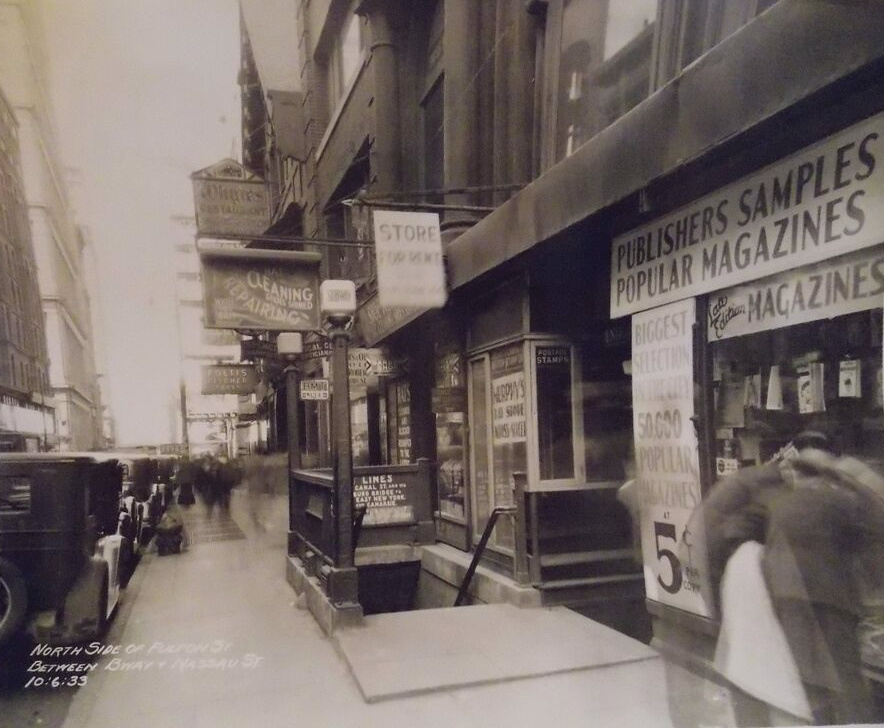
Since we know Lovecraft was also in this other street too, we might again imagine the picture’s scene shifted a few years in time. And that the men looking excitedly in the display-window resemble Lovecraft and Belknap Long — perhaps just hopped up from the subway to visit the “50,000 magazines store” — and seeing familiar names on the cover of a brand-new edition of Weird Tales.