New book: Weird Fiction in the Later 20th Century

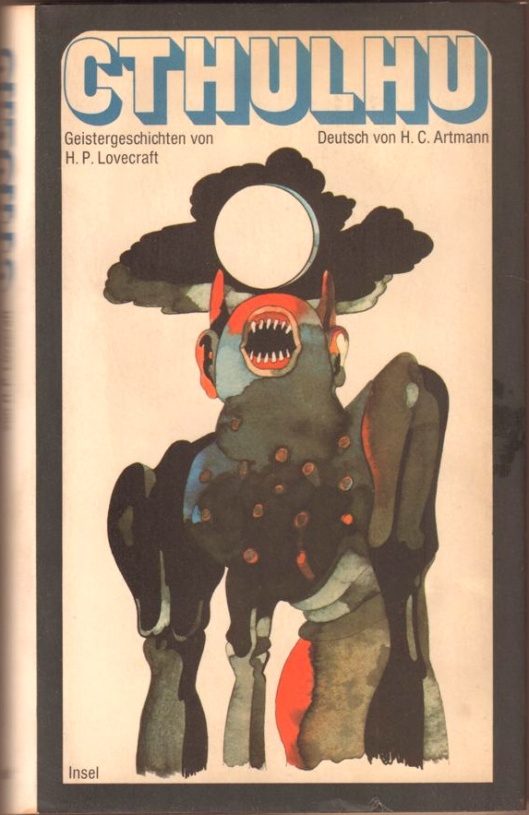
S.T. Joshi and Sarnath Press have released a new expanded edition of Joshi’s book The Modern Weird Tale: A Critique of Horror Fiction. As he writes on his blog

This is a substantial expansion of my Modern Weird Tale (2001), restoring the cuts — specifically, the chapters on Les Daniels, Dennis Etchison (whose own passing occurred only a few weeks ago), and David J. Schow, along with introductory passages to sections II, IV, and V — that my publisher, McFarland, required me to make.

The new expanded version is titled Weird Fiction in the Later 20th Century and is available as low-cost Kindle ebook as well as in paperback.

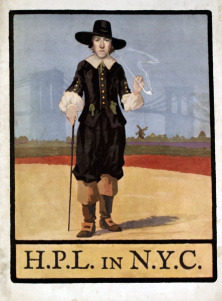
Friday ‘picture postals’ from Lovecraft: the Cloisters, NYC

H. P. Lovecraft once wrote to Galpin in 1934…

How are the “yarbs” [medieval-style herb garden] coming along? I enclose something about a similar enterprise. These old cloisters are very familiar to me — indeed, Belnape, Mortonius, & I visited them for the first time not long after our memorable Cleveland sessions of ’22..

Here he alludes to a remarkable architectural assemblage of medieval art in Manhattan. The “Barnard Cloister” had opened to the public in 1914, and was a poetic presentation in a large church-like structure with landscape setting. Attendants were garbed in the habits of medieval monks. This unusual architectural museum then expanded its content in 1926, when taken over by New York’s Met museum. In circa 1927/28 the Met then began to plan a new and larger museum a little further north along the hill, and their new building only finally formally opened in 1938 after Lovecraft’s death. The Met’s new Cloisters presented the collection with a coherent scholarly and curatorial rigour. The place is still open today and a major tourist attraction.

Period map showing subway station for the Cloisters.

The 1938 Cloisters in its landscape context, January 1961, beside the frozen river with ice-floes and with modern housing projects clustering around its forest park. The original Cloisters seems to have been just off the left of the picture, on the same ridge.

Lovecraft’s initial Autumn (Fall) 1922 visit would thus have been to the 1914 Cloisters. Free entry encouraged visits from the Lovecraft Circle despite the very long and tedious subway ride under Manhattan. Lovecraft’s first visit was with a day there with Sonia in 1922, but another was vividly recalled by Frank Belknap Long in his Lovecraft memoir, albeit a memoir written some fifty years later. Long has it that he, Morton and Lovecraft approached the Cloisters in the gloaming dusk, presumably hoping for a night-time candle-light tour perhaps around Halloween-time. It was only in winter that the museum closed at dusk. The group were rather startled to see old crones in black ‘hats’, using giant witch’s besom-brooms to sweep the darkling paths of the wooded grounds…

… we approached over a narrow, winding footpath we were instantly struck by the long and chilling shadows which the trees were casting in the deepening dusk. Then we saw — the witches. Three bent and fragile-looking women, unmistakably well advanced in years, were sweeping up the fallen leaves surrounding the Cloisters with long-handled brooms. There was a twilight glimmer at their backs, and they were wearing what at least from a distance looked like jet-black, conically tapering hats.

12th century doors, a working doorway at The Cloisters.

[Inside…] It was just as impressive as any similar shrine in Europe, with goblin tapestries and illuminated manuscripts vying in interior splendor with wood-carved figures, gilded or unadorned, dating back to the Middle Ages. For the most part the figures were angelic in aspect, but a few were chillingly demoniac with gargoyled features.

Archival material reveals that there were special candlelight evenings at the 1914 Cloisters, and one assumes that it one of these that spurred Lovecraft’s 1922 visit. Regrettably Long’s memoir can’t inform us on that point, as he recalled only the time of day, the forest, the ‘witches’, and the general nature of the exhibits. But evidently there were candle-light nights for the public, and here we see a photograph of one such at the 1914 Cloisters…

Here are some of the more grotesque carvings Lovecraft would have been especially pleased to spot on his visits, as the Cloisters became “very familiar” to him…

While an elevated roof-garden and children-friendly ‘unicorn tapestry’ galleries were added for the 1938 opening of the new building, Lovecraft may have seen early medieval wall murals such as this. Note the figures below the dragon…

There were also illuminated manuscripts at the 1914 Cloisters, because one of the ‘witch’ crones seen by Lovecraft turned out to be the keeper of the illuminated manuscripts. She and her companions wore the habits of the museum attendants. Their ‘black hats’ proved to be old stockings worn over the hair to keep out dust, twigs and insects, while sweeping dry leaves with the giant brooms.

Lovecraft’s 1925 Diary also records a later visit on the evening of June 27th, after he had spent the afternoon exploring Inwood near Long Beach. At this point in time the Met had taken over the 1914 Cloisters, but the new 1926 south wing was not yet open and the Rockefeller collection of religious figurative sculpture was not yet installed. Nor does it appear that the Met’s building work on the 1938 version of the Cloisters was underway by summer 1925.

The Met, having decided to build the new Cloisters, wanted to record the old Cloisters. One of the ways they chose to do this was a short and rather creaky cinema film, which was released in 1928 and is now on YouTube. In this we see something of the original Cloisters as Lovecraft would have known the place…

[youtube https://www.youtube.com/watch?v=8cH5T09cVd0?start=30&w=560&h=315]


Given his 1934 comment to Galpin that “These old cloisters are very familiar to me” we can assume other visits followed those of 1922 and 1925. Perhaps those with good access to Lovecraft’s letters can discover these dates, probably in the early 1930s, and also determine if Lovecraft later visited the (perhaps partly-built and partly-opened) ‘new’ Cloisters which formally opened in 1938. Though a few very scholarly sources say 1934, which may perhaps indicate a difference between a 1934 opening to the public and a 1938 ‘final official’ opening ceremony.


The Bernard Cloisters of New York were not the only cloisters Lovecraft experienced, as he also enjoyed those of Yale (forming from them some conception of the hushed quadrangles of the colleges of Oxford, in his beloved but never-visited England), and he also… “liked the cloistral hush of the Brown University campus, especially the inner quadrangle, where in the deserted twilight there seemed to brood the spirit of the dead generations.” (Lord of a Visible World). Yet, given the timings I’ve outlined above, it seems plausible to assume some influence of the 1914 Bernard Cloisters on elements of “The Lurking Fear” (written November 1922) and “The Rats in the Walls” (written August-September 1923).

This place and Lovecraft’s visits should remind us that Lovecraft was writing his most gothic work at the very tail end of the idea of the gloomy middle-ages. William Morris and Burne-Jones and others had of course done much to lift the idea of the medieval out of the mud, mostly in England, but it was not underpinned by the sort of heavy-duty scholarship needed to shift the idea of the medieval away from the old view of it. Even by the mid 1920s the consensus idea of the medieval in America was of a dark and rancid Church that hated industry and learning, and which shuffled the intelligent off into seclusion as shivering half-starved turnip-munching monks, mad sex-starved nuns, to be religious prisoners in dank dungeons, or (if they were lucky) they got to be ecclesiastic scholars who squabbled over religious trivialities such as the correct cut of a monk’s hair. There were no grand universities or thriving merchant towns, just dank castles lording it over lowly over-taxed peasants. There was no uniform set of traditions, sustained and nurtured across five centuries. There were no long distance trade or pilgrimage routes, no trade guilds, little law, no books and letters moving about Europe, and everyone was more or less stuck fast in their native clay speaking mutually incomprehensible dialects and languages. No-one could read and there was no cheap rush-lighting at night to read by anyway. There was no joyous art and music, yet at the same time people were emotionally incontinent, incapable of restraint. Dark Devilish heresy lurked behind every scraggly hedge, and an Inquisitor listened under every creaking bed. Kings and princes, if not completely mad religious zealots, were pompous, pig-ignorant and warlike.

That false view began to change with educative projects such as The Cloisters from 1914, and many other such efforts gathered steam in the USA by the mid 1920s, and thus we saw the first stirrings of a new and enlightened understanding of the medieval that the educated have today — though it can of course still be found in the gothic-horror vampire-and-werewolf end of popular culture. The counter-reaction may have gone too far, coming in the end to focus on and overly venerate the 12th and 13th centuries as a lost golden-age, but from that scholarly and literary over-correction came creative triumphs such as The Lord of the Rings and others which form the best works of high-fantasy.

Podcast: Subway fear

In the new Pessimists Archive podcast, each episode outlines a mass panic about new technologies or products — a panic that sooner or later proved to be unfounded.

Their The Subway episode seems relevant to Lovecraft and subways and similar tunnels. For instance in “Nyarlathotep” (1920) Lovecraft has… “Another [column of people] filed down a weed-choked subway entrance, howling with a laughter that was mad.”; Pickman paints a study called ‘Subway Accident’ featuring monsters climbing into the subway through a “crack in the floor” of the subway; and the climax of “At the Mountains of Madness” famously makes the comparison with a subway train. There was also Lovecraft’s general and growing dislike of subway travel when in New York, and then what appears to be his fear of using them by late 1925 / early 1926. One can also see broad comparisons between subways and the various other tunnel networks in his fiction.

For further reading, see my essays on “Lovecraft and the Subway” and the wider “It Emerged from the Subways! On the genesis of the monstrous under New York City”, in Walking With Cthulhu: H.P. Lovecraft as psychogeographer, New York City 1924-26.

Dark Adventure Radio Theatre: The Lurking Fear

Almost upon us, the Dark Adventure Radio Theatre dramatised full-cast edition of The Lurking Fear should be shipping/releasing in a day or two…

Downloads of The Lurking Fear will become available when the CD begins shipping. That date is currently estimated to be 21st June 2019 and may change.

You may also enjoy accompanying this, or preparing for it, with my free Annotated “Lurking Fear” PDF.

If you want CDs rather than downloads, you can also get a Boxed Set with old-time radio case that neatly holds four CDs…

When you provide your billing and shipping info at check out, please use the Customer Comments box to tell us which shows you’d like.

By which method you can pick up Fear plus another three CDs you may have missed, such as The Horror at Red Hook; The Haunter of the Dark; and The Rats in the Walls, among others.

Bear in mind that these are radically re-worked as 1930s style radio dramatisations, as if the broadcast rights for Lovecraft’s stories had been purchased by a slick New York radio theatre. This may not be to your taste if you prefer straight Wayne June -style readings of Lovecraft, so if you’re new to Dark Adventure you may want to listen to some samples and trailers… before you send your PayPal balance spiralling gibbering into the black gulf of cosmic nothingness.

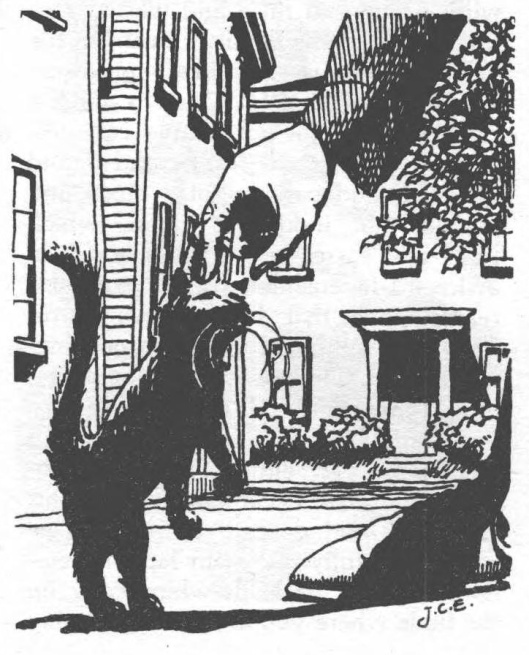
Kittee Tuesday: Unknown, Feb 1942

Celebrating H.P. Lovecraft’s keen interest in our mysterious felines.

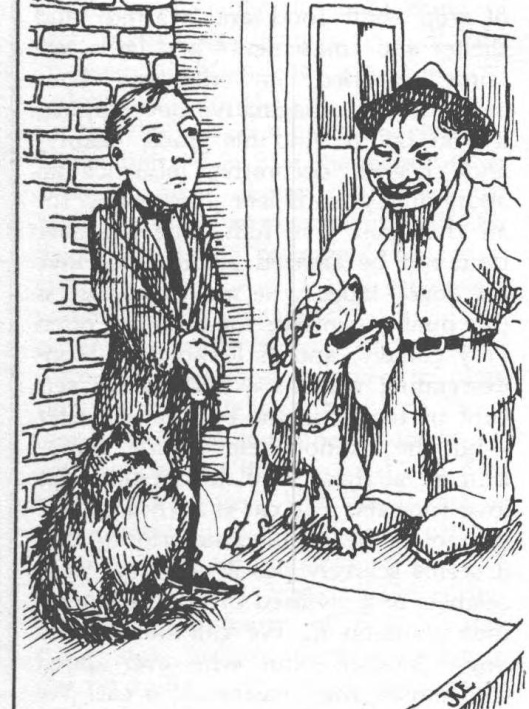
The opening illustration by Edd Cartier, for L. Ron Hubbard’s story in the newly digest-sized Unknown (February 1942), channelling the European fairy-tale tradition.

Lovecraft once had a long restaurant conversation with the flame-haired and young Hubbard, according to Frank Belknap Long. While impressed by the “extraordinary” lad, he evidently felt Hubbard was too professional and un-cosmic a writer to strike up a correspondence with. One wonders if Hubbard may have written a cat horror story as something of a salute to the recently deceased Lovecraft, on learning about the old gent’s keen interest in felines?

Graham Plowman’s Lovecraftian classical music

A new classical music piece from Graham Plowman, evoking Lovecraft’s “The Horror at Red Hook”. I see that in 2017 he also released an album, The Great Old Ones and Other Beings which is available on YouTube.

“For non-commercial projects no license is required” for re-used of his music, unless tagged with his publisher’s name “CD Baby”. Best to check with him and get permission in writing though, as YouTube and other postings are only “likely be tagged by my publisher CD Baby” — and “likely” implies it may not always be so tagged.

More Howard Days 2019 videos

More new videos from Howard Days 2019, kindly made and posted by Ben Friberg.

1. “What’s new with REH”

“Carney and Emmelhainz talking about their new role as editors of The Dark Man, the journal of Robert E. Howard studies” and new developments. The journal is being put on a regular schedule, and will be expanded in range to include papers on other Howard-era pulp topics. After this presentation there’s some news about the circa 2020 (affordable paperback) publication of Howard letters and poems, with all the known poems in perhaps three volumes. Then the session ends with an update on the ongoing Conan commercialisations, such as comics and games, in which the audience learns that Conan has now joined Marvel’s Avengers team of superheroes.

2. “The History of Project Pride”, on the locally-led and increasingly successful 30-year project to preserve Howard’s legacy in Cross Plains. A great listen, and you’ll learn a whole lot about the town and its spirit.

The Glenn Lord Symposium videos are also being posted, short presentations from scholars from the symposium element of the Days, but I’ll do a linking post on those once they’re all up.

The trailer, keynote speech and a major panel were all posted a few days ago.

Added to Open Lovecraft

Newly added to my Open Lovecraft page, of public open access scholarship:

* G. Parkinson, “We Are Property: The ‘Great Invisibles’ Considered Alongside ‘Weird’ and Science Fiction in America, 1919–1943”, The Space Between: Literature and Culture, 1914-1945, Vol. 14, 2018. (Discusses the early reception of H.P. Lovecraft in France via VVV during 1942-43, and the possible influence on Andre Breton. Also the wider reception of U.S. pulp writers and Charles Fort in continental Europe).

* From The Vaults of Yoh-Vombis: An Important and Valuable Collection of Books by Clark Ashton Smith, Thompson Rare Books, Catalogue No. 50, Fall 2018. (Illustrated scholarly bookseller catalogue for a collection of CAS rarities).

* A.M. McGee, “Haitian Vodou and Voodoo: Imagined Religion and Popular Culture”, Studies in Religion, Vol. 41, 2012. (Opens with a very brief discussion of Lovecraft’s Call of Cthulhu and sees… “his work as a prototype for many later presentations of voodoo”. Appears to be unaware of Henry S. Whitehead’s influence on the pulp idea of voodoo).

Future City

The Lovecraftian Murray Ewing has a new sci-fi soundtrack, Future City, inspired by the Terran Trade Authority (TTA) books of the 1970s. Judging by the samples the music might be described as ‘upbeat synthwave, but without many of the trance-ier overtones’.

Here’s a spread from the free Digital Art Live magazine’s issue 13 which had a mini-feature on the Terran Trade Authority, and which showed covers from all the books. TTA took science-fiction paperback covers of the 1970s, and re-purposed them to illustrate the timeline of an imagined space-faring future.

Howard Day 2019 – the first videos

The first of the video recordings are up for the Howard Days 2019, the major annual event which celebrates the life, work and home-town of Robert E. Howard…

1. Scene-setter, event trailer:

[youtube https://www.youtube.com/watch?v=nIXQ1XhF458&w=560&h=315]


2. Keynote Speech by Guest of Honor, author David C. Smith:

[youtube https://www.youtube.com/watch?v=4O0sGBUKlgU?start=234&w=560&h=315]


3. One-hour panel: “Kull, Conan, Kane or Bran: The Original Sword and Sorcery Characters”.

Houellebecq reprinted

The paperback of Michel Houellebecq’s H.P. Lovecraft: Against the World, Against Life (1991 in French) can be had for a few pounds/dollars in its 2000s Gollancz English edition, the 100-page essay being here heavily padded by the publisher to 256 pages with a couple of stories and a friendly fannish-looking cover added.

But the original 150-page English-translation hardback seems well out-of-print and has ascended to Collector-land…

Now, newly-listed for pre-order is a new 150-page hardback edition from Cernunnos, set for 3rd September 2019 and with a new cover. When the paperback is still widely available and cheap, why a reprint? My guess is they’re catering for continuing demand from university libraries, who want stout hardbacks on their shelves.

For those unfamiliar with the glittering catacombs of French intellectualism, I should note that Houellebecq can’t be thought of as a political philosopher or even a straight critic in the refined French style. He’s more what one what might call a gloomily poetic and provocative observer of his depressive times, and presumably in France he goes down well among those infected with their curious strain of gloomily nihilistic and largely gestural intellectualism. That said, the Lovecraft book was his first, and his breakthrough. It was written at the behest of the editor of Nouvelle Revue de Paris, to be one of the editor’s series of books for the high-end publisher Le Rocher. Thus Houellebecq had something to prove to a stern French literary establishment, the most perceptive of whose members knew a thing or three about Lovecraft by the late 1980s. I’ve read Against the World, Against Life in the unofficial Mackay translation. Houellebecq gets the broad biographical detail right, and weaves it with the fiction in an entertaining manner, and as such an undergraduate would definitely benefit from the essay as a short introduction which makes a dozen or more stimulating debating points. One can see why universities might deem the book suitable for degree courses.

But, despite this presumed need for rigour in writing a first ‘breakthrough’ book circa 1989/90, there appears to have also been a certain level of speed involved. In the text Houellebecq admits in passing that he doesn’t have access to the Letters, and seems to be working from memory in places. The Miskatonic Debating Club & Literary Society review usefully checks the book’s endnotes and finds them lacking…

… for all his assertions that he was forced by the constraints of the essay format to check his facts and cite his sources, he actually doesn’t. Most of what he says is supported by citations but some of it isn’t. Reading his Notes in the back of the book, the translator Dorna Khazeni lists many instances where throwaway references within the text attributed to HPL or others cannot be located, even after cross-checking with S.T. Joshi, who seems to have all of Lovecraft at his fingertips.


Update: the reprint just keeps getting pushed back and back, and at Jan 2020 is now well into 2020. I assume the expected library orders have not been flooding in…