Released: The Sinking City

You’re probably utterly fed up of hearing about The Sinking City, after what seems to have been years of interminable marketing overkill for a product that kept getting delayed. I’ve basically ignored it up until now. But finally, this new game has actually been released today on consoles, in stores (a DVD with what appears to be a Steam-lock), and a digital download for Windows PCs (the latter via the Epic Games Store only, so don’t go looking for it on Amazon or Steam).

There are now some genuine reviews available, from those who’ve completed it.

Why might the game be important? Partly because it follows the recent Lovecraft-faithful Call of Cthulhu (Cyanide Studios, 2018) and the general critical success of that game among fair-minded reviewers. Despite its imperfections, the initial sales success did wonders for Chaosium’s cash-flow, the company on whose famous RGP game it was closely based. Having two solid Lovecraftian games in a row, games that get a lot of things right in terms of aligning Lovecraft’s original vision with gaming fun, would be good. If might also lead to further glimmerings of understanding, among the masses, about who H.P. Lovecraft was.

But mainly The Sinking City promised to be important because the Ukrainian makers have a good track record, making detective-mystery-horror adventure games with Sherlock Holmes (apart from one, 2016’s Devil’s Daughter — which had a very weak storyline and crippling launch-day bugs). The Sinking City is the maker’s first Lovecraft game. From the E3 previews and trailers one can see that it’s big, polished, and from a team that really knows what they’re doing. Will it, therefore, be as enjoyable and accessible as nearly all of their Sherlockian outings?

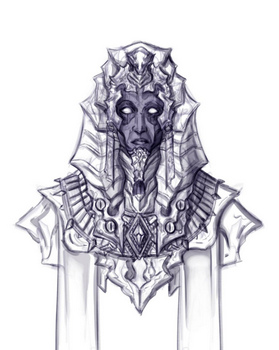
Picture: early concept art.

The setting is a 1920s coastal town of Oakmont (croak-monsters, geddit…) in New England, realised as a big ‘open world’ town… and if you’re a regular reader of this blog then I guess you kind of know the rest. It’s a good start that the makers have chosen such a historical setting. There’s also a Dark Corners-like ‘sanity meter’ in the game, another promising sign.
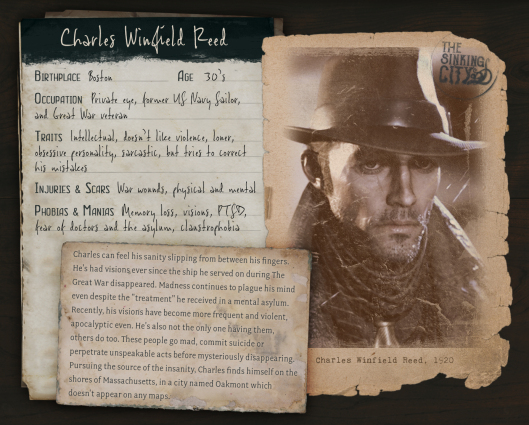
One difference from Lovecraft’s stories, though, is that your hero is physically Sherlockian and vulpine. He’s a cynical noir-detective type in post-war shell-shock, rather than a wilting antiquarian poet. As such you apparently get a Thomas F. Malone-like insight into ‘the world of hidden things’, you sport a nice Indiana Jones style hat, and (despite the “doesn’t like violence” on the character sheet) get to use guns and grenades.

Anyway, that’s the basics. It was released 48 hours early, to those who pre-ordered it, to try to forestall the usual haters. Here’s what some of the initial reviews say today…


A “decent detective game … As you explore a crime scene you collect clues that, while useless on their own, can be connected in the Mind Palace to open up new lines of investigation. And you have to make these connections yourself, without any hand-holding or hints, which makes a successful deduction especially satisfying. [yet] the solutions to many of the cases lacked a satisfying “Aha!’ moment. … combat is basic and uninspiring … [overall] it doesn’t quite stack up with the best of Frogwares’ Sherlock series” — PC Gamer, UK edition.

“Repetitive detective work … The most captivating cases are the more supernatural ones, where what one discovers is so unpleasant that it becomes worthwhile and one seeks out more such investigations. I wish the game had dared to slip away more often from the hard-boiled detective stance and let its atmosphere drift toward the approaching insanity that has Oakmont in its slimy grip.” — PC Gamer, Swedish edition (translation).

What’s not even mentioned in PC Gamer and other reviews is that there are adjustable levels of difficulty…

“… the perk of the easier game modes is they will give you hints as to what you should do next. While playing on master sleuth difficulty, you really are left to your own devices to figure things out.” — GameSpace.com

… while the Daily Dot also points out that 6-hour rush-reviewers may not have played it correctly…

“Where The Sinking City shines is in the elimination of any simple solutions. No matter how big or small the investigation, you must do it yourself. … The Sinking City demands astute observation—in everything from vague suspect descriptions to the intersection of street corners. Players must commit the very geography of Oakmont’s intricacies to memory.” — The Daily Dot.

“One of the real highlights of The Sinking City is how much freedom of movement there is and how much there is to explore. … the graphics in The Sinking City are gorgeous … When I was walking around many of the city squares, I was often reminded of Red Dead Redemption 2 both in the detail of creating the feel of a city in the grips of disaster and also just how beautiful everything looks. Top notch job on selling the setting and making it believable. It’s exciting and enthralling from the first moments right up to the very end. My biggest complaint is the archives [city and newspaper archives] are more frustrating to use than they should be, but that’s not a huge deal overall.” — GameSpace.com

“The city of Oakmont has quite a lot of character … boating through the town is genuinely enjoyable, even if you can get stuck on a reef and have no ability to just, like, nudge your boat back into the water. … The shooting feels terrible, encouraging you to mostly avoid it. Sometimes it’s better to run… Detective Charles Reed is a healthy mix of witty and dreary. And while Oakmont itself is samey within its own city limits, it’s a memorable setting nonetheless. … manually placing markers on the map (lots of markers) in order to track down quest and side-quest locations is great. I love it. Far more than if waypoints just automatically populated the map, like in pretty much any other open-world video game.” — gamingnexus.com

Sinking City does a fantastic job of keeping you on edge. The visions are genuinely unnerving, even if you’ve seen most of them with an hour or so of playing. The ambient noise of the city always sounds a little like something sneaking up behind you … an incredible atmosphere that really grips the darkest parts of your mind. Oakmont feels hostile, unwelcoming and full of secrets … While it stumbles with its characters and combat, The Sinking City is a great first step [for those new to such gaming] into the supernatural detective game.” — The Daily Star, UK tabloid newspaper.

“While the combat fails to prove engaging [and needs the inevitable post-launch patch]… The Sinking City delivers when it needs to. There’s a section early on where Reed dives underwater that truly contains one of the most bone-chilling, terrifying sequences I’ve ever seen.” — The Daily Dot.

The Sinking City is well worth playing for the initial rhythm of its casework and the freshness of its setting, but its mechanics, like its mystery, end up flooded [by elements that ‘pad-out’ the gameplay].” — videogamer.com

“Despite some technical shortcomings and constraints, The Sinking City does have a lot going for it. Fans of Lovecraft’s work will find plenty of references to dig into here. … I was impressed at how the Lovecraftian lore was intertwined into this spiralling tale. … More than other video games I can remember playing, I really felt I was investigating and solving a case here. I ended up being much more invested in building conclusions than I had anticipated.” — PlaystationLifestyle.

“More than any game I’ve played before, The Sinking City understands what it means to be Lovecraftian. Oakmont is contaminated with hatred and sickly, chilling environmental detail. Citizens spew vitriol at the player and at one another. The streets are often raked with rain and a harsh wind. Frogwares’ detailed ambiance goes a long way in making this game stand out among a crowded field.” — The Daily Dot.

Investigations can be… “repetitive, to say the least, but I enjoyed these investigations far longer than I thought I would. [Despite some lacklustre “bring me three X’s and I’ll tell you what I know” side-quests] I was still compelled to see the main story through to its conclusion. There are enough intrigues and unique characters I wanted to talk to, to just abandon it, despite it eventually culminating in an ending that falls flat despite its grand build-up. Yet while I enjoyed and frequently appreciated the side characters and the often fantastic voice acting given to them, I think The Sinking City’s other large problem is [the wooden detective] Charles Reed himself.” — MS Power User.

“It’s janky, a little unpolished and ugly but I couldn’t stop playing it.” — PowerUp!

“PC players need not worry too much about major problems such as crashes. I haven’t experienced any. Stuttering and slowdowns were also non-existent.” —PC Invasion technical review.

“[After finishing it] I realized that it’s a game which I would consider a treat for fans of H. P. Lovecraft’s works, the Cthulhu Mythos, and various stories of cosmic horrors and nightmares from the depths. Its presentation and atmospheric tones, at times disturbing and oftentimes portraying abject misery, perfectly depict the worlds crafted by masters of ungodly visions and terrors. The Sanity Effects and investigation processes are also decent and surprising at points. They’re even psychologically jarring on a couple of occasions. But as a survival horror or open-world adventure game, however, The Sinking City only wades in knee-deep waters instead of diving in to create something truly special.” — PC Invasion full review.


So it sounds like its the usual story for a first-day game release. Wait for a year, until the first three bug-fixing and AI-fixing patches are out, and there are two or three expansion packs to fill up the empty spaces the makers have deliberately left in their large open-world. If you’re a three-games-a-week player then you’ll probably hate it because you’ve ‘seen it all before’ and combat is poor and the weapons puny, but three-games-a-year players new to detective-mystery games will probably get a lot out of it. Seems to work best on a Windows gaming PC, at present.

Kittee Tuesday: Aliens in Space

Celebrating H.P. Lovecraft’s interest in our fascinating felines.

The cover of the hardback art-timeline book Aliens in Space, 1979, Stewart Cowley under the pen-name of ‘Steven Caldwell’. Cover painting by Bob Layzell. The Galactic Encounters books were a post-Star Wars series spun off from the Terran Trade Authority (TTA) books of the 1970s. The series took the reprint rights on art for space sci-fi paperback covers and used the covers to illustrate a timeline of an imagined spacefaring future.

Midderlands expansion

Over at one of my other blogs, Mythical beasts and places of Stoke-on-Trent, an unofficial expansion setting/gazetteer for The Midderlands RPG (old-school OSR). The game’s a sort of late-medieval / early-renaissance ‘Blackadder/Monty Python meets Lovecraft’ low fantasy game set in the Midlands of England, as if art-directed by Brian Froud and the original 1980s Spitting Image guys. Despite the richness of the world, the play samples I’ve seen so far have been quite lacklustre. It probably takes an imaginative game-master and players to do justice to the setting.

The Arthurian Lovecraft

There was an “Armitage Handout on Lovecraftian Arthuriana” at the scholarly symposium at NecronomiCon 2017. Basically, a preliminary but useful list of King Arthur work which elides in some way with Lovecraft.

This has now been revised and updated as “Mergers of the Matter of Britain and Lovecraft’s Cthulhuan Mythos: A Preliminary Bibliography (Revised)” (May 2019), which is online and public.

Picture: Merlin, by a young Howard Pyle.

Research funding: New England Regional Fellowship Consortium

New England Regional Fellowship Consortium offers grants for new archival and museum research into areas including… “literature, history and art history, anthropology, oceanography”. Lovecraft research could potentially work across several such areas.

Are you working on a specialized topic that requires a depth of resources such as only New England can provide? The New England Regional Fellowship Consortium (NERFC), a collaboration of 27 major cultural agencies, will offer at least two dozen awards in 2019–2020.

This year’s deadline of 1st February 2019 has been and gone, but it’s annual so presumably a 2020-21 deadline will be rolling around in February 2020. By that time the Boston Public Library will be open again for applications to host a Research Fellow.

New book: Weird Fiction in the Later 20th Century

S.T. Joshi and Sarnath Press have released a new expanded edition of Joshi’s book The Modern Weird Tale: A Critique of Horror Fiction. As he writes on his blog

This is a substantial expansion of my Modern Weird Tale (2001), restoring the cuts — specifically, the chapters on Les Daniels, Dennis Etchison (whose own passing occurred only a few weeks ago), and David J. Schow, along with introductory passages to sections II, IV, and V — that my publisher, McFarland, required me to make.

The new expanded version is titled Weird Fiction in the Later 20th Century and is available as low-cost Kindle ebook as well as in paperback.

Friday ‘picture postals’ from Lovecraft: the Cloisters, NYC

H. P. Lovecraft once wrote to Galpin in 1934…

How are the “yarbs” [medieval-style herb garden] coming along? I enclose something about a similar enterprise. These old cloisters are very familiar to me — indeed, Belnape, Mortonius, & I visited them for the first time not long after our memorable Cleveland sessions of ’22..

Here he alludes to a remarkable architectural assemblage of medieval art in Manhattan. The “Barnard Cloister” had opened to the public in 1914, and was a poetic presentation in a large church-like structure with landscape setting. Attendants were garbed in the habits of medieval monks. This unusual architectural museum then expanded its content in 1926, when taken over by New York’s Met museum. In circa 1927/28 the Met then began to plan a new and larger museum a little further north along the hill, and their new building only finally formally opened in 1938 after Lovecraft’s death. The Met’s new Cloisters presented the collection with a coherent scholarly and curatorial rigour. The place is still open today and a major tourist attraction.

Period map showing subway station for the Cloisters.

The 1938 Cloisters in its landscape context, January 1961, beside the frozen river with ice-floes and with modern housing projects clustering around its forest park. The original Cloisters seems to have been just off the left of the picture, on the same ridge.

Lovecraft’s initial Autumn (Fall) 1922 visit would thus have been to the 1914 Cloisters. Free entry encouraged visits from the Lovecraft Circle despite the very long and tedious subway ride under Manhattan. Lovecraft’s first visit was with a day there with Sonia in 1922, but another was vividly recalled by Frank Belknap Long in his Lovecraft memoir, albeit a memoir written some fifty years later. Long has it that he, Morton and Lovecraft approached the Cloisters in the gloaming dusk, presumably hoping for a night-time candle-light tour perhaps around Halloween-time. It was only in winter that the museum closed at dusk. The group were rather startled to see old crones in black ‘hats’, using giant witch’s besom-brooms to sweep the darkling paths of the wooded grounds…

… we approached over a narrow, winding footpath we were instantly struck by the long and chilling shadows which the trees were casting in the deepening dusk. Then we saw — the witches. Three bent and fragile-looking women, unmistakably well advanced in years, were sweeping up the fallen leaves surrounding the Cloisters with long-handled brooms. There was a twilight glimmer at their backs, and they were wearing what at least from a distance looked like jet-black, conically tapering hats.

12th century doors, a working doorway at The Cloisters.

[Inside…] It was just as impressive as any similar shrine in Europe, with goblin tapestries and illuminated manuscripts vying in interior splendor with wood-carved figures, gilded or unadorned, dating back to the Middle Ages. For the most part the figures were angelic in aspect, but a few were chillingly demoniac with gargoyled features.

Archival material reveals that there were special candlelight evenings at the 1914 Cloisters, and one assumes that it one of these that spurred Lovecraft’s 1922 visit. Regrettably Long’s memoir can’t inform us on that point, as he recalled only the time of day, the forest, the ‘witches’, and the general nature of the exhibits. But evidently there were candle-light nights for the public, and here we see a photograph of one such at the 1914 Cloisters…

Here are some of the more grotesque carvings Lovecraft would have been especially pleased to spot on his visits, as the Cloisters became “very familiar” to him…

While an elevated roof-garden and children-friendly ‘unicorn tapestry’ galleries were added for the 1938 opening of the new building, Lovecraft may have seen early medieval wall murals such as this. Note the figures below the dragon…

There were also illuminated manuscripts at the 1914 Cloisters, because one of the ‘witch’ crones seen by Lovecraft turned out to be the keeper of the illuminated manuscripts. She and her companions wore the habits of the museum attendants. Their ‘black hats’ proved to be old stockings worn over the hair to keep out dust, twigs and insects, while sweeping dry leaves with the giant brooms.

Lovecraft’s 1925 Diary also records a later visit on the evening of June 27th, after he had spent the afternoon exploring Inwood near Long Beach. At this point in time the Met had taken over the 1914 Cloisters, but the new 1926 south wing was not yet open and the Rockefeller collection of religious figurative sculpture was not yet installed. Nor does it appear that the Met’s building work on the 1938 version of the Cloisters was underway by summer 1925.

The Met, having decided to build the new Cloisters, wanted to record the old Cloisters. One of the ways they chose to do this was a short and rather creaky cinema film, which was released in 1928 and is now on YouTube. In this we see something of the original Cloisters as Lovecraft would have known the place…

[youtube https://www.youtube.com/watch?v=8cH5T09cVd0?start=30&w=560&h=315]


Given his 1934 comment to Galpin that “These old cloisters are very familiar to me” we can assume other visits followed those of 1922 and 1925. Perhaps those with good access to Lovecraft’s letters can discover these dates, probably in the early 1930s, and also determine if Lovecraft later visited the (perhaps partly-built and partly-opened) ‘new’ Cloisters which formally opened in 1938. Though a few very scholarly sources say 1934, which may perhaps indicate a difference between a 1934 opening to the public and a 1938 ‘final official’ opening ceremony.


The Bernard Cloisters of New York were not the only cloisters Lovecraft experienced, as he also enjoyed those of Yale (forming from them some conception of the hushed quadrangles of the colleges of Oxford, in his beloved but never-visited England), and he also… “liked the cloistral hush of the Brown University campus, especially the inner quadrangle, where in the deserted twilight there seemed to brood the spirit of the dead generations.” (Lord of a Visible World). Yet, given the timings I’ve outlined above, it seems plausible to assume some influence of the 1914 Bernard Cloisters on elements of “The Lurking Fear” (written November 1922) and “The Rats in the Walls” (written August-September 1923).

This place and Lovecraft’s visits should remind us that Lovecraft was writing his most gothic work at the very tail end of the idea of the gloomy middle-ages. William Morris and Burne-Jones and others had of course done much to lift the idea of the medieval out of the mud, mostly in England, but it was not underpinned by the sort of heavy-duty scholarship needed to shift the idea of the medieval away from the old view of it. Even by the mid 1920s the consensus idea of the medieval in America was of a dark and rancid Church that hated industry and learning, and which shuffled the intelligent off into seclusion as shivering half-starved turnip-munching monks, mad sex-starved nuns, to be religious prisoners in dank dungeons, or (if they were lucky) they got to be ecclesiastic scholars who squabbled over religious trivialities such as the correct cut of a monk’s hair. There were no grand universities or thriving merchant towns, just dank castles lording it over lowly over-taxed peasants. There was no uniform set of traditions, sustained and nurtured across five centuries. There were no long distance trade or pilgrimage routes, no trade guilds, little law, no books and letters moving about Europe, and everyone was more or less stuck fast in their native clay speaking mutually incomprehensible dialects and languages. No-one could read and there was no cheap rush-lighting at night to read by anyway. There was no joyous art and music, yet at the same time people were emotionally incontinent, incapable of restraint. Dark Devilish heresy lurked behind every scraggly hedge, and an Inquisitor listened under every creaking bed. Kings and princes, if not completely mad religious zealots, were pompous, pig-ignorant and warlike.

That false view began to change with educative projects such as The Cloisters from 1914, and many other such efforts gathered steam in the USA by the mid 1920s, and thus we saw the first stirrings of a new and enlightened understanding of the medieval that the educated have today — though it can of course still be found in the gothic-horror vampire-and-werewolf end of popular culture. The counter-reaction may have gone too far, coming in the end to focus on and overly venerate the 12th and 13th centuries as a lost golden-age, but from that scholarly and literary over-correction came creative triumphs such as The Lord of the Rings and others which form the best works of high-fantasy.

Podcast: Subway fear

In the new Pessimists Archive podcast, each episode outlines a mass panic about new technologies or products — a panic that sooner or later proved to be unfounded.

Their The Subway episode seems relevant to Lovecraft and subways and similar tunnels. For instance in “Nyarlathotep” (1920) Lovecraft has… “Another [column of people] filed down a weed-choked subway entrance, howling with a laughter that was mad.”; Pickman paints a study called ‘Subway Accident’ featuring monsters climbing into the subway through a “crack in the floor” of the subway; and the climax of “At the Mountains of Madness” famously makes the comparison with a subway train. There was also Lovecraft’s general and growing dislike of subway travel when in New York, and then what appears to be his fear of using them by late 1925 / early 1926. One can also see broad comparisons between subways and the various other tunnel networks in his fiction.

For further reading, see my essays on “Lovecraft and the Subway” and the wider “It Emerged from the Subways! On the genesis of the monstrous under New York City”, in Walking With Cthulhu: H.P. Lovecraft as psychogeographer, New York City 1924-26.

Dark Adventure Radio Theatre: The Lurking Fear

Almost upon us, the Dark Adventure Radio Theatre dramatised full-cast edition of The Lurking Fear should be shipping/releasing in a day or two…

Downloads of The Lurking Fear will become available when the CD begins shipping. That date is currently estimated to be 21st June 2019 and may change.

You may also enjoy accompanying this, or preparing for it, with my free Annotated “Lurking Fear” PDF.

If you want CDs rather than downloads, you can also get a Boxed Set with old-time radio case that neatly holds four CDs…

When you provide your billing and shipping info at check out, please use the Customer Comments box to tell us which shows you’d like.

By which method you can pick up Fear plus another three CDs you may have missed, such as The Horror at Red Hook; The Haunter of the Dark; and The Rats in the Walls, among others.

Bear in mind that these are radically re-worked as 1930s style radio dramatisations, as if the broadcast rights for Lovecraft’s stories had been purchased by a slick New York radio theatre. This may not be to your taste if you prefer straight Wayne June -style readings of Lovecraft, so if you’re new to Dark Adventure you may want to listen to some samples and trailers… before you send your PayPal balance spiralling gibbering into the black gulf of cosmic nothingness.

Kittee Tuesday: Unknown, Feb 1942

Celebrating H.P. Lovecraft’s keen interest in our mysterious felines.

The opening illustration by Edd Cartier, for L. Ron Hubbard’s story in the newly digest-sized Unknown (February 1942), channelling the European fairy-tale tradition.

Lovecraft once had a long restaurant conversation with the flame-haired and young Hubbard, according to Frank Belknap Long. While impressed by the “extraordinary” lad, he evidently felt Hubbard was too professional and un-cosmic a writer to strike up a correspondence with. One wonders if Hubbard may have written a cat horror story as something of a salute to the recently deceased Lovecraft, on learning about the old gent’s keen interest in felines?