The S. T. Joshi Endowed Research Fellowship in H. P. Lovecraft page has been refreshed for 2020/21. Application deadline: 13th March 2020. “Residence at the John Hay Library to be completed by 30th June 2021.”


03 Wednesday Jul 2019
Posted in Scholarly works
The S. T. Joshi Endowed Research Fellowship in H. P. Lovecraft page has been refreshed for 2020/21. Application deadline: 13th March 2020. “Residence at the John Hay Library to be completed by 30th June 2021.”
02 Tuesday Jul 2019
Posted in Kittee Tuesday, Lovecraftian arts
Celebrating H.P. Lovecraft’s interest in our fascinating felines.
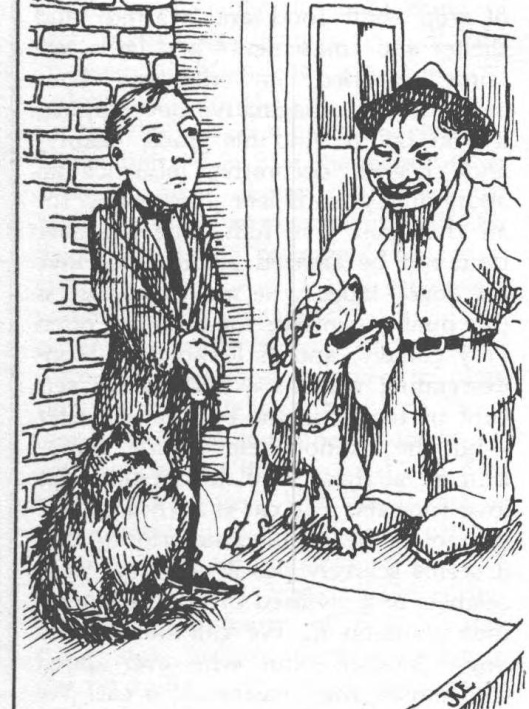
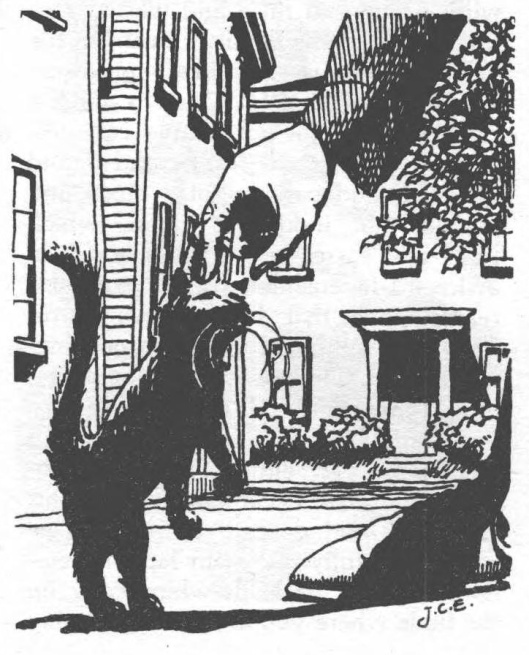
In August 1983 Twilight Zone magazine treated its readers to H.P. Lovecraft’s “Something about Cats”, with a brief introduction and some explanatory notes by S.T. Joshi. While the essay is now found in better form elsewhere as “Cats and Dogs”, there were illustrations by Jason Eckhardt and two of these featured Lovecraft himself.
02 Tuesday Jul 2019
Posted in Lovecraftian arts, New books
There’s a new 104-page comics adaptation of three Lovecraft stories, including “The Music of Erich Zann”, albeit in Italian. The new book is by D.D. Bastian and Sergio Vanello. It was released 20th June 2019 and the title in Italian is “La musica di Erich Zann e altri racconti”.


01 Monday Jul 2019
Posted in Odd scratchings
Here’s the opening illustration by Barnett Freeman for Walter de la Mare’s 1939 British anthology Behold, this dreamer: of reverie, night, sleep, dream, love-dreams, nightmare, death, the unconscious, the imagination, divination, the artist, and kindred subjects.

The book contains de la Mare’s perceptive introduction and what are effectively a long set of mini-essays, followed by the master anthologist’s judicious mix of selected poetry, prose and other texts. It’s deemed perhaps the best of his five anthologies, and is currently free on Archive.org via one of those basic Public Library of India scans. These scans, while welcome as readable freebies of post-1923 long-out-of-print works, regrettably all use such harsh contrast that they ruin any artwork or photography in a book.


Spine art…

1984 British paperback reprint cover by what might be another artist mimicking the style of the original art…

30 Sunday Jun 2019
Posted in Odd scratchings
It’s time for another monthly summary. Here in the UK the delightful sunny Maytime weather vanished for nearly all of the month. To be replaced by a typically English cool and ‘moist’ June. This ‘settled in’ and offered many a misty and mizzling dawn, attenuating away into a grey distance. 15,000 words were launched into this grey aether from Tentaclii Towers, opening with the popular post “Lovecraft’s bloody fingerprint”. In which a new partly-unpublished postcard from Lovecraft was noted and a fingerprint spotted on it. Despite the resulting big boost in traffic, my Patreon is still at only 16 people, though they kindly give $51 a month.
I’m pleased to report that a little bit of the Patreon helped me to bag a very cheap first-edition hardback of the de Camp Lovecraft biography, having previously only had the Gollancz ebook reprint which appeared on Amazon a few years ago. The 1975 hardback is said to have 20,000 more words than all later editions, and also has scholarly endnotes which pinpoint which letter or source he used. A bonus is that despite its price it isn’t a mauled-about ex-library copy. It’s in rather nice crisp condition in un-yellowed mylar wrapper, with only a corner-clipped dust-jacket to indicate it was probably once in a remaindered bookstore in the late 1970s. It’s a fat book, but despite my ‘small letter-box, block-of-flats’ delivery hurdle I was able to get the book via a hassle-free route.
This month my blog noted many books newly published or new-in-ebook included Frank Belknap’s Long memoir Dreamer on the Nightside in ebook via Amazon, Joshi’s expanded Weird Fiction in the Later 20th Century, and precise details of what’s in Joshi’s new The H. P. Lovecraft Cat Book. Plus a rich crop of new journal-books such as Windy City Pulp Stories #19, Lovecraftian Proceedings #3, Dead Reckonings #25, and the new Lovecraft issue of the academic journal Brumal. I also posted advance news of reprints such as 1991’s H.P. Lovecraft: Against the World. In the archives, I found a free scan of Index To The Verse In Weird Tales, plus a rare on-the-spot article by someone who met the bookseller Irvin Binkin (who saved so much Lovecraft material in the early 1970s) and had visited his final bookstore.
Various scholarly items and notes were posted here, including calls, an essay contest and research fellowship opportunities for 2020. Three more items were found and added to the Open Lovecraft page.
Several items of Lovecraft comics news appeared here. I’m now editing a monthly publication for comics-makers, as well as Digital Art Live magazine, so my interest in the better type of comic is higher than usual. I’ll be interviewing comics-makers for the new publication, so please comment and suggest names of non-gore comics makers you may know. We’re especially interested in people who use digital workflows, possibly involving 3D models.
Various art scans were posted, plus the call for the Ars Necronomica art-show to be staged at NecronomiCon 2019 later this year. A big Beardsley show at the Tate in London was noted, as was the release of the major Lovecraftian videogame The Sinking City.
I instituted a new regular themed post here: “Kittee Tuesday”. This will feature artistry involving fantasy, sci-fi and horror cats, and these will often be forlorn kittees I’ve rescued from the stygian blackness of forgotten archives.
In music and audio, noted items included the CD Sonnets of the Midnight Hours; the release of Dark Adventure Radio Theatre’s The Lurking Fear; Graham Plowman’s Lovecraftian classical music; and Lovecraft’s Murray Ewing’s retro sci-fi soundtrack album, Future City. Also linked where a couple of podcast episodes, and the first of the Howard Day videos.
My post “Whose work is entering the public domain in 2020?” was, I hope, a useful post for readers who are also publishers or artists.
My archival investigations led me into Lovecraft’s Red Hook, and I discovered that the real demographics of the place fitted those that Lovecraft described. In all but one respect. Having one of his protagonists in the story be Irish, he thus switched the Irish in the Red Hook population to ‘Spanish’ in his introductory scene-setting. Otherwise, Lovecraft’s Norwegians, Syrians and others were not figments of his overheated imagination, as some have claimed. Maps and pictures of the area were uncovered, and this post was followed by the 1,700-word Patreon-only post “Lovecraft and The Cult of the Peacock Angel”. That was on the topic of Lovecraft’s use of the Yazidis in the story “Red Hook”, and the surrounding historical context in the 1920s.
Other new discoveries this month were the address of the store where Lovecraft concluded his epic hunt for a cheap suit, after his clothes were stolen, and the location of a photo of the store interior (though not the photo itself). I also found a 1933 photo of a “biggest selection in the city” “50,000 magazines” store on Fulton St., Brooklyn — I can’t imagine this place was unknown to the Lovecraft Circle. If just one of the Circle had spotted it, then he would have told all the others.
New historic pictures made inside the Ladd Observatory were also noted, found over on the Observatory’s blog.
More importantly, in terms of influence Lovecraft’s major stories, I discovered that the Cloisters had been a significant antiquarian site for Lovecraft while in New York. This post led to a similar finding to that of my Yazidis essay, namely that mainstream academic scholarship was narrowing the scope that Lovecraft had for reader-friendly stories of devil-worshippers and the medieval gothic, and thus that ‘the times’ were pushing him to be radically more inventive by 1925/26. “Cthulhu” was a response not only to modernism, or to the new scientific discoveries, but also to strong and sudden shifts in ethnographic and medieval scholarship in the mid 1920s.
Password-protected Patreon-only posts, this month, were:
* “Lovecraft and The Cult of the Peacock Angel” (Lovecraft’s use of the Yazidis in “Red Hook”, and surrounding historical context in the 1920s).
* The Plot Genie (on a ‘plot-writing machine’).
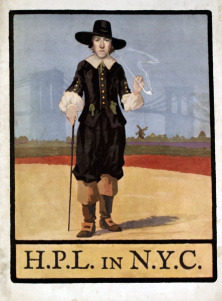
* My Patrons on Patreon will also find a large printable version of “H.P.L. in N.Y.C.” (showing Lovecraft in Puritan garb, with the Brooklyn Bridge in the background), on the Patreon blog.
Giving just $1 a month both supports Tentaclii, and also gets you access to posts like these. You can also support my work simply by telling your friends about Tentaclii, especially if you know them to be generous with their Patreon account! There must surely be some people out there with a stash of $13k bitcoins in their wallet, and who are thus feeling just a bit more generous than usual.
30 Sunday Jun 2019
Posted in Lovecraftian arts
Here’s a potential cover for a non-fiction history book on Lovecraft and astronomy. I’ve taken off the pre-existing text (it was the cover for an old booklet from India), fixed an obscuring label, and also re-coloured. It’s 2,900px on the longest size and thus should work for a cover / back-cover on a Lulu.com 6″ x 9″ book.

The space on the right could potentially host a Fivver-commissioned cameo done in the same style, featuring Lovecraft’s face. Or perhaps the Lovecraft silhouette in cameo, with a holding line added around it.
30 Sunday Jun 2019
Posted in Historical context, Odd scratchings
Uploaded to Archive.org in February 2019, The Alien Critic #5 (May 1973). It has the article “Irvin Binkin meets H.P. Lovecraft”, by Jack Chalker, in which Chalker meets and hears from Binkin. Reprinted from Chalker’s ‘zine Viewpoint #1 (February 1973).
… he’s decided that owning the world’s largest collection of Lovecraft is better than collecting the huge sums he could sell it for (he’s already turned down $30,000).
29 Saturday Jun 2019
Posted in Historical context, Lovecraftian arts
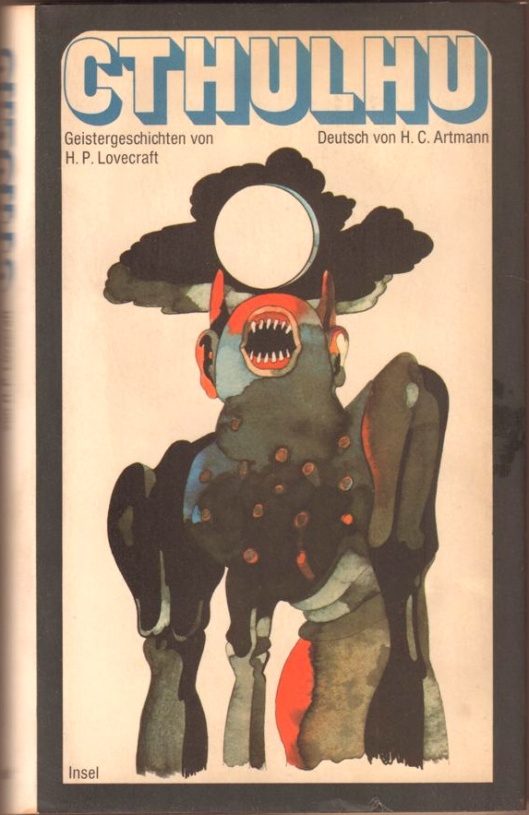
How Germany saw Cthulhu in 1968. Art by Heinz Edelmann. Is it meant to indicate the idol? Or perhaps “The Hound”?

29 Saturday Jun 2019
Posted in Lovecraftian arts
A lovely bit of pen and ink by Virgil Finlay, tucked away in Fantasy Newsletter #09 (1979) which has just popped up on Archive.org.

29 Saturday Jun 2019
Posted in New books, Scholarly works
Brumal, Vol. 7, No. 1 (2019), the special issue on “The fantastic universe of H.P. Lovecraft”. Public open access, and online now in full. Only the paper “H.P. Lovecraft on Screen” is in English. The editors’s introduction doesn’t (on translation) appear to be a summary of the papers, but on clicking through you’ll find that each paper’s record page has an English abstract.
28 Friday Jun 2019
Posted in Historical context, Picture postals

In early 1923 Lovecraft investigated the old North End of Boston and climbed up to the Copp’s Hill Burying Ground, est. 1659—1825…
At present this part of the town is an Italian quarter of the most squalid sort … Thence I proceeded up the steps to that fascinating necropolis the Copp’s Hill Burying Ground. This latter spot hath for me a singular fascination … Here are interr’d some of the most illustrious Colonial dead of the Province, including the Mathers, who are interesting to me from my possession of Cotton Mather’s “Magnalia Christi Americana”. But the chief charm of the scene is in the entire broad effect; the bleak hilltop with its horizon of leaden sky, harbour masts, and Colonial roofs. Over the sod was a thin coat of snow, thro’ which the slabs peer’d grimly whilst black leafless trees claw’d at a sinister lowering sky. … As I beheld the black slate slabs rising ghoulishly above the snow, & cast my glance about at the adjacent chimney-pots, it was difficult to realise that full two centuries have pass’d since the heyday of my particular aera. … In fancy I could conjure up the Boston of the late 17th century with its narrow, hilly, curving streets and quaint wooden and brick houses.
The above is a blend of two letters mentioning the same 1923 visit, one to Galpin and one to Kleiner. Lovecraft saw this old area just in time, as on a later visit in summer 1927 he was disappointed to find that large areas of the old town had been torn down and levelled.
A few years later Lovecraft would have Pickman paint a ghoulish scene here, in “Pickman’s Model”…
Gad, how that man could paint! There was a study called “Subway Accident”, in which a flock of the vile things were clambering up from some unknown catacomb through a crack in the floor of the Boylston Street subway and attacking a crowd of people on the platform. Another shewed a dance on Copp’s Hill among the tombs with the background of today. Then there were any number of cellar views, with monsters creeping in through holes and rifts in the masonry and grinning as they squatted behind barrels or furnaces and waited for their first victim to descend the stairs.

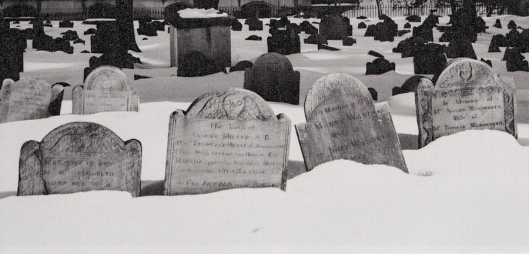
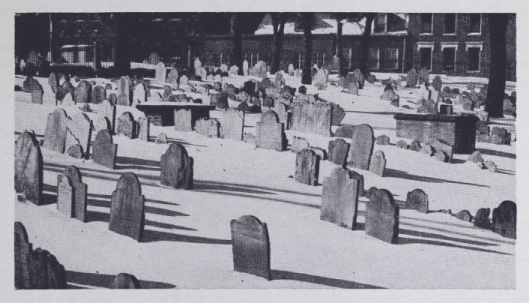


Above we see the side of the Copp’s Hill Burying Ground on the left of the pictures, with the street much as Lovecraft would have encountered it, perhaps photographed in the late 1910s and early 1920s. Even on a winter’s day Lovecraft encountered a small crowd of such urchins outside the Burying Ground, perhaps alerted by others who had seen him climbing through the squalid Italian quarter and up the hill — their juvenile trade was to spout some memorised historical doggerel to many visiting antiquarians and historians, and then demand coins for their ‘services’…
a horde of ragged little ciceroni who surrounded me & blocked my feet whilst spouting history in lifeless, mechanical voices. It was worth a handful of farthings to be rid of these small highwaymen, whose desire to instruct the traveller is not unmixt with a craving after sweetmeats.
It sounds like some of them may have been satisfied with candy from a bag Lovecraft had brought with him. He also always carried a small bag of cat-attracting catnip on such trips.
27 Thursday Jun 2019
Posted in Odd scratchings
A large Aubrey Beardsley exhibition will open in London on 4th March 2020, at the Tate. Over 200 original works, plus a selection of key inspirations for Beardsley, including works by Edward Burne-Jones and Gustave Moreau. Likely to be hugely popular, and very early booking is advisable.
