C.S. Lewis likely read Lovecraft

On ploughing through the Tolkien fan-journal Mallorn, from #53-64 (current) I discovered that January 1934 was the likely date when C.S. Lewis (the Narnia books, and he was also the midwife for The Lord of the Rings) started paying regular attention to American pulp magazines. This appears to mean Astounding magazine, which would mean that he read the magazine’s chopped-about versions of Lovecraft’s “At the Mountains of Madness” and “The Shadow Out of Time”. He may also have read Lovecraft in better form in at least one British book collection, but we can’t be sure. The problem being that his books became jumbled up with those of his SF-loving live-in girlfriend.

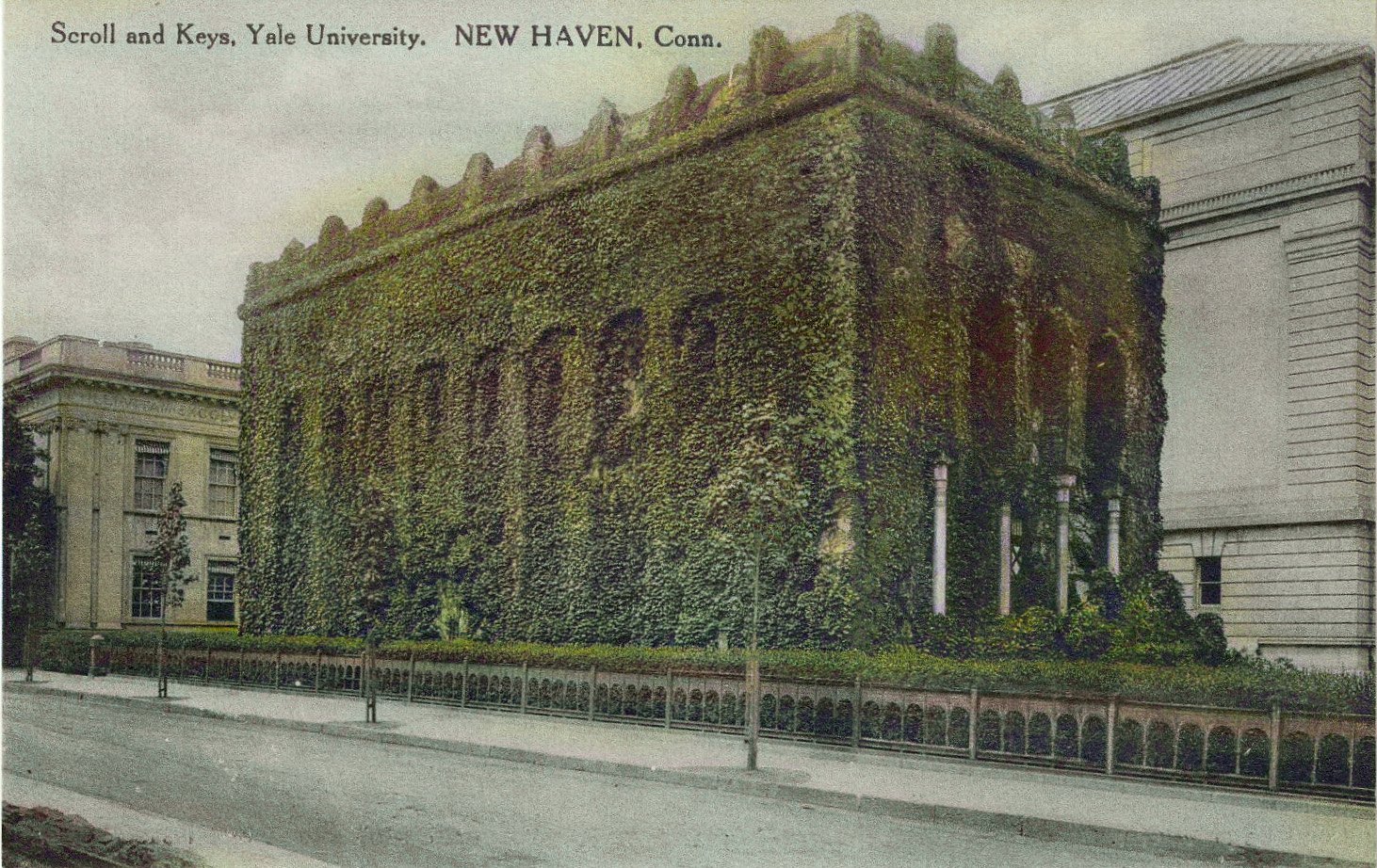
“… ivy so dense that one cannot but imagine it accursed or corpse-fed”

“Kuranes came very suddenly upon his old world of childhood. He had been dreaming of the house where he was born; the great stone house covered with ivy, where thirteen generations of his ancestors had lived” (“Celephaïs”)

The buildings Lovecraft strolled past and visited were often substantially covered in greenery, usually ivy, often to an extent that seems incredible today. Such as this…

Tolkien also lived in the same sort of environment, with the venerable Country Life magazine going so far as to chide his College for their “excessive” love of greenery, at a time when such greenery was everywhere rampant in England.

The bareness of brick often seen today is a legacy of the post-war ‘ivy removal’ fad, which by the 1960s and 70s had run as rampant as the ivy it condemned. Ivy removals worked alongside the fetish of the average modernist for bare everything, including brickwork and concrete. And perhaps alongside the interests of modernism-demented city authorities, with their passion for the sight of any visible decay which might justify demolishing swathes of old buildings. The economic depressions of the 1970s probably didn’t help — easier to tear the ivy down, than pay a man to trim it back every two years.

Yet it now turns out that ivy removal was the result of a false consensus, one with no basis in either building science or home economics. I was interested to learn of a recent major UK study by the Royal Horticultural Society and the University of Reading. An ivy covering reduces surface temperature swings on new brickwork, thus preventing flaking and cracking from developing over time. Damp was not ‘trapped’, as was commonly said by the ivy-haters, and the humidity was actually stabilised by the ivy covering and rain was kept off. Again, this stability helps to preserve the brick surface. Frost, salts, and vehicle pollution are all protected against, far outweighing any micro-damage done by the tiny adhesion points of the climbing ivy stems.

There appears to be a big energy benefit. The study found indoor summer temperatures cooler by up to 7.2 degrees. Given the UK’s usual dismal summer temperatures, this may not actually be a good thing, and might involve the inhabitants donning pullovers and hats. But the finding may interest places such as Lovecraft’s Providence, which endure much more steamy summers. Less air conditioning would be needed. The test houses also lost less heat in winter (costing less to heat, by as much as 20%), which would have been of much more use in the British climate.

That saving would of course have to be weighed against the cost of trimming back the ivy every two years. But likely the house owner could come out on top financially, especially given the soaring cost of energy. Also, I wonder if some sort of ivy-trimming flying drone might not yet be invented, with an AI camera to detect young and easily cut-able shoots? Consider also the ivy’s likely deterrence of the sort of graffiti scrawls which devalue one’s house, and also the entire street, through deterring possible house buyers.

The new UK study confirms earlier work which asked “Is Ivy Good or Bad for Historic Walls?”. Another recent study in Toronto suggested the easy-grow big-leafed Boston Ivy (Parthenocissus tricuspidata) as the ideal for restoring cities on the East Coast of the USA and Canada.

“… the ivy was climbing slowly over the restored walls as it had climbed so many centuries ago, and how the peasants blessed him for bringing back the old days” (“The Moon-Bog”).

And perhaps not only restoring. Those who laugh at the Syd Mead-like visions of a ‘solarpunk’ future, pointing to the unlikely abundance of greenery hanging from the gleaming white buildings, perhaps overlook both the likely advances in materials bio-science (building materials ‘grown’ from fungi) and in the tools (drones and robots) needed to control vegetation. Possibly also an advanced form of drip-feed irrigation. Future white-walled towns built from fungi and clad with gothic ivy, perhaps. Lovecraft would surely approve of that.


Ivy is rarely a notable feature of Lovecraft’s work, other than the two instances above where it is linked with an ancestral home. Since such greenery was at that time a commonplace which was all around him. As he states in Dexter Ward, speaking of this lack of interest in what one knows and sees everyday…

The odd thing was that Ward seemed no longer interested in the antiquities he knew so well. He had, it appears, lost his regard for them through sheer familiarity; and all his final efforts were obviously bent toward mastering those common facts of the modern world

He did make one early venture into plant horror, “The Tree”, but that was not a very successful tale.

But his protege Belknap Long, an inhabitant of the largely greenery-starved New York City, would create a wartime series for boys featuring monster plants (John Carstairs). For a high-rise apartment dweller such as Long, plants were a more unusual thing, and thus might be monster-ized following the lead given by various earlier pulp tales.

There are however some instances in Lovecraft’s letters, such as this from 1923 in which an ivy clad house elides with brief horror…

The coach ride [to the old Salem-Village] was delightful, giving frequent glimpses of ancient houses in a fashion to stimulate the antiquarian soul. Suddenly, at a graceful and shady village corner which the coach was about to turn, I beheld the tall chimneys and ivy’d walls of a splendid brick house of later Colonial design [… Asking to alight from the coach, and going around the back of the house] I loudly sounded the knocker […] My summons was answer’d simultaneously by two of the most pitiful and decrepit-looking persons imaginable — hideous old women more sinister than the witches of 1692, and certainly not under 80. For a moment I believ’d them to be Salem witches in truth…

New book: Selection de lettres (1927-1929)

Fabula reports the publication of Selection de lettres (1927-1929) in France. 86 Lovecraft letters newly translated into French for the first time, in a volume of over 400 pages. The Amazon UK listing has it as published with 600 pages and a hundred letters. So I’m guessing there may have been a truncation of the volume, so as to meet publishing schedules? Anyway, a vital chunk of Lovecraft’s letters, now available in French.

AI cover illustration, by the look of it, with no-one bothering to Photoshop it a little to remove the tall-tale signs. I’ve nothing against well-done AI images, but part of the process really should be a final pass by a human with Photoshop.

I assume these 82 letters don’t overlap with those in a book by another translator, Lettres de 1929: Juillet a Decembre published in 2021…

This collection offers us, in a quality translation, a selection of thirty letters written between July and December 1929, absolutely unpublished in French. Together with a very useful “glossary” of almost 50 pages, to help the French reader understand the numerous references found in these letters.

Incidentally, I believe Lovecraft’s translated tales first appeared in French in 1954? Which would make 2024 the 70th anniversary of the French discovery of Lovecraft.

In Pendleton courtyard

Rhode Island School of Design’s Pendleton Museum was a prime spot on the 1930s ‘Lovecraft tour’ of Providence, given to visiting members of the Lovecraft circle by Lovecraft himself. The Pendleton was an annexe to its main art galleries, one dedicated to colonial life as it had been lived, and it was thus a favourite Providence spot for Lovecraft.

Benefit Street, with the back end of the School of Art Museum and Pendleton House nestled alongside it on the right of the picture.

Pendleton Museum (or ‘Pendleton House’) was on Benefit Street but apparently had long had its public ‘entrance through Waterman St.’, rather than its own front entrance on Benefit. Here we see the arrangement on an early map. The map does not show the museum’s extension, present during Lovecraft’s life, which curved along the steep hillside and around Pendleton…

Public visitors would thus have had to walk through the Rhode Island School of Design galleries in order to reach the House. In “1897-8-9” the RISD entrance gallery at Waterman Street had been “an enchanted world” for the boy Lovecraft, due to the array of Greek and Roman reproduction sculpture.

In 1936, at the other end of his life, Lovecraft appears to have preferred the other end of the walk. Lovecraft told Galpin that he found the Pendleton Museum… “a perfect reproduction of a colonial mansion, containing the finest collection of American colonial furniture in the world.” There appears to them have been a connector in Lovecraft’s time, from the House to the newer art galleries on the slope below…

Attached to the north side of Pendleton House is a tiny arched, columned hexagonal adjunct no larger than a gazebo, with an interior dome. Exquisitely designed in the Neo-Renaissance manner, it provides the vestibule (out of the Pendleton House dining room) for Charles Platt’s stairway connector down the slope, through a (subsequently revamped) corridor gallery, also designed by Platt, to link the house with the so-called Waterman Galleries below.” (Society of Architectural Historians)

There were further additions. The Pendleton Museum was set to be matched with a long-anticipated new Colonial style courtyard garden, the Radeke Memorial Garden, but the project was delayed again and again until finally the plans for it were drawn up in 1933, and the Garden was not eventually realised until 1934. It was the sort of event and project that Lovecraft would have been on hand to support, and he had attended the opening of the Radeke museum extension in late April 1926. But I’m uncertain if he was also invited to the opening event for the garden. I have a vague recollection that he was there for the opening and he remarked that the garden was a little sparse in its initial planting (the opening event was sans plants but they were soon added). But I could be mis-remembering, and I can’t re-find the item.

I’ve now found good pictures of this garden, as Lovecraft would have experienced it in the years before his death as he took friends around the house, and presumably also the new garden. Though the 1934-37 planting was perhaps a little less established than seen in these newly colourised pictures. With thanks to the RISD Archive.

The statue in the niche is Pan depicted as a boy, woolly-shanked, cloven-hoofed and playing pipes. Lovecraft would surely have approved, and recalled his own sylvan boyhood shrines to Pan.

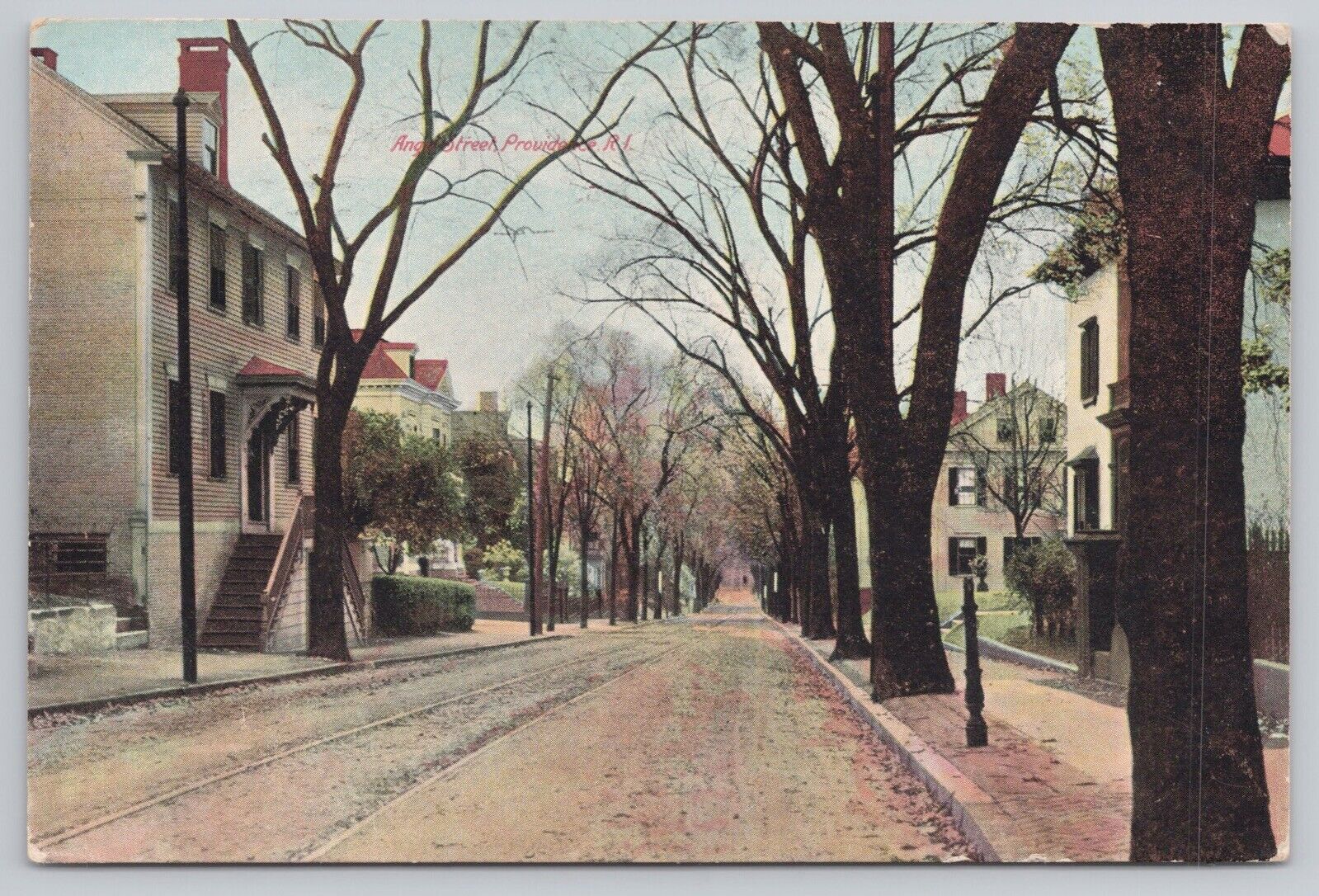
“There were in that Street many trees; elms and oaks and maples of dignity; so that in the summer the scene was all soft verdure and twittering bird-song. And behind the houses were walled rose-gardens with hedged paths and sundials, where at evening the moon and stars would shine bewitchingly while fragrant blossoms glistened with dew.” (Lovecraft, “The Street”)

The Radeke garden was restored to its original white scheme in the 1980s. It appears to be open to the public today (though may be found to be rented for weddings at weekends), and thus could be included on a Lovecraft-related tour of the city.

Mountains of maddening handwriting

SP Books (‘Editions des Saint Peres’) has spotted a niche for high-quality reproductions of author manuscripts. One of their latest is “At The Mountains of Madness” in an edition of 1,000. With an introduction by S.T. Joshi.

February 1931. During a cold winter night that brings a hush to Providence, Rhode Island, one man is wide awake. Leaning over his desk, he covers page after page with writing – sometimes in ink, sometimes in pencil for revisions – as the pile of sheets stacks up. Shadows dance around him from the glow of his candle, which flickers with the slightest breath.

He had nearly finished it by the end of April, and then typed it himself. Possibly because no-one else would be able to decipher the maddening scrawl.

If you don’t have the £170 for the hardback, you can also view the same pages free at the Brown Digital Repository.

Welcome to Arkham

Welcome to Arkham

is a complete guide to the city of Arkham and the neighboring towns of Dunwich, Innsmouth and Kingsport, detailing 115 fabled locations and featuring more than 500 illustrations.

Appears to be new and a companion to the Arkham Horror board-game, but may also be of interest to Mythos writers. There no hint that it’s a politically-tweaked and polished-up reprint of an older book, as often appears to be the case with Chaosium. I assume there must be maps, but they’re not specified in the description.

Free to read online as a flipbook, so you can see what it looks like inside. Though… my browser couldn’t get past the flipbook’s cookies blocking-notice.

Dark ‘n deep

You wait ages for new Lovecraft-ish LORAs to come along, then two come along on the same day. As usual these are for local generation of AI images with SD 1.5, and are free.

* Classic Film Noir (Concept) – v1.0. “This LORA is designed to reproduce the feeling of classic noir aesthetics. The clothing, the people, the lighting, the camera work and the time period.” And it’s not censored for the ubiquitous smoking of the era, either.

* Marine Biology v1.0 LORA.

* Also a most useful helper today, Vertical View Angle Slider LECO – v1.0. A LECO just goes in the LORA folder and acts the same. Use with From_Above or From_Below or (from below) placed early in the prompt, and then tweak the slider a bit for precise and reliable camera-angle control.

Lovecraft and religion

Voegelin has a new review of the relatively new book Theology and Lovecraft (2022)…

to say that Lovecraft was a man of his times is an understatement and deflection. He was more a man out of time, living firmly in a romanticized past and fantasizing about a dangerous future. This was a religious endeavor – which is to say, a mission of devotion and worship – even for a staunch atheist like Lovecraft.

See also the 2020 open-access article Altar Call of Cthulhu: Religion and Millennialism in H.P. Lovecraft’s Cthulhu Mythos. Which, incidentally, is under full Creative Commons Attribution.

This article offers a close analysis of millennialism within Lovecraft’s thought” as seen in three tales.

And in the latest Aeon magazine, H.P. Lovecraft, philosopher.

“Switch On The Light” anthology

New on Archive.org, a good clean scan of the British hardback anthology Switch On The Light (1931). This was one of a series bundled the better Weird Tales stories for the British market, and the volume gave Lovecraft a hardcover wrapping for “The Rats in the Walls” and also his ghost-written tale “The Curse of Yig”.

Incidentally, I see that facsimile dustjackets are available for the series.

Also new on Archive.org, a scan of The hermaphrodite; a poem by Loveman.