Completely Weird

Weird Tales: 1923-1954 complete in a handy linked spreadsheet, with links going mostly to Archive.org in all but one case. I assume the maker looked at which copy was the best and most complete scan, as there are often several versions of each issue on Archive.org. One can also find there the sister title Oriental Stories even a few of the re-titled Oriental Stories which was The Magic Carpet. These being also edited by Farnsworth Wright, though they’re not on the spreadsheet.

More unknown memoirs of Lovecraft

I’ve found more late 1940s memories of H.P. Lovecraft, from Muriel Eddy. Given that Joshi holds her 1940s memoir as more reliable than those of the 1960s, and that the earlier 1948 memoir I found in a similar magazine (see the post a few weeks ago) turned out to be quite provable from other sources including Lovecraft himself, then it seems worth trusting these too.

There are no great revelations here, as there was with uncle Eddy the bookseller. But I note that the following are not listed in Joshi’s Comprehensive Bibliography nor in de Camp’s biography.


1) Startling Stories, March 1949. “More Lovecraftiania”.

Her first “Lovecraftiania” letter in Startling Stories is banal and of no interest, but this second letter does offer one interesting and genuine-sounding specific memory.

When Lovecraft married… “his two aunts gave our children over 100 empty chocolate boxes to play with! (In fact, a bath-tub full!)”.

The boxes at Angell St. are known from Eddy’s unreliable 1961 memoir. Her main published 1940s memoir (which I now have access to, via A Weird Writer in Our Midst) talks only of two items of furniture being taken over to the Eddys, on Lovecraft’s departure for New York. But this comment on the “chocolate boxes” event may be of interest, because here it’s from 1949 and she even gives the quantity of boxes.

What was he doing with these boxes? The bathtub would, I suppose, be the curious but somewhat logical place to store a collection, if collection they were. Such boxes would otherwise be difficult-to-stack and the stacks inclined to tumble over, being made up of oddly-sized lightweight boxes. So far as I know, the 1920s was not a time of silver-foil collecting-for-charity (which was ‘a thing’ in the mid 1970s following the oil crisis, which caused a knock-on shortage of paper and tin-foil). Thus I doubt the boxes were collected for charity re-cycling. Did Lovecraft have a vague hope of taking up a hobby as a chocolatier at his little gas hot-plate, and re-filling the empty boxes with new weirdly-moulded chocolates to surprise his friends with? It’s a delightful notion, but it seems unlikely. Some vague Joseph Cornell-like ambition to turn them into proto-surrealist art-boxes, perhaps? Again, unlikely at that point in history.

Perhaps they were simply saved for their value as objects, as traditionalist works of ornate construction and printed art which he didn’t care to throw away? Here are quotes from historians on the matter of such boxes…

* “In the 1920s some of the boxes became a work of art in themselves” (The Science of Chocolate)

* “the chocolate boxes of the 1920s and 1930s were largely sentimental holdovers of Victorian romanticism. Modernism was meant to replace this old-fashioned mode with bold new designs [but failed in that respect].” (Chocolate: Food of the Gods).

* “the fancifully beribboned chocolate boxes which were another 1920s addition to the stock of national pleasures.” (Island Stories, of British boxes).

* The critic Banham twitted the great architectural historian Pevsner for bringing… “‘even so slight a thing as a chocolate box’ within his critical system”, while “… apparently not knowing that the design of chocolate boxes was a matter of wide (albeit joking) concern in the 1930s (cartoon of an aesthete pointing the finger of scorn at a sunset and shouting “Chocolate box-y, chocolate box-y!)” (A Critic Writes: Selected Essays by Reyner Banham)

Such lids would contain sunsets and kittens and suchlike, finely printed. Sunsets, kittens, chocolate… well, we know how Lovecraft felt about such things. About Olde worlde scenes from England and the 18th century, too.

Thus, it is not impossible that he kept a collection of the ‘best boxes’ with their traditionalist art, delicate iridescent foils and fancy construction, much in the same way as his friend Morton collected stamps. Of course the fanciest of such boxes would have been expensive, and Lovecraft generally had little money. But other people may have purchased and eaten the chocolates — then given the boxes to him because they knew of his interest in them. Slightly unlikely perhaps, but one imagines his aunts had many chocolate enthusiasts among their friends.

“And yet, who shall say that a bathtub cannot awake the Muse?” (Lovecraft, letter to Kleiner, 1916).

But why not just razor off the artwork and extract the foils, and thus save a lot of the space? He was, after all, quite seriously pressed for living space until 1933. I wonder if perhaps one solution is that the boxes were intended to one day store the sorted and archived collections of his voluminous collection of incoming correspondence? That seems quite a logical solution to his storage problems, since such a picture-coded ‘visual filing cabinet’ would be both practical and fast for consultation. ‘Loveman is in the box with the turtle-doves on it’, etc. Such boxes would make eminently suitable containers for letters, being complete with strong ribbon-ties, provided that the bath tub was thoroughly dried before re-installing the boxes in it.

However, that the aunts gave away 100 or so apparently empty boxes when he went to New York suggests the tub was more likely a curious form of art collection, arising from the fancy-box style of the era. But, on his later return to Providence, he may have found such a practical or long-intended use for a new collection of boxes as a form of letter-storage? Anyway, that would be one theory. Those who have full access to the letters may be able to shed more light on the matter.

The other possibility is that they formed temporary storage for papers when working out in the open, as he did for long stretches in the summer. One would be able to press a peg or long knitting-needle through the card of the box, and so fix them to the turf to prevent the wind taking them. They would also be relatively shower-proof.

Yet another possibility is their use as mailing-boxes for sending manuscripts and collections of amateur journals to his friends and correspondents, suitably wrapped in brown paper. And yet I’ve never heard or read of a correspondent mentioning such boxes.

For the moment it’s a bit of a mystery. We may learn more about such curious domestic arrangements once Lovecraft’s forthcoming ‘aunts letters’ are published. The boxes are of course only a small and seemingly trivial point in Lovecraft’s life, yet clarifying this point may help to forestall a shoddy biographer or hater’s claim that… ‘Lovecraft spent his days in squalor, surrounded by discarded candy-wrappers’ etc.


2) Fantastic Adventures, October 1948. “Shaver and Lovecraft”.

Lovecraft liked to watch husband Eddy writing his music, and he and Lovecraft talked about setting “weird poems” to music. Again this is possibly interesting because of the early date of the memory. I don’t see this point mentioned in the 1940s and 1960s Eddy memoirs I have access to.


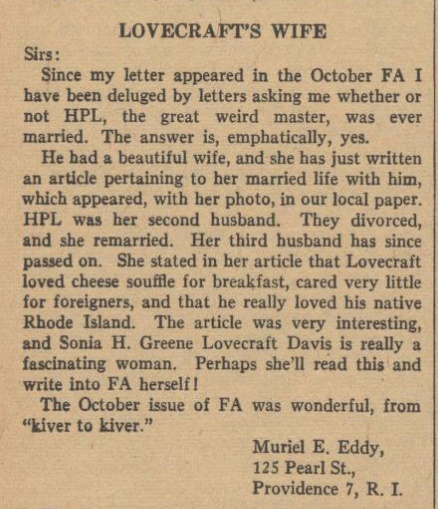
3) Fantastic Adventures, December 1948. “Lovecraft’s Wife”.
Only of very slight interest. Muriel Eddy notes a newspaper article by Sonia, presumably the memoir of Lovecraft first printed in the Providence Journal. This then must be the article abridged and edited by Winfield Townley Scott, and printed in The Providence Sunday Journal for 22nd August 1948. It later appeared in Books at Brown and then in Lovecraft Remembered.


4) Incidentally I have also found that Ghost Stories magazine for April 1929 has a letter to the editor from Muriel E. Eddy with the address of “317 Plain Street”, Providence. The content is of no interest, but the address may be of use to some researchers. She talks of living on “Second Street, East Providence” in her main 1940s memoir, then moving across the city so that Lovecraft called on the Eddy’s at a different address when he returned from his New York sojourn.

Les Carnets de Lovecraft

A new 96-page art-story book from France, Les Carnets de Lovecraft: La Cite sans nom (translates as ‘Lovecraft’s Notebooks: The City With No Name’). At first I thought it might be Lovecraft’s Commonplace Book with entries faced with pleasingly traditional pen-and-ink sketches. But it seems it’s a heavily illustrated edition of “The Nameless City” in French translation. The book is due 16th October 2019.

The same young artist did a heavily illustrated “Dagon” book in the same series, released August 2019. This art sample, done in pencil, indicates the approach of the Les Carnets de Lovecraft series. Not an artnovel or a ‘BD’ (short graphic novel), but a heavily illustrated book of a short story.

More Lovecraftian DeviantArt

A few of the newly-posted Lovecraftian illustrations on DeviantArt, since the last such post here at Tentaclii

“Cthulu” by Moebius emulator FoxyTomcat of the USA.

Qodaet (Eder Nogueira) of Brazil is doing a Lovecraft series in red crayon, with a somewhat ‘brass-rubbing’ look to them.

Altar of the Faceless God – Nyarlathotep by TRXPICS. See also his March 2019 Yog Sothoth.

Wanderer Of The Misty Dreamlands by OliverInk of the USA.

Kittee Tuesday: Black Cat for Halloween 1905

Celebrating H.P. Lovecraft’s interest in our fascinating felines.

The cover for The Black Cat magazine, October 1905. H.P. Lovecraft began to read this story-magazine in 1904, when he was aged about 14. The cover of each issue featured the distinctive cat configured within various graphic designs.

The idea of a big reward + a black cat may have been especially poignant to the 15 year-old Lovecraft when he picked this off the news-stands or opened a subscription copy in the morning mail. Because this edition was issued on the first year anniversary of the loss of his own beloved black cat, Trigger-ban, who had run away and been lost during the house-move of fall/autumn 1904.

New book: Providence After Dark and Other Writings

New from Hippocampus Press, the book Providence After Dark and Other Writings by T.E.D. Klein. Currently on their “New” page with a shipping date of “November 2019”.

Of Lovecraft interest…

I. On Lovecraft

Providence After Dark.

The United Amateur.

A Dreamer’s Tales [introduction to the 5th edition of Dagon and Other Macabre Tales, Arkham House, 1986].

Remembering Arkham House.

The Festival [recollections of the First World Fantasy Convention, Providence 1975].

The Old Gent.

T.E.D. Klein: Master of Ceremonies [1987 interview by Carl T. Ford].

II. On Other Authors

Frank Belknap Long.

etc…


Discovering the first place of publication for his First World Fantasy Convention report led me to a new booklet cover featuring Lovecraft, new in the sense that I hadn’t seen it before. The 52-page booklet had what appear to be three heavyweight convention reports all focused around musings on Lovecraft and Providence. I wouldn’t mind reading it but I see it’s become mildly collectable, so the price is now beyond me, and it’s not yet on Archive.org.

The John Brown house

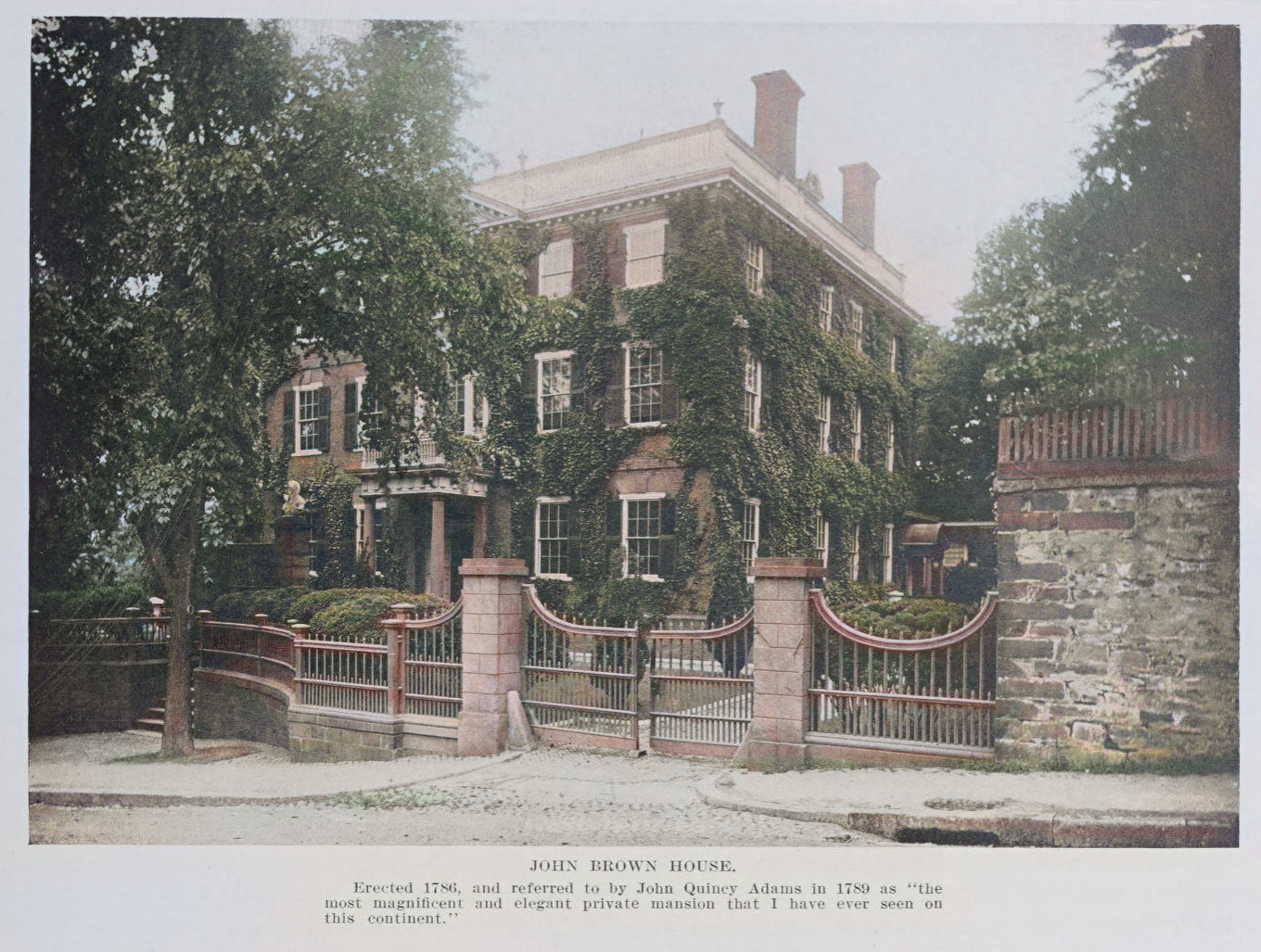
We know that Lovecraft sketched a scene through the John Brown House doorway in Providence, imaginging the scene as it might once have been in the era of the clipper ships, and included this in a letter to Talman circa September 1927…

[From the archival record of a Lovecraft collection:] “Contains drawing [by Lovecraft] of a scene (featuring indications of a steeple and a ship’s rigged mast) as viewed through the doorway from inside of the John Brown House.”

Also…

“At the very end of his life Lovecraft saw the opening of the John Brown house (1786) as a museum, and it is now the home of the Rhode Island Historical Society.” (Joshi, I Am Providence)

Here is the exterior…

I should add that this fine example of penmanship showing the John Brown House is not Lovecraft’s drawing. This is by “Laswell”, George Laswell, who was the creator of the book Corners and Characters of Rhode Island (1924). My thanks to Ken Faig Jr. for pointing out that Sonia recalled that Lovecraft knew and admired these pen sketches — they had first appeared weekly in the local newspaper on which Laswell was a Staff Artist. Oh, for the days when a local newspaper had a Staff Artist…

I imagine the book will have more such quality drawings of Providence in Lovecraft’s time, or near enough. Let’s hope that, as a 1924 book, it’s being lined up for release into the public domain at the start of 2020.


Update: a photograph from 1914…

New book: New Annotated H.P. Lovecraft – in Kindle ebook

Released tomorrow (Monday 23rd September) in Kindle ebook format, Leslie Klinger’s The New Annotated H.P. Lovecraft: Beyond Arkham. This is the second and final volume of Klinger’s Annotated Lovecraft and it’s good to see that S.T. Joshi’s corrected texts have once again been used.

The 512-page paper edition has a later release date according to Amazon UK (“25th Oct 2019”). But I’m told that it’s a simultaneous print/ebook release for the USA.

I see that in the ebook and the Google Books preview the annotations are given as endnotes, rather than footnotes. Presumably that’s to allow pop-outs over the page for Kindle Fire readers, and ’round-trip’ links on the older Kindle 3 e-ink ebook ereaders. But I read somewhere that the first print volume had a “1/3 sidebar” for its annotations, so presumably that format will be repeated for the second print volume? Update: Yes, Klinger confirms the same format is used for the second volume.

It’s an amusing touch to have the front cover hint at Lovecraft’s love of spaghetti. The print edition has a different cover.

In order of presentation in the book:

The Tomb.
Polaris.
The Transition of Juan Romero.
The Doom That Came to Sarnath.
The Terrible Old Man.
The Cats of Ulthar.
Facts Concerning the Late Arthur Jermyn and His Family.
The Temple.
Celephais.
From Beyond.
Ex Oblivione.
The Quest of Iranon.
The Outsider.
The Other Gods.
The Music of Erich Zann.
The Lurking Fear.
The Rats in the Walls.
Under the Pyramids.
The Shunned House.
The Horror at Red Hook.
Cool Air.
The Strange High House in the Mist.
Pickman’s Model.
The Dream-Quest of Unknown Kadath.

At the back there is a new ‘Lovecraft Gazetteer’ of place-names, as an appendix. This includes invented places, including places in outer space.

Poul Anderson’s English and northern fantasies

I don’t think I ever got far into the work of Poul Anderson, and in 2019 I vaguely associate the name with 1960s space-opera science-fiction. Perhaps I encountered some of his short stories as “best sci-fi stories of…” collections, and I might have read a few of his galaxy-spanning novels in the early 1980s. But I rather suspect he was another of those libertarian science-fiction authors whose I was shoo-ed away from, in the early 1980s, by left-leaning gatekeepers.

But now I discover he also did historical fantasy / sword and sorcery novels. Some of these are even set in my native England and one has a nicely earth-mysteries dark-faerie twist, even. The mostly interesting one is partly set in the English West Midlands. Who knew? Not me, and I’m fairly well versed on such work if set in the Midlands.

I became aware of his work again thanks to some useful new survey blog posts on this side of his work. These being Poul Anderson’s “Northern Cycle”: Part One and Part Two. Part Three is still to come, but in the meanwhile the same blog has dug up two old articles from the defunct Crom Records heavy metal music website, surveying the relevant works in relation to their possible influence on metal bands… one and two.

His 1950s novel set in England under the Viking Danelaw looks somewhat interesting, The Broken Sword. Apparently best read in its rare first edition form, which launched into that curious dead-zone for public interest in fantasy (circa 1950-1964) and promptly vanished. It was hailed as a lost classic when re-discovered in the late 1960s, but even so I think it may have been one of the few to have escaped me in its 1980s paperback reprint form.

But looking most interesting to me is his A Midsummer Tempest (1974), an alternative history fantasy set in an England in which Shakespeare’s Fairy Folk are real and the English Civil Wars are partly an early-steampunk affair with airships. Super. I may have read it in the early 1980s along with the similar Keith Roberts, et al. But if I did, then I don’t recall it now. Sadly there appears to be no audiobook version, but at just 200 pages it’s not too daunting to tackle in paper or get through the letterbox — not one of those 1990s-style over-padded door-stopper fantasy slabs of 500 pages. It also skips briskly between short scenes, some with chapter headings indicating they’re set in the northern Midlands and thus near to me. It’s also said to take in another setting in which I used to live, at the other end of the West Midlands.

So, a quality pre-PC West Midlands fantasy novel that I had no idea existed. Great stuff. I’ve no idea if the author ever set foot in the English West Midlands, but it’s a nice find all the same. The formatting on the ebook is bad, so I’ve bagged a first-edition hardback for much the same price at just £4 inc. postage. It has a horribly ugly cover, compared to the painted Bob Fowke cover of the Orbit paperback and the UK popular hardback reprint by Severn, but dustjackets can be removed…

“…a titanic achievement — a delightful alternate-history fantasy that brings the fictional worlds of Shakespeare’s plays to breathtaking life with style, wit, and unparalleled imagination.” (blurb from one of the reprints).

Nominated for the World Fantasy Award for Best Novel, Nebula Award for Best Novel, and it won the Mythopoeic Award — and that was back in the 1970s when such awards meant something and hadn’t become political vehicles.

There’s a linked story of The Old Phoenix in Fantasy & Science Fiction (May 1979), which should be read alongside the book.

Unfortunately in terms of his other works he’s another one of those 1950s-1980s writers with a vast and sprawling output, and this is often loosely interconnected in confusing ways. The one reader’s guide (Poul Anderson: Myth-Master and Wonder-Weaver: A Working Bibliography) which puzzled it all out is very firmly out-of-print and unobtainable. Apparently it went to five editions. Meaning that it’s difficult to know where to begin if one were to even sample him, though there have been various reprints in-series. Still, the blog articles linked above give a starter on the more R.E. Howard-like books. I see he also did one Conan book, Conan the Rebel (1980). The plot is said to be rather too convoluted, but looking at the writing it seems a good brisk pastiche in terms of the style. There appears to be no audiobook version for it.