Friday ‘picture postals’ from Lovecraft: the dockside

Providence, as if seen from a night-gaunt hovering above 66 College St. Available as an 8000px .TIF at the LOC.

This 1895 supplement the Providence Sunday newspaper at first appears to be a standard and rather dull city engraving of the period, until one zooms right in and sees the quality of the ink and wash work. Here we see a detail of the Providence river and dockside, the side usually shunned by postcard-makers…

In letters of the 1930s Lovecraft recalled the rigged sailing-ships of Providence, seen and admired in his youth but now departed.

In the heavy fog of late November 1923, his Providence friend Eddy introduced him to the sinister courtyards and back-alley labyrinths which ran back from the dockside seen above…

a squalid colonial labyrinth in which I moved as an utter stranger, each moment wondering whether I were indeed in my native town or in some leprous, distorted witch-Salem … there was a fog, & out of it & into it again mov’d dark monstrous diseas’d shapes … narrow exotick streets and alleys … grotesque lines of gambrel roofs with drunken eaves and idiotick tottering chimneys … streets, lines, rows; bent and broken, twisted and mysterious, wan and wither’d … claws of gargoyles obscurely beckoning to witch-sabbaths of cannibal horror in shadow’d alleys that are black at noon … and toward the southeast, a stark silhouette of hoary, unhallowed black chimneys and bleak ridgepoles against a mist that is white and blank and saline — the venerable, the immemorial sea”. (Lovecraft, heavily abridged from a letter to Morton, 5th December 1923).

Zooming further in we see a lone rower on the river…

As a sturdy lad, Lovecraft was for a short time an avid rower in a small boat, a period from which memories probably linger in the story “Dagon”. Lovecraft was (so far as we know) only boating around the corner on the Seekonk, rather than pulling past the sailing-ships and coalers as seen here. Still, the sight of a little rower is evocative of a freer time…

“I used to row considerably on the Seekonk … Often I would land on one or both of the Twin Islands — for islands (associated with remote secrets, pirate treasure, and all that) always fascinated me.” — Lovecraft letter to Rimel, April 1934.

“Klei edits The Brooklynite now”

Among the Lovecraft circle, Rheinhart Kleiner had once edited a monthly New York paper called The Brooklynite

Klei edits The Brooklynite now, & if he can surmount the difficulties of his task — the thankless task of recording social gossip — he will produce a paper worth a more careful reading than most Brooklynites. — Lovcraft, letter to Galpin, 1918.

This paper was read by Lovecraft during 1918, as Kleiner appears to have sent a copy of each issue. The magazine’s approach might have strongly shaped Lovecraft’s perception and awareness of Brooklyn, in terms of his later settling there.

The modern Brooklyn Magazine ran a short profile of the magazine in 2013. This found the magazine still lively and fresh, and revealed that the Brooklyn Historical Society only has…

“issues span the years 1926 through 1930.”

Little changes in some areas of human experience, it seems. One article in the magazine, it was noted…

recounts the existential crisis that one writer endured while he was waiting to have a phone placed in his apartment. Titled “Number Please,” the author writes, “To pass through the seemingly simple procedure of having a telephone installed is usually enough to hurry a normal person through the throes of dementia.”

We have some idea of it via Lovecraft’s noting of its poetry in his critical columns…

The general frivolity of The Brooklynite is doubtless due to the fact that this publication is designed primarily as a relaxation for persons engaged in other and more serious activities.

Elsewhere, a rare copy for sale terms it the “Official Organ of the Blue Pencil Club”, and The Fossil for 2017 confirms…

Brooklyn’s Blue Pencil Club held regular meetings and sponsored The Brooklynite through many decades.

Lovecraft not only read it, but was published in it, though perhaps not under Kleiner — it appears the history of the editorship remains to be written. Lovecraft’s long poetic celebration of “Providence” saw print in The Brooklynite for November 1924, for instance. Later, a comic poem Lovecraft had written for a Blue Pencil Club meeting was published in The Brooklynite for January 1926. One wonders if the publication may have also served as some sort of inspiration for the later commercial and even spicier Home Brew thus, by a sideways shift, giving Lovecraft another publication in which to publish fiction?

Back in 2013 I noted here that the archives of Vassar College has a good run of this publication…

1917-1918, 1921, 1923-1944.

… but it appears that these have still not been digitised or inspected by Lovecraftians or the historians of Brooklyn. Possibly The Fossil might run an article surveying the history and phases of the publication, and thus encourage a public scanning and digitisation of the Vassar College run, perhaps combined with that of the Brooklyn Historical Society?

Alhazred’s travels

Found in an obscure Spanish arts ‘zine from the late 1987, newly on Archive.org. Punto y Coma, No. 8 had a long section on Lovecraft. Several articles but basic introductory stuff, by the look of it. Yet there is this unusual map, which attempted to trace the movements of Abdul Alhazred, the mad poet.

I seem to recall there’s at least one chunky novel that tells the ‘life story of Alhazred’, and I guess it probably has maps. But this map may interest some.

Experimental Musical Instruments

Makers of strange Lovecraftian sonic devices may be interested to learn that a complete run of the journal Experimental Musical Instruments (1985-99) is now newly at Archive.org, with unified TOCs and article synopses. It appears to have been a practical journal by and for makers of working devices and instruments. Lots of practical articles on obscure and self-made instruments. For instance below we see the start of what appears, after much searching, to be the world’s only practical article on “clay bells” (April 1989).

Kittee Tuesday: a forthcoming cat game

We’ve entered the silly-season for news, and I’ll take what I can get. So this week’s ‘Kittee Tuesday’ post is a forthcoming videogame set on an uninhabited island in Maine, USA. It mixes “science fiction and alternative history”, and all the characters are… cats. What more could you ask from a game? Well, if you’re going to be a cat, perhaps that there are plenty of nice fat salmon basking in the shallows of the river…

Revue de la BnF and others

Cthulhu on the cover of the Revue de la BnF, the substantial journal of the French National Library. Sadly it’s not open access. The issue, #59 (October 2019), was a world-building special issue and led into a 2020 ‘year of comics’ for the Library.

What is open access and public is the Library’s shorter quarterly ‘lobby magazine’ Chroniques. Issue #87 (January-March 2020) of Chroniques was their special BD (comics) / fantasy / Tolkien issue (they had the big Oxford Tolkien show visiting, and made it even bigger).

The #87 issueof Chroniques well worth a look, even though it’s all in French. I’d recommend a translator software but, amazingly, in 2020 it’s still impossible to translate the text of a PDF in place, without uploading it to some Cloud service or doing a half-baked conversion to MS Word first. Sure, the PDF format is hard to parse. But how difficult can it be to take a 3000px snapshot of a page, OCR and translate the text on it, erase the original text, then return the translated text into the erased area? Project Naptha can do that, though only for English… so why can’t at least one desktop PDF reader software do it? On a page such as this…

Anyway, it may also interest some readers to know that the Library’s CNLJ (children’s literature dept.) produces a very long-running journal in French La Revue des livres pour enfants (Review of Books for Children). This has a two year rolling paywall, during which only free samples are available online. After that it’s open access all the way back to 1965. This back-list reveals choice items such as Nº 242: a Nicole Claveloux special-issue.

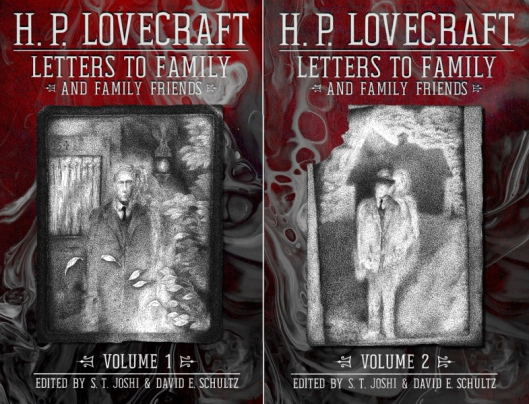
New book: H. P. Lovecraft: Letters to Family and Family Friends

H. P. Lovecraft: Letters to Family and Family Friends is now listed on the Hippocampus Press website. Nice and chunky at 1,110 pages, mostly because of the immense amount of letters to his aunts Lillian Clark and Annie Gamwell. These letters are here given “complete and unabridged” and also in a meticulously annotated and indexed form. There are also “previously unpublished letters written by Lovecraft’s grandfather, Whipple V. Phillips, to his grandson in the 1890s”.

Quite reasonably priced, at $60 for both in paperback. There’s an “Add to cart” button on the page, so I assume they’re shipping now. No sign of them yet on either Amazon USA or UK or eBay, but no doubt they’ll appear there in due course.

The books have a pleasing cover design by Daniel V. Sauer, around evocative art by David C. Verba.

The Fossil (July 2020)

Thanks to Ken Faig Jr. for telling me that there’s a new July 2020 edition of The Fossil, journal of the Historians of Amateur Journalism. This is freely available online.

There are two items of Lovecraftian material in the issue. David Goudsward offers “A Postscript to Myrta Little” in which he explains some of the context for Lovecraft’s apparent love poem “To Phillis”. This article might have perhaps been a touch longer, and also briefly considered Lovecraft’s sonnet to Whitehead’s young friend & guest Allan Grayson.

The main article is the biographical “A Memory of Andrew Francis Lockhart”…

“an early acquaintance of H.P. Lovecraft who is mainly known in literary circles for having written the first article about the famous horror writer.”

Lockhart was an ardently anti-liquor man and was admired by Lovecraft for his tussles with local rum-runners, and well as for his poetic and amateur endeavours. Lockhart was the subject of Lovecraft’s poem “To Mr. Lockhart, on His Poetry”, aka “To A.F. Lockhard”, and is enshrined in the travel account “Little Journeys to the Homes of Prominent Amateurs: II. Andrew Francis Lockhart”. The latter is available as a reading on Librivox.

Forthcoming: The Recognition of H. P. Lovecraft

Super news from S.T. Joshi’s Blog

I have plunged into the treatise that I have been promising for years to write: The Recognition of H. P. Lovecraft: His Rise from Obscurity to World Renown. In this month alone I have written about 50,000 words — and I’m only up to the year 1980!

Great, we need a good scholarly study digging in to his 1938-1974 ‘afterlife’ in fannish circles, and how he was understood and (often fruitfully) mis-understood in those decades. Ideally that would also survey the early use of ‘Lovecraft as character’, and briefly survey the more notable early Lovecraftian artists and book-cover designers and their approaches. But that’s because I’m rather more interested in the history of recognition by the fans, fan-creatives and small-presses than by the sniffy establishment. It would be ‘icing on the cake’ to also get a brisk account of the later 1975-2015 period, in terms of the more easily-surveyed life-research and scholarly criticism, his wide diffusion outside the English-speaking world, and the slow and often reluctant uptake of Lovecraft by university academics and mainstream publishers.

Joshi also reports a fine new set of Lovecraftian fiction, and some essays and letters, due soon-ish in French from “French publisher Mnemos”.