H. P. Lovecraft: A Bibliography (1952)

New in June on Archive.org, H. P. Lovecraft: A Bibliography by Joseph Payne Brennan (Revised Edition, 1952). As a 20 page booklet from 1952 it’s not at all to be compared to the enormous doorstopper we now have, but is still somewhat useful as a snapshot of ‘the state of Lovecraft’ at 1952, some 15 years after his death. Also because it has some timelines that are still useful for quick consultation…

* Lovecraft in anthologies during his lifetime and beyond, in date order from 1927 – 1952.

* Lovecraft in Weird Tales, a simple title list in date order of appearance.

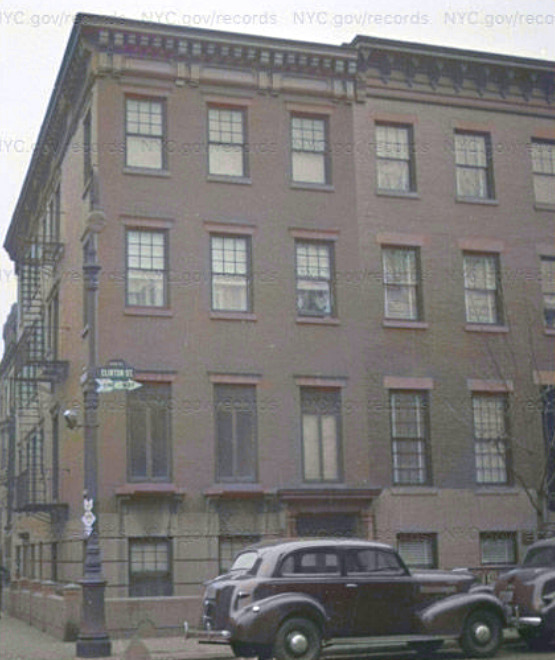
“The Horror at Clinton Street”

Colin Wilson specialist Gary Lachman notes on his blog that…

my article “The Horror at Clinton Street: H.P. Lovecraft in Brooklyn,” is in the September 2020 issue of Fortean Times, #396

The article is structured around biographical details of Lovecraft and Sonia in New York, interspersed with short paragraphs highlighting the very worst of the racist body-descriptions to be gleaned from the New York letters. Then there’s a standard short gloss on Lovecraft’s time alone at Clinton Street, with no additional research on Red Hook in the 1920s. For instance, how piquant it would have been just to point out that the large number of Syrians there were actually refugee Christians, fleeing persecution in their homeland. Or to note that Lovecraft later planned and outlined to Dwyer a long story which would feature the Clinton Street rooming house as the monster. Or to learn just in passing that Lovecraft’s closest friend in New York was a gay man, Samuel Loveman, and that another was a Harlem-based anarchist who lectured and published on racial equality. The article ends with a potted summary of the story “Red Hook” and “He”.

Added to Open Lovecraft

* S.M. Elizalde, “Horror Vacui: temporalidades para alem do tempo”, Capa, Vol, 18, No. 2, 2020. (In Portuguese. ‘Horror Vacui: Temporalities Beyond Time’. Discusses work on Lovecraft by the Argentine philosopher Fabian Luduena Romandini, re: modernity and the image of time, and also touches on Kant, Nick Land and accelerationism, and Marco Antonio Valentim who appears to be another Argentine philosopher).

* D.N. Gago, “A sombra de Lovecraft sobre Providence”, Gavea-Brown: A Bilingual Journal of Portuguese-American Letters and Studies, Vol. 41, 2019. (In Portuguese. Appears to be a short evocation of Lovecraft’s place in his home city).

* J.R. Leo, “There are more thinhgs. El horror Lovecraftniano en la obra de Jorge Luis Borges”, Anales de Literatura Hispanoamericana, Vol. 48, 2019. (In Spanish. Appears to be a survey of Borges’s debt to and symbiosis with Lovecraft’s work).

A Cold Fire Within

Reviews from R’lyeh considers the new mid-1930s RPG A Cold Fire Within: A Mind-Bending Campaign for Pulp Cthulhu. It seems worth noting here. Not just because it’s a major new Lovecraftian pulp work, albeit done as an RPG, but also because it’s not just mobsters, monsters ‘n machine-guns…

As an [RPG] campaign, A Cold Fire Within does something different. There have been plenty of scenarios for Call of Cthulhu which deal with the science fictional aspects of Lovecraft’s cosmic horror, but not a campaign. It is very much not a campaign of Lovecraftian investigative horror in the eldritch sense, but rather one of fringe science — or ‘Science!’ and fringe theories ranging from Theosophy to the Hollow Earth.

It appears to have been launched in February 2020, and requires two other core game-books. Here’s the blurb…

For those who are not gamers there are now twelve recorded ‘play’ episodes of this on YouTube, though as yet no YouTube playlist to collect all these.

For artists there’s also a full look at the “making of” the front cover at Mariusz Gandzel’s ArtStation pages

Friday ‘picture postals’ from Lovecraft: almost No. 66

I’ve found another view of Lovecraft’s lane and a bit of his home at No. 66. It’s tucked into the side of a 1906 bird’s eye view of the Brown Campus, possibly made from a balloon.

Tucked into the corner we just about get a glimpse of No. 66, set back from the road on its unpaved lane.

Here we see Lovecraft at the top of the steps leading up to his front door, these steps possibly appearing as a smudge on the postcard.

Judging by the eBay photo, the card was slightly clipped at both edges by the seller. So, since it was only a mere $5 with international postage… I bagged it. I’ll hope to have a bigger scanner-scan of that corner, in due course.

It’s a Lulu

Thanks to Andrew for trying to order some of my Lovecraft books in paperback, and thereby discovering that some of the Lulu.com links were dead. The context here is that print-on-demand service Lulu.com recently had an utterly disastrous site makeover, causing chaos and much loss at the back-end of the service. Many authors, including myself, are still locked out of the service after several months. Book pages and author pages are slowly getting back to normal, and on checking I found that remaining “404” URLs were for…

* Walking with Cthulhu: H.P. Lovecraft as psychogeographer, New York City 1924-26.

* Ice Cores: essays on Lovecraft’s novella ‘At the Mountains of Madness’.

* And my very first Historical Context book, just a collection of the early blog posts really, and not comparable to the later footnoted books… Lovecraft in Historical Context: Essays.

So those three links are now fixed, both on old posts and over on the Tentaclii sidebar.

Other book pages at Lulu appear to be back to normal, and books are now printing/shipping fine.

Lovecraft and Webster’s

This post is a small follow up to my recent post on Lovecraft’s Dictionary. Lovecraft used Webster’s in the form of Webster’s International, 1890, and continued to do so to the end of his life. But he wrote to Dwyer in 1927 that he had — as a boy — used Webster’s unabridged illustrated edition of 1864. There…

I became utterly infatuated with the pages of illustrations with the pages of illustrations of “Philosophic and Scientific Instruments” in the back of Webster’s unabridged of 1864.

Webster’s unabridged appears to have gone through numerous ever-expanding printings after 1864, all seemingly generally nodded to as “the 1864”. At each printing the illustrations at the back were often varied, being incrementally improved. For instance the pages on the 1880/86 edition of “the 1864” lack the appeal of the same pages in the 1890s editions…

This suggests Lovecraft’s family had an 1890s edition of “the 1864”. I say “1890s” because one can find eBay and Archive.org examples of the International which have title page dates from 1888 through 1895, and it appears it would probably be the work of a small thesis to work out the tangled printing history. But S.T. Joshi has “1891” in Lovecraft’s Library. Thus it appears on the face of it that what Lovecraft calls “the 1864” in his letter to Dwyer is in fact the the 1890 edition of “the 1864”. And that what in the 1930s he called the “1890” actually saw its second and final volume appear in 1891. To confuse matters further, there was evidently also an 1895 edition, which is the one most people now consult from that period on Archive.org.

If all this is correct then Lovecraft was likely “utterly infatuated” with the illustrations collected at the end of the second volume which appeared in 1891, these being presumably the same as the following 1895 edition illustrations

In part then, this central illustration of a telescope may be what started Lovecraft on his cosmic journey, as he revisited the illustrations after he had finished with his chemistry obsession…

Further on in this rear illustrated section of the 1895 printing one can find all manner of curious ocean life and fungi.

Incidentally, in the same 1927 letter to Dwyer he remarks on a possible sequel or continuation to his recent “The Call of Cthulhu”. In response to Dwyer’s tabulation of the approaches so-far used at the more cosmic end of fiction, Lovecraft muses briefly on a future cosmic story he might write and remarks…

I think I shall write about the place that Cthulhu came from.

One wonders if this might have been somehow entangled with the other story he tells Dwyer he wants to write, in which his Red Hook lodging-house was to be depicted as some sort of malign sentient entity.

“… words came up from that uncanny vault”

S.T. Joshi’s blog is back online again, and the latest update has lots of books news, including a preliminary chapter-list for his forthcoming The Recognition of H.P. Lovecraft.

Also, he notes that the hardback of the new Lovecraft-Smith letters, Dawnward Spire, is slightly different from the paperback…

“the hardcover edition is just about exhausted [i.e. sold out]. This paperback edition includes one or two scraps of correspondence (a postcard or two) that came to light after the hardcover edition appeared.”

Bulletin of the Cleveland Museum of Art

New on Archive.org, Bulletin of the Cleveland Museum of Art, The, 1914-1994. Judging by the 1922 issues they have been not yet been processed by the Archive.org bots to .PDF files though are available in other formats. The early part of the run is possibly of interest to some, re: the Cleveland scene circa 1922, which Lovecraft was involved in via Loveman and the literary circles orbiting Laukhuff’s Book Store. In terms of pinpointing possible local art exhibitions seen, Lovecraft was in Cleveland from 29th July to the 15th August 1922. I don’t know if there are pictures in it (I’ll wait for the PDFs) but in terms of possible group photos of those attending exhibition launch-events etc, 1921-23 would be the issues to flip through.

Ghostly Haunts #28

Dark Worlds Quarterly peers into the old 1970s Carlton Comics, and particularly their Lovecraftian work in the horror monthies… Part One and Part Two.

There’s a link on the first post to the Digital Comic Museum, of claimed “public domain” comics, where they have over 1,000 Charlton scans currently listed. Though sadly missing is Ghostly Haunts #28, December 1972, which Dark Worlds Quarterly spots as effectively featuring Lovecraft as both a cover-star and the lead character in “No Way Out”

With art by Joe Staton.

Ghostly Haunts was Charlton’s answer to the 1970s titles House of Mystery and Tower of Shadows and it ran from 1971-78. #28 also had Steve Ditko interior story, but even so it seems fairly easy to find cheap on eBay in a slightly worn condition. However a little searching online reveals… there’s “No Way Out”. Another item for a potential ‘Lovecraft as Character’ encyclopedia.


Talking of comics, an undergraduate-oriented introductory Comics Studies: A Guidebook book is set for publication in mid-August 2020, from Rutgers University Press.